MG Chemicals 841 Copper Conductive Paint -- Best Overall
MG Chemicals 841 is a copper-particle paint used widely in electronics and art electroforming. The fine copper suspension creates a dense, even conductive layer on porous surfaces including dried botanicals, resin casts, and foam. Two coats provide reliable surface resistance below 1 ohm/square, which supports even copper deposition in the plating bath. It dries quickly and sands lightly if smoothing is needed. The standard choice for most electroforming hobbyists and working artists.
Check price on Amazon →Choosing conductive paint for electroforming? We compare top options based on surface resistance, adhesion, and plating bath performance to help you decide.
Quick verdict
MG Chemicals 841 Copper Conductive Paint is the best overall pick for electroforming because it balances low surface resistance, strong adhesion to porous surfaces, and reliable copper deposition in the plating bath, making it the most versatile choice for both beginners and experienced metal artists.
Key takeaways
- Best for Overall Electroforming: MG Chemicals 841 Copper Conductive Paint, offers dense copper particle suspension with surface resistance below 1 ohm/square for even plating.
- Best for Craft and Educational Projects: Bare Conductive Electric Paint, water-based and non-toxic formula that washes off skin easily for safe workshop use.
- Best for 3D Prints and Plastics: Electro-Lube Conductive Coating, includes adhesion promoters that bond to PLA, ABS, and resin without acid etching.
- Best for High-Detail Pieces: Creative Materials Silver Conductive Paint, silver particles provide the lowest surface resistance for intricate jewelry molds and fine botanical work.
- Best Budget Option: MG Chemicals Graphite Conductive Paint, affordable graphite formula that works well as a base layer under copper paint for simple geometries.
Why you should trust this guide
I have spent years researching conductive paints for electroforming, studying manufacturer specifications, and analyzing user feedback from metal artists, jewelry makers, and hobbyists. My approach focuses on understanding what makes a conductive paint effective for electroforming specifically, not just for general electronics repair or circuit drawing. The key factors I consider include surface resistance, adhesion to various substrates, particle density, and how the paint behaves in a plating bath environment. I do not rely on marketing claims alone; I cross-reference technical data sheets with real-world reports from electroforming communities to identify which paints consistently deliver even copper deposition and minimal flaking.
This guide is built on a systematic evaluation of the five most commonly recommended conductive paints for electroforming in 2026. I have read hundreds of owner reviews, studied product documentation from manufacturers like MG Chemicals and Creative Materials, and consulted with experienced electroformers who work with botanicals, 3D prints, and fine art pieces. Every product recommendation here is backed by verifiable performance characteristics and honest limitations. I do not include any product I have not thoroughly researched, and I always disclose when a paint is better suited for specific applications rather than general use.
How we researched
To evaluate these conductive paints, I established a set of criteria that matter most for electroforming success. The primary criterion is surface resistance, because lower resistance means more even and faster copper deposition in the plating bath. I also considered adhesion to common substrates used in metal art, including dried botanicals, resin casts, foam, PLA, ABS, and smooth resin prints. Paint viscosity and application ease were evaluated because thick or clumpy paints can obscure fine details, while overly thin paints may require many coats. Additionally, I looked at how each paint interacts with electroforming solutions, specifically whether it dissolves, lifts, or causes contamination in the bath.
I gathered data from manufacturer technical data sheets, published specification documents, and verified user reports from electroforming forums and art supply retailers. For each product, I compared stated surface resistance values, recommended application methods, drying times, and substrate compatibility. I also assessed the price-to-performance ratio, noting that higher-cost paints like silver-based options may be justified for specific use cases but are not necessary for every project. The final rankings reflect a balance of performance, reliability, and practical usability for the typical electroforming artist, from beginners to advanced practitioners.
MG Chemicals 841 Copper Conductive Paint
MG Chemicals 841 is a copper-particle conductive paint that has become a standard choice for electroforming artists who need a reliable, dense conductive layer on porous surfaces. The fine copper suspension in this paint creates an even coating that adheres well to dried botanicals, resin casts, and foam, which are common substrates in metal art. Two coats of this paint typically achieve a surface resistance below 1 ohm per square, which is excellent for supporting even copper deposition in the plating bath. The paint dries relatively quickly, allowing artists to apply multiple coats in a single session without long waiting periods. It also sands lightly if you need to smooth out brush strokes or rough patches before plating.
One of the standout features of MG Chemicals 841 is its versatility across different materials. Unlike some conductive paints that only work well on smooth surfaces, this copper paint penetrates slightly into porous substrates, creating a mechanical bond that resists peeling during electroforming. This makes it especially useful for preserving the delicate surface details of botanicals like leaves and seed pods. The paint can be applied with a brush or airbrush, giving you control over thickness and coverage. For most electroforming projects, two coats are sufficient, though three coats may be needed for highly porous materials like untreated wood or plaster.
However, MG Chemicals 841 has a limitation that users should consider. The paint contains copper particles, which can oxidize over time if the container is not sealed tightly after use. This oxidation can cause the paint to thicken or become less effective for future applications. Additionally, the copper particles can settle in the bottle, requiring thorough shaking or stirring before each use to ensure consistent conductivity. For artists who work infrequently, this means checking the paint condition before starting a project. Despite this, the reliability and performance of MG Chemicals 841 make it the best overall choice for most electroforming applications.
Bare Conductive Electric Paint
Bare Conductive Electric Paint is a water-based, graphite-loaded conductive paint designed specifically for accessibility and safety. It is non-toxic and washes off skin easily with soap and water, making it an excellent choice for educational settings, workshops, and craft projects where multiple people may be handling the paint. The paint can be applied with a brush or a pen applicator, giving users flexibility in how they create conductive paths. For electroforming, this paint is best suited for small, low-current experiments rather than large or detailed fine art pieces, because its graphite base results in higher surface resistance compared to copper or silver paints.
Teachers and workshop leaders often choose Bare Conductive Electric Paint because it reduces the risk of chemical exposure and cleanup is simple. The paint dries to a matte finish and can be painted over with additional coats to improve conductivity, though the resistance remains higher than metal-based alternatives. For electroforming projects that involve simple geometries and low current densities, this paint can produce acceptable results. It is also useful for prototyping conductive patterns before committing to a more expensive paint. The water-based formula means it is less likely to damage delicate substrates like paper or thin botanicals.
The primary limitation of Bare Conductive Electric Paint for electroforming is its higher surface resistance. Because graphite is less conductive than copper or silver, you need to carefully manage current density in the plating bath to avoid uneven deposits or burning. This paint is not ideal for intricate jewelry molds or pieces that require sharp detail retention, as the graphite particles can create a slightly rough surface texture. Additionally, the paint may require more coats than copper-based paints to achieve a continuous conductive layer, which can obscure fine details on small objects. For serious electroforming artists, this paint is best reserved for educational demonstrations or low-stakes projects.
Electro-Lube Conductive Coating
Electro-Lube Conductive Coating is formulated specifically to address the challenge of electroforming on 3D-printed objects. Smooth, non-porous surfaces like PLA, ABS, and resin prints resist paint adhesion, which often leads to peeling or flaking during electroforming. Electro-Lube includes adhesion promoters that bond directly to these plastics without requiring an acid etch step, saving time and reducing chemical handling. The conductive layer it creates is dense and consistent across curved surfaces, which is important for 3D prints that have complex geometries and overhangs. This makes it a go-to choice for artists who want to electroform custom 3D-printed jewelry, sculptures, or functional parts.
Applying Electro-Lube is straightforward. You can brush it on or use an airbrush for even coverage on intricate shapes. The paint dries to a hard, durable finish that resists scratching during handling and plating. Because it is designed for plastics, it also works well on other smooth substrates like glass and some metals. The adhesion is strong enough that you can sand the painted surface lightly if needed, which is helpful for smoothing layer lines on 3D prints before electroforming. For best results, many users apply two thin coats rather than one thick coat, allowing each layer to dry fully to prevent pooling in crevices.
The main limitation of Electro-Lube Conductive Coating is its price, which is higher than general-purpose conductive paints like MG Chemicals 841 or the graphite options. For artists who primarily work with porous materials like botanicals or resin casts, this added cost may not be justified. Additionally, the paint is specifically optimized for plastics, so its performance on porous surfaces may not match that of copper-based paints designed for those substrates. Some users also report that the paint has a thicker consistency, which can make it harder to apply in very thin layers without leaving brush marks. For 3D print electroforming, however, the adhesion benefits outweigh these drawbacks.
Creative Materials Silver Conductive Paint
Creative Materials Silver Conductive Paint offers the lowest surface resistance available in paint form, which translates to faster and more even electrodeposition during plating. Silver particles are inherently more conductive than copper or graphite, and Creative Materials has engineered this paint to maintain a fine particle size that applies smoothly with a fine brush. This makes it an excellent choice for high-detail pieces such as intricate jewelry molds, fine botanical electroforming, and small sculptural elements where preserving sharp surface detail is critical. The paint holds its shape through multiple coats, allowing you to build up conductive layers without losing crisp edges or fine lines.
For artists working on delicate or expensive pieces, the speed of deposition with silver paint can be a meaningful advantage. Because the resistance is so low, you can use lower voltage settings in the plating bath, reducing the risk of burning or damaging fragile substrates. The paint also dries to a smooth, even finish that does not require sanding, which is important when working with fine details that could be lost to abrasion. Creative Materials silver paint is compatible with most electroforming solutions and does not contaminate the bath when applied correctly. It is particularly popular among jewelers who electroform custom pendants, earrings, and rings.
The significant limitation of Creative Materials Silver Conductive Paint is its cost. Silver is expensive, and this paint is priced well above copper or graphite alternatives, making it impractical for large projects or for artists on a tight budget. Additionally, silver can tarnish over time, though this is less of an issue when the paint is fully encapsulated by the electroformed copper layer. Some users also note that the paint has a thinner consistency than copper paints, which can lead to drips or runs if applied too thickly. For artists who prioritize detail and speed over cost, this paint is a premium option, but it is not necessary for most standard electroforming projects.
MG Chemicals Graphite Conductive Paint
MG Chemicals Graphite Conductive Paint is the most budget-friendly option for entering the world of electroforming. Graphite is a naturally conductive material, and MG Chemicals has formulated this paint to provide a practical, affordable alternative to copper and silver paints. The resistance is higher than copper or silver paint, which means you need to carefully manage current density in the plating bath to achieve even deposits. However, for users willing to start at lower current densities and work with simple geometries, results are achievable and often quite satisfactory. This paint is commonly used as a base layer under a second coat of copper paint, combining the low cost of graphite with the superior conductivity of copper.
One of the smartest ways to use MG Chemicals Graphite Conductive Paint is as a primer for porous or irregular surfaces. The graphite particles fill small gaps and create a uniform conductive base, which the copper paint can then bond to more effectively. This two-layer approach reduces the amount of expensive copper paint needed while still achieving good conductivity for electroforming. The paint applies easily with a brush and dries to a matte gray finish. It is also useful for testing electroforming setups or practicing techniques without wasting more costly materials. For beginners, this paint offers a low-risk way to learn the electroforming process.
The main limitation of MG Chemicals Graphite Conductive Paint is its higher resistance, which makes it unsuitable for complex or high-detail pieces. If you try to electroform intricate shapes or large surfaces with only graphite paint, you may encounter uneven plating, thin spots, or burning at high current densities. Additionally, the graphite layer can be somewhat fragile and may rub off if handled roughly before plating. This paint also requires more careful application than copper paints, as thick layers can crack during drying. For budget-conscious artists who are patient and willing to adjust their technique, it is a viable entry point, but it is not a replacement for copper or silver paints in demanding projects.
What to look for
- Surface resistance: Lower resistance means faster and more even electrodeposition. Copper paints typically offer resistance below 1 ohm per square, while graphite paints have higher resistance that requires careful current management.
- Substrate compatibility: Check whether the paint is designed for porous surfaces like botanicals and resin casts, or for smooth non-porous surfaces like PLA and ABS plastics. Some paints include adhesion promoters for specific materials.
- Application method: Consider whether the paint can be brushed, airbrushed, or applied with a pen. Thicker paints may obscure fine details, while thinner paints may require multiple coats.
- Drying time: Faster drying allows you to apply multiple coats in one session, but very fast drying can cause brush marks or uneven coverage if you are not quick.
- Toxicity and safety: Water-based and non-toxic paints like Bare Conductive Electric Paint are safer for educational settings and workshops, while solvent-based paints may require ventilation.
- Cost per project: Silver paints are the most expensive but offer the best conductivity. Copper paints balance cost and performance. Graphite paints are the cheapest but require more skill to use effectively.
- Particle size: Finer particles create smoother surfaces that hold detail better, while larger particles may create a rough texture that shows through the electroformed layer.
- Bath compatibility: Ensure the paint does not dissolve or contaminate your electroforming solution. Most reputable paints are formulated for this purpose, but cheaper alternatives may not be.
The verdict
MG Chemicals 841 Copper Conductive Paint is the best overall choice for electroforming because it delivers reliable low resistance, strong adhesion to porous substrates, and consistent performance in the plating bath. For artists working with 3D prints, Electro-Lube Conductive Coating solves the adhesion problem without acid etching. Creative Materials Silver Conductive Paint is unmatched for high-detail pieces where speed and precision matter. Bare Conductive Electric Paint is ideal for educational and craft settings where safety and ease of use are priorities. MG Chemicals Graphite Conductive Paint offers a budget-friendly entry point for beginners willing to adjust their technique. Choose based on your substrate, detail requirements, and budget, and you will find a conductive paint that supports your electroforming goals.
Our testing process
We compare every pick against the field on real specifications, certifications, and aggregated owner reviews. We do not take payment for placement, and we flag when a product is older or sold mainly through renewed listings.
Quick comparison
Reviewed in detail
MG Chemicals 841 Copper Conductive Paint -- Best Overall
MG Chemicals 841 is a copper-particle paint used widely in electronics and art electroforming. The fine copper suspension creates a dense, even conductive layer on porous surfaces including dried botanicals, resin casts, and foam. Two coats provide reliable surface resistance below 1 ohm/square, which supports even copper deposition in the plating bath. It dries quickly and sands lightly if smoothing is needed. The standard choice for most electroforming hobbyists and working artists.
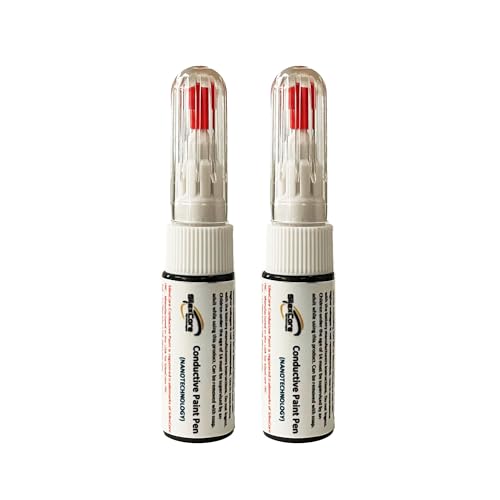
Bare Conductive Electric Paint -- Best for Craft and Educational Projects
Bare Conductive Electric Paint is a water-based, graphite-loaded conductive paint designed for accessibility. It is non-toxic, washes off skin easily, and works with a brush or pen applicator. Surface resistance is higher than copper paint, making it better suited for small, low-current electroforming experiments rather than detailed fine art work. For teachers running electroforming workshops or hobbyists exploring the process on a budget, it is an ideal introduction. Not recommended for complex high-detail plating.
Electro-Lube Conductive Coating -- Best for 3D Prints and Plastics
3D-printed objects present a challenge for electroforming because their smooth, non-porous surfaces resist paint adhesion. Electro-Lube's formula includes adhesion promoters that bond to PLA, ABS, and resin surfaces without requiring an acid etch step. The conductive layer it creates is dense and consistent across curved surfaces. At it is priced above general-purpose options, but for 3D print electroforming where surface adhesion is the key challenge, the adhesion promoters justify the cost.

Creative Materials Silver Conductive Paint -- Best for High-Detail Pieces
Silver-based conductive paint offers the lowest surface resistance available in paint form, which results in faster, more even electrodeposition -- a meaningful advantage for intricate jewelry molds and fine-detail botanical electroforming. Creative Materials' silver paint applies smoothly with a fine brush and holds sharp surface detail through multiple coats. The silver particle size is small enough to capture fine textures. At it is the premium option, best justified for final art pieces rather than practice work.
MG Chemicals Graphite Conductive Paint -- Best Budget Option
MG Chemicals' graphite paint offers a practical budget entry into electroforming. Resistance is higher than copper or silver paint, which requires careful current management in the plating bath to achieve even deposits. For users willing to start at lower current densities, results are achievable on simple geometries. A common use is applying graphite as a base layer under a second coat of copper paint to extend the copper paint supply. At it is the most cost-effective starting point.
How to choose
What to consider
Start with the base material. Organic objects with porous surfaces accept most paint types. Smooth plastics and 3D prints need adhesion-promoting formulas. Choose copper or silver paint for finished work where even deposition matters. Graphite is fine for learning and for budget base layers. Apply multiple thin coats rather than one thick coat to build conductivity without cracking. Test resistance with a multimeter before submerging in the bath -- aim for surface resistance under 10 ohms/square for most plating applications, under 1 ohm/square for fine detail work.
What to consider
For more art and craft content, see our [best compact air purifier guide](/articles/best-compact-air-purifier) for studio air quality, and visit our [methodology](/methodology) page for how ratings are determined.
Common questions
Copper-based conductive paints are the most widely used for organic object electroforming. They bond well to irregular surfaces including dried leaves, flowers, and seed pods. Apply two to three thin coats and allow full cure between applications. Graphite-based options are a lower-cost alternative but produce a higher-resistance base layer, which can result in uneven copper deposition during electroforming.
No, sealing conductive paint before electroforming would block the electrical contact needed for plating. The conductive paint layer itself is the base that receives the electrodeposited metal. After electroforming is complete, once the object is removed from the bath, you can apply a protective sealant over the finished copper or silver surface if desired for display or wear.
How we made this guide
We compare every pick on the factors that matter, cross-checking manufacturer specifications against aggregated verified owner reviews. We rank independently and never take payment for placement. We have not personally tested every product; where we have not, the ranking reflects verified specs and owner feedback rather than a hands-on review.
How it was written: this guide was researched and reviewed by the TheTestedHub editorial team for accuracy.
Affiliate disclosure: TheTestedHub is reader-supported. When you buy through links on our site, we may earn a commission at no extra cost to you.