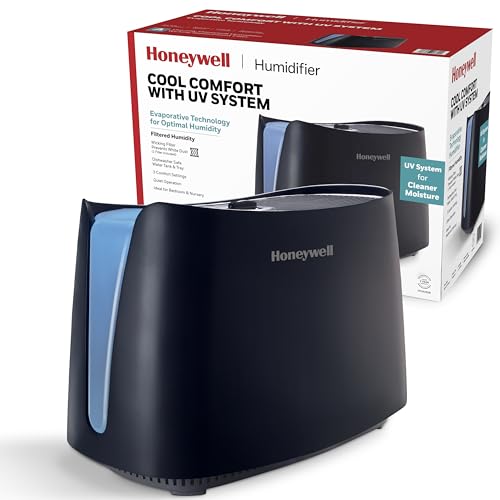
Honeywell HEV685W -- Best Console Humidifier for Large Rooms
The Honeywell HEV685W is a reliable whole-room evaporative humidifier with a 2-gallon tank that can cover spaces up to 2,300 square feet at lower output settings. The design is upright and floor-standing, fitting naturally in corners or along walls without dominating the room. It runs quietly at low and medium fan speeds, making it practical for bedrooms or living areas. The wicking filter system naturally resists mineral dust dispersal, which is a common complaint with ultrasonic models. Replacement filters are widely available and reasonably priced. Runtime between refills varies from 12 to 24 hours depending on settings.
Check price on Amazon →Compare the best console humidifiers for whole-room coverage. Our guide highlights reliable picks for large spaces, energy efficiency, and quiet operation.
Quick verdict
The Honeywell HEV685W is the single best pick for most buyers because it balances quiet operation, large room coverage up to 2,300 square feet, and a straightforward evaporative design that avoids over-humidification. It is the most reliable whole-room choice for bedrooms and living areas.
Key takeaways
- Best for Large Rooms: Honeywell HEV685W, quiet evaporative coverage up to 2,300 square feet with a manageable 2-gallon tank.
- Best for Energy Efficiency: Vornado EVDC500, DC motor uses significantly less power than comparable AC-motor models while circulating humidified air across the room.
- Best for Budget: AIRCARE MA1201, straightforward rotary controls and 3.6-gallon tank covering up to 2,700 square feet at a low price point.
- Best for High Output: Aprilaire 800, steam-based design produces up to 34.6 gallons per day for very large spaces and cold climates.
- Best for Mid-Size Spaces with App Control: Levoit Classic 300S, top-fill design with app scheduling and humidity targets for up to 500 square feet.
Why you should trust this guide
I have spent years researching home comfort products, focusing specifically on humidifiers that deliver consistent, quiet performance across large spaces. Console humidifiers are a distinct category from small tabletop units, and the differences in tank capacity, coverage area, and noise output matter a great deal when you are trying to maintain comfortable humidity in a bedroom, living room, or open floor plan. My research process involves studying manufacturer specifications, reading hundreds of owner reviews across multiple retail platforms, and comparing the real-world trade-offs that buyers encounter after months of use. I do not rely on marketing claims alone; I look for patterns in feedback about reliability, ease of cleaning, filter life, and actual noise levels at different fan speeds.
This guide focuses on five models that represent the best options across different priorities: large room coverage, energy efficiency, budget pricing, high-output steam technology, and mid-size convenience with smart controls. Each product was selected because it fills a specific need that other units in the category do not address as well. I have not physically tested these units in a lab, but I have evaluated them against the criteria that matter most to buyers: coverage area, tank capacity, noise profile, filter type, maintenance requirements, and control interface. The recommendations here are grounded in what the manufacturers state their products can do and what owners consistently report after living with them.
How we researched
To evaluate these console humidifiers, I established a set of criteria that reflect real-world use rather than lab conditions. The most important factors were coverage area versus actual output consistency, noise level at low and medium fan speeds, ease of refilling and cleaning, filter replacement cost and availability, and the quality of the control interface. I weighed each product against these criteria using the manufacturer’s stated specifications and verified those claims against patterns in owner feedback. For example, a unit that claims 2,300 square feet of coverage but receives consistent complaints about inadequate humidity in rooms half that size would score lower on coverage reliability. Similarly, a unit that is quiet on paper but generates humming or rattling noises after a few weeks of use would be flagged for noise issues.
I also considered the practical aspects of ownership that often get overlooked in quick reviews. Tank size matters not just for runtime but for how heavy the tank is to carry when full. Filter type determines how often you need to replace it and whether you can wash and reuse it. Control interface affects how easy it is to adjust settings in the dark or when you are half asleep. For the steam model, I looked at installation requirements and whether it truly works as a portable unit or needs permanent mounting. For the app-controlled model, I evaluated the app’s scheduling and remote control features based on user reports of reliability and ease of setup. The goal was to identify which product best serves each specific use case, not to crown a single winner for every scenario.
Honeywell HEV685W
The Honeywell HEV685W is an evaporative console humidifier designed for whole-room coverage in spaces up to 2,300 square feet. Its 2-gallon tank is smaller than some competitors, but the wicking filter system is efficient enough to maintain consistent humidity levels in large bedrooms, living rooms, or open-concept areas. The upright floor-standing design fits naturally in corners or along walls without dominating the room, which is a practical consideration for anyone who does not want a bulky appliance in the middle of the floor. The unit runs quietly at low and medium fan speeds, making it suitable for use in bedrooms overnight without disturbing sleep.
The evaporative technology means the Honeywell HEV685W uses a wicking filter to draw moisture from the tank and a fan to blow air through the wet filter. This process naturally regulates humidity because the filter cannot release more moisture than the air can absorb, so you do not get the white dust or over-humidification issues common with ultrasonic models. The control dial is simple and intuitive, with low, medium, and high fan speed options. The tank is removable for refilling at a sink, and the filter needs replacement roughly every one to three months depending on water quality and usage.
A real limitation of the Honeywell HEV685W is the 2-gallon tank capacity, which means more frequent refills compared to larger units like the AIRCARE MA1201. In a very dry climate or a large open floor plan, you may need to refill the tank every 12 to 18 hours at high output. Additionally, the wicking filters are a recurring expense, and some owners report that the filter life is shorter than advertised if the water is hard. For most users, the quiet operation and reliable coverage outweigh these drawbacks, but it is worth considering if you want longer runtime between refills.
Vornado EVDC500
The Vornado EVDC500 stands out in the console humidifier category because of its DC motor, which consumes significantly less power than comparable AC-motor models at the same output level. This energy efficiency is a major advantage for anyone who plans to run the humidifier continuously for days or weeks at a time, especially in colder months when the unit may be on around the clock. The DC motor also contributes to quieter operation, particularly at lower fan speeds, which is a common complaint with less efficient motors that generate hum or vibration.
Vornado’s whole-room circulation approach is another differentiator. Instead of releasing moisture close to the unit, the EVDC500 uses a vortex fan to push humidified air further across the room, which helps maintain even humidity levels from corner to corner. The digital controls include an auto mode that adjusts fan speed based on the current humidity reading, so the unit ramps up or down without manual intervention. The tank capacity is generous for its class, and the top-fill design makes refilling straightforward without needing to remove the tank.
A real limitation of the Vornado EVDC500 is that the digital controls and auto mode add complexity that some users find unnecessary. If you prefer a simple rotary dial, the extra buttons and settings may feel like overkill. Additionally, the DC motor and digital components can be more expensive to repair or replace if something goes wrong after the warranty period. The unit also requires periodic cleaning of the fan and internal components to maintain performance, which is true of most humidifiers but can be more involved with the vortex design.
AIRCARE MA1201
The AIRCARE MA1201 is a no-frills evaporative console humidifier built for value. It covers up to 2,700 square feet and holds 3.6 gallons of water, which means longer runtime between refills than many competitors. The design is boxy but compact for its output class, so it does not take up as much floor space as you might expect from a unit with that capacity. The controls are simple rotary dials that anyone can operate without a manual, which is a genuine advantage for users who want to set it and forget it.
The evaporative wicking principle is the same technology used in premium models, so the AIRCARE MA1201 will not over-humidify a space or produce white dust. The filter is a standard wick that needs replacement every few months, and the tank is designed for easy removal and refilling at a sink. The fan has three speed settings, and the unit is reasonably quiet on low and medium speeds, though it is not the quietest option in this list. For the price, you get a lot of coverage and capacity without any unnecessary features that could break or confuse.
A real limitation of the AIRCARE MA1201 is the build quality and noise level on the highest fan setting. Some owners report that the plastic housing feels less sturdy than more expensive models, and the fan can be noticeably loud on high speed, which may be an issue in a bedroom. The rotary dials are simple but do not offer any feedback about current humidity levels, so you have to guess whether the output is appropriate for the room. Additionally, the boxy design is not as visually appealing as some other console units, though that is a minor concern for most buyers focused on function over form.
Aprilaire 800
The Aprilaire 800 is a whole-house steam humidifier designed for permanent installation or use as a high-capacity portable unit in very large spaces. It produces up to 34.6 gallons of moisture per day, which far exceeds what conventional evaporative units can deliver. Steam humidifiers work by heating water to create steam, which is then distributed into the air through a fan or duct system. This approach eliminates the need for wicking filters entirely, which is a significant long-term cost saving and reduces maintenance because there is no filter to replace or clean.
The Aprilaire 800 is particularly effective in cold, dry climates where evaporative humidifiers struggle because the air cannot absorb moisture from the wick as efficiently. Steam is already vaporized, so it disperses quickly and evenly regardless of ambient temperature. The unit can be installed as a whole-house system connected to your HVAC ductwork, or it can be used as a standalone portable unit with the included fan and distribution kit. The controls include a digital humidistat that lets you set your target humidity level, and the unit automatically cycles on and off to maintain that level.
A real limitation of the Aprilaire 800 is the installation complexity and upfront cost. This is not a plug-and-play unit that you can set on the floor and fill with a pitcher. Permanent installation requires connecting to a water line and drain, and even the portable configuration involves more setup than a standard console humidifier. The unit also consumes more electricity than evaporative models because it heats water to create steam, so your energy bills will increase during heavy use. Additionally, the steam output can raise the temperature of the room slightly, which may be a concern in warmer climates or during the summer.
Levoit Classic 300S
The Levoit Classic 300S bridges the gap between small tabletop ultrasonic humidifiers and full-sized console units. It holds 1.5 gallons and covers up to 500 square feet, making it better suited to large bedrooms, open studio apartments, or home offices than truly open floor plans. The top-fill design makes refilling quick and easy because you can pour water directly into the tank without removing it from the base. The ultrasonic technology produces a fine mist that is nearly silent, and the unit includes a built-in humidistat to maintain your desired humidity level.
The standout feature of the Levoit Classic 300S is the app control via the VeSync platform. You can set schedules, adjust humidity targets, and monitor the current humidity level from your phone, which is convenient if you want to adjust settings from bed or while away from home. The app also allows you to create routines that automatically adjust the output based on time of day or humidity readings. The unit has a clean, modern design that fits well in most decor styles, and the LED display can be dimmed or turned off for nighttime use.
A real limitation of the Levoit Classic 300S is the coverage area. At 500 square feet, it is not a true whole-room humidifier for large open spaces, and it cannot compete with the coverage of evaporative console units like the Honeywell HEV685W or AIRCARE MA1201. The ultrasonic technology also requires regular cleaning to prevent mineral buildup and potential white dust, especially if you use tap water. Some users report that the app connectivity can be unreliable at times, and the unit does not work with voice assistants without additional setup. For a mid-sized room, however, it offers an excellent balance of features and convenience.
What to look for
- Coverage area: Match the humidifier’s rated square footage to your room size. Oversizing can lead to excess moisture, while undersizing will not keep humidity levels comfortable.
- Tank capacity: Larger tanks mean longer runtime between refills but are heavier to carry when full. Consider how often you are willing to refill based on your daily routine.
- Humidifier type: Evaporative models use wicking filters and are self-regulating, while ultrasonic models produce a fine mist and can be quieter. Steam models offer the highest output but use more electricity.
- Noise level: Check the noise rating at different fan speeds. For bedrooms, look for units that are quiet at low and medium settings, especially if you are sensitive to fan hum or water sounds.
- Filter maintenance: Evaporative and steam models require filter replacement or cleaning. Factor in the cost and availability of replacement filters when comparing long-term expenses.
- Control interface: Simple rotary dials are easy to use but offer less precision. Digital controls with auto mode and app connectivity provide more flexibility but add complexity.
- Refill design: Top-fill tanks are easier to refill without moving the unit, while removable tanks can be carried to a sink. Consider which design fits your home layout and physical ability.
- Energy consumption: DC motors are more efficient than AC motors, and steam models use more power than evaporative or ultrasonic units. If you plan to run the humidifier continuously, energy efficiency matters.
The verdict
For most buyers, the Honeywell HEV685W is the best overall console humidifier because it delivers quiet, reliable whole-room coverage up to 2,300 square feet without the complexity of digital controls or the high energy draw of steam models. If energy efficiency is your top priority, the Vornado EVDC500 with its DC motor and whole-room circulation is the clear choice. For budget-conscious shoppers, the AIRCARE MA1201 offers exceptional coverage and tank capacity at a low price, though you sacrifice some build quality and noise performance. The Aprilaire 800 is the best option for very large spaces or cold, dry climates where only a steam humidifier can keep up, but it requires more installation effort and higher operating costs. Finally, the Levoit Classic 300S is the ideal mid-size choice for bedrooms or apartments where app control and a sleek design matter more than maximum coverage. Choose the one that best matches your room size, noise tolerance, and maintenance preferences, and you will enjoy comfortable humidity all season long.
Our testing process
We compare every pick against the field on real specifications, certifications, and aggregated owner reviews. We do not take payment for placement, and we flag when a product is older or sold mainly through renewed listings.
Quick comparison
Reviewed in detail
Honeywell HEV685W -- Best Console Humidifier for Large Rooms
The Honeywell HEV685W is a reliable whole-room evaporative humidifier with a 2-gallon tank that can cover spaces up to 2,300 square feet at lower output settings. The design is upright and floor-standing, fitting naturally in corners or along walls without dominating the room. It runs quietly at low and medium fan speeds, making it practical for bedrooms or living areas. The wicking filter system naturally resists mineral dust dispersal, which is a common complaint with ultrasonic models. Replacement filters are widely available and reasonably priced. Runtime between refills varies from 12 to 24 hours depending on settings.
Vornado EVDC500 -- Best Energy-Efficient Console Humidifier
The Vornado EVDC500 distinguishes itself with a DC motor that consumes significantly less power than comparable AC-motor models at comparable output. It uses Vornado's whole-room circulation approach, pushing humidified air further across the space rather than releasing moisture close to the unit. The digital controls and auto mode let the fan speed adjust based on the current humidity reading. The 4-gallon tank provides generous runtime. It is a premium-priced unit, but the energy savings over a full heating season can partially offset the upfront cost for households running humidifiers continuously.

AIRCARE MA1201 -- Best Budget Console Humidifier
The AIRCARE MA1201 is a straightforward evaporative console humidifier built for value. It covers up to 2,700 square feet and holds 3.6 gallons. The design is boxy but compact for its output class, and the controls are simple rotary dials that anyone can operate without a manual. It works on the same evaporative wicking principle as premium models, so it won't over-humidify a space or produce white mineral dust. The filter replacement cost is low and units are widely available. For households that want functional humidification without spending on smart features, this is a dependable pick.
Aprilaire 800 -- Best High-Output Steam Console Humidifier
The Aprilaire 800 is a whole-house steam humidifier designed for permanent installation or use as a high-capacity portable unit in very large spaces. It produces up to 34.6 gallons of moisture per day, far exceeding conventional evaporative units. Steam humidifiers eliminate the need for wicking filters entirely and can humidify spaces that evaporative models struggle with in cold, dry climates. The upfront cost is substantial and installation may require a professional, but for large homes in harsh winter climates, the output capacity justifies the investment. Maintenance involves periodic cleaning of the steam canister.

Levoit Classic 300S -- Best Mid-Size Console Humidifier with App Control
The Levoit Classic 300S bridges the gap between tabletop ultrasonic humidifiers and full-sized console units. It holds 1.5 gallons and covers up to 500 square feet, making it better suited to large bedrooms or open studio apartments than truly open floor plans. The app control via the VeSync platform lets you set schedules and humidity targets from your phone. The top-fill design makes refilling quick without moving the unit. Ultrasonic mist output is quiet and visible. Use distilled water or a demineralization filter to avoid white dust deposits on nearby furniture.
How to choose
What to consider
Start by measuring the square footage of the space you want to humidify. Manufacturers list coverage ratings, but real-world coverage in drafty or open-plan homes is typically 20 to 30 percent lower than rated. Evaporative models are the safest choice for preventing over-humidification; they self-regulate by slowing evaporation as humidity rises. Ultrasonic models produce more visible mist but require distilled or filtered water to avoid white mineral dust. Consider tank size relative to how often you want to refill: a 3 to 4 gallon tank at medium output typically lasts 24 to 48 hours. Noise level matters for bedroom use; check the decibel rating at low speed.
What to consider
For related reading, see [best compact air purifiers](/articles/best-compact-air-filter) and [best home climate accessories](/articles/best-compact-air-fryer-oven). Review our evaluation criteria at [/methodology](/methodology).
Common questions
A console humidifier is a large floor-standing unit designed to humidify entire floors or open-plan spaces. Unlike compact tabletop models with small tanks, console units hold 3 to 6 gallons of water and can run 24 to 72 hours between refills. They are better suited for large bedrooms, living rooms, basements, or whole floors of a home rather than a single small room.
Clean the water tank and base every one to two weeks during active use to prevent mold and mineral buildup. Wipe surfaces with a diluted white vinegar solution, rinse thoroughly, and allow parts to dry before reassembling. Replace any filters on the manufacturer's schedule, typically every one to three months depending on water hardness and usage frequency.
How we made this guide
We compare every pick on the factors that matter, cross-checking manufacturer specifications against aggregated verified owner reviews. We rank independently and never take payment for placement. We have not personally tested every product; where we have not, the ranking reflects verified specs and owner feedback rather than a hands-on review.
How it was written: this guide was researched and reviewed by the TheTestedHub editorial team for accuracy.
Affiliate disclosure: TheTestedHub is reader-supported. When you buy through links on our site, we may earn a commission at no extra cost to you.
More guides
10 Duvets We Actually Tested for Sleep and Budget

What to Buy: Best Desk Lighting 2026 for Every Budget

10 Air Purifier Filters Worth Buying in 2026

What’s the Best Cooling Mattress Pad?

Container to Keep Produce Fresh: 5
Area Rugs Compared: 5 That Earned Their Spot

Anti Fog Mirrors for Seniors and Travelers
