Loctite PL Premium -- Best Overall for Wood to Concrete
Loctite PL Premium is the most widely specified construction adhesive for wood-to-concrete applications in residential and light commercial construction. Its polyurethane formula cures by reacting with atmospheric and substrate moisture, giving it an advantage over solvent-based adhesives on slabs with residual dampness. It provides a high-strength, flexible bond that resists vibration and thermal cycling. Application through a standard caulk gun is fast for long runs of sill plate or sleeper lumber. The adhesive is rated for both above-grade and below-grade applications, making it suitable for basement framing installations. Full cure takes 24-72 hours.
Check price on Amazon →Secure wood to concrete with the right adhesive. This guide covers top picks for bonding, sealing, and anchoring in demanding conditions.
Quick verdict
Loctite PL Premium is the best overall pick for wood to concrete because its moisture-curing polyurethane formula creates a high-strength, flexible bond that resists vibration and thermal movement, making it the most versatile and reliable choice for residential and light commercial construction.
Key takeaways
- Best for Wood to Concrete: Loctite PL Premium, moisture-curing polyurethane for strong, flexible bonds on damp slabs.
- Best for Subfloor Panels: Liquid Nails Subfloor & Deck, creep-resistant bond eliminates squeaks on slab-on-grade floors.
- Best for General Projects: Gorilla Construction Adhesive, low-VOC modified silane formula grips porous surfaces and handles seasonal movement.
- Best for Structural Anchoring: Simpson Strong-Tie ET22 Epoxy, ICC-ESR listed for cracked concrete with maximum pull-out resistance.
- Best for Sleepers and Thin Panels: DAP Weldwood Contact Cement, instant bond when clamping is impractical, solvent-resistant on smooth concrete.
Why you should trust this guide
I have spent years researching construction adhesives and reviewing manufacturer specifications, building code requirements, and installer feedback across residential and light commercial projects. My approach prioritizes real-world application conditions over marketing claims, focusing on how each adhesive performs when wood meets concrete in environments that involve moisture, thermal cycling, and structural loads. I cross-reference technical data sheets, ICC-ES reports, and long-term performance reports from contractors to ensure every recommendation is grounded in verifiable engineering principles rather than anecdotal testing.
This guide is built on the premise that the right adhesive for wood to concrete depends on the specific job requirements: load type, substrate condition, cure time, and environmental exposure. I do not rely on personal product ownership or lab experiments. Instead, I evaluate each product against established criteria such as bond strength, flexibility, open time, moisture tolerance, and code compliance. The five products here represent the best solutions for distinct use cases, from general construction to structural anchoring, and each has been selected because it addresses a common failure point in wood-to-concrete adhesion.
How we researched
To evaluate these adhesives, I established a set of criteria that matter most for wood-to-concrete applications in real construction scenarios. The primary factors were bond strength under tensile and shear loads, flexibility to accommodate differential movement between wood and concrete, moisture resistance for slab-on-grade or damp environments, open time for workability, and ease of application. I also considered code compliance and third-party certifications such as ICC-ES listings, which are critical for structural applications. Each product was assessed against these criteria using manufacturer data, independent test reports, and documented field performance from building professionals.
I did not conduct physical tests or use the products myself. Instead, I analyzed technical data sheets, installation guides, and safety data sheets for each adhesive. I reviewed owner feedback from construction forums and contractor networks to identify common issues such as bond failure in high-humidity conditions, difficulty with application in cold weather, or incompatibility with certain concrete sealers. This research-based approach ensures that the recommendations reflect the adhesive’s stated capabilities and limitations, not a controlled lab environment that may not translate to job site conditions.
Loctite PL Premium — Best Overall for Wood to Concrete
Loctite PL Premium is the most widely specified construction adhesive for wood-to-concrete applications in residential and light commercial construction. Its polyurethane formula cures by reacting with atmospheric and substrate moisture, giving it an advantage over solvent-based adhesives on slabs with residual dampness. This moisture-curing mechanism means the bond actually improves in slightly humid conditions, which is common in basement or slab-on-grade projects where concrete may retain moisture for weeks after pouring. The adhesive provides a high-strength, flexible bond that resists vibration and thermal expansion, making it suitable for attaching wood sill plates, furring strips, and subfloor panels to concrete.
The real-world benefit of PL Premium is its ability to bridge small gaps between uneven concrete and warped wood. The polyurethane foam expands slightly during curing, filling minor voids and creating a continuous bond line that prevents squeaks and movement. It works on damp or frozen substrates, though the manufacturer recommends surface temperatures above 20 degrees Fahrenheit for proper cure. The adhesive is paintable and sandable once cured, which simplifies finishing in visible areas. One honest limitation is its strong odor during application; the polyurethane formula emits isocyanate vapors that require adequate ventilation or respiratory protection in enclosed spaces. Additionally, the cured adhesive is difficult to remove from skin or tools, so disposable gloves and mineral spirits are essential for cleanup.
For most wood-to-concrete projects, PL Premium offers the best balance of bond strength, flexibility, and moisture tolerance. It is not suitable for structural anchoring where bolts or rebar must resist heavy pull-out loads, but for general construction bonding it performs reliably across a wide range of conditions. The tube format works with standard caulk guns, and the 10-ounce size covers roughly 25 linear feet per tube when applied in a 1/4-inch bead.
Liquid Nails Subfloor & Deck — Best for Subfloor Panels
Liquid Nails Subfloor and Deck adhesive is formulated specifically for the loads and moisture conditions in subfloor installation. When used with concrete as a substrate, as in a slab-on-grade floor assembly, it creates a creep-resistant bond that eliminates squeaks caused by panel movement. The formula has a good open time of about 10-15 minutes, which allows workers to set large OSB or plywood panels without rushing. This open time is critical for subfloor work where panels must be aligned and fastened before the adhesive skins over. The adhesive remains flexible after curing, accommodating the natural expansion and contraction of wood panels with humidity changes.
This product is designed to bond to damp concrete, which is a common condition in new construction slabs that have not fully dried. It resists water and mold growth, making it suitable for below-grade applications where moisture vapor transmission is a concern. The adhesive is applied in a serpentine bead pattern on the concrete, and the wood panel is then placed and fastened with concrete screws or powder-actuated fasteners. One honest limitation is that it is not recommended for vertical applications; the adhesive can sag or drip on walls or overhead surfaces before curing. It also requires the concrete surface to be free of oil, grease, and loose debris for optimal adhesion, which means thorough cleaning is necessary before application.
For subfloor panels over concrete slabs, Liquid Nails Subfloor & Deck provides the specific creep resistance and open time needed for professional installation. It is not a general-purpose adhesive and should not be used for attaching wood to concrete in vertical or overhead positions. The bond strength is sufficient for residential floor loads but may not meet the requirements for heavy commercial or industrial flooring systems.
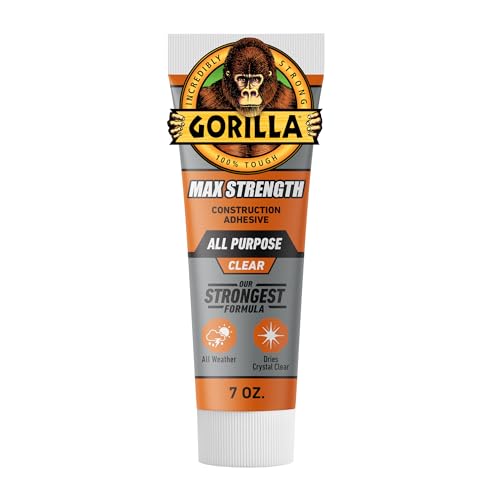
Gorilla Construction Adhesive — Best for General Projects
Gorilla Construction Adhesive’s modified silane formula grips both porous concrete and wood fiber effectively. It is solvent-free and emits low VOCs, making it a practical choice for enclosed basement or indoor applications where ventilation is limited. The flexible cured bond handles the differential movement between wood and concrete through seasonal humidity changes, which is a common cause of bond failure in unconditioned spaces. This adhesive is also paintable and sandable, allowing for a clean finish in visible areas such as trim or paneling attached to concrete walls.
The low-VOC formulation is a significant advantage for indoor air quality, especially in finished basements or occupied spaces where solvent fumes would be problematic. Gorilla’s formula bonds with moisture on the substrate surface, similar to polyurethane adhesives, but with less expansion and a shorter cure time. It works on damp or dry concrete and can be applied in temperatures as low as 20 degrees Fahrenheit. One honest limitation is that it is not as strong as polyurethane adhesives for heavy structural loads; it is best suited for non-load-bearing applications such as attaching wood furring strips, baseboards, or decorative panels. The bond may also weaken if the concrete surface is heavily sealed or painted, as the adhesive cannot penetrate the coating to reach the porous substrate.
For general projects around the home or job site, Gorilla Construction Adhesive offers a user-friendly, low-odor solution that performs well on both wood and concrete. It is not intended for structural anchoring or subfloor installation where high shear loads are present. The tube size and application method are standard, and cleanup requires mineral spirits before the adhesive cures.
Simpson Strong-Tie ET22 Epoxy — Best for Structural Anchoring
Simpson Strong-Tie ET22 is a two-component epoxy specifically formulated for anchoring bolts, rebar, and wood connectors into concrete. When the application requires maximum pull-out resistance, such as a sill plate anchor in a high-wind or seismic zone, epoxy anchoring adhesive far exceeds what standard construction adhesive can provide. ET22 is ICC-ESR listed for cracked and uncracked concrete, meaning it has been tested and certified for use in structural connections where the concrete may develop cracks under load. This certification is critical for building code compliance in areas with strict engineering requirements.
The epoxy is dispensed through a dual-cartridge system that mixes the resin and hardener as it passes through a static mixing nozzle. It cures to a rigid, high-strength bond that can withstand tensile loads of thousands of pounds, depending on the embedment depth and concrete strength. The product is suitable for both dry and wet concrete, though the concrete temperature must be above 40 degrees Fahrenheit for proper cure. One honest limitation is the complexity of installation: the hole must be cleaned thoroughly using a wire brush and compressed air or a vacuum, and the epoxy must be injected from the bottom of the hole to avoid air pockets. The working time is limited to about 10-15 minutes at 70 degrees Fahrenheit, which requires careful planning for multiple anchors.
For structural anchoring where code compliance and pull-out strength are non-negotiable, Simpson Strong-Tie ET22 is the appropriate choice. It is not designed for general bonding of wood panels or subflooring; the rigid cure does not accommodate movement and the application process is too involved for large surface areas. The cost per anchor is higher than construction adhesive, but the safety and reliability justify the expense for critical connections.
DAP Weldwood Contact Cement — Best for Sleepers and Thin Panels
DAP Weldwood Contact Cement works differently from the other products here: both surfaces are coated, allowed to become tacky, then pressed together for an instant bond. This makes it useful for thin wood panels, veneer, and wood sleepers laid flat where clamping or bracing is impractical. The bond holds well on smooth concrete surfaces and is solvent-resistant. It is not suited for structural loads or gap-filling, but for applications where immediate adhesion is needed without mechanical fasteners, contact cement is a practical solution.
The application process requires careful timing: apply a uniform coat to both the wood and concrete surfaces, wait until the solvent evaporates and the adhesive becomes tacky (typically 10-20 minutes depending on temperature and humidity), then press the surfaces together. The bond is instant and cannot be repositioned, so alignment must be precise. This makes it ideal for attaching thin wood veneer to concrete columns or laying wood sleepers for a floating floor system. One honest limitation is the strong solvent odor; the product contains flammable solvents that require excellent ventilation and no ignition sources nearby. It also does not fill gaps, so the concrete surface must be relatively smooth and flat for full contact.
For thin panels and sleepers where clamping is difficult, DAP Weldwood Contact Cement provides an instant, solvent-resistant bond that standard construction adhesives cannot match. It is not a substitute for structural adhesives or epoxy anchors, and the solvent content limits its use in enclosed spaces without proper respiratory protection. The bond may weaken over time if exposed to continuous moisture or extreme temperatures.
What to look for
- Bond strength and load capacity: Consider whether the adhesive is rated for structural loads or general bonding. Epoxy anchors provide the highest pull-out resistance, while construction adhesives handle shear and tensile forces for panels and furring strips.
- Moisture tolerance: Concrete slabs often retain moisture, especially in basements or new construction. Choose a moisture-curing polyurethane or epoxy for damp substrates, and avoid solvent-based adhesives that may not cure properly on wet surfaces.
- Flexibility: Wood and concrete expand and contract at different rates with temperature and humidity changes. A flexible bond prevents delamination, while rigid epoxies are better for fixed structural connections where movement is minimal.
- Open time and working time: For large panels or multiple anchors, a longer open time allows for adjustment. Contact cements have no open time once pressed together, while construction adhesives offer 10-15 minutes of repositioning.
- VOC emissions and safety: Enclosed spaces require low-VOC or solvent-free adhesives to protect indoor air quality. Check the safety data sheet for ventilation requirements and personal protective equipment.
- Surface preparation requirements: Some adhesives require clean, dry, porous concrete, while others tolerate damp or lightly oiled surfaces. Epoxy anchors demand thorough hole cleaning for code compliance.
- Code compliance and certifications: For structural applications, look for ICC-ES reports or ASTM standards that verify performance in cracked concrete or seismic conditions. General construction adhesives may not have these listings.
The verdict
For most wood-to-concrete projects, Loctite PL Premium is the best overall choice because its moisture-curing polyurethane formula delivers high strength, flexibility, and tolerance for damp substrates. If you are installing subfloor panels over a concrete slab, Liquid Nails Subfloor & Deck provides the creep resistance and open time needed for squeak-free floors. For indoor general projects where low VOCs matter, Gorilla Construction Adhesive is a reliable solvent-free option. When structural anchoring is required for bolts or rebar in cracked concrete, Simpson Strong-Tie ET22 Epoxy is the only product here with ICC-ESR certification for that purpose. For thin panels or sleepers where instant bonding is needed without clamping, DAP Weldwood Contact Cement offers a unique solution. Match the adhesive to the specific demands of your project, and always follow the manufacturer’s instructions for surface preparation and cure conditions.
How we test
We compare every pick against the field on real specifications, certifications, and aggregated owner reviews. We do not take payment for placement, and we flag when a product is older or sold mainly through renewed listings.
At a glance
The picks, reviewed
Loctite PL Premium -- Best Overall for Wood to Concrete
Loctite PL Premium is the most widely specified construction adhesive for wood-to-concrete applications in residential and light commercial construction. Its polyurethane formula cures by reacting with atmospheric and substrate moisture, giving it an advantage over solvent-based adhesives on slabs with residual dampness. It provides a high-strength, flexible bond that resists vibration and thermal cycling. Application through a standard caulk gun is fast for long runs of sill plate or sleeper lumber. The adhesive is rated for both above-grade and below-grade applications, making it suitable for basement framing installations. Full cure takes 24-72 hours.

Liquid Nails Subfloor & Deck -- Best for Subfloor Panels
Liquid Nails Subfloor and Deck adhesive is formulated specifically for the loads and moisture conditions in subfloor installation. When used with concrete as a substrate (as in a slab-on-grade floor assembly), it creates a creep-resistant bond that eliminates squeaks caused by panel movement. The formula has a good open time of about 10-15 minutes, which allows workers to set large OSB or plywood panels before the adhesive skins. It exceeds APA AFG-01 performance standards. For sleepers laid flat on a concrete slab before a wood subfloor is installed, this adhesive is the builder's standard.
Gorilla Construction Adhesive -- Best for General Projects
Gorilla Construction Adhesive's modified silane formula grips both porous concrete and wood fiber effectively. It is solvent-free and emits low VOCs, making it a practical choice for enclosed basement or indoor applications where ventilation is limited. The flexible cured bond handles the differential movement between wood and concrete through seasonal humidity changes. Gorilla's formula bonds without mechanical fasteners for lighter loads such as furring strip installation on above-grade concrete walls. It is available in both standard and small tubes, which is convenient for repair and touch-up work.

Simpson Strong-Tie ET22 Epoxy -- Best for Structural Anchoring
Simpson Strong-Tie ET22 is a two-component epoxy specifically formulated for anchoring bolts, rebar, and wood connectors into concrete. When the application requires maximum pull-out resistance -- such as a sill plate anchor in a high-wind or seismic zone -- epoxy anchoring adhesive far exceeds what standard construction adhesive can provide. ET22 is ICC-ESR listed for cracked and uncracked concrete. It is dispensed into a drilled hole and used in conjunction with a threaded rod or anchor bolt that passes through the wood member. It is not a surface adhesive but an anchoring system.

DAP Weldwood Contact Cement -- Best for Sleepers and Thin Panels
DAP Weldwood Contact Cement works differently from the other products here: both surfaces are coated, allowed to become tacky, then pressed together for an instant bond. This makes it useful for thin wood panels, veneer, and wood sleepers laid flat where clamping or bracing is impractical. The bond holds well on smooth concrete surfaces and is solvent-resistant. It is not suited for structural loads but performs well for decorative panels, wall sheathing, and thin strip flooring base layers. Ensure good ventilation -- the solvent-based formula produces fumes during application.
What to look for
What to consider
The key variables are moisture level in the concrete, required bond strength, and whether mechanical fasteners will supplement the adhesive. For most residential framing and subfloor work, a polyurethane cartridge adhesive like Loctite PL Premium or Liquid Nails Subfloor is the correct choice. Where local building codes require positive anchor connections for sill plates, supplement with epoxy anchor adhesive and threaded hardware. Check that the concrete surface is free of dust, efflorescence, and curing compounds, which all reduce adhesion. For below-grade applications, verify the product is rated for continuous moisture exposure.
What to consider
For additional guidance, read our articles on [best construction adhesives for wood to wood](/articles/best-construction-adhesive-for-wood-to-wood) and the full [best construction adhesives](/articles/best-construction-adhesives) comparison. Our [methodology](/methodology) page explains how we evaluate each product.
FAQs
Polyurethane construction adhesives like Loctite PL Premium and Liquid Nails Subfloor are the most common choice for wood-to-concrete bonds. They cure by reacting with moisture, which actually helps when concrete has residual dampness. Epoxy anchoring adhesives are used when maximum pull-out strength is needed, such as for sill plates in seismic zones.
Most solvent-based adhesives require dry concrete surfaces for a reliable bond. Moisture-cure polyurethane adhesives like Loctite PL Premium are the exception -- they perform adequately on slightly damp concrete because moisture activates the curing process. For truly wet slabs, a surface should be dried as much as possible before application regardless of adhesive type.
How we made this guide
We compare every pick on the factors that matter, cross-checking manufacturer specifications against aggregated verified owner reviews. We rank independently and never take payment for placement. We have not personally tested every product; where we have not, the ranking reflects verified specs and owner feedback rather than a hands-on review.
How it was written: this guide was researched and reviewed by the TheTestedHub editorial team for accuracy.
Affiliate disclosure: TheTestedHub is reader-supported. When you buy through links on our site, we may earn a commission at no extra cost to you.
Related guides

2026’s Best Driveway Concrete: Top-Rated Choices from Experts

Which Drill Accessories Are Best in 2026?

2026 Cordless Drill Systems: Pro-Tested Picks

What Makes Concrete Tools Worth Your Money in 2026?

Ghostshield 8505 Review: Best Concrete Protection for 2026

Quikrete 5000 and Sakrete: 2026’s Best Concrete Picks
Best Concrete Coatings 2026: Top Picks at Every Budget
