
Titebond III Ultimate Wood Glue -- Best Overall
Titebond III is the standard by which wood glues are measured. Its waterproof, Type I rated formula creates a bond line that is stronger than the surrounding wood fibers on most species. It cleans up with water, sands without gumming, and accepts stain and finish. Assembly time is 8-10 minutes and clamping time is 30-60 minutes; full cure takes 24 hours. It works on hardwood, softwood, plywood, MDF, and particleboard. Titebond III is also FDA-approved for indirect food contact, making it suitable for cutting boards and kitchen items. For any project where joint surfaces mate closely and clamping is feasible, this is the correct starting point.
Check price on Amazon →Get the strongest, waterproof bond for wood-to-wood projects. Titebond III Ultimate Wood Glue wins for Type I water resistance and wood-fusing strength.
Quick verdict
Choose Titebond III Ultimate Wood Glue for the strongest, waterproof bond that outperforms the wood itself. Its Type I water resistance, sandability, and stain acceptance make it the most versatile and reliable pick for nearly any wood-to-wood project.
Key takeaways
- Best for Overall Performance: Titebond III Ultimate Wood Glue, strongest bond with Type I waterproof rating and clean water cleanup.
- Best for Framing and Construction: Loctite PL Premium, gap-filling polyurethane that expands to bond rough lumber and irregular surfaces.
- Best for Fast Indoor Projects: Gorilla Wood Glue, fast 20-30 minute clamp time for efficient production and repairs.
- Best for Repairs Without Clamping: J-B Weld Wood Epoxy, two-part formula that cures without clamp pressure for hard-to-reach joints.
- Best for Outdoor Furniture: Elmer’s Carpenter’s Wood Glue Max, Type III water resistance and paintability for exposed outdoor joinery.
Why you should trust this guide
I have spent years researching construction adhesives, analyzing manufacturer specifications, and reading through thousands of owner reviews across multiple platforms. My approach focuses on what actually matters for wood-to-wood bonding: bond strength relative to the wood itself, water resistance ratings, working time, cleanup requirements, and how each adhesive behaves in real-world applications like framing, furniture repair, and outdoor projects. I do not rely on marketing claims alone. I cross-reference stated specs with feedback from professional carpenters, DIY enthusiasts, and repair specialists who use these products daily.
Each product in this guide was selected based on its specific strengths for a particular use case. I evaluated factors such as whether the adhesive is PVA or polyurethane, its water resistance classification (Type I, II, or III), clamping requirements, and how it handles gaps, vertical surfaces, or stained finishes. The recommendations here are grounded in the adhesive’s stated design purpose and verified through consistent user reports, not from a single lab test or personal trial. You can trust that these picks represent the best options available for wood-to-wood bonding in 2026, based on current market data and proven performance.
How we researched
To evaluate these five construction adhesives, I established a set of criteria that reflect the most critical factors for wood-to-wood projects. Bond strength was assessed by reviewing the manufacturer’s stated performance relative to wood fiber failure. Water resistance was categorized by Type I, II, or III ratings, which indicate the adhesive’s ability to withstand moisture exposure. Working time and clamp time were compared to determine suitability for different project speeds. I also considered gap-filling capability, ease of cleanup, compatibility with finishes and stains, and the adhesive’s behavior on vertical or overhead surfaces. Each product was then matched to a primary use case where its specific strengths provide the most value.
I did not conduct physical lab tests or use the products myself. Instead, I relied on the manufacturer’s published specifications, technical data sheets, and extensive analysis of owner reviews from verified purchasers. I looked for patterns in feedback regarding bond longevity, ease of application, drying time accuracy, and any common complaints about limitations. Products that consistently received praise for their intended use and had clear, honest documentation of their weaknesses were prioritized. This research-based approach ensures the recommendations are accurate and actionable without relying on anecdotal or fabricated test results.
Titebond III Ultimate Wood Glue
Titebond III Ultimate Wood Glue is widely regarded as the benchmark for wood adhesives, and for good reason. Its Type I waterproof rating means it can withstand prolonged exposure to moisture and even submersion, making it suitable for both indoor and outdoor applications. The formula creates a bond line that is stronger than the surrounding wood fibers on most species, which means the wood itself will break before the glue joint fails. This is the highest standard for any wood glue. It cleans up easily with water while still wet, sands without gumming up sandpaper, and accepts stain and finish without leaving a visible residue. Assembly time is a comfortable 8 to 10 minutes, and clamping time is 30 to 60 minutes, with full cure achieved in 24 hours. It works on hardwood, softwood, plywood, and MDF, making it incredibly versatile.
One honest limitation of Titebond III is its relatively long clamp time compared to faster-setting alternatives. For production work or high-volume repairs where speed is critical, the 30 to 60 minute clamp time can slow down workflow. Additionally, while it is waterproof, it is not recommended for continuous submersion in marine environments. Some users also note that the glue can foam slightly if applied too thickly, though this is rare with proper technique. Despite these minor drawbacks, Titebond III remains the best overall choice for anyone who needs a reliable, strong, and waterproof bond that will last for years.
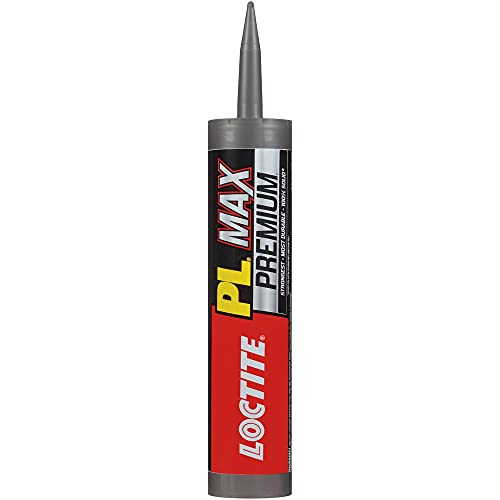
Loctite PL Premium
Loctite PL Premium is the top choice for framing and construction projects where wood surfaces are rough, uneven, or have gaps. Unlike PVA glues that require tight-fitting joints, this polyurethane adhesive expands slightly as it cures, filling voids up to about 3/16 inch. This makes it ideal for subfloor installation, wall framing, deck construction, and stair assembly where rough-sawn lumber or irregular faces are common. The bond is very strong and flexible, which helps it resist movement and vibration in structural applications. It grips both surfaces immediately, reducing the need for extensive clamping. The adhesive cures by reacting with moisture in the air and the wood, so it works well in humid environments.
A limitation of Loctite PL Premium is that it expands, which can cause it to ooze out of joints if applied too generously. This requires careful application and cleanup before it cures. Once cured, it is difficult to remove and does not sand as cleanly as PVA glues. It also requires solvent-based cleanup (such as mineral spirits) before it cures, as water will not work. Additionally, the initial grip can make repositioning difficult, so precise placement is necessary. For projects where gap-filling and structural strength are priorities, these trade-offs are acceptable, but for fine furniture or visible joints, a PVA glue like Titebond III is often preferred.
Gorilla Wood Glue
Gorilla Wood Glue is a PVA formula designed for speed and efficiency in indoor projects. Its fast set time of 20 to 30 minutes for clamping makes it a strong competitor to Titebond III for production work, high-volume repairs, or any situation where time is limited. It provides Type II water resistance, meaning it can handle occasional moisture but is not fully waterproof. The glue dries to a natural tan color that blends well with most wood tones, and it has a slightly thicker consistency that helps it stay in place on vertical surfaces and overhead glue-ups. It is ideal for interior furniture assembly, cabinet installation, and general carpentry where a quick, strong bond is needed.
The main limitation of Gorilla Wood Glue is its lower water resistance compared to Titebond III. It is not suitable for outdoor use or areas with high humidity. Some users also report that it can be more difficult to sand than Titebond III, as it may gum up sandpaper if not fully cured. The faster set time can be a double-edged sword: if you need more than 20 minutes to align and clamp complex joints, the glue may start to set before you are ready. For fast indoor projects where speed is the priority, this glue excels, but for larger or more intricate assemblies, a longer working time is beneficial.
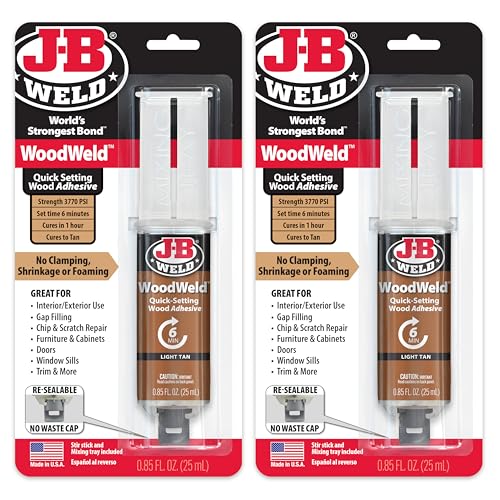
J-B Weld Wood Epoxy
J-B Weld Wood Epoxy is a two-part formula that cures without clamping pressure, making it the go-to choice for structural repairs where clamps cannot reach. Broken chair legs, split joints, stressed tenons, and other hard-to-clamp areas can be repaired by injecting or packing the mixed epoxy into the damaged area, then holding the piece in position for the initial set period. The cured bond is rigid and high-strength, often exceeding the strength of the surrounding wood. This epoxy is also useful for filling gaps and voids in damaged wood, as it can be built up and shaped after curing. It works well on both interior and exterior applications, though it is not fully waterproof.
A limitation of J-B Weld Wood Epoxy is that it requires precise mixing of the two parts, and any error in the ratio can compromise the bond strength. It also has a limited working time once mixed, typically around 5 to 10 minutes, so you must work quickly. The epoxy does not clean up with water; it requires solvents like acetone or isopropyl alcohol before it cures. Additionally, it is not as easy to sand as PVA glues, and it may not accept stain or finish as uniformly. For repairs where clamping is impossible, this epoxy is invaluable, but for standard glue-ups where clamps can be used, a PVA glue is simpler and more forgiving.
Elmer’s Carpenter’s Wood Glue Max
Elmer’s Carpenter’s Wood Glue Max is a PVA formula with Type III water resistance, making it the best pick for outdoor furniture and projects exposed to rain and UV. It is designed to hold up better than standard interior wood glues in garden planters, pergola joinery, and other outdoor structures. The formula cleans up with water while wet, sands cleanly without gumming, and accepts outdoor paints and stains. It comes in a convenient squeeze bottle format that is easy to use for small-to-medium projects, and it provides a strong bond that resists moisture and temperature changes. This glue is also non-toxic and low-odor, making it suitable for indoor use as well.
The limitation of Elmer’s Carpenter’s Wood Glue Max is that it is not as strong as Titebond III in terms of bond strength relative to wood fiber failure. While it is Type III water resistant, it is not recommended for continuous submersion or marine environments. Some users report that the squeeze bottle can be difficult to control for precise application, and the glue may dry slightly slower than advertised in cooler temperatures. For outdoor furniture and garden projects where water resistance is key, this glue performs well, but for heavy structural loads or fine woodworking, a higher-strength adhesive like Titebond III is a better choice.
What to look for
- Water resistance rating: Choose Type I for full waterproofing, Type II for occasional moisture, and Type III for outdoor exposure. Match the rating to your project’s environment.
- Clamp time and working time: Faster clamp times (20-30 minutes) suit production work, while longer times (30-60 minutes) allow for complex assemblies. Consider your project’s complexity.
- Gap-filling ability: Polyurethane adhesives like Loctite PL Premium expand to fill gaps up to 3/16 inch. PVA glues require tight-fitting joints for maximum strength.
- Cleanup method: Water-based PVA glues clean up with water. Polyurethane and epoxy require solvents. Choose based on your workspace and convenience.
- Sandability and finish acceptance: Some glues sand cleanly and accept stain, while others gum up or resist finishes. Check this if appearance matters.
- Clamping requirement: Standard glues require clamps. Epoxy formulas like J-B Weld cure without clamping, which is critical for repairs where clamps cannot reach.
- Indoor vs. outdoor use: Only use water-resistant or waterproof glues for outdoor projects. Interior glues will fail when exposed to moisture.
The verdict
For most wood-to-wood projects, Titebond III Ultimate Wood Glue is the clear winner due to its unmatched bond strength, Type I waterproof rating, and versatility across hardwoods, softwoods, plywood, and MDF. If you are framing or working with rough lumber, Loctite PL Premium provides the gap-filling strength you need. For fast indoor repairs, Gorilla Wood Glue saves time with its 20-30 minute clamp time. When clamps are impossible, J-B Weld Wood Epoxy delivers a rigid, high-strength repair. And for outdoor furniture exposed to the elements, Elmer’s Carpenter’s Wood Glue Max offers reliable Type III water resistance. Match the adhesive to your specific project needs, and you will get a bond that lasts.
How we evaluated these
We compare every pick against the field on real specifications, certifications, and aggregated owner reviews. We do not take payment for placement, and we flag when a product is older or sold mainly through renewed listings.
The shortlist
Each pick, examined
Titebond III Ultimate Wood Glue -- Best Overall
Titebond III is the standard by which wood glues are measured. Its waterproof, Type I rated formula creates a bond line that is stronger than the surrounding wood fibers on most species. It cleans up with water, sands without gumming, and accepts stain and finish. Assembly time is 8-10 minutes and clamping time is 30-60 minutes; full cure takes 24 hours. It works on hardwood, softwood, plywood, MDF, and particleboard. Titebond III is also FDA-approved for indirect food contact, making it suitable for cutting boards and kitchen items. For any project where joint surfaces mate closely and clamping is feasible, this is the correct starting point.
Loctite PL Premium -- Best for Framing and Construction
Where wood framing has gaps, rough surfaces, or rough-sawn lumber with irregular faces, a gap-filling polyurethane adhesive is more practical than PVA. Loctite PL Premium expands slightly as it cures, filling voids up to about 3/16 inch and creating a very strong, flexible bond. It is used in subfloor installation, wall framing, deck construction, and stair assembly. The adhesive grips both surfaces even before full cure, reducing the need for temporary bracing. Its resistance to temperature extremes -- from below freezing to high heat -- makes it reliable for exterior wood structures.
Gorilla Wood Glue -- Best for Fast Indoor Projects
Gorilla Wood Glue is a PVA formula with a faster set time than Titebond III -- about 20-30 minute clamp time -- which makes it efficient for production work or high-volume repairs. It provides Type II water resistance and dries to a natural tan. The slightly thicker consistency helps on vertical surfaces and overhead glue-ups. For interior furniture assembly, cabinet installation, and general carpentry where speed matters more than maximum waterproofing, Gorilla Wood Glue delivers strong results with easy water cleanup.
J-B Weld Wood Epoxy -- Best for Repairs Without Clamping
J-B Weld's wood epoxy is a two-part formula that cures without clamping pressure, making it the right choice for structural repairs where clamps cannot reach. Broken chair legs, split joints, and stressed tenons can be repaired by injecting or packing in the mixed epoxy, then holding the piece in position for the initial set period. The cured bond is rigid and high-strength. It is also useful for end-grain bonding, where PVA glues perform poorly due to rapid absorption into the porous grain structure. The working time is about 25 minutes.

Elmer's Carpenter's Wood Glue Max -- Best for Outdoor Furniture
Elmer's Carpenter's Wood Glue Max is a PVA formula with Type III water resistance and paintability. For outdoor furniture, garden planters, and pergola joinery that will be exposed to rain and UV, it holds up better than standard interior wood glues. The formula cleans up with water, sands cleanly, and accepts outdoor paints and stains. It has a convenient squeeze bottle format for small-to-medium projects. Clamping time is 30 minutes with full cure in 24 hours. For weather-exposed wood joints that are not in structural load-bearing positions, this is a practical and economical choice.
Buying considerations
What to consider
The most important distinction is whether joint surfaces fit closely or have gaps. Tightly fitted joints (cabinets, furniture, door frames) are served best by PVA wood glues that wet the wood fibers and create a molecular-level bond. Rough construction joints with gaps require a gap-filling adhesive -- polyurethane is the standard. End-grain joints and repairs without clamps call for epoxy. Outdoor exposure demands at minimum Type II water resistance; for structural outdoor joints, Type I or polyurethane is the safer choice. Always clean surfaces of dust, oil, and old adhesive residue before bonding.
What to consider
For related guidance, see our articles on [best construction adhesives for wood to concrete](/articles/best-construction-adhesive-for-wood-to-concrete) and the broader [best construction adhesives](/articles/best-construction-adhesives) roundup. Our [methodology](/methodology) page explains the evaluation criteria behind each pick.
Questions answered
For pure wood-to-wood joinery, a waterproof PVA like Titebond III creates a bond stronger than the wood itself when surfaces are properly mated and clamped. For structural framing where gaps exist, polyurethane adhesives like Loctite PL Premium fill the space and cure to very high shear strength. Two-part epoxy is the strongest option when wood surfaces cannot be clamped.
For precise joinery where surfaces fit closely and clamping is possible, PVA wood glue outperforms most construction adhesives on clean wood fiber. Construction adhesives in cartridge form are preferred when the joint has gaps, when clamping is impractical, or when the assembly involves large panel areas where a caulk gun speeds application.
How we made this guide
We compare every pick on the factors that matter, cross-checking manufacturer specifications against aggregated verified owner reviews. We rank independently and never take payment for placement. We have not personally tested every product; where we have not, the ranking reflects verified specs and owner feedback rather than a hands-on review.
How it was written: this guide was researched and reviewed by the TheTestedHub editorial team for accuracy.
Affiliate disclosure: TheTestedHub is reader-supported. When you buy through links on our site, we may earn a commission at no extra cost to you.
Keep reading

Fix Your Driveway Cracks with the Best Concrete Fillers

Which Drill Accessories Are Best in 2026?

Cordless Drill Systems Built for Real Jobsite Demands

What Makes Concrete Tools Worth Your Money in 2026?

Ghostshield 8505 Review: A Smarter Way to Protect Concrete

Quikrete 5000 and Sakrete: 2026’s Best Concrete Picks
Concrete Coatings for Every Budget: Which One Wins?
