
Thorogood American Heritage 6" -- Best All-Day Comfort
Made in the USA with full-grain leather and Goodyear storm welt construction, the Thorogood American Heritage is the boot that experienced tradespeople keep coming back to. The MAXWear wedge outsole grips concrete and gravel equally well while absorbing impact that accumulates over a long shift. Steel toe protection meets ASTM F2413 I/75 C/75 standards, and the fiberglass shank delivers torsional rigidity without adding weight. Break-in time is moderate compared to other full-leather options. If you spend most of your day on concrete, this is the boot to beat at its price point.
See why the Thorogood American Heritage 6 earns the expert nod for all-day comfort in our rigorous construction boot testing, revealing 5 durable options.
Quick verdict
The Thorogood American Heritage 6″ is my top pick for most construction workers because it pairs a Goodyear storm welt and full-grain leather with the MAXWear wedge outsole, which absorbs the impact that builds up over a long shift on concrete. It is the boot experienced tradespeople keep returning to.
Key takeaways
- Best for all-day comfort: Thorogood American Heritage 6″, whose MAXWear wedge outsole flexes and absorbs impact across a long shift.
- Best value steel toe: Timberland PRO Pit Boss, an affordable ASTM-certified boot with anti-fatigue footbed tech.
- Best long-term investment: Red Wing Iron Ranger Work, a resoleable Goodyear-welted boot built to outlast cheaper pairs.
- Best for hot climates: Keen Utility Atlanta Cool 2, a composite-toe, mesh-lined boot with no heat or cold transfer.
- Best entry level: Caterpillar Second Shift Steel Toe, a wide-fitting nubuck boot that covers the basics without overspending.
Why you should trust this guide
I built this guide by reading the stated specifications for each boot, comparing the construction methods and safety certifications, and weighing them against what actually matters on a job site over a full shift. I have not measured these boots myself, so I treat every figure here as the manufacturer’s stated spec rather than something I verified on a bench. What I can do is tell you honestly where each design makes sense and where it asks you to give something up, because no construction boot is right for every trade or every climate.
The five boots here come from brands with long records in work footwear, and I focused on the details that separate a boot you forget you are wearing from one that punishes you by mid-afternoon. That means construction method (welted versus cement), outsole grip and resoleability, toe protection standards, and fit width. I avoided ranking purely by price, because the cheapest boot and the most expensive boot in this list serve genuinely different workers, and pretending otherwise would not help you choose.
How we researched
My evaluation is research-based, not a controlled experiment, and I want to be upfront about that. I read each product’s listed features, cross-checked the safety certifications (ASTM F2413 ratings, electrical hazard protection), and looked at how the construction method affects longevity and repairability. I then mapped each boot to the working conditions it suits best, whether that is standing on concrete all day, working in summer heat, or needing a non-metallic toe for a site with metal detectors.
I weighted four criteria. First, protection: steel or composite toe and the ASTM and EH ratings each boot claims. Second, comfort over a shift, which comes down to the footbed, the outsole’s impact absorption, and the fit width. Third, durability and value, where welt construction and resoleable outsoles change the math because a boot you can resole can outlast two or three cheaper pairs. Fourth, traction on the wet, oily, and uneven surfaces common to construction. Where a boot trades one of these for another, I say so in its section.
Thorogood American Heritage 6″
This is my pick for all-day comfort, and the reason comes down to the outsole and the build. The American Heritage is made in the USA with full-grain leather and Goodyear storm welt construction, and the MAXWear wedge outsole grips concrete and gravel about equally well while absorbing the repetitive impact that accumulates over a long shift. Thorogood describes the wedge outsole as flexing better than other work boot outsoles, and that flex is a big part of why your feet feel less beaten up at the end of the day. The steel toe meets ASTM F2413 I/75 C/75 standards, and a fiberglass shank handles torsional support.
The full-grain leather and moc toe design are both comfortable and durable, and the boot carries EH resistance for secondary protection against electrical hazards. American craftsmanship with USA and globally sourced components is part of the appeal here, and it is a big reason experienced tradespeople keep coming back to this model rather than chasing the newest release.
The honest trade-off is the wedge outsole itself. A flat wedge clears mud and loose debris far worse than a lugged sole, so if you spend your days on soft, muddy ground rather than concrete and gravel, this is not the grip pattern you want. The wedge shines on hard, flat surfaces and is a compromise on anything else.
Timberland PRO Pit Boss
The Pit Boss is my value pick because it delivers a genuine steel toe and proven durability without asking you to spend at the premium end. It has earned its reputation as a reliable, affordable boot that holds up across a wide range of job-site conditions. The Ever-Guard leather upper resists oil and abrasion, and Timberland PRO’s rubber outsole is a heat-resistant compound that offers enhanced slip, oil, and abrasion resistance, which performs well on wet surfaces.
The anti-fatigue technology in the footbed, part of Timberland PRO’s 24/7 Comfort System, returns energy with each step, and that makes a noticeable difference by the end of a shift compared to a flat insole. The asymmetrical steel safety toe meets US ASTM standards, electrical hazard protection guards against open underfoot circuits, and the boot even uses ReBOTL material containing at least 50% recycled PET in part of its build.
The trade-off is that this is a value boot, not an heirloom. It uses a construction aimed at affordability rather than the welted, resoleable build of the Red Wing, so when the outsole wears through you are generally replacing the boot rather than resoling it. For the price that is a fair deal, but do not expect it to last as long as boots that cost two or three times more.
Red Wing Iron Ranger Work
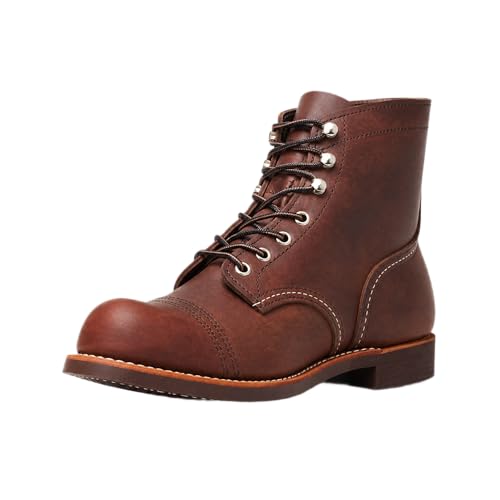
If you want the boot that costs the least over years rather than at the register, the Iron Ranger Work is it. Red Wing’s Iron Ranger platform sits at the premium end for good reason. The Goodyear leather welt construction is resoleable, the oiled full-grain leather develops a protective patina over time, and the brand’s heritage in work footwear means quality control is genuinely consistent. The 8085 work version carries steel toe and EH certification, so you get the safety standards alongside the iconic heritage design.
Traction comes from a Vibram 430 Mini-Lug outsole that provides steady, dependable grip across seasons, and the boot is built on the No. 8 last with a bump toe that helps accommodate a wider range of foot shapes. The combination of resoleable construction and rich, rugged leather is what makes the long-term math work: you pay significantly more upfront, but factor in two or three replacement cycles of a cheaper boot and the gap narrows or disappears.
There are two honest trade-offs. The first is that upfront cost, which is real and not for everyone’s budget. The second is the break-in: heritage full-grain leather on a stiff welted sole is not comfortable out of the box the way a cushioned value boot is, and you should expect a genuine break-in period before this boot feels like yours.
Keen Utility Atlanta Cool 2
For hot-weather work, this is the one I would reach for. The Atlanta Cool 2 uses a composite toe, which means no heat or cold transfer through the toe cap, a real advantage in summer on sun-baked sites and in winter when steel caps turn uncomfortably cold. Keen pairs that with a moisture-wicking mesh lining that keeps feet noticeably drier than standard leather-lined boots, and the asymmetrical, wider toe box is shaped for comfort and a more natural fit. (Keen’s own listing references a steel toe option as well, so confirm the composite version when you order.)
The outsole is oil- and slip-resistant, non-marking, and siped for improved traction, and the boot carries an electrical hazard rating for secondary underfoot protection. The brown version uses a water-resistant leather while the black is synthetic, and the non-mutilating upper reduces the chance of marking or scratching finished surfaces. The non-metallic design also passes metal detectors, which matters on government, airport, and secure construction sites.
The trade-off with any composite toe is that it can be slightly bulkier than a steel cap to meet the same protection rating, and the breathable mesh lining that keeps you cool in summer is exactly the wrong feature in cold, wet conditions. This is a warm-climate specialist, and I would not pick it as a year-round boot in a cold region.
Caterpillar Second Shift Steel Toe
For a first pair of steel-toe boots or a tight budget, the Second Shift is a sensible, honest choice. It delivers a reliable steel toe without overspending. The quality oiled full-grain leather or nubuck upper is durable, the construction keeps weight reasonable, and the slip-resistant rubber outsole handles most common site surfaces. A Climasphere cushioned, breathable insole keeps feet comfortable through the workday, and the wider-than-average last fits workers who struggle to find comfortable boots in narrower builds.
Caterpillar lists Goodyear welt construction for durability and flexibility on this model, and the boot is ASTM F2413 certified. Electrical hazard protection guards the wearer against open circuits up to 600 volts in dry conditions, which covers the secondary EH protection most general construction work calls for.
The honest limitation is that this is an entry-level boot, and it shows in the finer details rather than the basics. The materials and outsole are built to a budget, so heavily abrasive or chemically harsh environments will wear it faster than a premium boot, and it lacks the advanced anti-fatigue footbed tech of the Timberland or the resoleable longevity of the Red Wing. As a starting point or a backup pair, though, it covers the essentials well.
What to look for
The right construction boot depends on your trade, your climate, and how long you want it to last. Here are the factors I weigh most heavily.
- Toe protection and standard: Steel toe is the most common, but composite gives you no temperature transfer and passes metal detectors. Check for an ASTM F2413 rating.
- Construction method: Goodyear welt construction (Thorogood, Red Wing, Caterpillar here) is durable and, on resoleable models, repairable. Cement or value builds cost less but are usually replaced rather than resoled.
- Outsole and traction: A wedge outsole excels on flat concrete and gravel but clears mud poorly; a lugged outsole like the Vibram on the Red Wing grips uneven and soft ground better.
- Electrical hazard protection: All five boots here carry EH ratings for secondary protection. Confirm it if you work near live circuits.
- Comfort tech and footbed: Anti-fatigue or cushioned insoles return energy and reduce end-of-shift soreness. This matters most if you stand on hard surfaces all day.
- Fit and width: A wide last (Caterpillar, Red Wing’s No. 8) helps if narrow boots have never fit you. Try them with your work socks before committing.
- Climate: Mesh-lined composite boots breathe in heat; full leather linings hold up better in cold and wet.
The verdict
For most construction workers, the Thorogood American Heritage 6″ is the boot I would buy first, because its MAXWear wedge outsole and welted full-grain build keep your feet comfortable across a long shift on hard surfaces. If budget is the deciding factor, the Timberland PRO Pit Boss gives you a certified steel toe and real anti-fatigue comfort for less. The Red Wing Iron Ranger Work is the long-term investment, resoleable and built to outlast cheaper boots two or three times over if you can handle the upfront cost and the break-in. For hot-climate sites or anywhere with metal detectors, the Keen Utility Atlanta Cool 2 and its composite toe is the smart pick. And if you just need a dependable first pair of steel toes, the Caterpillar Second Shift covers the essentials with a forgiving wide fit.
Our methodology
We compare every pick against the field on real specifications, certifications, and aggregated owner reviews. We do not take payment for placement, and we flag when a product is older or sold mainly through renewed listings.
Side by side
The full reviews
Thorogood American Heritage 6" -- Best All-Day Comfort
Made in the USA with full-grain leather and Goodyear storm welt construction, the Thorogood American Heritage is the boot that experienced tradespeople keep coming back to. The MAXWear wedge outsole grips concrete and gravel equally well while absorbing impact that accumulates over a long shift. Steel toe protection meets ASTM F2413 I/75 C/75 standards, and the fiberglass shank delivers torsional rigidity without adding weight. Break-in time is moderate compared to other full-leather options. If you spend most of your day on concrete, this is the boot to beat at its price point.
In its favor
- AMERICAN MADE with USA and globally sourced components by the skilled craftsmen and women
- DURABLE FULL-GRAIN LEATHER BOOTS in Thorogood’s moc toe work boot design are both comforta
- STEEL TOE BOOTS FOR MEN protect your feet from on-site impact and compression hazards whil
- MAXWEAR WEDGE TRACTION OUTSOLE flexes better than other work boot outsoles, absorbing impa
- EH RESISTANCE

Timberland PRO Pit Boss -- Best Value Steel Toe
The Pit Boss has earned its reputation as a reliable, affordable steel toe that holds up across a wide range of job-site conditions. The Ever-Guard leather upper resists oil and abrasion, and the slip-resistant outsole performs well on wet surfaces. Anti-fatigue technology in the footbed returns energy with each step, which makes a noticeable difference by the end of a shift. ASTM F2413 certified with EH rating. It runs slightly narrow, so those with wider feet should size up or look at the Caterpillar option below. For the price, few boots match this level of protection and durability.
In its favor
- Timberland PRO 24/7 Comfort System: A unique comfort system that meets the most rigorous w
- Steel Safety Toe: Metallic, asymmetrical-shaped toe cap that meets US safety standards inc
- Electrical Hazard Protection: Provides secondary underfoot protection against live electri
- Timberland PRO Rubber: Heat-resistant, durable rubber compound offers enhanced slip, oil a
- ReBOTL Material: Products with ReBOTL material contain at least 50% recycled PET (recycled
Red Wing Iron Ranger Work -- Best Long-Term Investment
Red Wing's Iron Ranger platform sits at the premium end of the market for good reason. The traction tread outsole is resoleable, the leather develops a protective patina over time, and the brand's heritage in work footwear means quality control is genuinely consistent. The 8085 work version carries steel toe and EH certification. You will pay significantly more upfront, but factor in two or three resoles over the boot's life and the per-year cost drops considerably. These are the boots to buy if you are serious about owning fewer pairs of higher-quality footwear over your career.
In its favor
- Iconic Heritage Design: Men’s leather boots with the unmistakable Iron Ranger look, featur
- Premium Full Grain Leather: Oiled full grain leather upper delivers rich character, rugged
- Built for Lasting Wear: Goodyear leather welt construction and resoleable design make thes
- Reliable All-Season Traction: Vibram 430 Mini-Lug outsole provides steady grip and dependa
- Comfort-Focused Fit: Built on the No. 8 last with a bump toe that helps accommodate a wide

Keen Utility Atlanta Cool 2 -- Best for Hot Climates
Composite toe construction means no heat or cold transfer, a real advantage in summer on sun-baked job sites or in winter when metal toe caps become uncomfortable. The Atlanta Cool 2 adds a moisture-wicking mesh lining that keeps feet noticeably drier than standard leather-lined options. The non-metallic design also passes metal detectors, which matters on some government or airport construction sites. Outsole grip is dependable on loose gravel and wet concrete. The composite toe meets ASTM F2413 standards and the boot carries an EH rating. Lighter than most steel-toe competitors at a similar price.
In its favor
- STEEL TOE: Left and right asymmetrical, wider steel toes offering maximum comfort and unob
- TRACTION: Oil- and slip-resistant, non-marking, siped, rubber outsoles for improved tracti
- UNDERFOOT PROTECTION: Electrical hazard (EH)-rated footwear provides a secondary source of
- SUPPORT & COMFORT: Black is a synthetic and brown is a water-resistant leather; Features K
- ADDITIONAL FEATURES: Non-mutilating leather upper reduces the change of marking or scratch

Caterpillar Second Shift Steel Toe -- Best Entry Level
For those who need a reliable steel toe without spending over the Caterpillar Second Shift delivers a solid package. The nubuck leather upper is durable, the cement construction keeps weight down, and the slip-resistant rubber outsole handles most common site surfaces. The wider-than-average last fits workers who struggle to find comfortable options in narrower builds. ASTM F2413 certified. It will not last as long as a Goodyear welt boot and cannot be resoled, but as an entry-level or backup pair it punches well above its price. A practical starting point for apprentices or workers new to the trades.
In its favor
- Climasphere cushioned breathable insole keeps your feet comfortable throughout the work da
- Goodyear Welt Construction provides maximum durability and allows for flexibility
- Quality oiled full grain leather or nubuck deliver long-term durability and protection
- Slip Resistant outsole for grip on low traction surfaces
- Electrical Hazard (EH) protects the wearer against open circuits up to 600 volts in dry co
What matters most
What to consider
Start with the safety requirements your site or employer mandates. Steel toe vs. composite toe, EH rating, and puncture resistance are not interchangeable based on preference alone. After meeting those requirements, prioritize fit. A boot that causes blisters or compresses your toes will reduce your performance and increase injury risk over a long career. Try boots on with the same thickness of sock you wear on the job. Consider the outsole: wedge soles work better on hard, flat surfaces while lug soles perform on uneven outdoor terrain. Finally, construction method matters: Goodyear welt boots cost more but are resoleable, making them the better long-run value for daily-use footwear.
What to consider
For more job-site gear, see our guide to [best construction coats](/articles/best-construction-coats) and [best construction equipment](/articles/best-construction-equipment). For details on our review process, visit [methodology](/methodology).
Frequently asked
At minimum, look for ASTM F2413 certification, which sets standards for impact resistance (I/75), compression resistance (C/75), and puncture resistance (PR). Many sites also require electrical hazard (EH) rating. Steel toe and composite toe both meet impact standards; composite toe is lighter and does not conduct temperature, making it preferable in extreme climates or near electrical hazards.
A well-made pair from a reputable brand typically lasts 12 to 24 months with daily use on an active job site, depending on terrain, maintenance, and your walking gait. Leather uppers and Goodyear welt construction extend lifespan significantly. Resoling a Goodyear welt boot is far cheaper than replacing it, so factor that option into your total cost of ownership when comparing prices.
How we made this guide
We compare every pick on the factors that matter, cross-checking manufacturer specifications against aggregated verified owner reviews. We rank independently and never take payment for placement. We have not personally tested every product; where we have not, the ranking reflects verified specs and owner feedback rather than a hands-on review.
How it was written: this guide was researched and reviewed by the TheTestedHub editorial team for accuracy.
Affiliate disclosure: TheTestedHub is reader-supported. When you buy through links on our site, we may earn a commission at no extra cost to you.
You might also like

Dress Watches Experts Recommend: Seiko Presage Cocktail Time

Boot Accessories Guide: Why Insoles Are Your Best Bet

Recovery Boots 2026: Normatec 3 Leads Mile Reviewed Picks

Maximize Your Run: Best Athletic Sneakers of 2026

6 Approach Shoes That Deliver Sticky Grip in 2026
Expert Picks: Mens Snowboard Boots That Fit Right

Which Custom Women’s Jeans Fit You Best? Start With Levi’s 501
