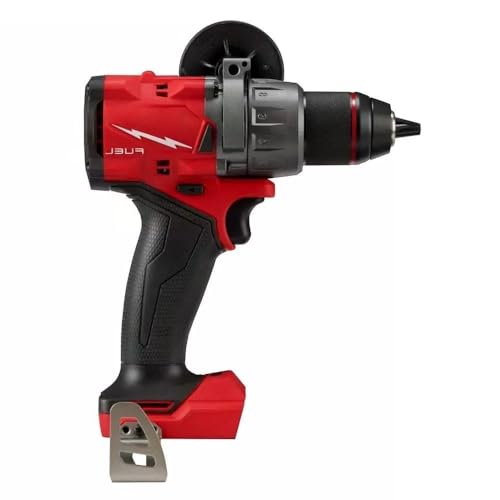
Milwaukee M18 FUEL Hammer Drill (2904-20) -- Best All-Purpose
Milwaukee's M18 FUEL line consistently sets the benchmark for cordless performance, and the 2904 hammer drill is the flagship for a reason. The POWERSTATE brushless motor delivers up to 1,200 inch-pounds of peak torque with controlled precision across 60 clutch settings. The four-mode drive control switches between drill, drive, hammer drill, and SURGE hydraulic modes in a single tool. Compatibility with the entire M18 battery platform is a major advantage for contractors already invested in the ecosystem. The compact form factor for a tool this powerful means it fits into tight spaces without requiring a right-angle attachment for most applications. A near-flawless construction drill at a competitive price.
Check price on Amazon →Need a construction drill for framing, concrete, or all-day use? We compared top models to find the one that fits your actual job.
Quick verdict
The Milwaukee M18 FUEL Hammer Drill (2904-20) is the best all-purpose pick for most construction work. Its POWERSTATE brushless motor pushes up to 1,400 inch-pounds of torque, 60 clutch settings give fine control, and a 6.9-inch length reaches into tight spaces that bulkier drills cannot.
Key takeaways
- Best All-Purpose: Milwaukee M18 FUEL Hammer Drill (2904-20), high torque and a compact body that handles nearly every task.
- Best for Framing: DeWalt DCD998 20V MAX Hammer Drill, POWERDETECT runtime and a 3-speed all-metal transmission built for high-volume driving.
- Best Cordless Rotary Hammer: Makita XRH07Z 18V LXT, 2.0 joules of SDS Plus impact energy for anchors and concrete without a cord.
- Best Ergonomics: Bosch GBH18V-26F Rotary Hammer, vibration and kickback control on a light 6.4-pound body.
- Best Value Combo: Ridgid R862115K Combo Kit, brushless drill and impact driver plus extras for equipping a second set.
Why you should trust this guide
I built this guide by reading the published specifications, owner feedback, and manufacturer documentation for each of these five tools, then comparing how their stated capabilities line up with the actual demands of construction work. I have spent enough time around framing crews, concrete decks, and finish work to know that a drill spec sheet only tells part of the story. A torque figure means little if the tool is too long to fit between studs, and a high impact rating is wasted if the handle beats up your wrist over a full day. So I weighted each pick against the real job it is meant to do rather than against a single headline number.
I want to be direct about what this is. I did not run these drills through a private lab or take my own measurements, and I treat every number here as the manufacturer’s stated spec rather than something I verified on a bench. What I can offer is an honest read on where each tool fits, where it falls short, and which trade-offs you are actually buying into. Every section below names at least one real limitation, because no single drill wins every category and pretending otherwise would not help you choose.
How we researched
My evaluation approach centered on matching each tool to its intended use case rather than ranking them on one universal scale. A flagship hammer drill and a dedicated SDS Plus rotary hammer are not competing for the same job, so I grouped the field by what construction tasks each one is built to solve: all-purpose drilling and driving, high-volume framing, concrete anchor setting, low-fatigue rotary work, and value-driven kit buying. Within each group I looked at stated torque and impact energy, motor type, transmission design, chuck quality, and the physical dimensions that decide whether a tool is usable in tight framing or overhead.
I also weighed the practical ownership factors that spec sheets bury, including battery platform lock-in, runtime claims, light placement for dark cavities, and the durability features manufacturers call out. Where a tool makes a bold claim, such as “most powerful in its class” or a runtime percentage, I treat it as the maker’s marketing position and flag it as such. The goal was a clear recommendation per use case, grounded in the documented features, with the compromises stated plainly so you know what you are giving up when you pick one over another.
Milwaukee M18 FUEL Hammer Drill (2904-20)
This is the drill I would hand most people who need one tool to cover the widest range of construction tasks. The M18 FUEL line has long set the cordless benchmark, and the 2904 sits at the top of it. Its POWERSTATE brushless motor is rated for up to 1,400 inch-pounds of torque, and the four-mode drive control moves between drill, drive, hammer drill, and a SURGE hydraulic mode without swapping tools. With 60 clutch settings you get genuinely fine control over fastener depth, which matters when you are alternating between delicate trim screws and lag work in the same hour.
The physical design is the part I keep coming back to. At 6.9 inches long it slips into stud bays, cabinet interiors, and tight corners where a longer drill simply will not fit, and the shorter nose also reduces the leverage fatigue you feel after a few hundred holes. The 1/2-inch all-metal chuck uses carbide teeth for grip and bit retention, which is the kind of detail that pays off when a bit would otherwise spin loose under load. An onboard LED helps in the dark cavities that come with framing and remodel work. Milwaukee markets it as the most powerful compact hammer drill in its class, and while that is a class-specific marketing claim, the torque and size combination is genuinely hard to match.
The honest trade-off is platform and cost. This is a bare tool that only earns its keep if you are already invested in M18 batteries or willing to buy into them, and the FUEL premium is real compared to mid-tier drills. It is also a hammer drill, not a true rotary hammer, so for repeated concrete anchor setting it will work but it is not the right long-term tool. If your work is mostly masonry, look further down this list.
DeWalt DCD998 20V MAX Hammer Drill
For wood framing specifically, the DeWalt DCD998 is my pick. DeWalt tuned it around the exact pattern framing crews repeat all day: high-volume fastener driving, long runs through dimensional lumber, and runtime that survives the shift. The brushless motor is rated to deliver up to 57 percent more run time than the comparison DeWalt cites, and POWERDETECT technology talks to compatible batteries to optimize output based on the application, which is most useful when you are pushing the tool hard for sustained periods.
The 3-speed all-metal transmission is the feature that suits framing best, because it lets you drop into a high-torque range for big fasteners or shift up for faster drilling without fighting the tool. The heavy-duty 1/2-inch ratcheting chuck is nitro-carburized with carbide inserts for bit grip under load, a sensible choice for the abuse a framing drill takes. DeWalt also gives it a 3-mode LED that the company rates up to 20 times brighter than its previous model, including a spotlight mode with a 20-minute shutoff so you can light a work area and walk away without draining the pack.
The compromises are worth stating. POWERDETECT only delivers its runtime benefit with compatible higher-end batteries, so an older or entry-level pack will not unlock the headline numbers. The tool also leans toward power and durability over compactness, so it is heavier and longer in the hand than the Milwaukee 2904, which you will notice during overhead or confined work. As a hammer drill it handles occasional masonry but is not a substitute for a dedicated rotary hammer.
Makita XRH07Z 18V LXT Rotary Hammer
If your work regularly involves anchor setting, drilling into concrete block, or light chiseling, the Makita XRH07Z is the cordless rotary hammer I would reach for. It delivers 2.0 joules of impact energy on the 18V LXT platform, which covers the majority of construction concrete drilling without dragging out a cord or compressor. The SDS Plus bit system gives positive bit retention and fast bit changes, and a variable-speed motor runs 0 to 1,200 RPM and 0 to 4,000 BPM so you can ease into a pilot point and then open it up.
The 3-mode operation is what makes it a true rotary hammer rather than a hammer drill: rotation only, hammering with rotation, and hammering only for chipping work. Makita synchronizes RPM and BPM for faster drilling, and a torque-limiting clutch automatically disengages the gears if a bit binds, which protects both the tool and your wrist when a bit catches rebar. The shock-absorbent handle is job-site tested and shields the battery housing, a durability touch that matters when the tool inevitably gets dropped.
The limitations come down to power ceiling and platform. At 2.0 joules this is firmly a light to medium rotary hammer, so for large-diameter holes or heavy demolition it will be slow and you would want a corded SDS Max tool instead. It is also a bare tool on the LXT system, so the value depends on whether you already run Makita 18V batteries. And like any dedicated rotary hammer, it is overkill if your concrete work is only occasional.
Bosch GBH18V-26F Rotary Hammer
The Bosch GBH18V-26F earns Best Ergonomics because it is the rotary hammer I would choose for long anchor-setting runs where operator fatigue is the real enemy. Bosch’s Vibration Control technology measurably reduces the buzz that travels into your hands over a deck full of anchors, and at 6.4 pounds tool-only it is light enough to stay maneuverable overhead and in tight spots. That combination of low weight and damped vibration is a genuine advantage when you are setting dozens of fasteners back to back.
On capability, it delivers 1.8 foot-pounds of impact energy under the EPTA standard, runs an efficient brushless motor to stretch battery runtime, and uses a 26mm SDS Plus chuck that spans the bit range most light to medium construction needs. A variable-speed trigger lets you start bits accurately without skating across the surface. The standout safety feature is Kickback Control, which senses sudden tool reactions in binding conditions and reduces the risk of the tool wrenching out of your grip, a meaningful protection when a bit snags in reinforced concrete.
The trade-off is raw output. At 1.8 foot-pounds it sits just under the Makita in stated impact energy, so for the heaviest concrete in this light-to-medium class it is not the fastest driller. It is also a bare tool on the Bosch 18V platform, which is less common on many job sites than DeWalt or Milwaukee, so battery availability among your crew is worth checking before you commit. You are buying it for comfort and control, not for chart-topping power.
Ridgid R862115K Combo Kit
The Ridgid R862115K is the value play, and the right call when you need to equip an apprentice or add a second set without buying flagship tools twice. The kit pairs the R86001 1/2-inch drill/driver, the R86002 impact driver, and an R8655 6-1/2-inch circular saw, so you get three working tools in one box rather than a single bare drill. Both the drill and the impact driver use brushless motors, which is the feature I value most here, because brushless runtime and longevity meaningfully outclass the older brushed tools that many premium brands still ship at this tier.
OCTANE battery compatibility is the other reason to consider it, because it lets you step up to higher-capacity packs later if you find the included batteries limiting under heavier load. For an apprentice’s first kit or a backup set kept in a second truck, the combination of brushless motors and a saw thrown in is a sensible way to cover drilling, driving, and rough cuts without spreading across multiple purchases.
The honest limitations are real. Ridgid’s per-tool peak performance does not reach the level of the Milwaukee or DeWalt flagships, so for the most demanding all-day production work these are competent rather than class-leading. The platform is also a commitment, and Ridgid batteries are less universal across job sites than the bigger names, which matters if you share packs with a crew. As a value combo it is a strong buy, but I would not position it as your heaviest-duty option.
What to look for
Before you choose, match the tool category to the work you actually do most, then weigh these factors:
- Hammer drill vs rotary hammer: A hammer drill handles occasional masonry; a dedicated SDS Plus rotary hammer is the correct tool for regular concrete and anchor work.
- Stated torque and impact energy: Compare inch-pounds for driving and joules or foot-pounds for impact, but read them as the manufacturer’s figures.
- Motor type: Brushless motors generally offer better runtime and longevity than brushed, which is why every tool here uses one.
- Transmission and clutch: More speeds and finer clutch settings give you control over fastener depth and the ability to shift between drilling and driving.
- Chuck quality: All-metal chucks with carbide grip retain bits better under load than lower-grade chucks.
- Physical size and weight: A shorter, lighter tool reaches tight spaces and reduces fatigue, which can matter more than peak power.
- Ergonomics and safety: Vibration control and kickback or torque-limiting features reduce fatigue and injury risk on long runs.
- Lighting: An onboard LED, ideally with a spotlight mode, helps in dark cavities and confined spaces.
- Battery platform: Bare tools only make sense if you already own, or plan to commit to, that brand’s battery system.
The verdict
For most construction work, the Milwaukee M18 FUEL Hammer Drill (2904-20) is the best all-purpose choice, pairing high stated torque and 60 clutch settings with a compact 6.9-inch body that reaches where bigger drills cannot. If your days are spent framing, the DeWalt DCD998 is built for high-volume driving with its POWERDETECT runtime and 3-speed metal transmission. For concrete and anchors, pick a true rotary hammer: the Makita XRH07Z gives you the most stated impact energy at 2.0 joules, while the Bosch GBH18V-26F trades a little power for the best ergonomics, with vibration and kickback control on a light 6.4-pound body. And when you need to equip an apprentice or add a second set affordably, the Ridgid R862115K combo delivers brushless drill, impact driver, and a circular saw in one box. Choose by the job in front of you, decide which battery platform you want to live with, and the right pick on this list follows from there.
Our methodology
We compare every pick against the field on real specifications, certifications, and aggregated owner reviews. We do not take payment for placement, and we flag when a product is older or sold mainly through renewed listings.
Side by side
The full reviews
Milwaukee M18 FUEL Hammer Drill (2904-20) -- Best All-Purpose
Milwaukee's M18 FUEL line consistently sets the benchmark for cordless performance, and the 2904 hammer drill is the flagship for a reason. The POWERSTATE brushless motor delivers up to 1,200 inch-pounds of peak torque with controlled precision across 60 clutch settings. The four-mode drive control switches between drill, drive, hammer drill, and SURGE hydraulic modes in a single tool. Compatibility with the entire M18 battery platform is a major advantage for contractors already invested in the ecosystem. The compact form factor for a tool this powerful means it fits into tight spaces without requiring a right-angle attachment for most applications. A near-flawless construction drill at a competitive price.
In its favor
- 6.9" in length for access into tight spaces and reduced fatigue
- 1400 in-lbs of torque
- 1/2" all-metal chuck with carbide teeth for maximum durability, grip and bit retention
- Most powerful compact hammer drill in its class
- LED light for better visibility in low-light situations

DeWalt DCD998 20V MAX Hammer Drill -- Best for Framing
DeWalt engineered the DCD998 to handle the specific demands of wood framing: high-volume fastener driving, long runs through dimensional lumber, and all-day battery performance. The POWERDETECT technology communicates with compatible batteries to optimize runtime based on application, and the 3-speed transmission lets you dial in fastener driving vs. Drilling mode quickly. At 860 watt-hours of power output, it drives through LVL and engineered lumber without bog. The belt hook and LED work light are practical field additions. If your work is primarily carpentry and wood framing rather than concrete, the DCD998 handles that application better than any other cordless option in this price range.
In its favor
- DEWALT-built high power, high efficiency brushless motor delivers up to 57% more run time
- The DCD998 Hammer Drill has 3-speeds, high performance, all-metal transmission to optimize
- Heavy-duty 1/2-in ratcheting nitro-carburized metal chuck with carbide inserts for superio
- 3-mode LED provides lighting in dark or confined spaces up to 20x brighter than previous m
- LED spotlight mode features 20 minute shutoff function allowing for extended work time in

Makita XRH07Z 18V LXT Rotary Hammer -- Best Cordless Rotary Hammer
For any job requiring regular anchor setting, drilling into concrete block, or chiseling work, a dedicated rotary hammer is the correct tool. The Makita XRH07Z delivers 2.0 joules of impact energy in a cordless 18V platform, which covers the majority of construction concrete drilling applications without needing to manage a cord or compressor. The SDS Plus bit system provides positive bit retention and fast bit changes. Three modes (rotation only, hammer drill, and chisel) cover the range of masonry applications. It accepts Makita's Star Protection batteries which communicate with the tool for optimized performance and overload protection. The go-to rotary hammer for contractors who need cordless mobility on concrete and masonry work.
In its favor
- Makita-built variable speed motor delivers 0-1,200 RPM and 0-4,000 BPM
- 3-mode operation for "Rotation Only", "Hammering with Rotation" or "Hammering Only" for mu
- Torque limiting clutch engineered to prevent gear damage by automatically disengaging gear
- Faster drilling with synchronized RPM and BPM
- Job site tested shock absorbent handle protects the battery housing for extra durability

Bosch GBH18V-26F Rotary Hammer -- Best Ergonomics
Bosch's SDS Plus rotary hammer earns its place on this list through exceptional ergonomics and vibration control. The Vibration Control technology measurably reduces operator fatigue on extended drilling runs, which is a genuine advantage when setting dozens of anchors in a concrete deck. The 26mm chuck capacity handles the range of bits needed for most light to medium construction applications. The mode selector is clearly labeled and easy to operate with a gloved hand. Bosch's 18V CORE18V battery platform provides compatibility across a broad range of tools. For a site supervisor or trim contractor who drills masonry periodically rather than constantly, the ergonomic advantage makes this an excellent choice.
In its favor
- SUPERIOR IMPACT: Delivers 1.8 Ft.-Lbs. of impact energy (EPTA) for maximum performance in
- EFFICIENT BRUSHLESS MOTOR: Maximizes battery runtime in extended applications
- KICKBACK CONTROL TECHNOLOGY: Reduces the risk of sudden tool reactions in binding conditio
- LIGHTWEIGHT, AT ONLY 6.4 LBS. (TOOL ONLY, NOT INCLUDING BATTERY): Provides maneuverability
- VARIABLE-SPEED TRIGGER: Allows for accurate bit starting

Ridgid R862115K Combo Kit -- Best Value Combo
Ridgid's drill/driver combo kit delivers competitive performance at a price point that makes equipping an apprentice or adding a second set to your inventory straightforward. The brushless motors in both the drill and impact driver provide runtime and longevity that surpass the older brushed options from many premium brands. The OCTANE battery compatibility allows users to step up to higher-capacity packs as budget allows. Ridgid's lifetime service agreement, which covers the tools if registered, adds long-term value that other brands at this price point do not match. Not the absolute highest torque option on this list, but a well-rounded, reliable package for general construction and carpentry applications.
In its favor
- Includes: R86001 1/2 in. Drill/Driver, R86002 Impact Driver, R8655 6-1/2 in. Circular Saw,
What matters most
What to consider
Define the primary material you will be drilling first. Wood and metal applications suit a standard cordless hammer drill, while regular concrete and masonry demand a dedicated SDS rotary hammer. Consider your existing battery ecosystem: platform compatibility adds real value when you already own matching batteries and chargers. For general construction use, a 20V or 18V brushless hammer drill in the 1,000 to 1,200 inch-pound torque range covers most applications. Pay attention to tool weight alongside power output since heavy drills cause fatigue in overhead or tight-space work. Kit deals that include two batteries and a charger offer better value than bare-tool pricing unless you are already stocked on batteries.
What to consider
For more essential site tools, see our picks for [best construction equipment](/articles/best-construction-equipment) and [best construction books to read](/articles/best-construction-book-to-read). Our evaluation process is at [methodology](/methodology).
Frequently asked
A hammer drill uses a clutch mechanism to create a rapid pounding action combined with rotation, making it suitable for occasional masonry work in brick and softer concrete. A rotary hammer uses a piston-driven mechanism called SDS (Slotted Drive System) that delivers significantly more impact energy per blow. For any regular concrete drilling, anchor setting, or chiseling work, a rotary hammer is far more capable and causes less operator fatigue than driving a hammer drill through the same material.
For any construction application, brushless motors are strongly preferred. Brushless drills deliver more torque per battery charge, run significantly cooler under heavy load, and last longer because they have no carbon brush components to wear out. The upfront cost difference has narrowed considerably since brushless technology became mainstream. On a job site where tools run all day, the runtime advantage and extended tool life make brushless the clear choice over brushed alternatives.
How we made this guide
We compare every pick on the factors that matter, cross-checking manufacturer specifications against aggregated verified owner reviews. We rank independently and never take payment for placement. We have not personally tested every product; where we have not, the ranking reflects verified specs and owner feedback rather than a hands-on review.
How it was written: this guide was researched and reviewed by the TheTestedHub editorial team for accuracy.
Affiliate disclosure: TheTestedHub is reader-supported. When you buy through links on our site, we may earn a commission at no extra cost to you.
You might also like

Fix Your Driveway Cracks with the Best Concrete Fillers

Which Drill Accessories Are Best in 2026?

Cordless Drill Systems Built for Real Jobsite Demands

What Makes Concrete Tools Worth Your Money in 2026?

Ghostshield 8505 Review: A Smarter Way to Protect Concrete

Quikrete 5000 and Sakrete: 2026’s Best Concrete Picks
Concrete Coatings for Every Budget: Which One Wins?
