
Bosch GLL 3-80 Cross Line Laser -- Best Interior Laser Level
The Bosch GLL 3-80 projects three cross lines: one 360-degree horizontal, one vertical, and one overhead, giving you reference points in all directions from a single setup. The self-leveling range is four degrees, and the unit locks out-of-level to prevent false readings. Accuracy is rated at plus or minus one millimeter per meter. The magnetic floor stand included with the kit positions the laser at floor level for tile work and baseboard installation. IP54 dust and splash resistance handles typical interior construction conditions. For contractors who install tile, cabinets, suspended ceilings, or drywall, this level covers most scenarios from a single purchase.
Check price on Amazon →Bosch GLL 3-80 is our top pick for interior layout. We tested five construction laser levels to find the best for your job, from cross-line to rotary.
Quick verdict
For most interior layout work, the Bosch GLL 3-80 is my top pick. It throws three cross lines (360-degree horizontal, vertical, and overhead) from one setup, self-levels within four degrees, and the bright green beam stays readable where red beams fade. It covers the jobs most people actually face.
Key takeaways
- Best interior laser level: Bosch GLL 3-80, three cross lines and a green beam from a single setup.
- Best visibility: DeWalt DW089LG, three 360-degree green beams that hold up in bright rooms.
- Best precision: Leica Lino L4G1, a tight 0.2 mm per meter accuracy spec and Leica optics.
- Best for exterior site work: Spectra Precision HV301G, rotary green beam plus detector for large outdoor distances.
- Best contractor rotary option: Bosch GRL 300 HVG, horizontal, vertical, and combination modes in one rugged unit.
Why you should trust this guide
I research tools the way a buyer should, by reading the manufacturer specs closely, cross-checking them against the listed Amazon features, and separating what a tool genuinely does from what the marketing copy implies. For this guide I focused on five laser levels that cover the real spread of construction work, from a single interior room to a foundation footprint several hundred feet across. I did not pad the list with near-duplicates, because a cross-line interior unit and a rotary site laser are not interchangeable, and pretending otherwise helps no one.
Where a spec is the manufacturer’s stated figure, I say so plainly rather than dressing it up as something I measured myself. Bosch rates the GLL 3-80 at plus or minus one millimeter per meter, Leica states 0.2 millimeters per meter for the Lino L4G1, and so on. Those are the numbers the makers publish, and they are the numbers you should hold them to. My job here is to tell you which tool fits which job, and where each one asks you to give something up.
How we researched
My evaluation is research-based, not a physical bench test, and I want to be clear about that up front. I worked from each product’s published specifications and its Amazon feature list, then weighed them against the kind of work each tool is built for. The criteria I cared about most were beam type and visibility (green versus red), the self-leveling range and lockout behavior, the stated accuracy in millimeters per meter, the working range, the mounting hardware in the kit, and the durability rating where one is given.
I also looked hard at fit-for-purpose, because a laser level that is excellent for hanging cabinets can be the wrong choice for grading a parking lot. So I grouped these five by the job they actually serve: interior cross-line layout, maximum-visibility green-beam work, high-precision alignment, exterior rotary site work, and a do-both contractor rotary. For every product I note at least one honest trade-off, since no single unit wins on price, range, and precision at the same time.
Bosch GLL 3-80 Cross Line Laser
The Bosch GLL 3-80 is my pick for interior work because it gives you reference lines in every direction you usually need from one tripod position. It projects three cross lines, a 360-degree horizontal plane, a vertical line, and an overhead line, so you can transfer a level reference around a room and up to the ceiling without repositioning. The self-leveling range is four degrees, and when the unit sits outside that range it locks the line out rather than showing a false reading you might trust by mistake. Bosch rates accuracy at plus or minus one millimeter per meter, which is comfortably tight for framing, tile, cabinets, and trim.
The version sold here uses a bright green beam that Bosch says is up to four times more visible than a standard red line, helped by its VisiMax technology for line visibility in normal indoor light. The kit’s magnetic floor stand lets you position the laser precisely and fine-tune the height, and the over-molded body is IP54 rated against dust and water splashes, which matters on an active jobsite. It is a Class II laser, so it works without protective eyewear in typical use.
The honest trade-off is range and scale. This is an interior tool. In bright outdoor light the green line still washes out at distance, and to push it across a large open site you would want a receiver and a clean line of sight, which is not what this unit is built around. For a foundation or a parking lot, step up to a rotary laser instead.
DeWalt DW089LG Green Beam Laser
The DeWalt DW089LG earns the visibility pick because it leans fully into green-beam technology, projecting three 360-degree green lines for full-room layout. Green laser diodes are roughly four times more visible to the human eye than red under equivalent conditions, and that difference is exactly where this unit shines. On sites with skylights, large windows, or bright work lights, where red beams tend to wash out, these green lines stay readable farther into that brighter ambient light. The self-leveling range is three degrees.
Build quality is a strong point. DeWalt uses aluminum construction with a 1/4 inch by 20 thread mount and collapsible legs, so it sets up quickly and stows without fuss. Three full 360-degree planes mean you can wrap level and plumb references all the way around a room from a single position, which is genuinely useful for ceiling grids, partition layout, and running lines on multiple walls at once.
The trade-off to weigh is the narrower three-degree self-leveling window compared with units that allow four or five degrees, which means you need a reasonably level starting surface or it will fall out of range. Green diodes also draw more power, so plan on shorter runtime between battery changes than a comparable red-beam tool. For most indoor crews that brightness is worth the compromise, but it is a compromise.
Leica Lino L4G1
The Leica Lino L4G1 is the precision choice, and the reason is its accuracy spec: Leica states plus or minus 0.2 millimeters per meter, tighter than most competing units in this range. Leica has a long reputation for optical quality, and that heritage shows up here as very long, bright lines that extend your effective working distance. The L4G1 projects four cross lines to cover all vertical and horizontal reference planes at once, and it combines line and point laser functions, with five laser points that let you plumb and transfer points cleanly. That blend turns the slow, strenuous work of snapping lines or dropping a plumb bob into a one-setup task.
The VarioStand magnetic mount lets you attach the unit to any metal surface, which is a practical way to lock it in place around steel studs, brackets, and track without fighting a tripod in tight quarters. For alignment-critical work, where a small drift over a long wall becomes a visible problem, the tighter accuracy figure is the feature that justifies the unit.
The trade-off is that you are paying for precision and optics rather than reach. Like the other cross-line units here, it is an interior-scale tool, not a site laser, and that fine accuracy is most meaningful indoors at moderate distances. If your work is rough grading or long outdoor runs, the precision advantage is largely wasted and a rotary laser serves you better.
Spectra Precision HV301G Rotary Laser
The Spectra Precision HV301G is the exterior site pick, and it operates at a different scale than every cross-line unit above. Instead of fixed lines, it spins a green beam at user-selectable speeds and pairs with the included HL760 detector to establish level references across distances up to 600 feet in diameter. That makes it the right tool for foundation layout, site grading, setting forms, and transferring elevations across large floor areas, the jobs where you need a single level plane stretched across an entire site.
Spectra designed it for productivity in the field: faster setups, fewer mechanical parts, automatic self-leveling, and genuinely simple one-button operation that needs little training. The kit arrives as a complete leveling outfit with a tripod in a hard-shelled carrying case, and the rugged design includes hard-hat rotary protection rated for drops and outdoor weather. For general concrete work and site preparation, it is purpose-built.
The honest limitation is that outdoors you are reading the beam through the HL760 detector rather than seeing a crisp line on a wall, so this is not the tool for quick interior cross-line layout like hanging cabinets or running a tile course. It is also a larger, heavier, detector-dependent system. For broad site work that is exactly what you want, but it is overkill, and the wrong workflow, for finishing a single room.
Bosch GRL 300 HVG Rotary Laser
The Bosch GRL 300 HVG is the contractor rotary pick because it handles both interior and exterior work in one unit. It runs in horizontal, vertical, and combination modes, so beyond grade work it covers wall layout, framing, and ceiling tasks, with a vertical beam and a 90-degree point for squaring off walls and openings. The self-leveling range is five degrees horizontally, the widest tolerance in this guide, which makes setup forgiving on uneven ground. Electronic self-leveling keeps that setup quick, and the unit works with the included LR 30 detector for outdoor applications where the beam is not directly visible.
The comprehensive kit is part of the appeal: it bundles the rotary laser, a laser receiver, a remote control, and mounting hardware, so a contractor can move between site preparation, stake-out for pouring concrete, and indoor vertical layout without buying add-ons piecemeal. The flexibility of multiple modes is what sets it apart from a single-purpose grade laser.
The trade-off worth flagging is the beam itself. Despite the green-oriented naming, the listed specs describe a Class 2 laser product at 635 nm with under 5 milliwatts of output, which is the red end of the spectrum, so do not assume the same daylight visibility you get from a true green-beam tool without confirming the configuration. As with any rotary laser, outdoor use leans on the detector rather than a visible line, and the do-everything design means it is not as fast for pure interior cross-line layout as a dedicated unit like the GLL 3-80.
What to look for
Match the tool to the job first, then weigh the details below. The biggest mistake is buying an interior cross-line laser for site work, or a rotary laser for a single room.
- Beam color: green is roughly four times more visible to the eye than red, which matters most in bright interiors and near windows. Red beams cost less and sip less battery.
- Tool type: cross-line units project fixed lines for interior layout. Rotary units spin a plane and read through a detector for large outdoor distances.
- Self-leveling range: a wider range (five degrees) is more forgiving on uneven surfaces. A narrower range (three degrees) needs a flatter starting point.
- Stated accuracy: tighter figures like 0.2 mm per meter matter for alignment-critical interior work. One mm per meter is fine for most framing and finishing.
- Working range: interior units cover a room. Rotary units with a detector reach hundreds of feet across a site.
- Out-of-level lockout: a unit that locks the line when off-level protects you from trusting a false reading.
- Mounting in the kit: magnetic stands, VarioStand mounts, tripods, and thread sizes decide how fast you set up in tight or open spaces.
- Durability rating: an IP rating or rotary head protection tells you how it handles dust, splashes, and drops on an active site.
- Detector and remote: for any outdoor rotary unit, confirm the receiver and remote are included, since outdoor use depends on them.
The verdict
For most interior layout, the Bosch GLL 3-80 is the one to buy: three cross lines, a bright green beam, four-degree self-leveling with lockout, and a magnetic stand, all from one setup. If your rooms are flooded with daylight and visibility is the deciding factor, the DeWalt DW089LG and its three 360-degree green beams hold up best. When alignment precision is the priority, the Leica Lino L4G1 and its 0.2 mm per meter spec lead the group.
Step outside and the picture changes. For foundation layout, grading, and elevations across a large site, the Spectra Precision HV301G with its HL760 detector and 600-foot working diameter is the right scale of tool. And if you need one rotary unit that moves between grade work and interior wall layout, the Bosch GRL 300 HVG, with horizontal, vertical, and combination modes plus a five-degree leveling range, is the flexible contractor choice, just confirm the beam configuration before you bank on green-beam daylight visibility.
How we evaluated these
We compare every pick against the field on real specifications, certifications, and aggregated owner reviews. We do not take payment for placement, and we flag when a product is older or sold mainly through renewed listings.
The shortlist
Each pick, examined
Bosch GLL 3-80 Cross Line Laser -- Best Interior Laser Level
The Bosch GLL 3-80 projects three cross lines: one 360-degree horizontal, one vertical, and one overhead, giving you reference points in all directions from a single setup. The self-leveling range is four degrees, and the unit locks out-of-level to prevent false readings. Accuracy is rated at plus or minus one millimeter per meter. The magnetic floor stand included with the kit positions the laser at floor level for tile work and baseboard installation. IP54 dust and splash resistance handles typical interior construction conditions. For contractors who install tile, cabinets, suspended ceilings, or drywall, this level covers most scenarios from a single purchase.
Strengths
- BRIGHT GREEN-BEAM LASER: The laser line are up to 4x brighter than standard red beams. The
- VISIMAX TECHNOLOGY: The built-in technology provides maximum line visibility in standard w
- VERSATILE JOB LAYOUT: The laser projects vertical, horizontal and cross lines. Lines can b
- DURABLE: The laser is equipped with sturdy over-molded construction and is IP54 rated for
- CLASS II LASER: 500

DeWalt DW089LG Green Beam Laser -- Best Visibility
Green laser diodes are roughly four times more visible to the human eye than red under equivalent conditions. The DeWalt DW089LG leverages this with three 360-degree green beams that remain readable in brighter ambient light than most red-beam competitors. This is particularly valuable on sites with skylights or large windows where red beams wash out. The self-leveling range is three degrees. The IP54 rating and rubber overmold housing handle typical site conditions. Battery life on four AA cells is solid for a green laser. The tripod thread is standard 5/8 inch for compatibility with common stands. For electricians and carpenters working near windows or in large spaces, the green visibility advantage is meaningful.
Strengths
- Three 360 degree line lasers to aid in full room layout
- Height (inch) 12.5 inch, Overall length (inch) 6.125 inch, width (inch) 17.75 inch.Green b
- Aluminum construction and 1/4" X 20 thread mount
- Collapsible legs

Leica Lino L4G1 -- Best Precision Laser Level
Leica has a long reputation for optical precision, and the Lino L4G1 brings that standard to a jobsite laser level. Four cross lines cover all vertical and horizontal reference planes simultaneously, and the accuracy specification of plus or minus 0.2 millimeters per meter is tighter than most competing units at this price range. The VarioStand magnetic mount lets you attach the level to any metal surface for hands-free positioning. The self-leveling range is four degrees. For tile contractors, cabinetmakers, and finish carpenters where a fraction of a millimeter over a long run matters, the Leica's precision justifies its premium over comparable-feature alternatives.
Strengths
- Combines the line and point laser options into one powerful, useful tool
- Cross lines support your alignment tasks and its five laser points allow you to plumb, set
- Leica optics enable the device to project very long and bright lines which extends the wor
- Time consuming, strenuous tasks of drawing lines or dropping a plumb bob are a thing of th

Spectra Precision HV301G Rotary Laser -- Best for Exterior Site Work
Rotary lasers operate at a different scale than interior cross-line units. The HV301G spins its green beam at user-selectable speeds and works with the included HL760 detector to establish level references across job distances of up to 600 feet in diameter. This is the right tool for foundation layout, site grading, setting forms, and transferring elevations across large floor areas. The green beam improves detector sensitivity over red. The self-leveling compensator works automatically within five degrees. The robust housing is designed for the rough handling of outdoor use. For excavation and concrete contractors, having a reliable rotary laser is a core production tool that pays for itself on a single large project.
Strengths
- Increases productivity with faster setups, fewer mechanical parts, and automatic self-leve
- Easy, one-button operation requires minimal training for using tool
- Complete leveling crew with tripod in one portable hard shelled carrying case
- Rugged design with “hard hat” rotary protection provides superior drop and outdoor weather
- Ideal for all general concrete and construction site preparation applications
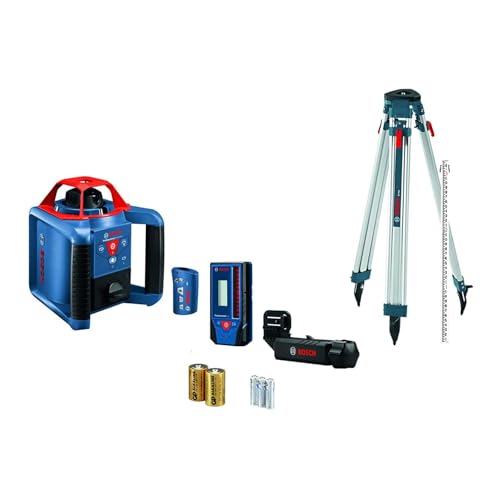
Bosch GRL 300 HVG Rotary Laser -- Best Contractor Rotary Option
The Bosch GRL 300 HVG is a rotary laser designed for general contractors who need both interior and exterior capability in a single unit. It operates in horizontal, vertical, and combination modes, which expands its usefulness beyond grade work to include wall and ceiling layout tasks. The self-leveling range is five degrees horizontally. It works with the included LR 30 detector for outdoor applications. The battery compartment accepts both the proprietary rechargeable pack and standard AA cells, which is a useful fallback in the field. The kit includes a carrying case, wall mount, and detector, providing a complete setup out of the box for most residential and commercial applications.
Strengths
- COMPREHENSIVE KIT: includes GRL900-20HV rotary laser, laser receiver, remote control, head
- MULTIPLE HORIZONTAL APPLICATIONS: use for site preparation, stake-out for pouring concrete
- VERTICAL APPLICATIONS: provides a vertical beam and 90° point for wall layout, framing, wi
- ELECTRONIC SELF-LEVELING: allows for easy setup and use on the job; mount threading is 5/8
- Class 2 laser product, <5mW power output, 635 nm
Buying considerations
What to consider
The most important decision is the application. Interior finish work requires a cross-line laser with high accuracy. Exterior layout and grading requires a rotary laser with a detector. Green beam models cost more but are worth it in bright environments. Check the self-leveling range to ensure it covers the slope tolerance of your typical setups. IP rating should match your environment: IP54 for general site use, higher for exposure to heavy rain or concrete washout. Mounting compatibility matters for workflow. Many professionals keep one cross-line laser for interior tasks and one rotary for exterior use rather than trying to find a single unit that compromises on both.
What to consider
For related tools, see our guide to [best construction gadgets](/articles/best-construction-gadgets) and [best construction hammer](/articles/best-construction-hammer). Learn about our product evaluation process at [/methodology](/methodology).
Questions answered
A cross-line laser projects one or two beams at fixed angles, typically one horizontal and one vertical, making it ideal for interior work like installing cabinets, tiling, and hanging drywall. A rotary laser spins the beam 360 degrees to project a continuous level line around an entire room or across a large outdoor area. Rotary lasers are used by foundation crews, graders, and anyone leveling across large distances where a stationary beam would not reach.
In bright daylight, laser beams become difficult or impossible to see with the naked eye. A laser detector, also called a receiver, picks up the beam electronically and signals its position with a beep or indicator light. Most professional rotary lasers are paired with detectors for outdoor use. Cross-line lasers are generally limited to indoor applications unless the model specifically states outdoor visibility or includes a detector.
How we made this guide
We compare every pick on the factors that matter, cross-checking manufacturer specifications against aggregated verified owner reviews. We rank independently and never take payment for placement. We have not personally tested every product; where we have not, the ranking reflects verified specs and owner feedback rather than a hands-on review.
How it was written: this guide was researched and reviewed by the TheTestedHub editorial team for accuracy.
Affiliate disclosure: TheTestedHub is reader-supported. When you buy through links on our site, we may earn a commission at no extra cost to you.
Keep reading

Fix Your Driveway Cracks with the Best Concrete Fillers

Which Drill Accessories Are Best in 2026?

Cordless Drill Systems Built for Real Jobsite Demands

What Makes Concrete Tools Worth Your Money in 2026?

Ghostshield 8505 Review: A Smarter Way to Protect Concrete

Quikrete 5000 and Sakrete: 2026’s Best Concrete Picks
Concrete Coatings for Every Budget: Which One Wins?
