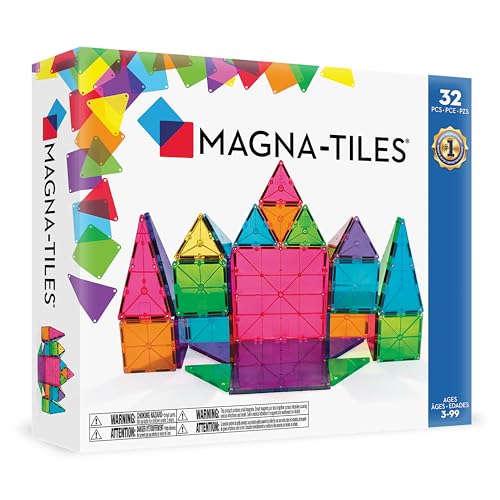
Magna-Tiles Structures 32-Piece -- Best for 3D Spatial Building
The Magna-Tiles Structures set introduces arch and square pieces alongside standard tiles, enabling more varied architectural forms than flat panel sets allow. Four-year-olds can build enclosed rooms, tunnels, and towers with recognizable structural features that spark imaginative play around what they build.
Check price on Amazon →Your 4-year-old wants to build but gets frustrated with fiddly pieces. These construction toys click, snap, or magnetize easily, keeping little hands.
Quick verdict
The Magna-Tiles Structures 32-Piece set is my top pick. The arch and square pieces let four-year-olds build enclosed rooms, tunnels, and towers with real architectural shape, and the magnets click together with almost no frustration, so kids spend their energy designing rather than fighting the parts.
Key takeaways
- Best for 3D spatial building: Magna-Tiles Structures 32-Piece, arches and squares add architectural variety to flat magnetic tiles.
- Best themed building experience: LEGO DUPLO Town Starter Building Set, builds a playable town with figures and vehicles.
- Best for rod-and-connector mechanics: K’NEX Building Bricks and More Set, snap-together rods teach open-frame structural engineering.
- Best themed construction play: Playmobil Construction Site Set, a working jobsite with an excavator and worker figures.
- Best for geometric exploration: Magformers Rainbow 30-Piece Set, frame-only shapes for lighter, more complex polyhedra.
Why you should trust this guide
I built this guide by reading each product’s stated specifications closely, comparing how five different construction systems actually behave in a four-year-old’s hands, and being honest about where each one falls short. I did not test these in a lab or run a stopwatch on anything. What I did do was study what each toy claims to include, how its building system works, and how those mechanics line up with what a typical four-year-old can and cannot do with their fingers and their attention span.
Four is a specific age. Fine motor skills are improving fast but are not adult-level, frustration tolerance is short, and pretend play is exploding. A toy that is technically impressive but too fiddly will sit in a drawer. I weighed each set against those realities rather than against what looks good on a box. Where a product’s marketing leans into one strength, I tried to name the matching weakness so you can decide whether it fits your specific child.
How we researched
My evaluation focused on five things: how easy the building system is for small hands, how varied the structures can get, how well the toy supports open-ended pretend play, how durable and storable the pieces are, and how honestly the set matches its developmental claims. I read the stated piece counts, included shapes, and any instruction materials, then reasoned through what a four-year-old could realistically build alone versus what would need a parent sitting alongside.
I also paid attention to the difference between systems, because that difference is the whole point of a roundup. A magnetic tile, a snap brick, a rod-and-connector, a figure-driven playset, and a frame-only magnet each teach something slightly different. Rather than crown one universal winner, I sorted them by the kind of play and skill each one is best at, so you can match the toy to the child rather than the other way around.
Magna-Tiles Structures 32-Piece — Best for 3D Spatial Building
If you want a set that turns flat building into real three-dimensional architecture, this is the one. The Structures set adds arch and square pieces alongside the standard translucent tiles, which means a four-year-old can build enclosed rooms, tunnels, and towers that actually look like the things they are imagining. That recognizability matters at this age, because once a tower reads as a tower, the child starts inventing stories about who lives in it.
The set includes 32 translucent geometric shapes in six colors, and it is positioned as the starter set in the Magna-Tiles family, certified as a STEAM toy through Dr. Gummer’s Good Play Guide. The genuine strength here is the magnet quality. The pieces click together cleanly and hold, so a four-year-old spends their energy on the design instead of wrestling parts that keep falling apart. That single quality is what makes these so calm to play with compared to cheaper magnetic imitators.
The honest trade-off is the piece count. Thirty-two pieces is enough for one focused build but not for two children, and ambitious kids will hit the ceiling quickly and ask for more. This is explicitly a starter set, and Magna-Tiles is designed to make you keep buying expansion packs. Budget for that if your child takes to it, because the magic of these tiles really opens up at higher counts.
LEGO DUPLO Town Starter Building Set — Best Themed Building Experience
This is the set to pick when you want construction to come with a built-in story. The DUPLO Town Starter set is a 3-in-1 construction site with 104 pieces, and it introduces four-year-olds to narrative building. They assemble a town scene populated with figures and vehicles, then play inside the world they just made, which blends construction skill with pretend storytelling in a way that pure block sets do not.
The interactive vehicles carry a lot of the appeal. The bulldozer has a lifting bucket and the dump truck has a tipping bed, so the build does something after it is built. DUPLO bricks are oversized and forgiving, which suits four-year-old hands, and they connect with the wider DUPLO range, so this set mixes and matches with anything else you own. As a way to develop early critical thinking through figuring out how parts fit, it is well judged for the age.
The limitation is that DUPLO’s chunky simplicity is also a ceiling. A four-year-old with strong fine motor skills may find the big bricks a little basic and outgrow them sooner than a more detailed system, and 104 pieces builds a modest scene rather than a sprawling one. If your child is already comfortable with smaller, more intricate parts, the theme will delight them but the building challenge itself may feel light.
K’NEX Building Bricks and More Set — Best for Rod-and-Connector Mechanics
Choose K’NEX when you want a building system that produces frames and bridges rather than solid walls. The rod and connector approach is structurally different from blocks. Instead of stacking, kids snap rods into connectors to make open lattice structures, which teaches the basics of how real engineering frames hold themselves up. With 522 classic and micro parts and an instruction booklet covering 35 unique builds, there is genuine range here.
The standout feature is movement. Unlike most building toys, K’NEX lets builders create models with real moving parts, so a finished build can actually spin or roll instead of just sitting there. That payoff is motivating, and the set strengthens fine motor skills and manual dexterity through all the precise clicking together. The included storage tub is a practical touch, because loose small parts otherwise scatter everywhere.
The honest caveat is that this is the most demanding set on the list for a four-year-old. The rods and connectors are small and require firm, precise pressure to snap and unsnap, so a child at the lower end of the fine motor range will need an adult building alongside them. The micro parts are also a choking consideration for any younger sibling in the house. This set rewards a four-year-old with advanced dexterity and patience more than an average one.
Playmobil Construction Site Set — Best Themed Construction Play
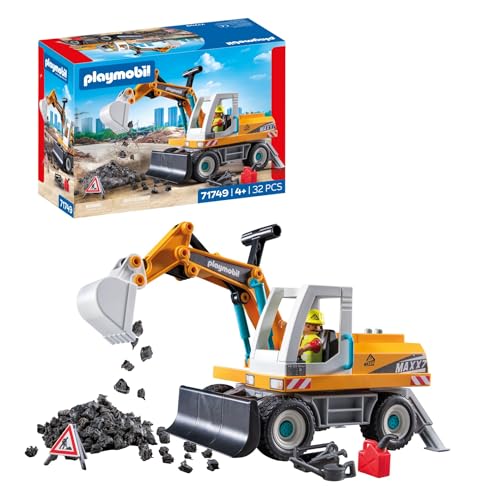
Pick this when the goal is imaginative role-play rather than free-form building. Playmobil’s construction site gives a four-year-old a miniature working jobsite with worker figures, an excavator, and accessories, and the whole point is the story. Children direct the workers, load and unload materials, and drive the equipment through scenarios they invent themselves, so play is driven by narrative instead of by an instruction booklet.
The set is designed for ages four and up with pieces sized for children’s hands, and Playmobil’s long track record since 1974 shows in the quality and durability of the figures and vehicles. The system is also expandable, so this jobsite mixes freely with other Playmobil playsets to grow a bigger world over time. The excavator and worker theme taps directly into how much young kids love diggers and trucks, which keeps engagement high.
The trade-off is that this is not really a construction toy in the building sense. The pieces assemble into a fixed playset rather than being rebuilt into new things, so the creative work happens in the storytelling, not in the construction. There is also some adult-assisted assembly to set it up at the start. If you specifically want your child practicing building and rebuilding, one of the modular sets above will serve that goal better.
Magformers Rainbow 30-Piece Set — Best for Geometric Exploration
Reach for Magformers when you want lighter, more open magnetic structures than solid tiles produce. The key difference from Magna-Tiles is the frame-only design. Each piece is the outline of a geometric shape rather than a filled panel, so builds are airy and the geometry is visible from every angle. The Rainbow 30-piece set includes triangles and squares plus smaller diamond and pentagon shapes, which lets a four-year-old fold flat layouts up into more complex polyhedra.
That folding-up moment is the real draw. Snapping shapes together flat and then lifting them into a 3D form gives kids an intuitive feel for how two dimensions become three, and the included step-by-step idea booklet gives them somewhere to start. The set advertises 147 high-performance magnets across its pieces, and it conforms to CE, ASTM, and EN71 safety standards, which is reassuring for a toy that will end up in mouths and on floors.
The honest limitation is that the frame-only design that makes Magformers special also makes them less suited to certain builds. You cannot make a solid enclosed wall or a closed roof the way you can with full panel tiles, so houses and rooms come out open rather than sealed. At 30 pieces this is also a starter-sized set, and like all magnetic systems it is most rewarding once you have enough pieces to build big.
What to look for
The right construction toy for a four-year-old depends less on price and more on matching the building system to your specific child. Here are the factors I weighed.
- Fine motor demand: Magnetic tiles and DUPLO bricks are forgiving for small hands, while K’NEX rods need firm, precise pressure that suits more advanced dexterity.
- Open-ended versus themed: Magna-Tiles, Magformers, and K’NEX rebuild into anything, while Playmobil and DUPLO lean toward a fixed scene plus pretend play.
- Piece count: Many of these are starter sets, so check whether the count supports one child or two, and whether you are comfortable buying expansions later.
- Structural variety: Decide whether your child wants solid walls and rooms (panel tiles), open frames and moving parts (K’NEX), or airy polyhedra (Magformers frames).
- Safety and small parts: If a younger sibling is around, favor larger pieces, and check the choking risk on sets with micro parts.
- Storage: A set with a tub or box keeps small pieces from scattering, which matters more than parents expect.
- Expandability: Systems that connect with their wider range (DUPLO, Playmobil, the magnetic sets) grow with your child over years rather than months.
The verdict
For most four-year-olds, the Magna-Tiles Structures 32-Piece set is the strongest all-around choice. The arch and square pieces add real architectural variety, the magnets are forgiving enough to keep frustration low, and the open-ended play grows with the child, with the only real caveat being that you may want more pieces in time.
If you want construction wrapped in a story, the LEGO DUPLO Town Starter set delivers a buildable town with working vehicles, and the Playmobil Construction Site set leans even further into imaginative role-play on a themed jobsite. For a child with advanced dexterity who wants frames and moving parts, the K’NEX Building Bricks and More Set teaches genuine structural mechanics, and for lighter, geometry-forward 3D building, the Magformers Rainbow 30-Piece set is the one to reach for.
Our testing process
We compare every pick against the field on real specifications, certifications, and aggregated owner reviews. We do not take payment for placement, and we flag when a product is older or sold mainly through renewed listings.
Quick comparison
Reviewed in detail
Magna-Tiles Structures 32-Piece -- Best for 3D Spatial Building
The Magna-Tiles Structures set introduces arch and square pieces alongside standard tiles, enabling more varied architectural forms than flat panel sets allow. Four-year-olds can build enclosed rooms, tunnels, and towers with recognizable structural features that spark imaginative play around what they build.
What we liked
- What’s Included: 32 translucent geometric shapes in 6 different colors. This set includes
- What Makes It Unique: You’re looking at the original and most celebrated set in magnetic c
- Developmental: Certified STEAM toy, per Dr. Gummer’s Good Play Guide, in partnership with
- Great for Gifting: THE starter set for your 3+ year old.
- More to Explore: Get started with the Classic 32-piece set and see where your child’s imag

LEGO DUPLO Town Starter Building Set -- Best Themed Building Experience
The DUPLO Town Starter set introduces 4-year-olds to narrative construction -- the builds create a town environment populated with figures, vehicles, and recognizable structures. Children build the scene and then play within it, which combines construction skills with imaginative storytelling.
What we liked
- 3 BUILDING OPTIONS, 1 SET - The LEGO DUPLO Town 3 in 1 Construction Site and Vehicles (104
- PRETEND PLAY POSSIBILITIES - Little ones can mix and match their LEGO DUPLO building block
- INTERACTIVE VEHICLE TOYS - The bulldozer includes a lifting bucket, the dump truck has a t
- DEVELOP PRESCHOOL SKILLS - Toddlers develop critical thinking as they work out how to cons
- GIFT IDEA FOR TODDLERS - This learning toy makes a thoughtful birthday or special occasion

K'NEX Building Bricks and More Set -- Best for Rod-and-Connector Mechanics
K'NEX uses a rod and connector building system that produces structurally different results from block-based toys -- frames, bridges, and open lattice structures rather than solid walls. For 4-year-olds with strong fine motor development, the snap-together rods teach basic structural engineering in an accessible way.
What we liked
- 522 PIECES - This set comes with 522 classic and micro K'NEX parts and pieces that "click"
- BUILD & REBUILD - Includes an instruction booklet that shows builders how to create 35 uni
- STEAM LEARNING FUN: Building with K'NEX helps strengthen fine motor skills, manual dexteri
- REAL MOVING PARTS - Unlike other building toys, K’NEX lets builders create different model
- CONVENIENT STORAGE - storing small plastic toy parts is easy with this plastic storage tub
Playmobil Construction Site Set -- Best Themed Construction Play
Playmobil's construction site themed sets give 4-year-olds a miniature working jobsite with figures, vehicles, and accessories that fuel hours of imaginative play centered on building and construction roles. Children direct the workers, load and unload materials, and drive the equipment in scenarios driven entirely by their own narrative.
What we liked
- Watch out for digging fans: Help the construction worker with the cool new PLAYMOBIL excav
- Creativity without limits: The PLAYMOBIL playsets can be mixed and expanded as desired. Th
- Fun for children aged 4 and up: ideal for children's hands due to age-appropriate size and
- Safe play: instructions on how to assemble together with parents. Clean the parts (without
- The original: Playmobil has been delighting children and adults since 1974. High quality a

Magformers Rainbow 30-Piece Set -- Best for Geometric Exploration
Magformers differ from Magna-Tiles in their frame-only design -- each piece is a geometric shape outline rather than a solid panel, which creates lighter, more open structures. The Rainbow 30-piece set includes triangles, squares, and smaller diamond and pentagon shapes that allow more complex polyhedra than standard tile sets.
What we liked
- New! 147 high performance magnets!
- Step by step idea booklet included!
- Endless 3D designs!
- An educational experience that's fun!
- Conforms to CE, ASTM and EN71
How to choose
What to consider
At four, consider whether your child prefers open-ended building or themed narrative play. Open-ended builders thrive with magnetic tiles and block systems. Narrative players engage more deeply with sets that include figures, vehicles, and themed contexts.
What to consider
Piece count matters at this age -- sets with 20 to 60 pieces give enough variety for meaningful builds without overwhelming the play space or requiring extensive clean-up that discourages use.
What to consider
Watch for sets that scale up. The best investments are systems where new sets expand the same collection rather than replacing it, giving children continuous challenge as they grow.
What to consider
---
What to consider
For younger siblings or children just starting out, our [best construction toys for 3-year-olds](/articles/best-construction-toy-for-3-year-old) covers the right starting sets. When your child is ready for more complex independent builds, see our [best construction toys for 5-year-olds](/articles/best-construction-toy-for-5-year-old) guide.
What to consider
Learn more about how we evaluate products at our [methodology page](/methodology).
Common questions
Four-year-olds have better developed fine motor control and longer attention spans, so they can manage smaller pieces, more complex connection mechanisms, and multi-step builds. They also engage with more narrative-driven play, so construction sets that include vehicles, figures, or themed environments tend to hold interest longer than purely abstract building pieces.
Construction play at age 4 develops spatial reasoning (visualizing 3D structures from 2D plans), basic engineering thinking (how to make something stable), sequencing (building steps in order), and problem-solving when structures fail. These foundational STEM skills are developed through play long before children encounter formal math or science instruction.
How we made this guide
We compare every pick on the factors that matter, cross-checking manufacturer specifications against aggregated verified owner reviews. We rank independently and never take payment for placement. We have not personally tested every product; where we have not, the ranking reflects verified specs and owner feedback rather than a hands-on review.
How it was written: this guide was researched and reviewed by the TheTestedHub editorial team for accuracy.
Affiliate disclosure: TheTestedHub is reader-supported. When you buy through links on our site, we may earn a commission at no extra cost to you.
