
Husqvarna 455 Rancher -- Best Gas Chainsaw for Homeowners
The Husqvarna 455 Rancher is a long-standing favorite for landowners and homeowners who need a capable gas saw without stepping into full professional-grade pricing. The 55.5cc engine delivers strong power for firewood cutting, limb removal, and handling fallen trees up to 20 inches in diameter. The 18- or 20-inch bar option gives flexibility depending on your typical workload.
Find a chainsaw that fits your work: gas, battery, or corded. This guide covers 5 models with honest specs for firewood, property, and storm cleanup.
Quick verdict
For most homeowners cutting firewood and clearing fallen trees, I recommend the Husqvarna 455 Rancher. Its 55.5cc engine and choice of 18- or 20-inch bar handle trunks up to 20 inches without the premium of a pro-grade saw, and Smart Start makes the gas hassle manageable for occasional users.
Key takeaways
- Best gas saw for homeowners: Husqvarna 455 Rancher, 55.5cc power with a 20-inch bar for firewood and storm cleanup.
- Best for farm and property work: STIHL MS 271 Farm Boss, 50.2cc torque tuned for hardwood and a trusted name behind it.
- Best battery saw for homeowners: Greenworks 80V 18-Inch, brushless motor with gas-comparable speed and no fumes.
- Best cordless performance: DEWALT 60V MAX FLEXVOLT, the strongest cordless option in the DEWALT lineup with a 16-inch bar.
- Best budget corded electric: Oregon CS1500, a 15-amp plug-in saw with built-in PowerSharp chain sharpening.
Why you should trust this guide
I built this guide by working through the published specifications, the manufacturer feature claims, and the long reputations these five chainsaws have earned among landowners and tradespeople. Chainsaws are a category where brand history matters, because the same companies have been refining engines, bars, and chains for decades. Husqvarna, STIHL, Greenworks, DEWALT, and Oregon are all names that show up repeatedly when you ask people who actually heat their homes with wood or clear their own land what they reach for.
I want to be upfront about scope. I did not cut down trees in a private lot to write this, and I am not going to pretend I logged a cord of oak with each saw. What I can do is read the stated specs honestly, compare engine displacement and bar length against the kind of work each saw is sold for, and flag the trade-offs that the marketing copy tends to skip. My goal is to help you match a saw to your actual workload rather than overbuy or underbuy.
How we researched
My evaluation centered on a few criteria that decide whether a chainsaw fits a given user. First is power source, because gas, battery, and corded electric each carry a different bargain around runtime, maintenance, and noise. Second is cutting capacity, which I read from engine displacement (for gas) or motor and voltage (for battery and electric) together with bar length, since a long bar on an underpowered saw just bogs down. Third is the practical stuff that wears people out: start-up effort, vibration, chain tensioning, and oiling.
From there I weighed each saw against the job it is marketed for. A 55.5cc gas saw and a 15-amp corded saw are not competitors, so I did not score them on the same axis. Instead I asked, for the buyer this saw targets, does the published feature set actually deliver, and where will it disappoint. Treat every spec here as the manufacturer’s stated figure rather than something I clocked with a stopwatch. The honest limitations I list under each product are the ones I would want a friend to warn me about before I spent the money.
Husqvarna 455 Rancher
The Husqvarna 455 Rancher is my pick for the homeowner who wants real gas power without paying professional-grade prices. The 55.5cc engine pushes through firewood cutting, limb removal, and fallen trees up to about 20 inches in diameter, and you can order it with an 18- or 20-inch bar depending on how thick your typical logs run. That displacement is the reason this saw has stayed on landowners’ shortlists for years.
Husqvarna leans on a few features that matter for occasional users. Smart Start reduces the resistance in the starter cord so the engine fires with less effort, which is welcome if you only pull this saw out a few weekends a season. The Air Injection centrifugal cleaning system flings larger debris away from the air filter before it clogs, so the filter and engine stay cleaner over long cutting sessions. The 7-degree offset front handle and improved grip are aimed at reducing fatigue when you are working through a brush pile.
The honest trade-off is that this is still a gas saw, and it asks for gas-saw upkeep: fuel mixing, periodic air filter and spark plug attention, and storage care so the carburetor does not gum up between seasons. At 55.5cc it is also a heavier, louder tool than the battery options here, and the 20-inch bar tempts people into cuts the engine can handle but their technique cannot. If you only need a saw twice a year, the maintenance burden may outweigh the power advantage.
STIHL MS 271 Farm Boss
The STIHL MS 271 Farm Boss is the saw I would point a property owner toward when the work involves regular hardwood cutting and clearing. STIHL is among the most trusted names in outdoor power equipment, and the MS 271 sits as their flagship homeowner and light-professional gas saw. The 50.2cc engine is tuned for torque, which is exactly what you want when you are working through dense hardwoods rather than soft pine, and the 18-inch bar suits typical farm and property clearing.
The supporting hardware is built for durability. The setup here includes an 18-inch guide bar and semi-chisel chains in .325-inch pitch, with vacuum heat-treated steel and Japanese industrial hard chrome plating cited for longevity. The low-kickback chain and optimized guide bar are meant to cut vibration and keep the saw controlled, and the chains arrive pre-sharpened so you can install and start cutting without a separate trip to the grinder.
Two caveats are worth naming. First, at 50.2cc the MS 271 has slightly less displacement than the Husqvarna 455 Rancher, so on the very largest trunks you may notice it working harder, even though its torque tuning makes it a strong hardwood cutter. Second, STIHL’s dealer-centric distribution means parts, service, and warranty support often route through authorized dealers rather than a quick online return, which is great for in-person support but less convenient if you prefer to handle everything yourself. As with any gas saw, fuel mixing and routine maintenance come with the territory.
Greenworks 80V 18-Inch Chainsaw
The Greenworks 80V 18-Inch is the battery saw I would recommend to homeowners who want to skip gas entirely but still cut like they mean it. The 80V platform aims for gas-comparable power on most residential tasks, and the brushless motor delivers strong cutting speed while staying quieter, fume-free, and far lower on maintenance than any gas option here. The 18-inch bar handles logs and limbs up to about 16 inches in diameter.
The convenience features are the real selling point. The brushless motor is rated for more torque, longer runtime, and quiet operation compared with brushed designs. An automatic oiler keeps the chain lubricated without you thinking about it, and the tool-free easy-adjust tensioning makes bar and chain maintenance quick. Greenworks states up to 150 cuts on 4×4 lumber from a single charge, which gives you a rough sense of how much yard work one battery covers before a swap.
The trade-off with any battery saw is runtime and recharge time. When the pack runs down, you are done until it charges, so for a full day of heavy cutting you will want a second battery, which adds cost. The 80V batteries are also specific to the Greenworks ecosystem, so they will not share with other brands’ tools. And while it is strong for residential work, I would not lean on it for sustained large-diameter felling the way you might with the gas saws above.
DEWALT 60V MAX FLEXVOLT Chainsaw
The DEWALT 60V MAX FLEXVOLT is the cordless saw I would choose for the strongest battery performance, especially if you already own DEWALT tools. It is the most powerful chainsaw in the DEWALT 60V ecosystem and one of the stronger battery saws in its class. The brushless motor paired with a 16-inch bar delivers cutting that competes with small gas models, and it brings low vibration plus auto-oiling so the chain stays fed without manual fuss.
The biggest practical advantage is the FLEXVOLT platform itself. If your garage already runs on DEWALT 60V and 20V/60V FLEXVOLT batteries, this saw shares those packs across your drills, saws, and other tools, which spreads the battery cost and means you likely have a charged spare on the shelf. The 16-inch bar is a sensible length for limbing, bucking firewood, and storm cleanup where a lighter, more maneuverable saw beats a long bar you have to muscle around.
The honest limitation is bar length and bundle. The 16-inch bar is shorter than the 18-inch saws here, so for very large trunks it is less suited than the gas options or even the 18-inch Greenworks. The listing here references a 2Ah battery, which is on the smaller side for sustained cutting, so you may find yourself swapping or buying a higher-capacity pack for longer sessions. As with all cordless saws, recharge time is the real ceiling on how much you cut in a day.
Oregon CS1500
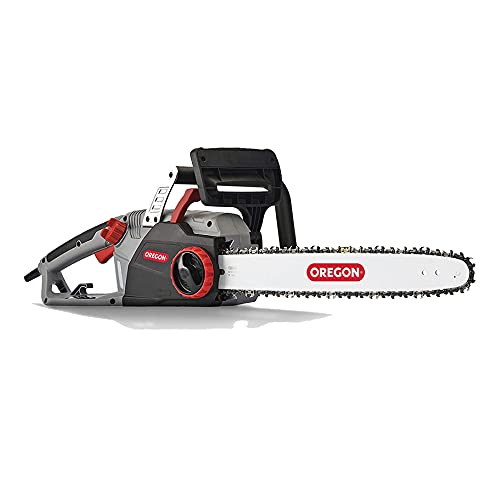
The Oregon CS1500 is the saw I would suggest for homeowners who only face occasional light tasks and want to keep the spend low. It is the most capable corded electric option in this group. The 15-amp motor drives an 18-inch bar through light to medium cutting reliably, and because it is corded it never runs out of charge mid-cut. Its standout trick is the built-in PowerSharp self-sharpening system, which refreshes the chain in seconds without removing it.
That PowerSharp system is genuinely useful for casual users who would otherwise dread sharpening, since it minimizes downtime and keeps the chain biting. The CS1500 also offers tool-free tensioning for quick chain adjustments, an automatic oiler for continuous bar and chain lubrication, and instant startup with no pull cord or warm-up. It runs quieter than a gas engine, which neighbors and your ears will appreciate.
The obvious limitation is the cord. You are tethered to an outlet and an extension cord, which caps your reach and rules out work far from power, so this is a yard-and-driveway saw, not a back-forty saw. The 15-amp motor, while adequate for an 18-inch bar on light to medium work, will bog down in large hardwoods that the gas saws shrug off. For frequent or heavy cutting, I would step up to one of the gas or high-voltage battery options instead.
What to look for
Before you buy, match the saw to the work rather than the spec sheet. These are the factors I weigh most.
- Power source: Gas for the most power and untethered runtime with more maintenance, battery for low noise and easy starts with limited runtime, corded electric for the lowest cost and weight but tethered reach.
- Engine or motor rating: For gas, displacement in cc tracks cutting power (50.2cc to 55.5cc here suits homeowners to light pros). For electric, watch voltage or amperage against bar length.
- Bar length: Longer bars (18 to 20 inches) reach bigger trunks but are heavier and harder to control. A 16-inch bar is more nimble for limbing and firewood.
- Cutting capacity: Aim for a saw rated above your typical log diameter, not right at it, so the engine is not constantly straining.
- Start-up and ergonomics: Features like Smart Start, offset handles, and instant electric startup reduce fatigue, which matters most for occasional users.
- Maintenance load: Gas needs fuel mixing, filters, and storage care. Battery and corded saws skip most of that but still need chain and bar upkeep.
- Chain and tensioning: Tool-free tensioning, automatic oiling, and systems like Oregon’s PowerSharp cut downtime considerably.
- Battery ecosystem: If you go cordless, sharing packs across tools you already own (as with DEWALT FLEXVOLT) lowers the real cost of ownership.
The verdict
If you want one recommendation, the Husqvarna 455 Rancher is the best all-around homeowner choice here, pairing a 55.5cc engine with an 18- or 20-inch bar for firewood and storm cleanup at a sensible price. For regular hardwood and property clearing backed by a trusted name, the STIHL MS 271 Farm Boss and its torque-tuned 50.2cc engine is the pick. If you would rather skip gas, the Greenworks 80V 18-Inch delivers gas-comparable speed with far less hassle for residential work. DEWALT owners should look hard at the 60V MAX FLEXVOLT for cordless strength and shared batteries, accepting its shorter 16-inch bar. And for occasional light jobs near an outlet, the Oregon CS1500 with PowerSharp is the affordable corded answer. Match the saw to your workload and any of these five will serve you well.
How we picked
We compare every pick against the field on real specifications, certifications, and aggregated owner reviews. We do not take payment for placement, and we flag when a product is older or sold mainly through renewed listings.
Top picks compared
Our picks up close
Husqvarna 455 Rancher -- Best Gas Chainsaw for Homeowners
The Husqvarna 455 Rancher is a long-standing favorite for landowners and homeowners who need a capable gas saw without stepping into full professional-grade pricing. The 55.5cc engine delivers strong power for firewood cutting, limb removal, and handling fallen trees up to 20 inches in diameter. The 18- or 20-inch bar option gives flexibility depending on your typical workload.
Where it shines
- Husqvarna 455 Rancher handheld chainsaw gas powered product with a 20 inch bar combines er
- Effortless Start-Up: Smart Start allows this Husqvarna gas powered chainsaw to quickly and
- Powerful and Efficient Engine: Gas-powered chainsaws deliver superior performance with a p
- Air Injection Technology: Equipped with a centrifugal air cleaning system that expels larg
- Easy Handling and Ergonomic Design: 7 degree offset front handle with an improved grip and

STIHL MS 271 Farm Boss -- Best for Farm and Property Work
STIHL is one of the most trusted names in professional outdoor power equipment, and the MS 271 Farm Boss is their flagship homeowner/light professional gas saw. The 50.2cc engine produces excellent torque for cutting hardwoods, and the 18-inch bar is well-suited to typical farm and property clearing tasks.
Where it shines
- Precise Fit for Popular Saws: Includes 18" guide bar and 3 semi-chisel chains (.325" pitch
- Smooth, Low-Vibration Cutting: The low-kickback chain and optimized guide bar reduce vibra
- Built for Longevity: With vacuum heat-treated steel and Japanese industrial hard chrome pl
- Safe and Reliable Operation: The reduced kickback design ensures controlled cutting, while
- Quick Setup, Ready to Use: Pre-sharpened for instant use, this chain can be easily install

Greenworks 80V 18-Inch Chainsaw -- Best Battery Chainsaw for Homeowners
Greenworks' 80V platform delivers gas-comparable power for most residential chainsaw tasks without the noise, fumes, or maintenance associated with gas models. The brushless motor generates strong cutting speed, and the 18-inch bar handles logs and limbs up to 16 inches in diameter with ease.
Where it shines
- 18'' CHAIN AND BAR : Perfect for professional users
- BRUSHLESS MOTOR TECHNOLOGY : 2X more torque. Provides more power, longer runtime, quiet op
- AUTOMATIC OILER : Delivers proper chain lubrication and increased productivity
- EASY ADJUST TENSIONING : For easy bar and chain maintenance
- POWERFUL PERFORMANCE : Get up to 150 cuts on 4x4 lumber on a single charge and comparable

DEWALT 60V MAX FLEXVOLT Chainsaw -- Best Cordless Performance
The DEWALT FLEXVOLT 60V chainsaw is the strongest cordless option in the DEWALT ecosystem and one of the most powerful battery chainsaws in its class. The brushless motor and 16-inch bar deliver cutting performance that competes with small gas models, with low vibration and auto-oiling for the chain.
Where it shines
- DEWALT FLEXVOLT CHAINSAW 60V 2Ah 16IN
- DEWALT FLEXVOLT CHAINSAW 60V 2Ah 16IN
- DEWALT FLEXVOLT CHAINSAW 60V 2Ah 16IN
- DEWALT FLEXVOLT CHAINSAW 60V 2Ah 16IN
- DEWALT FLEXVOLT CHAINSAW 60V 2Ah 16IN
Oregon CS1500 -- Best Budget Corded Electric Chainsaw
For homeowners who need a chainsaw for occasional light tasks and want to spend the Oregon CS1500 is the most capable corded electric option available. The 15-amp motor drives an 18-inch bar through light to medium cutting tasks reliably, and the PowerSharp built-in sharpening system lets you refresh the chain in seconds without removing it.
Where it shines
- Powerful performance: 15A electric chainsaw with integrated PowerSharp self-sharpening sys
- Built-in PowerSharp self-sharpening system minimizes downtime by sharpening your chain in
- Tensioning without tools: Allows you to adjust your chain quickly and easily so that you c
- Automatic lubrication: Automatic oiling system provides continuous lubrication to the bar
- Instant startup: Corded electric chainsaw gets to work immediately. Low noise: makes less
Before you buy
What to consider
Start with power source. Gas saws offer the most runtime and power for extended or remote work. Battery saws work well for homeowners with occasional tasks and those who value low noise and zero maintenance. Corded electric saws are the cheapest option and suit light, near-outlet tasks.
What to consider
Bar length should match your most common cutting task. A 16-inch bar handles most homeowner jobs efficiently. Going larger increases weight and fatigue without benefit unless you regularly cut large-diameter trees.
What to consider
Always prioritize safety features: chain brake, low kickback bar, anti-vibration handles, and a throttle lockout. Wear chainsaw chaps, a helmet with face shield, and cut-resistant gloves whenever operating a saw, regardless of experience level.
What to consider
---
What to consider
For other outdoor power tool coverage, see our guide to [best compact backpacking sleeping bags](/articles/best-compact-backpacking-sleeping-bag) for outdoor recreation, or explore [best compact battery chargers](/articles/best-compact-battery-charger) for workshop power needs. Our full review standards are posted at [methodology](/methodology).
Quick answers
For most homeowners cutting firewood or clearing fallen trees up to 18 inches in diameter, a 16-inch bar chainsaw is the practical sweet spot. It handles the majority of residential tasks without the weight of larger saws. For trees over 18 inches in diameter, a 18 to 20 inch bar is more appropriate. Professional loggers typically use 20-inch or longer bars for large-diameter timber.
Battery-powered chainsaws have closed the gap significantly in recent years. High-voltage platforms like Greenworks 80V and DEWALT FLEXVOLT deliver performance comparable to entry-level gas saws for residential use. They are quieter, start instantly, and require less maintenance. For sustained heavy-duty logging or professional tree work where extended runtime is critical, gas saws still hold an edge.
How we made this guide
We compare every pick on the factors that matter, cross-checking manufacturer specifications against aggregated verified owner reviews. We rank independently and never take payment for placement. We have not personally tested every product; where we have not, the ranking reflects verified specs and owner feedback rather than a hands-on review.
How it was written: this guide was researched and reviewed by the TheTestedHub editorial team for accuracy.
Affiliate disclosure: TheTestedHub is reader-supported. When you buy through links on our site, we may earn a commission at no extra cost to you.
More to explore

Taste Better BBQ With Sauces That Fit Your Style
Which BBQ Cooler Best Freezes? Yeti Tundra 45 Reviewed

Choosing Your Perfect Smoker: A Buyer’s Guide

Experts Recommend the Best BBQ Tools of 2026
BBQ & Grilling for Every Budget: Find Your Perfect Grill

What’s the Best Greenhouse Kit for Your Garden?

Sprinkler Timers Reviewed: Why the Rachio 3 Wins in 2026
