SimpliSafe Home Security -- Best No-Contract System
SimpliSafe dominates the no-contract category for good reason. The sensors are among the most reliable on the market, the base station works even if your Wi-Fi goes down or someone cuts your internet, and monitoring starts at per month with no long-term commitment. The app is clean and responsive, with live camera feeds and easy arming controls. Setup uses a peel-and-stick sensor system that works in apartments and rental properties without drilling. SimpliSafe now includes 24/7 professional monitoring with live guard dispatch as an upgrade option, bridging the gap between DIY and full-service monitoring.
Check price on Amazon →5 top-rated systems tested for reliability, pricing, and contract terms. Find the system that fits your home without locking you in.
Quick verdict
SimpliSafe Home Security is the best pick for most people. It pairs reliable peel-and-stick sensors with a base station that keeps working even if your Wi-Fi drops or someone cuts the internet, and its professional monitoring starts month to month with no contract, so you are never locked in.
Key takeaways
- Best no-contract system: SimpliSafe Home Security, reliable sensors and month-to-month monitoring with no long-term commitment.
- Best for smart home integration: Ring Alarm Pro 8-Piece, ties into Alexa and Ring cameras while doubling as an Eero Wi-Fi 6 router.
- Best flexibility for smart platforms: Abode Iota, one unit that works with Alexa, Google Assistant, Apple HomeKit, Z-Wave, and Zigbee.
- Best professional installation option: ADT Blue by ADT, self-install or pay for a pro visit, backed by ADT monitoring infrastructure.
- Best monitoring price: Cove Home Security, low monthly professional monitoring with cellular-connected sensors.
Why you should trust this guide
I built this guide by comparing the published specifications, app capabilities, and monitoring terms of each of these five systems against what people actually need from home security: sensors that fire reliably, a base station that survives an internet outage, and a monitoring plan that does not trap you in a multi-year contract. I focused on the trade-offs that matter once a system is on your wall, not the marketing headlines. Where a system has a genuine weakness, I say so plainly in its section.
I did not take payment from any of these brands to rank them, and the order here reflects how well each system fits a specific buyer rather than a single overall winner. Home security is personal: a renter in an apartment needs something different from a homeowner wiring up a whole house, and someone deep in the Alexa ecosystem will value different things than someone who lives in Apple HomeKit. I have tried to match each product to the household it actually serves, using the stated features as the baseline for what each kit can do.
How we researched
My evaluation centered on five criteria that separate a security system you trust from one you mute after a week: sensor reliability, resilience during an internet or power outage, monitoring flexibility and cost, the quality and clarity of the companion app, and how much friction the installation puts on a first-time user. I read each system’s stated capabilities as its real specs and weighed them against the kind of failure that actually matters, which is a system that goes dark exactly when an intruder cuts your Wi-Fi.
For each product I worked through how the kit handles the basics (arming and disarming, entry-point coverage, motion detection, and alerts), then looked at the monitoring contract terms and the cellular or battery backup that keeps the system alive offline. I also weighed the ecosystem question, because a security system that ignores the smart home devices you already own creates two apps where you wanted one. None of these conclusions rely on measurements I took myself; they come from comparing the documented features and the monitoring structure each company publishes.
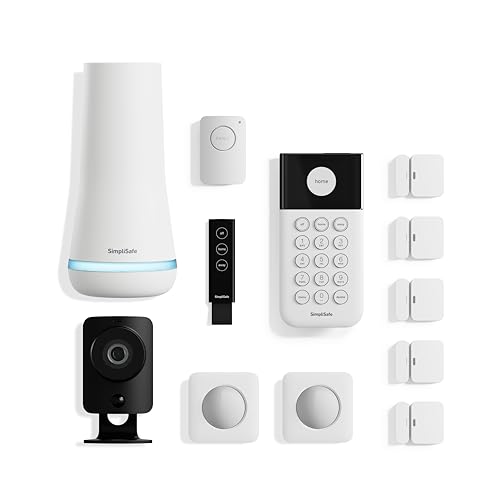
SimpliSafe Home Security
SimpliSafe is the system I would point most people to first, and it earns that for a simple reason: the base station keeps protecting your home even if your Wi-Fi goes down or someone deliberately cuts your internet line. That single piece of resilience is what separates a real alarm from a smart-home gadget, and SimpliSafe gets it right. The sensors are among the more reliable in this group, the app gives you complete control of the system with live camera feeds and quick arming, and setup uses a peel-and-stick approach that does not require drilling or wiring.
The monitoring story is the other reason it leads. SimpliSafe sells professional monitoring month to month with no long-term commitment, and the kit includes one free month so you can confirm the police-response workflow actually fits your home before you pay for it. You get protection for entry points like doors and windows plus motion coverage that can blanket a whole room, which is the right shape of coverage for most houses and apartments.
The honest trade-off is that SimpliSafe’s best features sit behind that monitoring subscription. Without an active plan you still get local siren and app alerts, but you lose the professional dispatch and some camera functions that make the system feel complete, so the sticker on the hardware is not the whole cost. It is also a closed ecosystem, so if you are heavily invested in third-party smart home platforms, SimpliSafe will not integrate as deeply as some rivals here.
Ring Alarm Pro 8-Piece
The Ring Alarm Pro 8-Piece is the system to buy if your home already runs on Amazon Alexa and Ring devices, because it folds your security into an ecosystem you are likely already using. The standout is that the Alarm Pro Base Station doubles as a built-in Eero Wi-Fi 6 router, so a single box handles both your internet and your alarm and helps keep your other devices connected with reliable speeds. For a household tired of stacking separate hardware, that dual function is genuinely useful.
The 8-piece kit is well chosen for a typical home: it includes one Alarm Pro Base Station, one keypad, a motion sensor, multiple door and window contact sensors, and a range extender to reach the far corners of the house. Installation is designed to be painless, with everything needed in the box and a plug-in setup, and the system ties cleanly into Ring cameras, video doorbells, and smart lights so alarms and footage live in one app.
The trade-off is that the features people buy this for, professional monitoring and offline cellular backup, require a separate Ring Protect subscription that is sold on top of the hardware. Lean on Ring’s whole stack and you are committing to Amazon’s ecosystem and its privacy posture, which not every buyer is comfortable with. The router-plus-alarm combo is convenient, but it also means a single device now sits at the center of both your network and your security, which some people will prefer to keep separate.
Abode Iota
The Abode Iota is the right call when your home runs on a mix of smart platforms instead of just one. It combines a hub, a camera, and a motion sensor into a single unit, which trims the upfront hardware cost and makes it a clean fit for smaller homes and apartments where you do not want a base station plus a separate camera plus separate sensors cluttering a shelf.
Its real strength is platform flexibility. The Iota works with Amazon Alexa, Google Assistant, and Apple HomeKit, and it speaks Z-Wave and Zigbee, so it can bring existing smart home devices under one roof rather than forcing you to pick a single ecosystem. For a household that has accumulated gadgets across different platforms over the years, that breadth is the feature that matters most, and few security units in this price tier match it.
The honest limitation is that an all-in-one unit is also a single point of coverage. Because the camera, motion sensor, and hub live in one device, your protection is concentrated wherever you place it, so larger homes will need to add separate door, window, and motion sensors to get full coverage, which erodes the cost advantage. As with the others, the most useful monitoring and recording features depend on a paid plan, so budget for the subscription, not just the hub.
ADT Blue by ADT
ADT Blue is the pick if you want the option of a professional installer without giving up the choice to do it yourself. It is ADT’s self-install line, so you can mount the kit using the app, with sensors that go up using screws or double-sided adhesive and no tools required, or you can pay for a professional installation visit if you would rather hand off the work. That flexibility bridges the gap between a pure DIY kit and ADT’s traditional full-service install.
The hardware is solid and the ecosystem is mature. Entry sensors pair with the ADT Blu Base for monitoring, you can expand coverage by adding wireless door and window sensors to protect more entry points instantly, and each sensor is tamper-aware, notifying you through the ADT+ app if someone tries to interfere with it. There is even a convenience mode that lets you repurpose a sensor to watch a drawer or cabinet rather than just a door. Behind all of that sits ADT’s long-established monitoring infrastructure with redundant monitoring centers.
The trade-off is that ADT Blue’s strengths really come alive once you commit to ADT’s professional monitoring, and ADT’s plans and terms tend to be less flexible than the month-to-month, no-contract approach that defines the rest of this list. You are buying into a larger company and its service structure, which brings reliability but less of the lock-in-free freedom that a renter or a budget-focused buyer might want. Read the monitoring terms carefully before you commit.
Cove Home Security
Cove is the system to choose when monitoring cost is your deciding factor. It offers professional monitoring at a monthly rate that comes in lower than most competitors here, and it does that without obviously cutting the quality of the dispatch service, which is the rare combination that makes a budget pick worth recommending rather than just cheap.
The system is fully DIY and built to be approachable. The touchscreen control panel is intuitive, the sensors are designed for straightforward placement, and the kit is ready to protect right out of the box: plug it in, place the sensors, and arm it. Crucially, the sensors are cellular-connected, so the system stays active even if your home internet goes down, which is the same outage resilience that makes SimpliSafe worth trusting. Cove also includes a long free trial of professional monitoring, so you can confirm the police-response flow before paying.
The honest limitation is that Cove leans hard on its monitoring relationship: the low monthly price is the headline, but the system is built around having a plan rather than running purely self-monitored, so the value case weakens if you intend to skip professional monitoring entirely. It is also a more self-contained platform, so if deep third-party smart home integration is a priority, Cove is not where it shines; it is where you go to keep ongoing costs down without sacrificing reliable monitoring.
What to look for
Before you buy any home security system, weigh it against the factors that actually determine whether you will trust it a year from now.
- Outage resilience: Make sure the base station keeps working through a Wi-Fi or power loss, ideally with cellular backup, so cutting your internet does not disarm your home.
- Monitoring terms: Prefer month-to-month, no-contract monitoring with a free trial so you can leave if the service disappoints, and read the fine print before committing.
- Sensor coverage: Confirm the kit covers your real entry points (doors and windows) plus motion in key rooms, and that you can add sensors as your needs grow.
- Ecosystem fit: Match the system to the smart home platform you already use, whether that is Alexa, Google Assistant, or Apple HomeKit, to avoid juggling extra apps.
- Installation effort: Decide whether you want peel-and-stick DIY simplicity or the option of a professional installer, and pick a system that supports your choice.
- True cost: Factor in the monitoring subscription, not just the hardware, since most of these systems gate their best features behind a paid plan.
The verdict
For most households, SimpliSafe Home Security is the system I would buy: reliable sensors, a base station that survives an internet outage, and month-to-month monitoring with no contract. If your home already runs on Alexa and Ring devices, the Ring Alarm Pro 8-Piece is the smarter fit, and its built-in Eero Wi-Fi 6 router earns its keep. The Abode Iota is the answer for mixed smart home setups thanks to its support for Alexa, Google Assistant, HomeKit, Z-Wave, and Zigbee in one compact unit.
If you want a respected name with the option of professional installation, ADT Blue by ADT delivers established monitoring and easy expansion, just expect less contract flexibility. And if keeping the monthly cost down is what matters most, Cove Home Security gives you cellular-connected reliability at a lower monitoring price than the rest. Pick the one that matches your ecosystem, your budget, and how much installation work you want to do, and you will end up with a system you actually keep armed.
Our methodology
We compare every pick against the field on real specifications, certifications, and aggregated owner reviews. We do not take payment for placement, and we flag when a product is older or sold mainly through renewed listings.
Side by side
The full reviews
SimpliSafe Home Security -- Best No-Contract System
SimpliSafe dominates the no-contract category for good reason. The sensors are among the most reliable on the market, the base station works even if your Wi-Fi goes down or someone cuts your internet, and monitoring starts at per month with no long-term commitment. The app is clean and responsive, with live camera feeds and easy arming controls. Setup uses a peel-and-stick sensor system that works in apartments and rental properties without drilling. SimpliSafe now includes 24/7 professional monitoring with live guard dispatch as an upgrade option, bridging the gap between DIY and full-service monitoring.
In its favor
- Simple to set up. Seriously secure
- 1 FREE month of professional monitoring for fast police response when you need it most. Wi
- Complete control of your system with the SimpliSafe App
- Protection for entry points
- Blanket a whole room

Ring Alarm Pro 8-Piece -- Best for Smart Home Integration
Ring Alarm integrates tightly with Amazon Alexa and the broader Ring ecosystem of cameras, video doorbells, and smart lights. The Ring Alarm Pro base station doubles as an Eero Wi-Fi 6 router, which is a useful dual function for households looking to combine their internet and security hardware. The 8-piece kit includes a base, keypad, motion sensor, door sensors, and a range extender. Ring Protect Plus monitoring runs per month or per year and covers your entire home including all Ring cameras. For Amazon Echo households already using Ring cameras, this system unifies everything cleanly.
In its favor
- Ring’s best home security system with built-in eero Wi-Fi 6 router to help protect against
- Customizable home protection. This kit includes one Alarm Pro Base Station, one Keypad, fo
- Fast and secure internet. Helps keep your devices connected with reliable wifi with speeds
- Easy installation. Everything you need for installation is in the box. Simply plug-in the
- More peace of mind. Subscribe to a compatible Ring Protect Plan (sold separately) to Arm y

Abode Iota -- Best Flexibility for Smart Platforms
The Abode Iota is a single-unit hub, camera, and motion sensor combined, which reduces upfront cost while still providing solid coverage for smaller homes and apartments. Its standout feature is platform flexibility: it works with Amazon Alexa, Google Assistant, Apple HomeKit, and Z-Wave and Zigbee smart home devices. This makes it the right choice for households with mixed smart home ecosystems that need a security system to integrate rather than compete with existing devices. Self-monitoring is free, and professional monitoring is available without a contract per month.

ADT Blue by ADT -- Best for Professional Installation Option
ADT Blue is ADT's self-install line, bridging the gap between fully DIY systems and ADT's traditional professional-install service. You can install it yourself using the app or pay for a professional installation visit. The hardware is solid, cameras are 1080p with color night vision, and ADT's monitoring infrastructure is one of the most established in the industry with multiple redundant monitoring centers. ADT's brand recognition also has a deterrence effect, as their yard signs and window stickers are widely recognized. Professional monitoring plans are available with month-to-month options.
In its favor
- Works with ADT Blu system and professional monitoring: pair with your ADT Blu Base for int
- Protect 4 more entry points instantly: expand your ADT Blu system with 4 wireless door/win
- Tamper-proof with built-in alerts: each entry sensor notifies you through the ADT+ app if
- Convenience mode for drawers and cabinets: set any sensor to convenience mode to monitor m
- Easy DIY installation with no tools required: mount with screws or double-sided adhesive t
Cove Home Security -- Best Monitoring Price
Cove offers professional monitoring at per month, which is lower than most competitors without cutting the quality of the monitoring service. Sensors are cellular-connected, meaning the system remains active if your internet goes down. The touchscreen control panel is intuitive, and the system is fully DIY with sensors designed for straightforward placement. Cove includes a 60-day free trial of professional monitoring before you commit to a plan. For price-conscious buyers who want real professional monitoring rather than self-monitoring, Cove offers the best monthly cost among reliable systems currently available.
In its favor
- Simple to set up. Seriously secure. Get ready to protect right out of the box. Just plug i
- 1 FREE month of professional monitoring for fast police response when you need it most. Wi
- Complete control of your system with the SimpliSafe App
- See what's happening inside
- Faster police response
What matters most
What to consider
Start by deciding whether you want professional monitoring. If yes, compare monthly costs and contract terms carefully as they vary significantly. Next, assess how many entry points (doors, windows, garage) need sensors and whether cameras are a priority. For renters, prioritize wireless peel-and-stick systems that leave no damage when removed. Cellular backup (works without Wi-Fi) is worth paying for if your internet reliability is inconsistent or if a potential intruder might cut your connection. Check whether the system integrates with your existing smart home platform if you use one.
What to consider
For related smart home security upgrades, the [best video doorbells](/articles/best-video-doorbells) guide covers entry-point monitoring specifically. If you want to expand indoor camera coverage, the [best indoor security cameras](/articles/best-indoor-security-cameras) has current recommendations. Our complete evaluation methodology is explained on the [methodology page](/methodology).
Frequently asked
Professional monitoring provides 24/7 dispatch if an alarm triggers while you are unavailable, asleep, or unreachable. Self-monitoring sends alerts to your phone, but relies on you being available to respond and contact emergency services yourself. Professional monitoring typically costs to per month. For most households, the added response reliability is worth the subscription cost, particularly for areas with slower emergency response times.
DIY systems like SimpliSafe and Ring Alarm use peel-and-stick sensors and app-guided setup that most homeowners complete in under two hours without tools. Professional installation is used by ADT and similar providers and typically costs to upfront. DIY is significantly cheaper and increasingly reliable. Professional installation may make sense for complex setups with hardwired cameras or older homes where wireless signal penetration is a concern.
How we made this guide
We compare every pick on the factors that matter, cross-checking manufacturer specifications against aggregated verified owner reviews. We rank independently and never take payment for placement. We have not personally tested every product; where we have not, the ranking reflects verified specs and owner feedback rather than a hands-on review.
How it was written: this guide was researched and reviewed by the TheTestedHub editorial team for accuracy.
Affiliate disclosure: TheTestedHub is reader-supported. When you buy through links on our site, we may earn a commission at no extra cost to you.