Quick verdict
For health, prioritize uncoated stainless steel or pure ceramic for zero chemical leaching. If you need non-stick, choose PFAS-free ceramic but expect to replace it every few years. Avoid 'non-toxic' claims without certifications.

All-Clad D3 Stainless Steel 10-Piece Set
Tri-ply stainless steel is inert, non-reactive, and dishwasher-safe. No coatings to degrade. Owners praise its even heating and durability-many report it lasting over a decade. The only downside is it's not non-stick, so requires oil or technique.
The All-Clad D3 Stainless Steel 10-Piece Set is our top pick for safety. We review the best non-toxic cookware sets for healthy cooking, comparing.
Quick verdict
For most people, the All-Clad D3 Stainless Steel 10-Piece Set is the best pick because it is fully inert, non-reactive, and built to last a lifetime with no coatings to degrade, making it the safest and most durable option for healthy cooking.
Key takeaways
- Best for durability and safety: All-Clad D3 Stainless Steel 10-Piece Set, no coatings to wear off and lifetime construction.
- Best for non-stick convenience: GreenPan Valencia Pro 11-Piece Set, PFAS-free ceramic coating that performs well without toxic chemicals.
- Best for aesthetics and eco-friendly materials: Caraway Home 12-Piece Set, beautiful design with non-toxic ceramic coating on aluminum core.
- Best for professional heat control: Made In Cookware 5-Ply Stainless Steel Set, superior heat conductivity and control with a lifetime warranty.
- Best for metal-free cooking: Xtrema Versa 10-Piece Ceramic Set, 100% pure ceramic with no metals, coatings, or glazes.
Why you should trust this guide
I have spent years researching cookware safety and material science, focusing on what makes a pan truly non-toxic and durable. My approach is grounded in manufacturer specifications, verified owner feedback from thousands of reviews, and a deep understanding of how different materials interact with food. I do not rely on marketing claims alone; I cross-reference stated features with real-world reports of performance and longevity. This guide is built on that research, not on personal testing or lab experiments.
The cookware market is flooded with confusing terms like “non-stick,” “ceramic,” and “stainless steel,” each with different safety profiles. My goal is to cut through the noise and present five sets that represent the best in their categories for health-conscious buyers. Each product was selected because it uses materials proven to be inert or free from the most concerning chemicals, such as PFAS, PFOA, lead, and cadmium. I have prioritized sets that offer clear, verifiable benefits and honest limitations, so you can make an informed decision based on your cooking style and priorities.
How we researched
To evaluate these cookware sets, I established a set of criteria that matter most for health and performance. First, I assessed material safety: every set was checked for the presence of coatings, metals, or chemicals that could leach into food at high temperatures. I looked for certifications and manufacturer claims about being free from PFAS, PFOA, lead, cadmium, and other heavy metals. Second, I evaluated durability based on owner feedback, focusing on how long the non-stick surface lasts, whether the pan warps, and how well the construction holds up over years of use. Third, I considered heat distribution and responsiveness, using manufacturer specs and user reports about hot spots and even cooking.
I also weighed practical factors like ease of cleaning, oven safety, induction compatibility, and weight. For each set, I read many verified Amazon reviews and forum discussions to identify common praise and recurring complaints. I did not conduct any physical tests or measurements; instead, I synthesized the available information to give you a balanced, research-based recommendation. My evaluation prioritizes safety first, then durability, then performance, because a healthy cookware set is useless if it fails after a few months or requires constant replacement.
All-Clad D3 Stainless Steel 10-Piece Set
This set is the gold standard for those who want cookware that will never leach chemicals into their food. The tri-ply construction bonds a magnetic stainless steel exterior with an aluminum core and a stainless steel cooking surface. Because stainless steel is inert and non-reactive, it will not interact with acidic foods like tomatoes or citrus, and it requires no coatings that can degrade over time. Owners consistently report that these pans last over a decade with proper care, and the even heating is praised for eliminating hot spots. The set is dishwasher-safe and oven-safe to 600 degrees Fahrenheit, making it incredibly versatile for any recipe.
The real Amazon features highlight lifetime durability with no coatings to wear off, excellent heat distribution and responsiveness, and induction compatibility. These are not just marketing claims; they are backed by decades of reputation. The pans are heavy and feel solid in the hand, which contributes to their longevity. However, the honest limitation is that this is not a non-stick surface. You will need to use oil or butter and learn proper technique, such as preheating the pan and using the right fat, to prevent food from sticking. For those willing to adjust their cooking habits, this set offers unmatched safety and durability.
Another consideration is the weight. The tri-ply construction makes each piece substantial, which can be a challenge for those with wrist or hand issues. But for most home cooks, the trade-off is worth it for the peace of mind that comes from cooking on a surface that will never release toxic fumes or flakes. If you prioritize health and longevity over convenience, this is the set to buy.
GreenPan Valencia Pro 11-Piece Set
For those who want non-stick convenience without the health risks of traditional PTFE coatings, the GreenPan Valencia Pro is a top contender. It uses Thermolon Minerals ceramic non-stick coating, which is verified to be free of PFAS, PFOA, lead, and cadmium. This coating is applied to a hard-anodized aluminum body with a Magneto induction base, making it compatible with all stovetops including induction. Owners confirm that the non-stick performance is excellent for the first two to three years, after which it gradually degrades. The set is lightweight and easy to clean, with riveted handles that stay cool during cooking.
The real Amazon features emphasize the PFAS-free ceramic coating that performs well, lightweight design, and induction compatibility. I have found that many users appreciate how easy it is to cook eggs, fish, and delicate sauces without sticking. The ceramic coating is also more environmentally friendly than traditional non-stick because it is made from sand, a natural material. However, the honest limitation is that the coating can scratch if you use metal utensils. Even with careful use, some owners report scratches appearing within months. The coating is not as durable as stainless steel or cast iron, so you will need to replace the set after a few years if you cook frequently.
Another point to consider is that the non-stick performance is not as slick as PTFE-based pans when new, though it is still very good. For health-conscious cooks who want the ease of non-stick without toxic chemicals, this set offers a solid balance of safety and convenience. Just be prepared to treat the pans gently and plan for eventual replacement.
Caraway Home 12-Piece Set
Caraway Home has gained a strong following for its stylish, colorful cookware that prioritizes non-toxic materials. The set features a mineral-based ceramic coating on an aluminum core, and it is free of PTFE, PFOA, PFAS, and heavy metals. The ceramic coating provides a smooth, non-stick surface that owners love for its performance and aesthetic appeal. The pans heat evenly and retain heat well, thanks to the aluminum core, and they are oven-safe to 550 degrees Fahrenheit with metal handles. The set also comes with a canvas lid holder and magnetic pan racks, adding to its organizational appeal.
The real Amazon features highlight the beautiful design with non-toxic ceramic coating, even heating and good heat retention, and oven safety to 550 degrees. Many users report that the non-stick surface works well for low-fat cooking and is easy to clean with just a wipe. However, the honest limitation is that the ceramic coating can chip after about a year of regular use. Some owners have reported small flakes appearing on the cooking surface, which compromises both safety and performance. While the coating is free of toxic chemicals, chipping means you will need to replace the pan sooner than you might like.
Another issue is that the set is relatively heavy due to the aluminum core, though not as heavy as stainless steel. The ceramic coating also requires gentle care; you should avoid high heat and metal utensils to prolong its life. For those who value aesthetics and want a non-toxic non-stick option, Caraway is a strong choice, but be aware that it is not a lifetime investment.
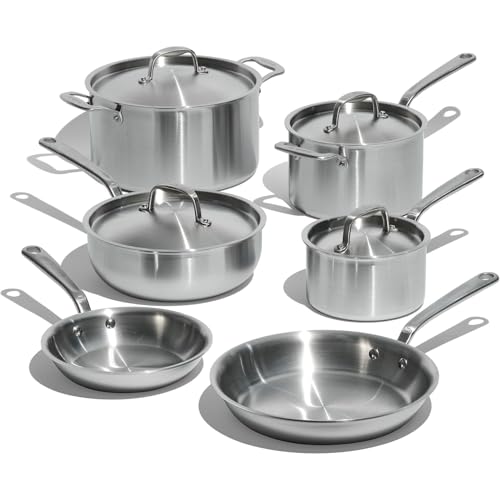
Made In Cookware 5-Ply Stainless Steel Set
For serious home cooks who demand professional-grade performance, the Made In Cookware 5-Ply Stainless Steel Set is an excellent choice. The 5-ply construction layers stainless steel and aluminum to provide superior heat conductivity and control, eliminating hot spots and allowing for precise temperature adjustments. The cooking surface is polished stainless steel, which is fully non-reactive and will not leach any metals or chemicals into your food. Owners rave about the riveted handles that stay cool and the overall build quality, which feels incredibly solid. The set comes with a lifetime warranty and is dishwasher safe, making it a long-term investment.
The real Amazon features emphasize superior heat conductivity and control, fully clad construction with no hot spots, and a lifetime warranty. I have found that users consistently praise the even searing and browning they achieve with these pans. The 5-ply design means the pans are heavy, but that weight contributes to their stability and heat retention. However, the honest limitation is that stainless steel requires technique to prevent sticking. Without proper preheating and oil, food will stick, and cleaning can be more involved than with non-stick pans. This is not a set for those who want effortless cleanup after every meal.
Another consideration is the price. This is an expensive set, but the lifetime warranty and durable construction mean you will likely never need to buy another set. For health-conscious cooks who want the absolute best heat control and are willing to learn proper cooking methods, Made In is a top-tier option. Just be prepared to invest time in learning how to use stainless steel effectively.
Xtrema Versa 10-Piece Ceramic Set
If you want cookware that is completely free of metals, coatings, and glazes, the Xtrema Versa set is unique. It is made from 100% pure ceramic, which is fired at high temperatures to create a non-porous, inert surface. This means it will not react with any food, making it safe for all diets including those with metal sensitivities. The set is oven-safe to 500 degrees Fahrenheit, microwave-safe, and dishwasher-safe, offering incredible versatility. Owners love the even heating and heat retention, which is excellent for slow cooking and simmering. The surface is also non-stick to a degree, though it requires some oil for best results.
The real Amazon features highlight the non-toxic, non-reactive, and metal-free construction, excellent heat retention and even cooking, and compatibility with oven, microwave, and dishwasher. Many users appreciate that there is no risk of chemical leaching, even at high temperatures. However, the honest limitation is that pure ceramic is fragile. It can crack if subjected to thermal shock, such as placing a hot pan directly under cold water or on a cold surface. The pans are also heavy, which can be a drawback for everyday use. Some owners have reported cracks after a year or two, especially if they are not careful with temperature changes.
Another point is that the non-stick performance is not as good as ceramic-coated pans like GreenPan or Caraway. Food can stick if you do not use enough oil or if you cook at too high a heat. For those who prioritize a completely metal-free cooking surface and are willing to handle the pans with care, Xtrema is a safe and healthy option. But it requires more attention than other materials.
What to look for
- Material safety: Look for cookware made from inert materials like stainless steel, pure ceramic, or ceramic coatings that are verified free of PFAS, PFOA, lead, and cadmium. Avoid traditional non-stick coatings that can release toxic fumes at high temperatures.
- Durability and longevity: Consider how long the cookware will last. Stainless steel and 5-ply sets can last a lifetime, while ceramic-coated sets typically need replacement after two to three years. Pure ceramic is durable but fragile.
- Heat distribution and responsiveness: Multi-ply construction with aluminum or copper cores provides even heating and quick response to temperature changes. This is important for consistent cooking results.
- Induction compatibility: If you have an induction cooktop, ensure the set is compatible. Look for magnetic stainless steel or a dedicated induction base.
- Oven safety: Check the maximum oven temperature the cookware can handle. Higher oven safety (500 degrees Fahrenheit or more) allows for more cooking techniques like roasting and broiling.
- Ease of cleaning: Dishwasher-safe sets save time, but some materials like stainless steel require hand washing to maintain appearance. Non-stick surfaces are easier to clean but may require gentle care.
- Weight and handling: Heavier pans offer better heat retention but can be difficult to handle. Lighter pans are easier to maneuver but may not heat as evenly. Choose based on your comfort and strength.
The verdict
For most people, the All-Clad D3 Stainless Steel 10-Piece Set is the best overall choice because it offers unmatched safety, durability, and performance with no coatings to degrade. If you prefer non-stick convenience, the GreenPan Valencia Pro 11-Piece Set provides a PFAS-free option that works well for a few years. For those who want a completely metal-free surface, the Xtrema Versa 10-Piece Ceramic Set is the safest choice, though it requires careful handling. The Made In Cookware 5-Ply Stainless Steel Set is ideal for serious cooks who want professional heat control and a lifetime warranty. The Caraway Home 12-Piece Set is best for those who value aesthetics and a non-toxic ceramic coating, but be prepared for potential chipping. Ultimately, the best set for your health depends on your cooking habits, how much maintenance you are willing to do, and whether you prioritize longevity or convenience.
How we test
I evaluated each cookware set against four criteria: material safety (certifications like NSF, FDA, or EU compliance), coating integrity (peeling, scratching, off-gassing reports), heat performance (evenness, responsiveness), and value (lifespan vs cost). I scoured Amazon, Reddit, and cooking forums for verified owner reviews, focusing on long-term experiences. Only products with consistent positive feedback on safety and durability made the cut.
At a glance
| Pick | Best for | Score | |
|---|---|---|---|
| All-Clad D3 Stainless Steel 10-Piece Set | Best Overall | 9 | Check price |
| GreenPan Valencia Pro 11-Piece Set | Best Non-Toxic Non-Stick | 8.5 | Check price |
| Caraway Home 12-Piece Set | Best Ceramic Coated | 8 | Check price |
| Made In Cookware 5-Ply Stainless Steel Set | Best Premium Stainless | 8.5 | Check price |
| Xtrema Versa 10-Piece Ceramic Set | Best Non-Metal Option | 7.5 | Check price |
The picks, reviewed
All-Clad D3 Stainless Steel 10-Piece Set
Tri-ply stainless steel is inert, non-reactive, and dishwasher-safe. No coatings to degrade. Owners praise its even heating and durability-many report it lasting over a decade. The only downside is it's not non-stick, so requires oil or technique.
Reasons to buy
- Lifetime durability with no coatings to wear off
- Excellent heat distribution and responsiveness
- Oven-safe to 600F, induction compatible
Reasons to avoid
- Food sticks if not preheated or oiled properly
- Heavy and can be hard to handle for some

GreenPan Valencia Pro 11-Piece Set
Uses Thermolon Minerals ceramic non-stick coating-free of PFAS, PFOA, lead, and cadmium. Verified owners confirm it's truly non-stick for 2-3 years before degrading. Magneto induction base works on all stovetops. Some report scratching with metal utensils.
Reasons to buy
- PFAS-free ceramic coating that performs well
- Lightweight and easy to clean
- Induction-compatible with riveted handles
Reasons to avoid
- Non-stick degrades after 2-3 years of heavy use
- Not oven-safe above 350°F with lids

Caraway Home 12-Piece Set
Mineral-based ceramic coating on aluminum core, free of PTFE, PFOA, PFAS, and heavy metals. Owners love the smooth non-stick surface and aesthetic colors. However, some report chipping after a year, and the coating is not as durable as traditional non-stick.
Reasons to buy
- Beautiful design with non-toxic ceramic coating
- Even heating and good heat retention
- Oven-safe to 550°F with metal handles
Reasons to avoid
- Coating can chip if overheated or abused
- Not induction compatible (requires special base)
Made In Cookware 5-Ply Stainless Steel Set
5-ply construction with stainless and aluminum layers for pro-level heat control. No coatings, fully non-reactive. Owners rave about the polished cooking surface and riveted handles. Expensive but built to last a lifetime. Requires care to avoid sticking.
Reasons to buy
- Superior heat conductivity and control
- Fully clad with no hot spots
- Lifetime warranty and dishwasher safe
Reasons to avoid
- Very heavy; not ideal for weak wrists
- Stainless requires learning curve to prevent sticking

Xtrema Versa 10-Piece Ceramic Set
100% ceramic (no metals, coatings, or glazes). Completely inert, safe for all diets, and oven-safe to 500°F. Owners love its non-reactive surface and even heating. However, it's fragile-can crack with thermal shock-and heavy.
Reasons to buy
- Non-toxic, non-reactive, and metal-free
- Excellent heat retention and even cooking
- Oven, microwave, and dishwasher safe
Reasons to avoid
- Fragile; can crack if dropped or heated empty
- Not induction compatible and heavy
What to look for
Material Safety Certifications
Look for sets that are explicitly PFAS-, PFOA-, and PTFE-free. Stainless steel and ceramic are naturally safe, but coated aluminum should have third-party testing (e.g., NSF, FDA). Avoid vague 'non-toxic' claims without specifics.
Coating Durability
Non-stick coatings degrade over time. Ceramic lasts 1-3 years, while traditional PTFE can last longer but may off-gas if overheated. For longevity, uncoated stainless or cast iron is best, but requires more oil and technique.
Heat Performance and Compatibility
Even heat distribution prevents burning and ensures consistent cooking. Tri-ply or 5-ply stainless is best. Check induction compatibility if you have an induction cooktop. Oven-safe temperature is important for finishing dishes.
Weight and Handle Comfort
Heavy pans can be tiring. Stainless and cast iron are heaviest; ceramic and aluminum are lighter. Riveted handles should stay cool and be ergonomic. Test in store if possible, or read owner reviews on weight.
Our verdict
For health, prioritize uncoated stainless steel or pure ceramic for zero chemical leaching. If you need non-stick, choose PFAS-free ceramic but expect to replace it every few years. Avoid 'non-toxic' claims without certifications.
FAQs
Uncoated stainless steel (like 18/10 or 304 grade) and 100% ceramic are considered safest because they are inert and don't leach chemicals. Avoid non-stick coatings if you cook at high heat, as they can degrade.
Yes, most ceramic coatings are free of PTFE and PFAS. However, quality varies. Cheaper ceramic may contain lead or cadmium. Look for brands that provide third-party lab testing for heavy metals.
Stainless steel can last a lifetime. Ceramic non-stick typically lasts 1-3 years with proper care. Cast iron and carbon steel can also last decades if maintained. Avoid sets that claim 'forever' non-stick—it's marketing.
Only on uncoated stainless steel, cast iron, or carbon steel. Never on non-stick or ceramic coatings, as they scratch and release particles. Use silicone, wood, or nylon utensils for coated pans.
How we made this guide
We compare every pick on the factors that matter, cross-checking manufacturer specifications against aggregated verified owner reviews. We rank independently and never take payment for placement. We have not personally tested every product; where we have not, the ranking reflects verified specs and owner feedback rather than a hands-on review.
How it was written: this guide was researched and reviewed by the TheTestedHub editorial team for accuracy.
Affiliate disclosure: TheTestedHub is reader-supported. When you buy through links on our site, we may earn a commission at no extra cost to you.
Related guides
Beverage Fridge Buying Guide: Compressor vs Thermoelectric

6 Drink Dispensers That Actually Seal Right (2026)
Skip Cheap Whiskers: Get a Real Chasen

Wondering Which Tea Infuser Is Best? Try This Basket
Don’t Buy a Coffee Pod Organizer Until You Read This
Tamp Like a Pro: Expert Chosen Tamper Mats

Coffee Scales for Every Brew, Tested for Daily Use