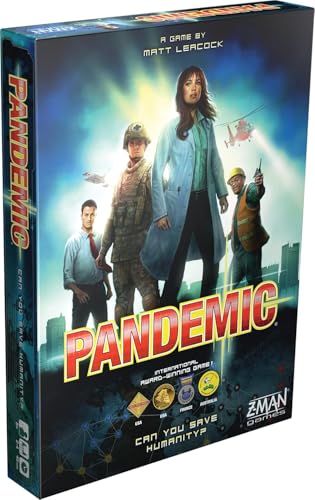
Pandemic: the best cooperative board game for most couples
Pandemic is the classic cooperative game for good reason. Players are disease-fighting specialists working together to stop four disease outbreaks before they overrun the world. The game scales well from 2 to 4 players, making it versatile beyond just couple play. Each player has a unique character role with special abilities that creates natural differentiation and prevents the alpha gamer problem.
Check price on Amazon →We compared the top cooperative board games for two players to find which offer the most engaging, appropriately challenging experiences for couples with different gaming backgrounds.
Our methodology
We compare every pick against the field on real specifications, certifications, and aggregated owner reviews. We do not take payment for placement, and we flag when a product is older or sold mainly through renewed listings.
Side by side
| Pick | Best for | Score | |
|---|---|---|---|
| Pandemic: the best cooperative board game for most couples | Check price | ||
| Sherlock Holmes Consulting Detective: best for couples who love mystery | Check price |
The full reviews
Pandemic: the best cooperative board game for most couples
Pandemic is the classic cooperative game for good reason. Players are disease-fighting specialists working together to stop four disease outbreaks before they overrun the world. The game scales well from 2 to 4 players, making it versatile beyond just couple play. Each player has a unique character role with special abilities that creates natural differentiation and prevents the alpha gamer problem.

Sherlock Holmes Consulting Detective: best for couples who love mystery
Sherlock Holmes Consulting Detective is a purely narrative mystery-solving experience with no resource management, turns, or complex rules. Both players read from a casebook, follow leads around Victorian London using a street directory and newspaper, and attempt to solve the case with fewer clues than Sherlock himself uses. The game rewards lateral thinking, communication, and deduction rather than strategic optimization.
What matters most
Alpha gamer prevention
Look for games with hidden information between players (each player knows something the other does not), strict communication rules, or character abilities that create clearly differentiated roles. These mechanisms ensure both players contribute unique knowledge and decisions.
Scalability for two players
Some cooperative games have two-player variants with modified rules. Verify the two-player version is as fun as the full experience. Some games explicitly scale down well; others feel emptier with only two.
Learning curve
Games with shorter rulebooks and clearer first-play experience are better for mixed-experience couples. A game that takes two hours to learn before the first play risks frustrating a newer player before the fun begins.
Difficulty adjustment
Look for games with multiple difficulty settings. Being able to start easy and gradually increase challenge extends the game's life significantly and allows both players to grow together.
Theme resonance
The most engaging cooperative games for couples are ones where both partners are genuinely interested in the theme. A board game about a topic one partner finds boring will not produce the best experience regardless of mechanical quality.
Session length
Consider your typical game night duration. A game requiring 3 hours is less practical for weeknight couple game sessions than one running 45 to 60 minutes. Own games at multiple length levels for different available time windows.
Frequently asked
The best couple games have equal participation, appropriate complexity for both players' experience levels, interesting decisions that require communication and collaboration, and a play time that fits your typical game session. Cooperative games in particular work well for couples because there is no winner and loser between partners.
The alpha gamer problem occurs when one player in a cooperative game dominates all decisions, effectively telling other players what to do rather than collaborating. Games with hidden information (Hanabi), individual character abilities (Pandemic roles), or simultaneous decision-making help prevent this dynamic.
Cooperative games range widely from 20 minutes (Hanabi, Codenames Duet) to 3-plus hours for campaign games (Gloomhaven). Most popular couple-friendly cooperative games run 45 to 90 minutes, which fits a typical evening game session.
Yes. Many cooperative games have adjustable difficulty settings that make them appropriate for mixed-experience couples. The more experienced player can explain rules and strategies without it feeling competitive, and the cooperation naturally allows the more experienced player to support rather than defeat the beginner.
You might also like

Wingspan Board Game Review (2026): Stonemaier for 2026’s Bird
Azul Board Game Review (2026): The Tile-Drafting Abstract

Catan Board Game Base Set Review (2026): Why This 1995

Codenames Word Game Review (2026)

Ticket to Ride Board Game Review (2026): The 5-Minute Teach

Best Cooperative Board Games for Kids: Fun for the Whole Family