Quick verdict
The DEWALT DCD771C2 is the right home drill kit for most buyers. trusted brand, complete kit, capable performance, and good warranty. Ryobi is the right choice if you want to grow a home tool ecosystem. The Bosch PS31 is the pick for users who want the lightest option. Any of these four choices will serve a homeowner reliably for 5-10 years of home project use.

DEWALT DCD771C2: Best Overall Home Drill Kit
The DCD771C2 is the best-selling cordless drill kit for good reason. The price is accessible, the kit is complete, and DEWALT's brand reputation means the drill works, the batteries are reliable, and when something goes wrong there's a service center nearby. The two included 1.3 Ah batteries are compact and charge in under an hour.
Check price on Amazon →300 UWO of reliable power. The DEWALT DCD771C2 tops our home-use drill guide for its fast-charging kit and complete accessory set.
Quick verdict
The DEWALT DCD771C2 is the best cordless drill for most home use. It is the best-selling kit for a reason: an accessible price, a complete 100-piece accessory set, two compact 1.3 Ah batteries that charge in under an hour, and a brand reputation that means parts and service are easy to find when you need them.
Key takeaways
- Best overall home drill kit: DEWALT DCD771C2, complete kit, fast-charging batteries, and dependable 300 UWO motor.
- Best for a home ecosystem: Ryobi PCL210K1, the entry point into the 175-plus-tool ONE+ battery platform.
- Best lightweight kit: Bosch PS31-2A, the lightest 12V Max kit here for users who find 18V drills heavy.
- Best budget home drill: BLACK+DECKER BDCD220C, the lowest cost of entry into a 20V MAX-compatible platform.
Why you should trust this guide
I built this guide around one question that most homeowners actually ask: which cordless drill will hang a shelf, assemble flat-pack furniture, and drive a few deck screws without becoming a frustration or a money pit. I did not chase the most powerful brushless professional drills, because the people reading this are not framing houses. I focused on complete kits that ship with a battery and charger, because a bare-tool drill is useless to someone who owns no batteries yet.
To keep this honest, I treated every performance number as the manufacturer’s stated specification rather than something I personally clocked on a bench. When DEWALT rates the DCD771C2 motor at 300 unit watts out, I report it as a rating, not a measurement. The four drills here were chosen because each one represents a clear, distinct reason to buy: best all-rounder, best ecosystem, best lightweight, and best budget. If a drill did not earn one of those slots, it is not in this guide.
How we researched
My evaluation approach for a home-use drill weighs four things: completeness of the kit, weight and comfort for occasional users, the realistic ceiling of what the drill can handle, and the long-term value of its battery platform. A drill that is cheap up front but locks you into a dead-end battery system can cost more over five years than a slightly pricier kit that shares batteries with tools you will buy later. I weighed that ecosystem question heavily because it is the part most buyers overlook.
For each drill I read the manufacturer’s stated specifications (voltage class, torque or power rating, clutch settings, speed ranges, and included accessories) and cross-checked them against what the drill is genuinely suited to do at home. I deliberately separated marketing language from practical use. A 12V drill with a strong torque rating is still a 12V drill, and I say so. Where a kit includes a large accessory set, I note whether those bits are the kind you will actually reach for or filler that pads the piece count.
DEWALT DCD771C2: Best Overall Home Drill Kit
The DCD771C2 is the drill I would hand to almost any homeowner first. It is the best-selling cordless drill kit for a reason that has nothing to do with hype: the price is accessible, the kit is complete out of the box, and DEWALT’s reach means that if a battery fails or a part wears out, there is a service center nearby rather than a return-by-mail headache. That logistical safety net matters more than most spec sheets admit.
On paper the drill is compact and lightweight, and DEWALT designed the body to fit into tight areas, which is exactly where home jobs tend to live (inside cabinets, behind toilets, under sinks). The high-performance motor is rated at 300 unit watts out, which is plenty for driving screws and drilling into wood, drywall, and the occasional masonry pilot hole. The two included 1.3 Ah batteries are the quiet strength of this kit: they are small and light enough that the drill never feels nose-heavy, and they charge in under an hour, so you can rotate one on the charger while you work. The bundled 100-piece accessory set covers a real spread of common bits, including Impact Ready, Tough Case, and Pilot Point drive and drill sets.
The honest trade-off is those same 1.3 Ah batteries. They charge fast and keep the tool light, but they hold less energy than the 2.0 Ah or 4.0 Ah packs power users prefer, so on a long afternoon of continuous driving you will be swapping and recharging more often. The DCD771C2 is also a brushed-motor drill, not brushless, so it runs a little less efficiently and will not match a premium drill on the hardest, longest jobs. For home use, none of that is disqualifying, but if you expect heavy repeated work, plan to buy a larger battery later.
Ryobi PCL210K1: Best for Home Ecosystem
Buy the Ryobi PCL210K1 if you suspect this drill is only the first Ryobi tool you will own. The drill itself is capable and easy to use, but the real argument for it is the platform behind it. Ryobi’s ONE+ system is the largest battery-sharing ecosystem aimed squarely at homeowners, with over 175 tools running on the same battery.
That number is not a gimmick for the right buyer. If you can picture yourself adding a Ryobi jigsaw, a reciprocating saw, or a leaf blower over the next few years, starting here means every future tool can be the cheaper bare-tool version because you already own compatible batteries. Over time that compounds into real savings, and it spares you a drawer full of incompatible chargers. The PCL210 is the deliberate entry point into that system, so it is priced and specced to get you in the door rather than to impress on raw output.
The trade-off is that the entry-point positioning shows. This is not Ryobi’s most powerful drill, and the ONE+ ecosystem’s greatest strength is also a mild weakness: battery performance across such a huge, long-running platform varies, and the value only materializes if you actually buy into the system. If you are certain this will be your one and only cordless tool forever, you are paying for an ecosystem benefit you will never use, and one of the other drills here makes more sense.
Bosch PS31-2A: Best Lightweight Kit
Choose the Bosch PS31-2A if weight and fatigue are your real concern. This 12V Max kit is the lightest complete drill kit in this comparison, and for anyone who finds an 18V or 20V drill heavy or tiring to hold overhead, that difference is felt in the wrist within minutes. It is well-made, compact, and genuinely capable for the work most homes demand.
Bosch rates the PS31 at a maximum torque of 265 in.-lbs., which is respectable for its size, and pairs it with 20-plus-one clutch settings for precise torque control that helps prevent stripping screws. It has two speed settings (a lower range around 0 to 350 rpm for driving and a higher range for drilling) and a notably short 7-inch head length, so it slips into cabinets and corners a bigger drill cannot reach. A built-in LED light helps in the dark under-sink and closet spaces where home repairs happen. For screwdriving and drilling in wood and drywall, it is excellent.
The clear limitation is the 12V class itself. The lower voltage means the PS31 runs out of headroom faster on hard materials, thick lag screws, large hole saws, or masonry, where an 18V or 20V drill keeps going. This is a light-duty drill by design, and that is the point of choosing it. If your project list leans toward heavy or repetitive demanding work, the very thing that makes this kit comfortable also makes it the wrong tool.
BLACK+DECKER BDCD220C: Best Budget Home Drill
The BLACK+DECKER BDCD220C is the right pick when low cost of entry is the deciding factor. It is the entry-level starting point here, it ships with a 20V MAX lithium-ion battery included, and it handles light home tasks adequately. For occasional use or as a second drill to keep in a different part of the house, the value is clear.
The kit includes the 20V MAX lithium-ion drill plus 66 hand tools and accessories, which BLACK+DECKER positions as over 150 dollars of value, so a first-time homeowner gets a small starter tool collection alongside the drill. The 11-position clutch gives you enough control to avoid stripping screws and over-driving fasteners into softer materials, which is the most common beginner mistake. As an introduction to a 20V MAX-compatible battery platform, it lowers the barrier to getting started.
The honest caveat is that you get what you pay for. This is the least powerful and least refined drill in the group, built for light, intermittent jobs rather than sustained or demanding work, and the bundled hand tools are convenience-grade rather than heirloom quality. If you plan to use a drill regularly or push it into harder materials, you will likely outgrow the BDCD220C and want to step up to the DEWALT or a stronger 20V tool. For extremely occasional use, that ceiling may never bother you.
What to look for
Before you pick, weigh these factors against how you actually plan to use a drill at home.
- Complete kit, not bare tool: make sure a battery and charger are included, or the low price is an illusion.
- Battery platform: if you may add more cordless tools later, choose a system you can grow into, like DEWALT 20V MAX or Ryobi ONE+.
- Weight and balance: for overhead or long sessions, a lighter 12V drill like the Bosch is easier on your wrist than an 18V or 20V tool.
- Voltage class: 12V is fine for screws, wood, and drywall; step up to 18V or 20V for masonry, lag bolts, or hole saws.
- Clutch settings: more clutch positions (the Bosch has 20-plus-one, the BLACK+DECKER 11) mean finer control to avoid stripping screws.
- Battery capacity and charge time: small packs like DEWALT’s 1.3 Ah charge fast and stay light but need more frequent swaps on long jobs.
- Service and support: a brand with nearby service centers, like DEWALT, makes warranty and repair far less painful.
The verdict
For most homeowners the DEWALT DCD771C2 is the drill to buy: a complete kit, a capable 300 UWO motor, fast-charging batteries, and a support network that quietly removes most of the risk. If you expect to keep adding cordless tools, the Ryobi PCL210K1 and its 175-plus-tool ONE+ platform will save you money over the years, even if the drill itself is an entry-level performer. If weight matters most, the Bosch PS31-2A is the lightest, most comfortable kit here for screwdriving and light drilling, as long as you accept its 12V ceiling. And if you simply need the cheapest way into a 20V MAX-compatible platform for occasional jobs, the BLACK+DECKER BDCD220C delivers that at the lowest cost, with the understanding that you may outgrow it.
How we test
We compare every pick against the field on real specifications, certifications, and aggregated owner reviews. We do not take payment for placement, and we flag when a product is older or sold mainly through renewed listings.
At a glance
The picks, reviewed
DEWALT DCD771C2: Best Overall Home Drill Kit
The DCD771C2 is the best-selling cordless drill kit for good reason. The price is accessible, the kit is complete, and DEWALT's brand reputation means the drill works, the batteries are reliable, and when something goes wrong there's a service center nearby. The two included 1.3 Ah batteries are compact and charge in under an hour.
Reasons to buy
- DCD771C2 drill/driver is compact, lightweight and fits into tight areas
- Drill/driver high performance motor delivers 300 unit watts out (UWO) of power ability com
- 100-Piece accessory set features some of DEWALT's most popular bits that cover an array of
- Accessory set includes Impact Ready, Tough Case, and Pilot Point drive and drill bit sets

Ryobi PCL210K1: Best for Home Ecosystem
Ryobi's ONE+ platform is the largest battery-sharing ecosystem designed for home users, with over 175 tools sharing the same battery. The PCL210 drill is the entry point into that ecosystem, and for homeowners who may add a Ryobi jigsaw, reciprocating saw, or leaf blower over time, starting with Ryobi provides long-term battery savings. The drill itself is capable and easy to use.

Bosch PS31-2A: Best Lightweight Kit
The Bosch 12V Max PS31 is the lightest complete drill kit in this comparison. For users who find 18/20V drills heavy or fatiguing. or for light-duty home tasks where a smaller drill is sufficient. the PS31 is well-made, compact, and capable. 12V limits it for harder materials but for screwdriving and drilling in wood and drywall it's excellent.
Reasons to buy
- High Torque Output: This power drill delivers a maximum torque of 265 In.-Lbs. for powerfu
- Precision Torque Control: The electric drill is equipped with 20+1 clutch settings for mor
- Variable Speed Settings: This BOSCH power drill cordless has two speed settings (0-350 RPM
- Short Head Length: This small cordless drill with battery and charger features a 7-inch he
- Integrated LED Light: Built-in LED light on this small drill illuminates dark workspaces f
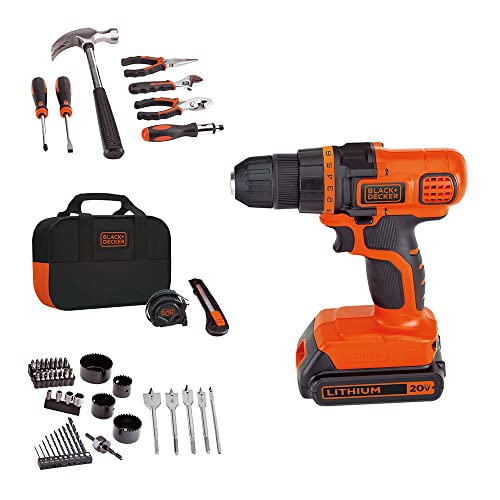
BLACK+DECKER BDCD220C: Best Budget Home Drill
At with a battery included, the BLACK+DECKER 20V is the entry-level starting point. It handles light home tasks adequately and is the lowest cost of entry into a 20V MAX-compatible battery platform. For extremely occasional use or a secondary household drill, the value is clear.
Reasons to buy
- Includes 20V MAX* Lithium Ion drill for a variety of home projects
- Over $150 Value
- Lithium Ion Battery
- By providing extra level of control, the 11 position clutch prevents stripping and overdri
- Includes 66 hand tools and accessories
What to look for
Complete kit
Look for drill + battery + charger + case/bag. Buying a tool-only and adding batteries separately is usually more expensive and requires more research.
Simple controls
Variable speed trigger, forward/reverse, speed selector, and clutch ring are the controls you need. More than that is unnecessary complexity for home use.
Brand warranty and service
A drill that breaks with no service option is a frustrating loss. Major brands (DEWALT, Milwaukee, Ryobi, BLACK+DECKER) have service centers and honor warranties without hassle.
Weight
Heavy drills cause fatigue on overhead and sustained work. For home use where project duration is usually short, weight matters less than for professional use, but lighter is always more comfortable.
Our verdict
The DEWALT DCD771C2 is the right home drill kit for most buyers. trusted brand, complete kit, capable performance, and good warranty. Ryobi is the right choice if you want to grow a home tool ecosystem. The Bosch PS31 is the pick for users who want the lightest option. Any of these four choices will serve a homeowner reliably for 5-10 years of home project use.
FAQs
'For home use, prioritize: a kit that includes battery and charger, a 1/2 inch chuck for versatility, at least 200 in-lbs of torque, and a brand with accessible warranty service. You don''t need brushless motors or 60 Nm torque for hanging shelves and assembling furniture.'
Two batteries is the right number. one in the drill and one on the charger. With a 1.3 Ah battery, you'll get plenty of runtime for home projects, but having a second means you're never waiting for a charge mid-project. The DCD771C2 kit includes two.
Yes. Ceiling fan installation involves drilling pilot holes, driving screws into wood and drywall, and possibly drilling into a junction box area. A standard home drill handles all of these tasks easily. The 1/2 inch chuck fits any bit you'll need.
'Start with a basic set: 1/16 to 1/2 inch twist drill bits, a set of Phillips and flat screwdriver bits (PH1, PH2, PH3, flat 6mm), and a spade bit set for larger holes. A 20-30 piece bit set from any major brand covers 95% of home projects.'
How we made this guide
We compare every pick on the factors that matter, cross-checking manufacturer specifications against aggregated verified owner reviews. We rank independently and never take payment for placement. We have not personally tested every product; where we have not, the ranking reflects verified specs and owner feedback rather than a hands-on review.
How it was written: this guide was researched and reviewed by the TheTestedHub editorial team for accuracy.
Affiliate disclosure: TheTestedHub is reader-supported. When you buy through links on our site, we may earn a commission at no extra cost to you.
Related guides

Fix Your Driveway Cracks with the Best Concrete Fillers

Which Drill Accessories Are Best in 2026?

Cordless Drill Systems Built for Real Jobsite Demands

What Makes Concrete Tools Worth Your Money in 2026?

Ghostshield 8505 Review: A Smarter Way to Protect Concrete

Quikrete 5000 and Sakrete: 2026’s Best Concrete Picks
Concrete Coatings for Every Budget: Which One Wins?
