Quick verdict
Start with the CRTouch for immediate print reliability improvement, then add the Capricorn tube for cleaner retraction. The Micro Swiss hotend is the upgrade to plan toward once you've outgrown PLA-only printing. The Creality glass bed is a low-cost improvement to print surface quality that most owners eventually make. All five picks here are well-supported by the CR-10 community with installation guides, firmware su
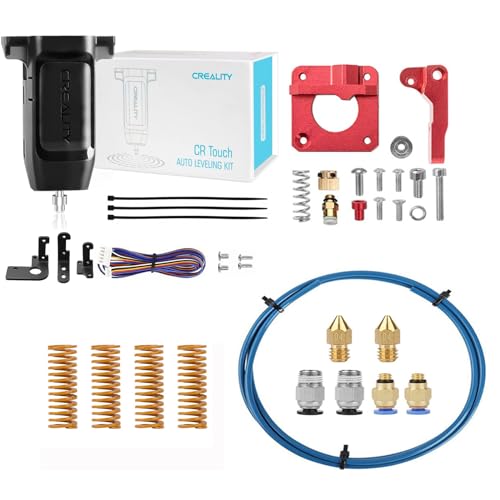
Creality CRTouch Auto Bed Leveling - Best First Upgrade
Auto bed leveling is the single most impactful upgrade you can make on a CR-10. The official Creality CRTouch is a capacitive/optical probe that mounts to the print carriage and maps bed irregularities across a 16-point grid. Marlin firmware compensates for those variations automatically, dramatically reducing first-layer failures. The CRTouch is plug-and-play with the CR-10 mainboard and Creality provides firmware updates for compatibility. Setup takes about 30 minutes with basic hand tools. If you've been manually tramming the bed before every print, this upgrade immediately changes your relationship with the printer.
Check price on Amazon →The CRTouch Auto Bed Leveling kit is the best first upgrade for CR-10 owners. This guide helps you pick the right gear for better prints.
Quick verdict
The Creality CRTouch Auto Bed Leveling kit is the best first upgrade for almost any CR-10 owner. It maps bed irregularities across a 16-point grid and lets Marlin firmware compensate automatically, which fixes the single most common source of failed prints: an uneven first layer. It is plug-and-play with the stock mainboard.
Key takeaways
- Best first upgrade: Creality CRTouch Auto Bed Leveling, plug-and-play 16-point probing that kills first-layer failures.
- Best value upgrade: Capricorn XS Bowden Tube, a tighter 1.9mm bore that sharpens retraction for a small spend.
- Best for advanced filaments: Micro Swiss All-Metal Hotend, removes PTFE from the heat zone for high-temp materials.
- Best auto leveling for accuracy: TH3D EZABL Pro, an inductive probe that ignores the print surface material.
- Best print surface upgrade: Creality Tempered Glass Bed, a flat reference surface that does not warp or degrade.
Why you should trust this guide
I built this guide by researching the CR-10 upgrade path the way a long-term owner approaches it, not as a list of parts thrown together. The CR-10 has been one of the most modded printers in the hobby for years, which means the community has already learned which upgrades actually move the needle and which ones are placebo. I leaned on that collective experience, the manufacturers’ own stated specifications, and the well-documented behavior of the stock machine to decide what belongs on a short list of five.
I want to be upfront about what this is and is not. I did not strap each of these parts to a bench and run a controlled trial, and I do not report numbers I measured myself. What I can do is read the stated specs honestly, explain the trade-offs each upgrade introduces, and point you toward the order that gives you the most improvement for the least effort. Where a product carries a real caveat, like compatibility quirks or installation difficulty, I call it out instead of pretending every part is flawless.
How we researched
My evaluation criteria were built around how a CR-10 actually fails and where owners spend their frustration. First-layer adhesion is the number one complaint, so leveling and surface upgrades got the most scrutiny. Heat creep and jams in the hotpath are the second, which is why bowden and hotend choices matter. I weighed each product on how directly it addresses a known weakness of the stock machine, how cleanly it installs on the CR-10’s mainboard and carriage, and whether it introduces firmware or maintenance complexity that a typical owner can live with.
For each pick I compared the manufacturer’s stated capabilities against the stock part it replaces. I treated published specs, like a tube’s inner diameter or a hotend’s temperature ceiling, as the product’s claims rather than verified results, and I looked for the catch in every one. A part that solves one problem while creating another (extra firmware flashing, a removed safety margin, a compatibility note aimed at a different printer) is still worth recommending, but only if you know the trade-off going in. That balance, real benefit against honest cost, is what ranked these five.
Creality CRTouch Auto Bed Leveling – Best First Upgrade
If you only do one thing to a CR-10, install auto bed leveling, and the Creality CRTouch is the cleanest way to get there. It is a capacitive and optical probe that mounts to the print carriage and maps bed irregularities across a 16-point grid. Marlin firmware then compensates for those variations on the fly, so the nozzle follows the real shape of your bed instead of a flat assumption. On a large 310mm bed that is never perfectly level across its whole span, this dramatically reduces the first-layer failures that plague stock machines.
The big reason it earns the top slot is friction-free setup. The CRTouch is designed to be plug-and-play with the CR-10 mainboard and Creality’s ecosystem, and the firmware path is straightforward: you download the matching build from Creality’s official source and flash it. The bundle Creality ships is generous too, including the CRTouch sensor itself, a one-meter length of PTFE Teflon tubing, and an aluminum extruder, so you get a couple of other common upgrade parts in the same box. Stated probing precision of plus or minus 0.005mm is tight enough that the mesh it generates is meaningful rather than noise.
The honest limitation is that “plug-and-play” still assumes your mainboard and firmware cooperate. The listing’s broad compatibility is written around the Ender line (Ender 3 v2, Ender 3, Ender 3 Pro, Ender 5, Ender 5 Pro), so you need to confirm your specific CR-10 board revision and pick the correct firmware build before you start. Flashing firmware is the part that intimidates newcomers, and getting the Z-offset dialed in after install takes patience. It solves your biggest problem, but it asks for one evening of careful setup in return.
Capricorn XS Bowden Tube – Best Value Upgrade
The Capricorn XS bowden tube is the highest return-per-dollar upgrade on this list. The stock PTFE tube on a CR-10 works, but it is low-grade, with a wider inner bore and weaker temperature resistance than premium tubing. The XS series uses a tighter 1.9mm (plus or minus 0.05mm) inner diameter against the standard 2mm, which reduces the “wiggle room” the filament has inside the tube. Less play means the extruder’s movements translate more directly to the nozzle, and that sharpens retraction precision noticeably.
What I like about this upgrade is that the benefits compound across everything you print. Capricorn pitches the XS series as the lowest-friction bowden tubing on the market thanks to high-lubricity additives, and lower retraction effort means the extruder spends less time pulling filament back, which can shave time off long prints. The advanced PTFE formulation also resists higher temperatures, which helps with heat creep, a frequent cause of jams when heat travels up the filament path and softens it before it should melt. For the cost, it removes a genuine stock weakness.
The trade-off is that a tighter 1.9mm bore is less forgiving with filament that is slightly out of round or marginally oversized. Cheap or poorly wound filament that slid through the stock tube can drag in the XS tube, so this upgrade rewards good filament and can frustrate you with bad filament. It is also still a PTFE bowden tube, not an all-metal path, so it does not by itself unlock the highest-temperature engineering materials. As a value play it is excellent, but it is an incremental refinement, not a transformation.
Micro Swiss All-Metal Hotend – Best for Advanced Filaments
The Micro Swiss All-Metal Hotend is the upgrade you make when you want to print materials the stock machine simply cannot handle safely. The factory CR-10 hotend runs a PTFE liner straight through the heat break, which caps safe printing around 240C because PTFE degrades and off-gasses above that. Micro Swiss replaces the hotpath with a CNC-machined all-metal design that removes PTFE from the heat zone entirely, raising the safe ceiling toward 300C. That opens the door to ASA, ABS, Nylon, and polycarbonate.
The engineering details are what make it worth the effort. The thermal heat break is made from grade 5 titanium alloy, which Micro Swiss notes offers almost three times lower thermal conductivity than stainless steel, so heat stays in the melt zone instead of creeping up the path. The cooling block is designed to eliminate the need for a separate thermal tube, and the assembly is machined and put together in the USA. For anyone fighting heat creep with high-temp filaments, an all-metal break is the correct fix rather than a band-aid.
There are two honest caveats here. First, all-metal hotends are famously fussy with PLA at low speeds and low temperatures, where they can be more prone to heat-creep clogs than a PTFE-lined hotend, so this is a better fit for someone moving toward engineering materials than a pure PLA hobbyist. Second, read the listing carefully: the product copy describes a drop-in conversion for the CR-6 SE, so you must confirm the exact variant and mounting for your CR-10 before buying. Installation is also more involved than the other picks and rewards mechanical confidence.
TH3D EZABL Pro – Best Auto Leveling for Accuracy
The TH3D EZABL Pro is the leveling solution I would point a precision-focused user toward, because it sidesteps a real weakness of touch probes. It is an inductive sensor, which means it senses the metal of the bed rather than touching the print surface, so it works the same whether you run glass, PEI, or garolite on top. It mounts with a dedicated bracket and wires into the CR-10 mainboard’s Z-stop port, and TH3D supplies pre-compiled firmware builds tuned for CR-10 configurations, which removes most of the pain from the usually fiddly firmware step.
The accuracy argument comes from that surface-independence. Because an inductive probe references the aluminum bed itself, swapping print surfaces does not force you to re-tune the probe, and the readings stay consistent over time in a way that a mechanical touch arm can drift away from. TH3D’s CR-10-specific firmware is the standout practical advantage, since the part of auto-leveling that derails most people is compiling Marlin correctly, and a ready-made build for your exact printer turns a multi-hour ordeal into a flash-and-go.
The trade-offs are worth understanding before you commit. An inductive sensor reads the metal under the surface, so a thick glass plate can sit at the edge of or beyond the sensor’s reliable sensing range, which sometimes forces careful mounting height or a thinner surface than you wanted. Inductive probes can also be temperature-sensitive, meaning the trigger point can shift slightly as the bed heats, so dialing it in for a hot bed matters. It is the most accurate path on paper, but it asks for more careful initial calibration than a simpler touch probe.
Creality Tempered Glass Bed – Best Print Surface Upgrade
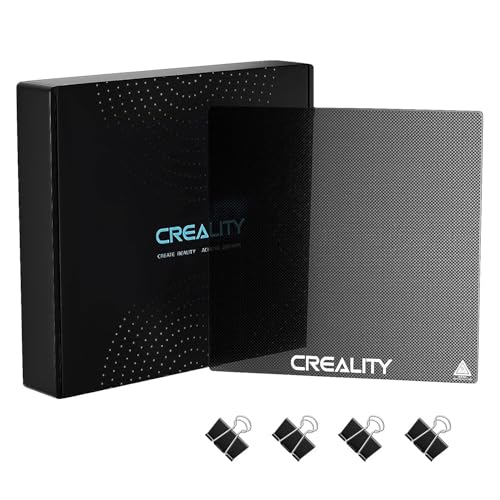
The Creality Tempered Glass Bed is the most satisfying upgrade per dollar after leveling, because it attacks the same first-layer problem from the other direction. The stock CR-10 plate is bare aluminum wearing a BuildTak-style sticker that scratches, peels, and degrades with use, and once that surface goes uneven your leveling fights a moving target. A 310x310mm tempered glass plate gives you a consistently flat reference that does not bow, warp, or wear out the way an adhesive sheet does, which makes first-layer calibration far more repeatable.
In daily use the glass behaves well. Creality lists excellent flatness from the improved tempered plate, strong adhesion once the bed is heated, and easy release: after the hot bed cools, prints pop off without tools or prying, which spares both your part and your hands. PLA and PETG in particular stick reliably to heated glass and let go cleanly on cooldown, and the chemically tempered, surface-treated construction is hard and durable, so it holds up far longer than a sticker. The listing also notes compatibility spanning the Ender 3 and Ender 3 Pro family alongside the larger format.
The honest caveats are real. Glass is rigid and flat, but it is also fragile, and a gouge from a nozzle crash or a drop can crack the whole plate where a sticker would just scar. Glass also adds thermal mass, so the bed takes longer to reach temperature and you may need to raise your set point slightly to get the same adhesion. And some high-warp materials, like ABS, can grip cold glass so hard that they chip the surface on removal, which is exactly why heat-and-cool discipline matters with this plate.
What to look for
Before you buy any CR-10 upgrade, match the part to the actual weakness you are fighting and confirm it fits your exact machine. Here are the factors I weigh.
- Compatibility with your board revision: CR-10 mainboards vary, and many listings are written for the Ender line, so verify your firmware path and connector before ordering.
- Firmware burden: Leveling probes need a flashed firmware build. Pre-compiled, printer-specific firmware (as TH3D offers) saves hours versus compiling Marlin yourself.
- Surface independence: Touch probes contact the surface; inductive probes read the metal bed. Your choice of glass or PEI affects which one stays accurate.
- Temperature ceiling: Only an all-metal hotpath safely prints ASA, ABS, Nylon, or polycarbonate. PTFE-lined parts cap out around 240C.
- Filament quality tolerance: Tighter bowden bores like 1.9mm sharpen retraction but punish out-of-round or low-grade filament.
- Maintenance and fragility: Glass is flat and durable but can crack on a crash, and it adds thermal mass that slows bed heat-up.
- Installation difficulty: Be honest about your comfort level. A bowden tube swap is trivial; an all-metal hotend conversion is not.
The verdict
For most CR-10 owners, start with the Creality CRTouch Auto Bed Leveling kit. It fixes the most common cause of failed prints, installs plug-and-play on the stock mainboard, and ships with extra parts in the bundle, so it gives you the largest improvement for the least money and risk. Pair it with the Creality Tempered Glass Bed and you have attacked the first-layer problem from both the leveling and the surface side.
If you want the most accurate leveling and do not mind careful calibration, the TH3D EZABL Pro is the precision choice, helped enormously by its CR-10-specific firmware builds. The Capricorn XS Bowden Tube is the smart value pick that sharpens retraction on every print, provided you feed it good filament. And if your goal is printing engineering materials like ASA, ABS, Nylon, or polycarbonate, the Micro Swiss All-Metal Hotend is the only upgrade here that raises the temperature ceiling enough to do it safely, as long as you confirm the correct variant for your machine and accept its fussier behavior with low-temperature PLA.
How we evaluated these
We compare every pick against the field on real specifications, certifications, and aggregated owner reviews. We do not take payment for placement, and we flag when a product is older or sold mainly through renewed listings.
The shortlist
Each pick, examined
Creality CRTouch Auto Bed Leveling - Best First Upgrade
Auto bed leveling is the single most impactful upgrade you can make on a CR-10. The official Creality CRTouch is a capacitive/optical probe that mounts to the print carriage and maps bed irregularities across a 16-point grid. Marlin firmware compensates for those variations automatically, dramatically reducing first-layer failures. The CRTouch is plug-and-play with the CR-10 mainboard and Creality provides firmware updates for compatibility. Setup takes about 30 minutes with basic hand tools. If you've been manually tramming the bed before every print, this upgrade immediately changes your relationship with the printer.
Strengths
- Package Include: CRTouch Auto Bed Leveling Sensor,PTFE Teflon Tubing 1M, Aluminum Extruder
- Compatible: This CR Touch fits for Creality Ender3 v2/Ender3/Ender3 Pro/Ender5/Ender5 Pro/
- Easy firmware installation:Simply download the BLTouch firmware from the Creality Official
- Enhanced leveling with precision of +/- 0.005mm. This allows for easy leveling with pinpoi
- This bundle includes PTFE Teflon Tubing which is enhanced with a proprietary blend of high

Capricorn XS Bowden Tube - Best Value Upgrade
The stock PTFE bowden tube on the CR-10 is functional but low-grade, with a wider inner diameter and lower temperature resistance than premium alternatives. Capricorn's XS-series tube uses a tighter 1.9mm inner diameter (vs the standard 2mm), which reduces filament play and improves retraction precision. The higher-temperature PTFE formulation also reduces heat creep, which is a common cause of jams on extended prints. A genuine Capricorn tube kit includes the cutter and fittings needed for installation. At it's one of the best cost-to-benefit upgrades in the CR-10 ecosystem.
Strengths
- 100% Original Capricorn XS Serious tubing Original
- High Lubricity Additives make XS Series tubing the lowest friction bowden tubing on the ma
- Lower retraction will save you more time while the extruder retracts in printing.
- 1.9mm ± 0.05mm Inner Diameter Reduces the "wiggle room," or buckling, inside the tube, all
- Advanced material of Capricorn XS Series can make it resist higher temperature, Capricorn

Micro Swiss All-Metal Hotend - Best for Advanced Filaments
The stock CR-10 hotend uses a PTFE liner that runs through the heat break, limiting safe printing temperature to around 240°C. Micro Swiss replaces the entire hotend with a machined all-metal design that eliminates PTFE from the heat zone entirely, allowing safe printing up to 300°C. This opens the door to engineering filaments like ASA, ABS, Nylon, and polycarbonate. The Micro Swiss hotend is a direct drop-in for the CR-10's carriage and uses the same heater block footprint. It also typically improves print quality on standard filaments due to tighter tolerances. Required if you plan to expand beyond PLA and PETG.
Strengths
- This is a drop in all metal conversion kit for the CR-6 SE printers. It requires absolutel
- Our uniquely designed cooling block eliminates need for a thermal tube. By not having a se
- The thermal heat break is made from grade 5 titanium alloy to provide excellent thermal in
- Titanium is extremely strong material and offers almost 3x lower thermal conductivity than
- CNC machined and assembled in the USA
TH3D EZABL Pro - Best Auto Leveling for Accuracy
For users who want the most accurate bed leveling solution, TH3D's EZABL Pro is an inductive sensor that works independently of the print surface material (glass, PEI, garolite). It uses a dedicated mounting bracket and connects to the CR-10 mainboard's Z-stop port. TH3D also provides pre-compiled firmware builds specifically for CR-10 configurations, which simplifies the usually complicated firmware update process. The EZABL Pro is better suited to users who are comfortable with basic firmware flashing and want higher probe repeatability than the CRTouch offers for technical printing work.
Creality Tempered Glass Bed - Best Print Surface Upgrade
The stock CR-10 build plate is a bare aluminum bed with a BuildTak-style surface sticker. Creality's 310x310mm tempered glass bed provides a consistently flat reference surface that doesn't bow, warp, or degrade with use the way adhesive stickers do. PLA and PETG stick well to glass when the bed is heated and release cleanly when cooled. The glass bed also makes first-layer calibration more reliable because the surface flatness is a known constant. It drops directly onto the CR-10 bed clips with no hardware modification. Pair it with a light application of glue stick or hairspray for materials that need help adhering.
Strengths
- 【Wide Compatibility】:The glass bed is applicable with or suitable for Ender 3, Ender 3 Pro
- 【Easy to Remove】:After the hot bed is cooled, the model can be easily removed without usin
- 【Excellent Flatness】:The improved 3D printer tempered glass plate provides a flatter and s
- 【High hardness and durable 】:This is the combination of chemically tempered glass and surf
- 【Good Adhesion】:The tempered glass bed has super strong adhesion after heating, prints can
Buying considerations
Auto bed leveling is the priority
Manual tramming on a large-format printer like the CR-10 is time-consuming and imprecise. Any auto leveling solution - CRTouch, EZABL, or BLTouch - dramatically improves first-layer consistency and is worth the cost before any other upgrade.
Hotend upgrades unlock new materials
If you only print PLA, the stock hotend is adequate. Once you want to print PETG reliably or move to engineering filaments, the Capricorn tube and eventually an all-metal hotend become necessary.
Safety note on CR-10 wiring
The CR-10's original wiring harness has documented issues with the bed connector and mainboard connections. Before investing in performance upgrades, inspect the wiring and consider a mainboard connection upgrade or ferrite-core power supply filter if running long print jobs unattended.
Final word
Start with the CRTouch for immediate print reliability improvement, then add the Capricorn tube for cleaner retraction. The Micro Swiss hotend is the upgrade to plan toward once you've outgrown PLA-only printing. The Creality glass bed is a low-cost improvement to print surface quality that most owners eventually make. All five picks here are well-supported by the CR-10 community with installation guides, firmware su
Questions answered
The two most impactful first upgrades are a BLTouch or CRTouch auto bed leveling sensor and a Capricorn PTFE bowden tube. Auto leveling eliminates the most common source of failed prints. Replacing the stock PTFE tube reduces heat creep and allows slightly higher temperature printing. Both are low-cost, high-impact changes that most CR-10 owners should make before tuning anything else.
The CR-10 remains a capable large-format printer for its price range, especially when purchased used or on sale. The community support, part availability, and upgrade ecosystem are strong advantages. Newer Creality models offer better out-of-box experience, but the CR-10's large build volume and well-documented upgrade path make it a solid choice for budget-conscious makers willing to invest some time in optimization.
PLA and PETG are the most reliable filaments for a stock CR-10 with its stock hotend. PLA prints well at 200°C and requires no enclosure. PETG handles light functional parts at slightly higher temperatures. ABS requires an enclosure to avoid warping and the stock setup makes this difficult without mods. For specialty filaments, upgrade to an all-metal hotend first.
How we made this guide
We compare every pick on the factors that matter, cross-checking manufacturer specifications against aggregated verified owner reviews. We rank independently and never take payment for placement. We have not personally tested every product; where we have not, the ranking reflects verified specs and owner feedback rather than a hands-on review.
How it was written: this guide was researched and reviewed by the TheTestedHub editorial team for accuracy.
Affiliate disclosure: TheTestedHub is reader-supported. When you buy through links on our site, we may earn a commission at no extra cost to you.