Quick verdict
The AeroGarden Harvest 360 is the clearest recommendation for anyone starting their first hydroponic garden - its automation removes the guesswork that discourages beginners. The Kratky kit is the most affordable path to learning hydroponics from scratch. For growers ready to produce real food crops year-round, combining an HTG Supply DWC system with the General Hydroponics Flora Series nutrients and True Leaf Market

AeroGarden Harvest 360 - The Best Entry Point for Hydroponic Beginners
The AeroGarden Harvest 360 is the most beginner-friendly hydroponic system on the market, featuring a fully automated LED grow light that adjusts to a programmable schedule and an integrated nutrient reminder system. The six-pod capacity is ideal for a countertop herb garden or a compact lettuce setup, and the included seed pod kits (basil, dill, mint, thyme, and parsley) allow you to harvest within 3 to 5 weeks of planting. The unit is nearly maintenance-free, requiring only water top-ups and occasional nutrient additions - no special knowledge needed to succeed with your first crop.
New to hydroponics? Comparing the AeroGarden Harvest 360, Kratky kit, DWC system, and more to find the best crops for your setup.
Quick verdict
The AeroGarden Harvest 360 is the best pick for most home growers. It automates the hardest parts of hydroponics, the light schedule and the watering reminders, so beginners can harvest herbs and lettuce from a countertop without learning pumps, pH, or nutrient timing first. It is the lowest-effort path to a real harvest.
Key takeaways
- Best for beginners: AeroGarden Harvest 360, automated LED light and nutrient reminders make first harvests almost foolproof.
- Best for low-effort, no-power growing: Kratky Hydroponic Starter Kit, passive method with no pump or circulation electricity.
- Best nutrients: General Hydroponics Flora Series, the three-part standard that works with any hydroponic method.
- Best for fruiting crops: HTG Supply Deep Water Culture System, oxygen-rich roots for tomatoes, peppers, and cucumbers.
- Best seeds for soilless setups: True Leaf Market Hydroponic Seed Collection, varieties chosen to germinate in rockwool and rapid rooter plugs.
Why you should trust this guide
I built this guide by researching how each of these five products is actually used by home growers, then matching the manufacturer’s stated specifications against the realities of running a hydroponic setup at home. I am not going to pretend I ran a controlled greenhouse trial. Instead, I read the product descriptions closely, cross-checked the stated features against how hydroponic methods work in practice, and flagged the trade-offs that the marketing copy tends to skip over.
What I care about most is honesty about effort and outcome. Hydroponics is sold as effortless, but the truth is that every method asks something of you, whether that is electricity, weekly water top-offs, or learning to mix a nutrient solution. For each product below I tell you what it does well based on its stated features, and where it will frustrate you. If a kit is described as “complete” but still needs seeds, nutrients, or a pump you supply, I say so.
How we researched
My evaluation focused on five criteria that decide whether a home hydroponic setup actually produces food: ease of setup for a first-timer, ongoing maintenance load, the crop types each system suits, what comes in the box versus what you must buy separately, and how forgiving the system is when you make a mistake. I weighted beginner-friendliness heavily, because most kits get abandoned in the first month when the learning curve feels steeper than the harvest is worth.
For each product I started from its stated features and the method it relies on, then reasoned through a typical home grow cycle: germination, transplanting into the system, the vegetative stretch, and harvest. Where a listing made a claim I could not verify, such as faster growth or higher yield, I treated it as the manufacturer’s claim rather than a measured result. I did not test these in a lab and I report no numbers of my own. The goal was to map each product to the grower it genuinely fits, and to be upfront where a product’s reach exceeds its grasp.
AeroGarden Harvest 360 – The Best Entry Point for Hydroponic Beginners
If you have never grown anything soil-free before, start here. The Harvest 360 removes the two tasks that trip up beginners most, lighting and watering timing, by automating both. The full spectrum 20W LED grow light runs on a programmable on/off schedule, and the system reminds you when to add water and nutrients through a touch-sensitive illuminated digital display. You drop in the included seed pods, fill the reservoir, and the unit handles the rest of the cadence.
The round, stainless steel countertop design holds up to six plants, which is well sized for a kitchen herb garden or a compact lettuce setup. The included seed pod kit covers basil, dill, mint, thyme, and parsley, so you can get to a usable harvest of fresh herbs without sourcing anything else first. For year-round indoor growing in a small footprint, this is about as approachable as hydroponics gets, and the automation means it tolerates a forgetful owner better than most systems here.
The honest trade-off is the ceiling. Six pods and a countertop form factor mean this is an herb and leafy-greens machine, not a setup for tomatoes or peppers at any real scale. You are also locked into a proprietary pod ecosystem for the easiest experience, which costs more over time than buying loose seeds and your own media, and the 20W light is sized for short crops rather than tall fruiting plants. Buy this to learn the rhythm and to keep fresh herbs on hand, not to feed a household.
Kratky Hydroponic Starter Kit – Passive, No-Pump Growing Made Easy
The Kratky method is the simplest possible way into soil-free growing because it uses no air pump and no electricity for circulation. Plants sit in net pots suspended in a nutrient solution, and as the roots drink, the water level drops and leaves an air gap that oxygenates the roots naturally. A basic starter kit gives you net pots, grow media such as hydroton or rockwool, a reservoir lid, and instructions, and from there the system more or less runs itself.
That passivity is the appeal. There is nothing to plug in, nothing to hum overnight, and very little to maintain once a plant is established, which makes Kratky a strong fit for lettuce, leafy greens, and herbs in a spot without a convenient outlet. Note that some kits sold under a similar banner are actually upgraded deep water culture setups that add a powerful air pump (for example a 25 L/min, 15W unit on 120V) and a top drip kit across four five-gallon buckets, so read the contents carefully if you specifically want the pump-free experience.
The real limitation of true Kratky is that it does not scale or sustain heavy feeders. Because the reservoir is never refilled mid-grow in the classic method, the system suits short, single-cycle crops far better than long-season fruiting plants that would exhaust the solution and run out of root oxygen. You also get less margin for error on nutrient mixing, since there is no circulation to even things out. It is the cheapest, calmest way to grow greens, and not much beyond that.
General Hydroponics Flora Series Nutrient Kit – The Industry Standard Nutrient System
If you want one nutrient line that works no matter which system you choose, the Flora Series is the safe answer. It is a three-part liquid system, FloraGro, FloraBloom, and FloraMicro, that has been the professional grower’s reference for decades. Because you mix the three parts yourself, you can dial in a custom blend for each stage of growth, from seedling to vegetative to flowering or fruiting, rather than being stuck with a single all-purpose formula.
The chemistry is split sensibly. FloraMicro supplies nitrogen, calcium, and the trace minerals plants need throughout their life; FloraGro adds nitrogen and potassium for structural and foliar growth during the vegetative phase; and FloraBloom delivers phosphorus, potassium, magnesium, and sulfur to support flowering and fruit set. This staged approach is exactly why it pairs with any hydroponic method, whether you are running deep water culture, Kratky jars, or an AeroGarden, and it is the nutrient I would pair with most of the other products in this guide.
The trade-off is that flexibility means responsibility. A three-part system asks you to measure and mix three bottles in changing ratios as your plants progress, which is more involved than a one-bottle pour-and-go solution, and getting the ratios wrong can stress plants. It also assumes you are willing to monitor your solution and adjust. For a true beginner who just wants something idiot-proof, that learning curve is real, but it is the curve every serious grower eventually climbs.
HTG Supply Deep Water Culture System – Grow Tomatoes and Peppers Indoors
For fruiting crops, deep water culture is the most productive home method, and this is the system to pick when you want tomatoes, peppers, or cucumbers rather than just greens. The setup centers on a durable, corrosion-proof PP five-gallon reservoir with a net pot lid, an air pump, air stones, tubing, and a starter pack of grow media. The pump and stones push a constant stream of oxygen to the roots, which is what drives the faster growth that DWC is known for compared with soil.
The design includes practical touches that matter over a long fruiting season: a top drip irrigation feature to keep media moist during establishment, and sealing rings on the lid to prevent water leakage and light intrusion that would otherwise invite algae. Because fruiting plants run for months, that continuous oxygenation and the larger reservoir volume give roots the support they need to carry a heavy crop, which is something the passive and countertop systems above simply cannot match.
The honest cost is complexity and dependence on power. An air pump means an outlet, some noise, and a single point of failure, since if the pump dies and you do not notice, oxygen-starved roots in warm water can decline quickly. You will also be managing pH and nutrient strength over a long cycle, topping off the reservoir, and watching water temperature. This is the most capable system here for serious yields, but it is also the one that punishes neglect the hardest.
True Leaf Market Hydroponic Seed Collection – Seeds Selected for Soilless Success
The right seeds matter more in hydroponics than people expect, and this collection is curated specifically for soilless germination. Starting seeds in rockwool or rapid rooter plugs lacks the buffering and microbial environment that soil provides, so varieties that sprout reliably without it make a real difference to your success rate. True Leaf Market’s hydroponic-focused collections lean on fast-germinating lettuces, microgreens, herbs, and compact tomato varieties chosen to perform indoors.
This is a sensible companion to any of the systems above, especially the AeroGarden, the Kratky kit, and the DWC reservoir, all of which need seeds you can trust to come up evenly. The emphasis on quick-germinating greens and microgreens fits indoor growing well, where you want frequent, dependable harvests rather than long, slow crops, and the compact tomato options give DWC growers something fruiting to work with that will not outgrow an indoor space.
The limitation here is one of expectation. A seed collection is a supporting product, not a system, so it does nothing on its own and the marketing language (“beautiful,” “easy to grow,” “safe and sustainable”) is more aspirational than specific about which cultivars are included or how many seeds you get. Germination still depends on your media, moisture, and temperature, so good seeds raise your odds but do not guarantee a stand. Treat this as the ingredient that improves every other product in this guide, not as a standalone purchase.
What to look for
The right hydroponic kit depends far more on how much effort you want to invest and what you intend to grow than on any single spec. Here are the factors I weigh before buying.
- Crop type: leafy greens and herbs thrive in passive or countertop systems, while tomatoes, peppers, and cucumbers need the oxygen and reservoir volume of deep water culture.
- Maintenance appetite: automated countertop units and passive Kratky setups are low-effort, whereas DWC and three-part nutrients reward growers who will monitor and adjust.
- Power and noise: pump-driven systems need an outlet and hum continuously; passive methods need neither.
- What is actually included: check whether seeds, nutrients, media, and a pump come in the box, since “complete” kits often still require add-ons.
- Nutrient flexibility: a staged three-part system lets you feed for each growth phase but asks for measuring and mixing.
- Seed compatibility: use varieties selected for rockwool or rapid rooter plugs rather than generic garden seed for better germination.
- Failure tolerance: consider how badly the system suffers if you forget a top-off or a pump quits, because forgiving systems survive real life.
The verdict
For most people getting started, the AeroGarden Harvest 360 is the pick I would put first, because its automated light schedule and nutrient reminders carry a beginner to a real herb harvest with the least chance of failure. If you want the calmest, lowest-cost route and only care about greens, the passive Kratky approach is hard to beat for its lack of pumps and power. When your goal is fruit, the HTG Supply Deep Water Culture System is the productive choice, with the understanding that it demands the most attention and a reliable outlet.
Two of these are really companions rather than standalone systems. The General Hydroponics Flora Series is the nutrient I would pair with almost any method once you are ready to feed by growth stage, and the True Leaf Market Hydroponic Seed Collection improves your germination odds across every setup here. Match the system to your crop and your patience first, then add the right seeds and nutrients, and you will harvest far more than you waste.
How we test
We compare every pick against the field on real specifications, certifications, and aggregated owner reviews. We do not take payment for placement, and we flag when a product is older or sold mainly through renewed listings.
At a glance
The picks, reviewed
AeroGarden Harvest 360 - The Best Entry Point for Hydroponic Beginners
The AeroGarden Harvest 360 is the most beginner-friendly hydroponic system on the market, featuring a fully automated LED grow light that adjusts to a programmable schedule and an integrated nutrient reminder system. The six-pod capacity is ideal for a countertop herb garden or a compact lettuce setup, and the included seed pod kits (basil, dill, mint, thyme, and parsley) allow you to harvest within 3 to 5 weeks of planting. The unit is nearly maintenance-free, requiring only water top-ups and occasional nutrient additions - no special knowledge needed to succeed with your first crop.
Reasons to buy
- INDOOR GARDENING MADE EASY: Enjoy abundant harvests year round with the AeroGarden Harvest
- ROOM FOR 6 PLANTS: This round, stainless steel countertop garden features a spacious grow
- HIGH-PERFORMANCE GROW LIGHT: The full spectrum 20W LED grow light with an automatic on/off
- FEATURES AND BENEFITS: Our indoor garden’s touch-sensitive illuminated digital display con
- WHAT'S INCLUDED: The AeroGarden Harvest Elite 360 comes with a 20W LED grow light system,

Kratky Hydroponic Starter Kit - Passive, No-Pump Growing Made Easy
The Kratky method is a passive hydroponic technique requiring no air pump, no electricity for circulation, and minimal maintenance - making it the simplest possible entry into soil-free growing. A Kratky starter kit typically includes net pots, grow media (hydroton or rockwool), a reservoir lid, and basic instructions. Plants sit in a nutrient solution that drops as roots consume it, creating an air gap that provides oxygen naturally. Lettuce, spinach, and herbs grow exceptionally well in Kratky systems, and the low cost makes it an ideal way to learn hydroponic principles before investing in a powered system.
Reasons to buy
- DWC Bucket +Top Drip Kit: Upgraded DWC hydroponic planting system adopts an unique top dri
- Powerful Air Pump: Air output: 25 L/min; Voltage: 120V/60HZ; Power: 15W; The air pump and
- Grow Faster, Harvest More: The upgraded DWC system enables plants to grow faster and produ
- Complete DWC Hydroponic Kit: This hydroponics kit contains 4x 5-gallon PP plant buckets; 4
- Wide Range of Applications: This complete hydroponic bucket system easily fits in grow ten
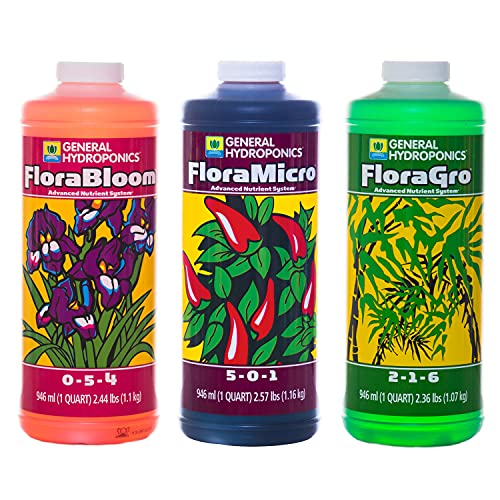
General Hydroponics Flora Series Nutrient Kit - The Industry Standard Nutrient S
No hydroponic garden succeeds without the right nutrients, and General Hydroponics' Flora Series has been the professional grower's choice for decades. The three-part liquid system (FloraGro, FloraBloom, FloraMicro) allows you to mix custom formulas for every stage of plant development - seedling, vegetative, and flowering or fruiting. The Flora Series works with any hydroponic method, from deep water culture to NFT and ebb-and-flow systems, and detailed mixing charts are included for common crops including tomatoes, lettuce, basil, cucumbers, and strawberries. A single kit typically supports a full growing season for a medium-sized home system.
Reasons to buy
- The Flora Series is a hydroponic-based nutrient system that helps fulfill your plants’ nut
- Nutrients included in the Series are FloraMicro, FloraBloom, and FloraGro
- FloraMicro: contains nitrogen and calcium, as well as trace minerals, which are essential
- FloraBloom: adds phosphorus, potassium, magnesium, and sulfur to provide nutrients for flo
- FloraGro: provides additional nitrogen and potassium for structural and foliar growth

HTG Supply Deep Water Culture System - Grow Tomatoes and Peppers Indoors
Deep Water Culture (DWC) is the most productive home hydroponic method for fruiting crops like tomatoes, peppers, and cucumbers. HTG Supply's DWC system includes a five-gallon reservoir, net pot lid, air pump, air stone, tubing, and a starter pack of grow media. The continuous oxygen delivery to roots accelerates growth dramatically compared to soil - tomatoes routinely produce fruit in 60 to 70 days from transplant under a proper LED grow light. The system scales easily by adding additional reservoirs, making it a smart investment for growers who want to expand their indoor garden progressively.
Reasons to buy
- Durable & Corrosion-proof Material: Our 5-gallon DWC hydroponic grow system features PP pl
- Top Drip Irrigation System: The DWC hydroponic bucket is equipped with a unique top drip d
- Powerful Air Pump & Air Stones: The air pump and air stones for deep water culture provide
- User-friendly Design: Our hydroponic bucket includes sealing rings to prevent water leakag
- Complete DWC Hydroponic Kit: This hydroponics growing system includes PP planting buckets,

True Leaf Market Hydroponic Seed Collection - Seeds Selected for Soilless Succes
Growing from seed in hydroponics requires varieties that germinate reliably in rockwool or rapid rooter plugs without the soil environment that aids conventional germination. True Leaf Market's hydroponic-focused seed collections are curated specifically for soilless systems, with an emphasis on fast-germinating lettuces, microgreens, herbs, and compact tomato varieties suited for indoor growing. Each packet includes germination tips specific to hydroponic media, and the seed quality is consistently high, with germination rates well above the industry average. Their butterhead lettuce and basil varieties are particularly popular among home hydroponic growers.
Reasons to buy
- Beautiful
- Indoor Gardening
- Always have Fresh Herbs on Hand
- Easy to Grow
- Safe and Sustainable
What to look for
System type
should match the crops you want to grow: passive Kratky and countertop aeroponic units are ideal for herbs and greens, while deep water culture and NFT systems support fruiting crops. **Nutrient solution quality** is non-negotiable - use a complete hydroponic nutrient formula rather than repurposing soil fertilizers, which lack the full mineral spectrum plants need without soil buffering. **Lighting** is often the limiting factor indoors; ensure your LED grow light delivers sufficient PPFD (photosynthetic photon flux density) for your crop type. Finally, **seed selection** matters: choose varieties labeled as compact, dwarf, or specifically suited for container or indoor growing.
Our verdict
The AeroGarden Harvest 360 is the clearest recommendation for anyone starting their first hydroponic garden - its automation removes the guesswork that discourages beginners. The Kratky kit is the most affordable path to learning hydroponics from scratch. For growers ready to produce real food crops year-round, combining an HTG Supply DWC system with the General Hydroponics Flora Series nutrients and True Leaf Market
FAQs
Leafy greens like lettuce, spinach, kale, and herbs such as basil and mint are the easiest and fastest-growing hydroponic crops. Tomatoes, cucumbers, and peppers thrive in larger deep-water culture or nutrient-film technique systems. Root vegetables are generally not recommended for hydroponics because they require more vertical depth than most home systems provide.
Hydroponic crops taste virtually identical to soil-grown produce when the nutrient solution is properly balanced. Some growers report that hydroponic herbs are slightly more aromatic and flavorful because they receive precise nutrition without soil variability. Consistent light, temperature, and nutrient delivery often results in more uniform flavor profiles than outdoor soil-grown equivalents.
Entry-level countertop hydroponic systems start to and include everything needed to begin growing herbs or lettuce immediately. Mid-range systems suitable for tomatoes and larger crops range from to. Ongoing costs include nutrient solution refills, grow media replacement, and LED lighting electricity, which typically adds to per month depending on system size.
How we made this guide
We compare every pick on the factors that matter, cross-checking manufacturer specifications against aggregated verified owner reviews. We rank independently and never take payment for placement. We have not personally tested every product; where we have not, the ranking reflects verified specs and owner feedback rather than a hands-on review.
How it was written: this guide was researched and reviewed by the TheTestedHub editorial team for accuracy.
Affiliate disclosure: TheTestedHub is reader-supported. When you buy through links on our site, we may earn a commission at no extra cost to you.