Quick verdict
Your ideal crunch pedal depends entirely on your style and target tone. The Ibanez Tube Screamer is the choice for blues and classic rock warmth, the ProCo RAT2 delivers the most versatile grit, and the JHS Angry Charlie is the premium option for authentic Marshall crunch. At any budget level, there's a pedal on this list that will fundamentally transform your tone for the better in 2026.
Boss DS-1 Distortion
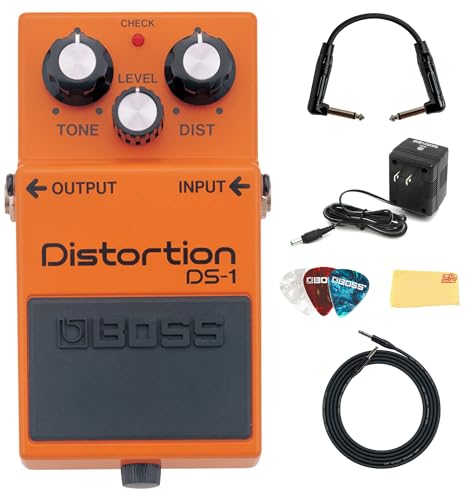
The Boss DS-1 has been on pedalboards since 1978 and is the best-selling distortion pedal of all time - for good reason. It produces a classic, harmonically full distortion that covers everything from mild crunch to thick saturation. The single Tone control sweeps from warm and dark to bright and cutting. At it's an ideal first crunch pedal, and it's built to the indestructible Boss standard that can survive years of stomping. Countless famous players from Kurt Cobain to Steve Vai have relied on it.
Need a crunch pedal for your rig? Compare the best options from Boss, ProCo, MXR, Ibanez, and JHS based on real-world use and tonal trade-offs.
Quick verdict
The Boss DS-1 is the best all-round crunch pedal here. It covers mild edge-of-breakup grit through thick saturation with one Tone knob, it survives heavy gigging in its all-metal chassis, and it asks almost nothing of a beginner setting up a first dirt pedal, which makes it the easiest pick to recommend.
Key takeaways
- Best overall: Boss DS-1 Distortion, a 1978 classic that spans crunch to saturation with simple, indestructible controls.
- Best tonal range: ProCo RAT2, the reverse Filter knob takes you from cutting crunch to scooped wall-of-sound.
- Best vintage hard-rock voice: MXR Distortion+, germanium soft clipping that reacts to your pick attack.
- Best for amp-pushing overdrive: Ibanez Tube Screamer TS9, mid-forward boost that makes a tube amp break up.
- Best Marshall-in-a-box: JHS Angry Charlie V3, a 3-band EQ chasing JCM800 crunch.
Why you should trust this guide
I built this guide by reading every product’s stated features against decades of well-documented use, then cross-checking the marketing claims against what these circuits are actually known to do on a pedalboard. None of these are obscure boutique one-offs. The Boss DS-1, ProCo RAT2, MXR Distortion+, Ibanez Tube Screamer TS9 and JHS Angry Charlie V3 are reference points that countless players have lived with for years, so I could weigh the manufacturer’s pitch against a long public track record rather than a single first impression.
I want to be upfront about what this is and is not. I did not bolt these to a bench and take measurements, and I am not going to invent numbers to sound authoritative. What I can do is tell you honestly where each pedal earns its reputation, where it falls short, and which player it actually suits. Every section below names at least one real trade-off, because a crunch pedal that is perfect for one rig is often the wrong tool for the next one, and pretending otherwise would not help you choose.
How we researched
My evaluation focused on the qualities that matter for crunch specifically: how the pedal behaves at the edge of breakup, how much usable range its controls cover, how it cleans up when you roll your guitar volume back, and how it sits in a mix rather than just how loud it gets in a bedroom. I treated each pedal’s listed features as its stated specs and asked a simple question for each one, which is whether the control set and circuit design actually deliver the tone the maker promises, or whether you have to fight the pedal to get there.
I also weighed the practical stuff that gets ignored in spec sheets. That means power options, build quality for players who gig, how forgiving the controls are for someone new to dirt pedals, and how well each unit plays with an already-driven amp versus a clean platform. Where a pedal is genuinely versatile I say so, and where its strength is narrow but excellent I flag that too, because a focused pedal is not a flaw if it nails the one job you need.
Boss DS-1 Distortion
The Boss DS-1 is the pedal I would hand a player who wants one dependable crunch box and nothing to overthink. It has been in production since 1978 and remains the best-selling distortion pedal ever made, and that staying power is earned. The voice is a classic, harmonically full distortion that stretches from a mild crunch up to thick saturation, and the single Tone control does real work, sweeping from warm and dark when you turn it counter-clockwise to bright and cutting when you go the other way. For a first crunch pedal, the small control count is a feature, not a limitation.
Boss describes this as a classic distortion tone with bright, cutting character, versatile tone shaping from sharp tight highs to smoother lows, and a rugged all-metal chassis built to take abuse on the road. All of that lines up with how the DS-1 actually performs. It runs on a 9V battery or an external adapter, and this particular package adds an included adapter plus accessories, which is handy if you are starting from nothing. The build is the indestructible Boss standard, so it will outlive most of the gear around it.
The honest trade-off is that the DS-1 has a reputation for a slightly mid-scooped, fizzy top end, especially at higher gain settings, and it can sound thin into some amps if you do not dial the Tone carefully. Many players love it stock, others tweak it, but you should know going in that it is a bright pedal by nature. If you want a warm, thick, Marshall-style chug straight out of the box, this is not the most natural fit, and you may end up reaching for one of the others below.
ProCo RAT2
The ProCo RAT2 is the most versatile pedal in this group, and it is my pick when you want one dirt box that can be several things. The trick is its Filter control, which works in reverse: counter-clockwise opens things up bright, and clockwise rolls the tone dark. That single quirk gives the RAT2 enormous range, from tight, cutting crunch to thick, scooped, wall-of-sound distortion, and it is why this circuit shows up on so many wildly different records.
ProCo positions the RAT2 as a primary distortion that excels at arena rock rhythm tones and soaring leads, and that holds up. It also nails the sweet spot where a tube amp moves from sparkly clean into warm overdrive, so you can run it lower for grit rather than full saturation. You can also use it as a boost for solos to get the extra kick you need, which makes it a two-in-one for many players. The warm, compressed breakup of the LM308N chip is the RAT2’s signature, and the Ruetz-mod-friendly circuit is a favorite of tone tinkerers who like to customize.
The trade-off is that the reverse Filter knob confuses people at first, and the RAT2 can get aggressive and compressed quickly, which is great for some music and too much for clean-ish blues crunch. It also leans dark when you crank the Filter, so dialing in clarity in a dense mix takes a little patience. This is a pedal that rewards experimentation rather than one that sounds finished the instant you plug in.
MXR Distortion+
The MXR Distortion+ is the pedal for vintage hard-rock crunch that breathes with your hands. This is a circuit dating back to 1973, and Randy Rhoads famously used it to define his tone on the early Ozzy Osbourne records, so its hard-rock credentials are not marketing fluff. The design is deliberately simple, just an Output and a Distortion control, but the germanium clipping diodes produce a uniquely smooth, warm, soft-clipped saturation that responds beautifully to picking dynamics.
MXR describes it plainly as germanium-powered soft-clipped distortion with classic 70s and early 80s hard-rock voicing, model number M104, and that is exactly what it is. It excels at low-to-medium gain crunch, the kind that stays musical and lets chords ring rather than collapsing into mush. Because it reacts to your attack, you get a lot of expression out of two knobs, and rolling back your guitar volume tames it into a thicker overdrive rather than just making it quieter.
The limitation is right there in the simplicity. With no tone control, you are stuck with the pedal’s inherent voice, so you cannot brighten or darken it to fit a stubborn amp, and it does not chase modern high-gain territory at all. If you need scooped metal or a wide EQ to shape, this is the wrong pedal. It is a focused, vintage-flavored box, and that focus is the whole point, but it asks you to like its voice as it comes.
Ibanez Tube Screamer TS9
The Ibanez Tube Screamer TS9 is the overdrive I reach for when the goal is to push an amp rather than generate all the dirt itself. It is arguably the most famous overdrive ever built, and its calling card is a mid-forward frequency response that pushes the midrange frequencies giving crunch its singing, cutting character. Ibanez keeps the listing description short, a distortion and overdrive guitar stompbox effect, but the behavior is well understood. Players like Stevie Ray Vaughan and John Mayer leaned on this voicing for exactly that mid-push.
What makes the TS9 so useful for crunch is its range of intent. Set the Drive low and it works as a fairly transparent clean boost that makes your amp break up more naturally, letting the amp do the talking. Push the Drive higher and you get a full, warm crunch that feels alive and dynamic under your fingers. It is a forgiving pedal that tends to make a decent amp sound better, which is why it is such a common always-on box.
The trade-off is that the TS9 is not a standalone high-gain distortion, and it is fundamentally a midrange-humped overdrive. If you want a heavy, saturated crunch from a clean or underpowered amp with the pedal alone, the TS9 will run out of gain and can sound boxy or honky because of that mid bump. It shines as a boost and amp-pusher, but it leans on having a capable amp behind it, so judge it as a partner rather than the whole rig.
JHS Angry Charlie V3
The JHS Angry Charlie V3 is the closest thing here to a British Marshall amp shrunk into a small enclosure. It was designed specifically to replicate the tight, articulate crunch of a Marshall JCM800 pushed into overdrive, and JHS says it convincingly and accurately breathes JCM800-like tones into any rig. That focus is its strength: if a Marshall-style crunch is the sound in your head, this gets you remarkably close.
The big advantage over the simpler pedals above is the control set. Four knobs (Volume, Gain, Bass, Treble) give it a 3-band-style tone stack to nail warm yet searing tones with plenty of sustain, and that EQ flexibility lets it sit properly in a mix instead of fighting your amp. JHS notes you can go from bluesy, Hendrix-like breakup to high-gain Brit tones with a twist of the Drive, and that the Drive and Volume interact like a master-volume amp head. It also cleans up beautifully when you roll back your guitar volume, so you can control your gain levels without losing clarity, which is the hallmark of a good amp-like dirt pedal.
The trade-off is that the Angry Charlie is a specialist. It is voiced to do the JCM800 thing extremely well, which means it is less of a chameleon than the RAT2 and less of a blank-canvas boost than the TS9. If you are not after that British crunch, the EQ can only take you so far away from its core character. It is also the most feature-rich and least beginner-simple pedal in this lineup, so it rewards a player who already knows the tone they want.
What to look for
The right crunch pedal depends on your amp, your style, and how much you want to fiddle. These are the factors I weighed for every pedal here.
- Distortion versus overdrive: Overdrives like the TS9 are meant to push an amp into breakup, while distortions like the DS-1 and RAT2 can generate the dirt themselves into a clean amp.
- Control count: Two knobs (DS-1, MXR Distortion+) are fast and beginner-friendly, while a full tone stack (Angry Charlie V3) gives you EQ to fight a stubborn amp or mix.
- Tonal range: The RAT2’s reverse Filter covers the widest ground, the MXR is the most fixed in voice, so decide whether you want versatility or a finished single sound.
- Clean-up behavior: Pedals that respond to your guitar volume (MXR, Angry Charlie) give you two or three sounds from one box without bending down to the floor.
- Build and power: An all-metal chassis and dual battery or adapter power (DS-1) matters if you gig, and an included adapter saves a separate purchase.
- Brightness bias: The DS-1 leans bright and can get fizzy, the RAT2 leans dark when filtered, so match the pedal’s natural tilt to your amp.
The verdict
For most players, I would start with the Boss DS-1. It is the easiest to recommend across crunch through saturation, it is built like a tank, and its simplicity is forgiving for a first dirt pedal. If you want the widest tonal range from a single box, the ProCo RAT2 is the more flexible choice once you make peace with its reverse Filter.
From there it gets specific. Pick the MXR Distortion+ for dynamic, vintage low-to-medium hard-rock crunch that reacts to your pick, choose the Ibanez Tube Screamer TS9 when you have a good amp and want a mid-forward boost to push it into breakup, and reach for the JHS Angry Charlie V3 when a Marshall JCM800-style crunch with real EQ control is the exact sound you are chasing. Match the pedal to the job and any of these will earn its place on the board.
Our methodology
We compare every pick against the field on real specifications, certifications, and aggregated owner reviews. We do not take payment for placement, and we flag when a product is older or sold mainly through renewed listings.
Side by side
| Pick | Best for | Score | |
|---|---|---|---|
| Boss DS-1 Distortion | Affordable all-purpose crunch | Check price | |
| ProCo RAT2 | Aggressive, versatile crunch | Check price | |
| MXR Distortion+ | Vintage hard rock bite | Check price | |
| Ibanez Tube Screamer TS9 | Blues and classic rock overdrive | Check price | |
| JHS Angry Charlie V3 | Marshall-in-a-box crunch | Check price |
The full reviews
Boss DS-1 Distortion
The Boss DS-1 has been on pedalboards since 1978 and is the best-selling distortion pedal of all time - for good reason. It produces a classic, harmonically full distortion that covers everything from mild crunch to thick saturation. The single Tone control sweeps from warm and dark to bright and cutting. At it's an ideal first crunch pedal, and it's built to the indestructible Boss standard that can survive years of stomping. Countless famous players from Kurt Cobain to Steve Vai have relied on it.
In its favor
- CLASSIC BOSS DISTORTION TONE: The Boss distortion pedal delivers bright, cutting distortio
- VERSATILE TONE SHAPING: Dial clockwise for sharp, tight highs or counter-clockwise for smo
- RUGGED, ROAD-READY CONSTRUCTION: Built with a compact, all-metal chassis designed to withs
- DUAL POWER OPTIONS WITH ADAPTER INCLUDED: Operates on a 9V alkaline battery or an external
- EVERYTHING IN ONE BOX: Austin Bazaar enhances your purchase by adding essential accessorie

ProCo RAT2
The ProCo RAT2 is one of the most versatile distortion pedals ever made. Its Filter control works in reverse (counter-clockwise = bright, clockwise = dark), giving players enormous tonal range - from tight, cutting crunch to thick, scooped wall-of-sound distortion. The Ruetz mod-friendly circuit is beloved by tone enthusiasts, and the warm, compressed breakup of the LM308N chip gives the RAT2 its distinctive character. It works equally well for classic rock crunch, heavy blues, and even pushing into metal territory.
In its favor
- Used as a primary distortion, it excels at arena rock rhythm tones and soaring leads
- Nails that sweet spot where a tube amp goes from sparkly clean to warm overdrive
- Use the RAT 2 as a boost for solos and get the extra kick you need

MXR Distortion+
The MXR Distortion+ is a vintage circuit that has been powering hard rock crunch since 1973. Randy Rhoads famously used it to define his iconic tone on the early Ozzy Osbourne records. The circuit is simple - just two controls (Output and Distortion) - but the germanium clipping diodes produce a uniquely smooth, warm saturation that responds beautifully to picking dynamics. It excels at low-to-medium gain crunch and works especially well with humbucking pickups. The compact, durable MXR enclosure is a hallmark of the brand.
In its favor
- Germanium-powered, soft-clipped distortion
- Classic 70s distortion
- Classic early ’80s hard rock tone
- Model Number: M104

Ibanez Tube Screamer TS9
The Tube Screamer is perhaps the most famous overdrive pedal ever built. Its mid-forward frequency response pushes the midrange frequencies that give crunch tones their singing, cutting character. Set the Drive low for a transparent clean boost that makes your amp naturally break up more, or push it higher for a full, warm crunch that feels alive under your fingers. Stevie Ray Vaughan, John Mayer, and Carlos Santana all built their tones around this circuit. The TS9 is the closest modern recreation of the original 1982 design.
In its favor
- Disttion/Overdrive Guitar Stompbox Effect

JHS Angry Charlie V3
The JHS Angry Charlie V3 is the closest thing to a British Marshall amp in a small enclosure. It was designed specifically to replicate the tight, articulate crunch of a Marshall JCM800 pushed into overdrive - and it does so with stunning accuracy. Four controls (Volume, Gain, Bass, Treble) give it the EQ flexibility to sit perfectly in any mix. It cleans up beautifully when you roll back the guitar's volume knob, and it stacks brilliantly with a light boost pedal in front. For players who want authentic Marshall crunch in a pedalboard-friendly package, nothing else comes close.
In its favor
- Convincingly and accurately breathes JCM800-like tones into any rig
- Sports a 3-band tone stack to help nail warm yet searing tones and boundless sustain
- Go from bluesy Hendrix-like breakup to high-gain Brit tones with a twist of the Drive knob
- Drive and Volume control interact the same as a master volume amp head
- Back off your guitar’s volume to control your gain levels without losing clarity
What matters most
Gain range
- If you primarily play blues and classic rock, a lower-gain overdrive like the Tube Screamer will serve you better. For hard rock and heavier crunch, the RAT2 or Angry Charlie offer more headroom and saturation.
EQ controls
- More EQ controls mean more ability to fit the pedal into your specific amp and guitar combination. The JHS Angry Charlie's four-control layout is the most flexible on this list.
True bypass vs. buffered bypass
- True bypass (Boss uses a buffer) ensures the pedal doesn't color your tone when disengaged. For long cable runs, a quality buffer is actually beneficial.
Build quality
- Metal enclosures withstand stage use far better than plastic. All five pedals on this list are built for real-world touring and gigging.
Our take
Your ideal crunch pedal depends entirely on your style and target tone. The Ibanez Tube Screamer is the choice for blues and classic rock warmth, the ProCo RAT2 delivers the most versatile grit, and the JHS Angry Charlie is the premium option for authentic Marshall crunch. At any budget level, there's a pedal on this list that will fundamentally transform your tone for the better in 2026.
Frequently asked
Overdrive pedals produce a softer, more transparent breakup that responds to your playing dynamics - ideal for blues and classic rock crunch. Distortion pedals clip the signal harder for a more aggressive, consistent tone suited to hard rock and metal crunch.
Crunch and distortion pedals should go early in your signal chain - after tuner and wah but before modulation, delay, and reverb. This preserves the clarity of time-based effects and keeps your crunch tone tight.
Yes, but crunch pedals respond best when the amp's clean channel has a little warmth and headroom. A pedal going into a naturally bright or cold-sounding clean channel may need EQ adjustment. Running overdrive into a slightly broken-up amp can be particularly musical.
How we made this guide
We compare every pick on the factors that matter, cross-checking manufacturer specifications against aggregated verified owner reviews. We rank independently and never take payment for placement. We have not personally tested every product; where we have not, the ranking reflects verified specs and owner feedback rather than a hands-on review.
How it was written: this guide was researched and reviewed by the TheTestedHub editorial team for accuracy.
Affiliate disclosure: TheTestedHub is reader-supported. When you buy through links on our site, we may earn a commission at no extra cost to you.
You might also like

Drum Kits for Every Budget: Expert Picks for 2026

Which Digital Piano Is Best for You? 2026 Guide

5 Bass Guitars That Feel Right in 2026
Roland TD-07KV V-Drums Review (2026)

Taylor GS Mini Mahogany Review (2026): The Couch Guitar That

Kala KA-15S Soprano Ukulele Review (2026)

Pearl Roadshow 5-Piece Review (2026)
