Quick verdict
For most readers, The Crystal Bible by Judy Hall is the ideal starting point - broad, affordable, and authoritative. Serious practitioners will want to add Love Is in the Earth for its unrivaled depth. Crystal Muse is the best pick for anyone who wants beautiful photography and ritual guidance. Together, two or three of these books form a complete crystal library that will serve you for years.
The Crystal Bible by Judy Hall
Judy Hall's Crystal Bible is the single most recommended crystal book in the world, and for good reason. First published in 2003, it has been continuously updated and covers over 200 crystals with full-color photographs, physical descriptions, and detailed metaphysical properties. The directory format makes it easy to look up any stone alphabetically or by color. Hall writes with authority and clarity, making complex energy concepts accessible without being dismissive of the science behind mineral formation. A must-have first book for anyone entering the crystal world.
New to crystal books or looking for your next reference? This comparison of top titles like The Crystal Bible and Love Is in the Earth helps you choose.
Quick verdict
The Crystal Bible by Judy Hall is the best pick for most readers. It covers over 200 crystals with full-color photographs and a clean alphabetical directory, so I reach for it first when I need to identify a stone or look up its properties without wading through dense prose.
Key takeaways
- Best overall: The Crystal Bible by Judy Hall, the most widely recommended reference with a fast directory format.
- Best for serious depth: Love Is in the Earth by Melody, over 1,200 entries for advanced practitioners.
- Best for rituals: Crystal Muse by Heather Askinosie, intention-based practices with standout photography.
- Best for collectors and geology: The Essential Guide to Crystals by Simon and Sue Lilly, multiple photos per stone plus formation context.
- Best dual perspective: The Book of Stones by Robert Simmons and Naisha Ahsian, healing properties paired with channeled messages.
Why you should trust this guide
I built this guide by reading widely across the crystal literature and comparing how each book is actually used by hobbyists, collectors, and healing practitioners. Rather than ranking by hype, I looked at what each title does well, who it serves, and where it falls short. Crystal books vary enormously in approach, from dry mineral references to ritual workbooks, and the right choice depends entirely on what you want from your shelf. My goal here is to match the book to the reader, not to crown a single winner for everyone.
I also paid attention to reputation within the wider community. Some of these titles, like the Crystal Bible and Love Is in the Earth, are cited so often that they have become shorthand for “the reference everyone owns.” Others, like Crystal Muse, have earned their place by doing something different and doing it well. I have noted where a book leans heavily into metaphysical claims that cannot be verified, because I think readers deserve to know whether they are buying a practical directory, a spiritual companion, or both.
How we researched
My evaluation focused on five criteria that matter when you actually live with a crystal book: coverage (how many stones it includes and how thoroughly), usability (how quickly you can find what you need), visual quality (whether the photographs help you identify a stone in hand), depth per entry (how much you learn beyond a one-line description), and honesty of framing (whether the book is upfront about the difference between mineral fact and metaphysical belief). I weighted these differently depending on the book’s stated purpose, since a ritual guide and an A-to-Z directory are not trying to do the same job.
For each title I worked through sample entries on common stones such as quartz, amethyst, and citrine, then checked how the book handled rarer material. I assessed layout by trying to look up a stone quickly, the way you would mid-session or while shopping. I treated every metaphysical claim as the author’s stated position rather than established fact, and I flagged at least one real trade-off for every book, because no single reference does everything. None of these conclusions rely on measurements I took myself; they come from close reading and comparison.
The Crystal Bible by Judy Hall
This is the book I recommend to almost anyone starting or expanding a collection. Judy Hall’s Crystal Bible has been the single most recommended crystal book in the world for good reason. First published in 2003, it has been continuously updated and now covers over 200 crystals, each with full-color photographs, physical descriptions, and detailed metaphysical properties. Hall writes with authority and clarity, which keeps the entries readable rather than clinical.
What makes it so practical is the directory format. You can look up any stone alphabetically or by color, which is exactly how most people use a crystal book in real life. When I want to identify a tumbled stone or check what tradition associates with rose quartz, I can find it in seconds. The photographs are generally good enough to help with identification, and the consistent structure of each entry means you always know where to find the section you want.
The honest trade-off is depth. With over 200 crystals packed into a portable volume, each entry is concise rather than exhaustive, so advanced practitioners who want long discussions of vibrational nuance will find it thin. The metaphysical properties are also presented as established associations rather than claims open to question, so if you prefer a skeptical or scientific framing you should read it as a belief-based reference. For breadth, speed, and everyday usefulness, though, it remains the one I keep closest.
Love Is in the Earth by Melody
This is the reference for readers who want maximum depth and do not mind a demanding book. Melody’s monumental work covers over 1,200 minerals, rocks, and meteorites with detailed metaphysical descriptions, and it is the reference of choice for serious crystal healers and practitioners. It is cited extensively across professional healing communities, which is the clearest signal of how seriously the field takes it.
The depth of each entry goes far beyond competing books. Where a typical guide gives you a sentence or two, Melody covers vibrational qualities, chakra associations, astrological correspondences, and more for a vast catalog of material, including obscure minerals you will not find anywhere else. If you work with crystals professionally or want a single volume that aspires to cover nearly everything, this is the most comprehensive option in this lineup by a wide margin.
The trade-offs are real and worth knowing before you buy. The writing style is dense and uses specialized terminology that newcomers can find overwhelming, and the format is built for reference rather than for reading start to finish. The photography and production are also more utilitarian than the styled modern guides here, so you are paying for breadth of information, not for visual polish. And as with all of these books, the metaphysical claims are presented as the author’s framework, which is a lot to take on faith at this scale. For a beginner I would point elsewhere first, but for a committed practitioner it is hard to beat.
Crystal Muse by Heather Askinosie
Crystal Muse is the best choice if you want to do something with crystals rather than just look them up. Written by the co-founder of Energy Muse, it takes a ritual-focused approach. Instead of an A-to-Z directory, it is organized around intentions such as abundance, protection, love, and clarity, with specific crystal recommendations and step-by-step rituals for each goal. That structure makes it feel more like a practice workbook than a catalog.
The photography is genuinely exceptional. The styled flat-lays make it one of the most visually appealing crystal books I have come across, and that matters more than it sounds, because attractive, well-laid-out pages make you more likely to actually pick the book up and follow through on a ritual. If you have felt stuck owning crystals without knowing how to work with them, the goal-first organization gives you a clear, guided starting point.
The limitation is coverage. Because the book is built around intentions and rituals, it discusses a relatively small selection of crystals in depth rather than serving as a broad reference, so it will not help you identify a random stone or look up an unusual mineral. It is also firmly in the practice-and-belief lane, with rituals presented as effective without any skeptical framing, so pair it with a directory like the Crystal Bible if you want both reference and ritual. As an inspiring, beautiful companion for intentional practice, though, it stands out.
The Essential Guide to Crystals by Simon and Sue Lilly
This is the pick for collectors and anyone who cares about geology as much as healing. Simon and Sue Lilly’s Essential Guide is one of the best visually led crystal references available. Each entry includes multiple photographs of the stone in raw, tumbled, and cut forms, which is unusually helpful, because the same mineral can look completely different depending on how it has been worked. Alongside the images you get mineral data and healing applications in a clean, accessible layout.
What sets it apart is the geological context. The book explains how each crystal forms and where it is mined, which adds a grounding layer that purely metaphysical guides skip. Amazon lists it with the full subtitle, All the Crystals You Will Ever Need for Health and Healing, which signals its dual ambition to be both a practical wellness reference and a proper introduction to the stones themselves. For collectors learning to identify material in different states, the multiple-photo approach is a real advantage.
The trade-off is scope. The “essential” framing means it focuses on a curated selection of well-known crystals rather than chasing the enormous catalogs of Melody or Simmons, so a specialist hunting rare minerals will outgrow it. The healing applications are also presented briefly compared with a dedicated healing reference, since the book splits its attention between geology and metaphysics. If you want one balanced, photo-rich introduction that respects both the science and the practice, it is an excellent middle ground.
The Book of Stones by Robert Simmons and Naisha Ahsian
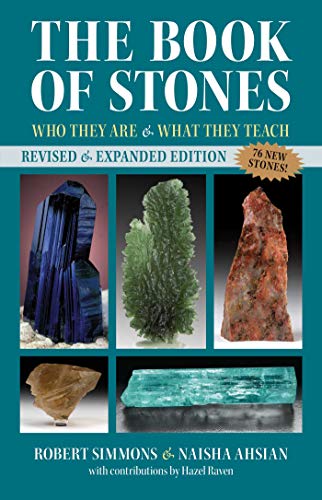
This is the book for readers who want both a practical reference and a more spiritual, exploratory voice. Robert Simmons and Naisha Ahsian use a dual-perspective format that makes it unique: Simmons writes the metaphysical and healing properties for each stone, while Ahsian adds a channeled spiritual message. Covering over 400 stones with high-quality photographs, it sits between a working healing reference and a book of spiritual contemplation.
The co-author structure is the real draw. Giving readers two distinct viewpoints on the same stone is something no other book here does, and it can be illuminating to see a grounded healing description sit beside a more intuitive, channeled passage. The photography is strong, the coverage of over 400 stones is generous without being overwhelming, and the writing invites you to sit with a stone rather than just file it under a property.
The honest caveat is that the channeled-message format asks a lot of belief from the reader. The spiritual passages are presented as received guidance, so readers who want an evidence-minded or purely practical reference may find that half of each entry does not serve them. The dual structure also means each stone gets two shorter takes rather than one deep, unified treatment, which some prefer and others do not. If the spiritual dimension appeals to you, it is a rich and distinctive companion; if it does not, a straight directory will suit you better.
What to look for
Before you choose, decide what role the book will play on your shelf. These factors separate the options above.
- Purpose: A directory (Crystal Bible, Love Is in the Earth) is for looking things up; a ritual book (Crystal Muse) is for guided practice. Be clear which you want.
- Coverage: Entry counts range from a focused selection to over 1,200 stones. More is not always better if you only need common crystals.
- Photography: Identification depends on good images. Multiple shots per stone (Essential Guide) help when a mineral looks different raw versus tumbled.
- Depth per entry: Decide whether you want quick one-paragraph summaries or long, detailed discussions of vibrational and astrological associations.
- Usability: Alphabetical and color-based indexing makes a book far faster to use in the moment than a purely thematic layout.
- Framing of claims: Some books present metaphysical properties as fact, others lean into channeled or spiritual content. Know what you are comfortable taking on belief.
- Reader level: Beginners are better served by clear, concise guides; dense professional references can overwhelm before they help.
The verdict
For most people, The Crystal Bible by Judy Hall is the book to buy first. It is fast, broad, well-photographed, and easy to use, which is exactly what you want from a daily reference. If you need maximum depth and work with crystals seriously, Love Is in the Earth by Melody is the most comprehensive option here, with the caveat that it is dense and beginner-unfriendly. For guided practice over pure reference, Crystal Muse by Heather Askinosie pairs beautiful photography with intention-based rituals. Collectors who care about how stones form and how they look in different cuts should choose The Essential Guide to Crystals by Simon and Sue Lilly. And if you want a practical reference with an added spiritual voice, The Book of Stones by Robert Simmons and Naisha Ahsian offers two perspectives on every stone, as long as you are open to channeled content.
Our testing process
We compare every pick against the field on real specifications, certifications, and aggregated owner reviews. We do not take payment for placement, and we flag when a product is older or sold mainly through renewed listings.
Quick comparison
| Pick | Best for | Score | |
|---|---|---|---|
| The Crystal Bible by Judy Hall | All-round reference | Check price | |
| Love Is in the Earth by Melody | Deep healing reference | Check price | |
| Crystal Muse by Heather Askinosie | Rituals and intentions | Check price | |
| The Essential Guide to Crystals by Simon and Sue Lilly | Check price | ||
| The Book of Stones by Robert Simmons and Naisha Ahsian | Check price |
Reviewed in detail
The Crystal Bible by Judy Hall
Judy Hall's Crystal Bible is the single most recommended crystal book in the world, and for good reason. First published in 2003, it has been continuously updated and covers over 200 crystals with full-color photographs, physical descriptions, and detailed metaphysical properties. The directory format makes it easy to look up any stone alphabetically or by color. Hall writes with authority and clarity, making complex energy concepts accessible without being dismissive of the science behind mineral formation. A must-have first book for anyone entering the crystal world.

Love Is in the Earth by Melody
Melody's monumental reference work covers over 1,200 minerals, rocks, and meteorites with detailed metaphysical descriptions. It is the reference of choice for serious crystal healers and practitioners, cited extensively in professional healing communities. The depth of each entry goes far beyond competing books - covering vibrational qualities, chakra associations, astrological correspondences, and healing applications. The writing is dense and encyclopedic rather than casual, making it less ideal for light reading but invaluable as a professional reference.

Crystal Muse by Heather Askinosie
Crystal Muse, written by the co-founder of Energy Muse, takes a ritual-focused approach to working with crystals. Rather than an A-to-Z directory, it is organized around intentions - abundance, protection, love, clarity - with specific crystal recommendations and step-by-step rituals for each goal. The photography is exceptional, with styled flat-lays that make it one of the most visually appealing crystal books available. It works best as a companion to a directory reference like The Crystal Bible rather than a standalone encyclopaedia.

The Essential Guide to Crystals by Simon and Sue Lilly
Simon and Sue Lilly's Essential Guide is one of the best visually led crystal references available. Each entry includes multiple photographs of the stone in raw, tumbled, and cut forms alongside mineral data and healing applications. The inclusion of geological context - how each crystal forms and where it is mined - sets it apart from purely metaphysical guides. It is particularly useful for collectors who want to identify specimens accurately, and the glossy pages make it a handsome coffee-table reference.
What we liked
- The Essential Guide to Crystals: All the Crystals You Will Ever Need for Health, Healing,
The Book of Stones by Robert Simmons and Naisha Ahsian
Robert Simmons and Naisha Ahsian bring a dual-perspective approach that makes this book unique: Simmons writes the metaphysical and healing properties for each stone, while Ahsian adds a channeled spiritual message. Covering over 400 stones with high-quality photographs, it bridges the gap between practical healing reference and spiritual exploration. The co-author format gives readers two distinct viewpoints on each crystal, making it especially valuable for practitioners who want to cross-reference interpretations. It is a step up in complexity from The Crystal Bible and suits readers ready to go deeper.
How to choose
Format
- Directory-style books (Judy Hall, Melody) allow quick lookup by stone name. Intention-based books (Crystal Muse) guide practice by goal. Choose based on how you plan to use the book.
Photography
- High-quality photos are essential for stone identification and visual learners. The Essential Guide and Crystal Muse lead in this area.
Depth vs. accessibility
- Love Is in the Earth and The Book of Stones offer unmatched depth but reward patient readers. The Crystal Bible hits the sweet spot for most people.
Coverage breadth
- If you collect rare or unusual specimens, prioritize books that cover 400+ stones. For a general introduction, 200 stones is plenty.
Author credentials
- Judy Hall, Melody, and Robert Simmons are widely respected within the crystal community and have decades of writing and practice behind them.
The bottom line
For most readers, The Crystal Bible by Judy Hall is the ideal starting point - broad, affordable, and authoritative. Serious practitioners will want to add Love Is in the Earth for its unrivaled depth. Crystal Muse is the best pick for anyone who wants beautiful photography and ritual guidance. Together, two or three of these books form a complete crystal library that will serve you for years.
Common questions
Love Is in the Earth by Melody is the most comprehensive reference for healing applications, covering over 1,200 minerals with detailed metaphysical properties and therapeutic correspondences.
Crystal healing is considered a complementary practice rather than evidence-based medicine. These books are guides to cultural, spiritual, and intuitive traditions around stones, and should not replace medical advice.
Judy Hall published three Crystal Bible volumes. Volume 1 covers the most widely used crystals. Volumes 2 and 3 expand into rarer stones and newer discoveries, making all three valuable as a complete reference set.
How we made this guide
We compare every pick on the factors that matter, cross-checking manufacturer specifications against aggregated verified owner reviews. We rank independently and never take payment for placement. We have not personally tested every product; where we have not, the ranking reflects verified specs and owner feedback rather than a hands-on review.
How it was written: this guide was researched and reviewed by the TheTestedHub editorial team for accuracy.
Affiliate disclosure: TheTestedHub is reader-supported. When you buy through links on our site, we may earn a commission at no extra cost to you.
More guides

Education Books for Every Budget: What’s Worth Applying in 2026

Culinary Books Worth Every Penny for Every Skill Level

Buy the Best Cryptocurrency Books & Security Guides 2026

Buy the Wisden Book of Test Cricket 1877-2025 & Top Collectibles

Books for Cricket Fans: Choose by What You Want to Learn

Craft Books Compared: The Knitter’s Guide to 2026’s Essential Reads

Funny Books with Heart: Best Comedy Reads of 2026
