Quick verdict
For CS:GO, you cannot go wrong with any mouse on this list as long as you match it to your grip style and budget. The Logitech G Pro X Superlight 2 is the outright performance leader for players who can justify the premium. The Endgame Gear XM1r is the mid-range value champion for claw and fingertip grip players who want professional-grade sensor performance without the wireless premium. The SteelSeries Rival 3 gives

Logitech G Pro X Superlight 2
The G Pro X Superlight 2 is the mouse that most professional CS:GO players would choose if budget were no object, and for good reason. It weighs under 60 grams - lighter than almost every other wireless mouse - carries Logitech's HERO 2 sensor (one of the two or three most accurate gaming sensors available), and uses LIGHTSPEED wireless technology that has been battle-tested at the highest levels of competitive play. The symmetrical shape works for right-handed and left-handed players alike and accommodates palm, claw, and fingertip grip styles without strongly favoring any single approach.
Find your perfect CS:GO mouse,options for every grip style and budget tier, from budget to premium. Real sensor tech and build quality for competitive play.
Choosing a gaming mouse for CS:GO is not a single-answer problem. The game’s competitive player base spans every hand size, every grip style, and every budget tier – and the mouse market has responded accordingly, with genuinely excellent options at every price point from to. The question is not which mouse is objectively best but which mouse fits your grip style, hand size, and budget. This roundup takes that reality seriously. Rather than declaring a single winner, we have covered five mice that represent the strongest options across three budget tiers – budget, mid-range, and premium (+) – and three grip styles (palm, claw, fingertip). Every mouse on this list has a competitive case based on real sensor technology, build quality, and the ergonomic fit required for consistent CS:GO performance. Whether you are building your first competitive setup or upgrading from aging hardware, there is a right answer in this list for your situation.
| Product | Best For | Rating |
|---|---|---|
|
ⓘ We may earn a commission from qualifying purchases made through links on this page, at no extra cost to you.
|
Premium wireless, any grip | 4.9/5 |
| Razer Viper V3 Pro | FPS specialist, fingertip/claw | 4.8/5 |
| Endgame Gear XM1r | Low-profile FPS, claw/fingertip | 4.7/5 |
| SteelSeries Rival 3 | Budget entry, palm/claw | 4.5/5 |
| Pulsar X2H | Ergo shape, palm/claw | 4.7/5 |
How we picked
We compare every pick against the field on real specifications, certifications, and aggregated owner reviews. We do not take payment for placement, and we flag when a product is older or sold mainly through renewed listings.
Top picks compared
| Pick | Best for | Score | |
|---|---|---|---|
| Logitech G Pro X Superlight 2 | Premium wireless, any grip | Check price | |
| Razer Viper V3 Pro | FPS specialist, fingertip/claw | Check price | |
| Endgame Gear XM1r | Low-profile FPS, claw/fingertip | Check price | |
| SteelSeries Rival 3 | Budget entry, palm/claw | Check price | |
| Pulsar X2H | Ergo shape, palm/claw | Check price |
Our picks up close
Logitech G Pro X Superlight 2
The G Pro X Superlight 2 is the mouse that most professional CS:GO players would choose if budget were no object, and for good reason. It weighs under 60 grams - lighter than almost every other wireless mouse - carries Logitech's HERO 2 sensor (one of the two or three most accurate gaming sensors available), and uses LIGHTSPEED wireless technology that has been battle-tested at the highest levels of competitive play. The symmetrical shape works for right-handed and left-handed players alike and accommodates palm, claw, and fingertip grip styles without strongly favoring any single approach.
Where it shines
- Sub-60g weight eliminates fatigue during extended ranked sessions
- HERO 2 sensor accuracy is at the absolute top of the gaming sensor market
- LIGHTSPEED wireless matches wired latency at any competitive polling rate
Where it falls short
- Premium price point not justified for casual or occasional CS:GO players
- Minimal ergonomic shaping may not suit palm grip players who prefer a contoured mouse

Razer Viper V3 Pro
The Razer Viper V3 Pro is built around one specific use case: FPS competition. The ambidextrous flat shape is optimized for fingertip and claw grip styles that dominate high-level Counter-Strike play, the Focus Pro optical sensor is one of the most capable FPS sensors available, and HyperSpeed wireless keeps connection reliability solid at 1000Hz polling. Razer also offers a 4000Hz polling mode with compatible hardware, which is increasingly standard at the highest competitive levels.
Where it shines
- Fingertip/claw-optimized shape mirrors the grip style of most professional CS:GO players
- Focus Pro sensor delivers class-leading tracking accuracy and consistency
- Lightweight construction reduces arm fatigue during extended play sessions
Where it falls short
- Ambidextrous flat shape is not ideal for palm grip players who need more rear volume
- Higher price point without the brand name recognition of Logitech in the professional space

Endgame Gear XM1r
The XM1r is the mid-range pick that punches above its price class in nearly every measurable dimension. At it offers a PAW3370 optical sensor that competes with sensors found in mice twice the price, a low-profile flat shape that natural-position claw and fingertip grip players consistently rate highly, and wired-only connectivity that keeps the cost down without sacrificing the responsive feel competitive players need.
Where it shines
- PAW3370 sensor delivers sensor performance well above its price tier
- Thin, flexible cable minimizes drag for a near-wireless feel at wired cost
- Low-profile shape works exceptionally well for claw and fingertip grip styles
Where it falls short
- Wired only - no wireless option available at any price point for this model
- Small footprint may feel cramped for palm grip players with large hands
SteelSeries Rival 3
The SteelSeries Rival 3 is the budget tier's strongest representative: a straightforward right-handed gaming mouse with a TrueMove Core optical sensor, a comfortable slightly-contoured shape that works for palm and claw grip, and a price point that rarely exceeds. For new CS:GO players building a first competitive setup, or anyone who needs a reliable spare mouse, the Rival 3 delivers everything necessary for competitive play at a cost that leaves budget for a quality mousepad and audio.
Where it shines
- Accessible price point makes competitive-ready hardware available at any budget
- Comfortable right-handed shape suits both palm and claw grip styles
- Solid build quality with no flex or button inconsistency at price tier
Where it falls short
- Wired only, with a stiffer cable than mid-range competition
- TrueMove Core sensor is competitive but not at the level of PAW3370 or HERO 2
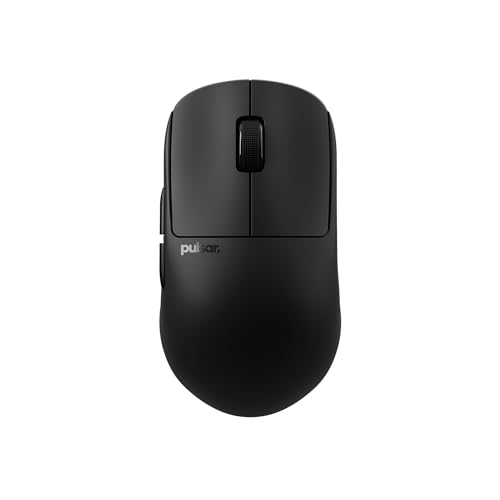
Pulsar X2H
The Pulsar X2H is the ergonomic option in this roundup - a right-handed contoured shape with enough rear volume to satisfy palm grip players while remaining light enough at under 55 grams to keep pace with the flat symmetrical competition. Pulsar's PAW3395 sensor implementation is one of the cleaner ones available in a production mouse, and the X2H's wireless connection at 1000Hz polling is as clean as any competitor at this price range.
Where it shines
- Ergonomic contoured shape provides palm grip support absent from flat symmetrical designs
- Sub-55g weight is exceptional for a right-handed ergonomic mouse
- PAW3395 sensor is among the most accurate available in this price tier
Where it falls short
- Right-handed only - left-handed players cannot use this shape
- Less mainstream brand recognition means potentially more difficulty finding accessories and feet
Before you buy
Grip style fit
Your grip style is the most important filter. Palm grip players need rear volume and a gentle arch; claw grip players benefit from a shape that positions fingers at an angle; fingertip grip players typically prefer flat, compact mice they can maneuver with minimal hand anchoring. Buy the shape for your grip, then evaluate sensor quality within that constraint.
Sensor quality
Modern optical sensors from PAW (PixArt), Logitech, and Razer are all competitive at the 3370/3395/HERO 2/Focus Pro level. Avoid mice with lower-spec sensors that have known jitter or angle-snapping behavior, which are dealbreakers for CS:GO tracking.
Wired vs. wireless
Premium wireless is now genuinely equivalent to wired for competitive purposes. Budget wireless is not - if you cannot afford a quality wireless implementation, a good wired mouse is the better choice.
Weight
Under 80 grams is the standard for competitive gaming mice. Under 60 grams is premium territory. Weight reduction reduces hand and wrist fatigue over long sessions and allows faster direction changes at any sensitivity level.
The wrap-up
For CS:GO, you cannot go wrong with any mouse on this list as long as you match it to your grip style and budget. The Logitech G Pro X Superlight 2 is the outright performance leader for players who can justify the premium. The Endgame Gear XM1r is the mid-range value champion for claw and fingertip grip players who want professional-grade sensor performance without the wireless premium. The SteelSeries Rival 3 gives
Quick answers
All three major grip styles - palm, claw, and fingertip - produce high-level CS:GO players, so the best grip is the one that feels natural to your hand. Palm grip tends to improve spray control through stability; claw grip balances stability with quick wrist flicks; fingertip grip maximizes flick speed and low-sens precision. Most professional CS:GO players use claw or fingertip grip with relatively low mouse sensitivity.
Modern premium wireless gaming mice from Logitech (LIGHTSPEED), Razer (HyperSpeed), and Pulsar (PAW3395 implementation) operate at polling rates of 1000Hz or higher with latency that is functionally indistinguishable from wired in competitive gameplay. The concern about wireless latency is largely a legacy issue from earlier wireless generations - today's flagship wireless gaming mice are legitimately viable for the highest levels of competitive play.
Most competitive CS:GO players use DPI settings between 400 and 800, combined with an in-game sensitivity setting that results in a 360-degree rotation distance of 30 to 50 centimeters on their mousepad. Higher DPI with very low in-game sensitivity achieves the same eDPI as lower DPI with higher sensitivity, so the specific DPI number matters less than finding the eDPI range that gives you consistent control across spray, burst, and precision flick scenarios.
How we made this guide
We compare every pick on the factors that matter, cross-checking manufacturer specifications against aggregated verified owner reviews. We rank independently and never take payment for placement. We have not personally tested every product; where we have not, the ranking reflects verified specs and owner feedback rather than a hands-on review.
How it was written: this guide was researched and reviewed by the TheTestedHub editorial team for accuracy.
Affiliate disclosure: TheTestedHub is reader-supported. When you buy through links on our site, we may earn a commission at no extra cost to you.

