Quick verdict
There is no single best baby cup - there is only the best cup for where your baby is right now. The Philips Avent Natural Transition Cup and NUK Learner Cup serve the earliest stage beautifully. The Munchkin Miracle 360 is the most versatile single cup across the 9-18 month range. The EZPZ Tiny Cup provides essential open cup practice that complements every other option. And the Thermos Foogo transitions the straw cu
Munchkin Miracle 360
The Munchkin Miracle 360 is the most universally recommended baby cup in this category and has earned that reputation across more than a decade of real-world parent use. The design eliminates the spout entirely - instead, the baby drinks from a 360-degree rim sealed by a soft valve that opens only when lips create suction and pressure. The result is a cup that teaches an open-cup-like drinking motion while remaining completely spill-proof.
From 6-month-old first sips to confident toddler drinking, 5 tested baby cups matched to developmental stage. Find the right cup for your baby's age and.
Baby cups are one of the most confusing product categories for new parents – walk the baby aisle of any store and you will find a wall of sippy cups, straw cups, 360 cups, open cups, transition cups, and training cups all competing for attention. The confusion is understandable, but the underlying logic is simple: different cup types suit different developmental stages, and matching the cup to your baby’s age and capability is the key to a successful, low-frustration cup journey.
This guide covers the entire spectrum from first sips at 6 months through confident toddler drinking. Whether you are buying your baby’s very first cup, choosing a bottle-transition cup at 12 months, or equipping a toddler for independent hydration, this overview will help you understand what each cup type actually does and which developmental stage it is designed for.
| Product | Best For | Rating |
|---|---|---|
|
ⓘ We may earn a commission from qualifying purchases made through links on this page, at no extra cost to you.
|
Best 360 cup for the transition stage | 4.8/5 |
| Philips Avent My Natural Transition Cup | Best for breastfed babies first cup | 4.7/5 |
| NUK Learner Cup | Best soft spout beginner cup | 4.7/5 |
| EZPZ Tiny Cup | Best open cup for all-stage practice | 4.6/5 |
| Thermos Foogo Straw Bottle Sippy | Best insulated straw cup for toddlers | 4.6/5 |
How we picked
We compare every pick against the field on real specifications, certifications, and aggregated owner reviews. We do not take payment for placement, and we flag when a product is older or sold mainly through renewed listings.
Top picks compared
| Pick | Best for | Score | |
|---|---|---|---|
| Munchkin Miracle 360 | Best 360 cup for the transition stage | Check price | |
| Philips Avent My Natural Transition Cup | Best for breastfed babies first cup | Check price | |
| NUK Learner Cup | Best soft spout beginner cup | Check price | |
| EZPZ Tiny Cup | Best open cup for all-stage practice | Check price | |
| Thermos Foogo Straw Bottle Sippy | Best insulated straw cup for toddlers | Check price |
Our picks up close
Munchkin Miracle 360
The Munchkin Miracle 360 is the most universally recommended baby cup in this category and has earned that reputation across more than a decade of real-world parent use. The design eliminates the spout entirely - instead, the baby drinks from a 360-degree rim sealed by a soft valve that opens only when lips create suction and pressure. The result is a cup that teaches an open-cup-like drinking motion while remaining completely spill-proof.
Where it shines
- 360 rim eliminates spout - promotes mature drinking motion from the start
- Genuinely spill-proof at any angle - practical for active babies
- Works from 12 months through toddlerhood without needing a size upgrade
Where it falls short
- 360 valve requires intentional lip suction - some babies under 9 months find it confusing initially
- Valve wears over time and requires periodic replacement
Philips Avent My Natural Transition Cup
Philips Avent built the My Natural Transition Cup specifically for the 6-12 month range, with the breastfed baby transition in mind. The soft silicone spout closely replicates the shape and flex of a breast nipple, which dramatically increases acceptance rates for babies who reject hard-spout cups because nothing else feels familiar. The natural flex and movement of the spout under lip pressure is notably different from competing products.
Where it shines
- Breast-mimicking soft spout specifically reduces rejection by breastfed babies
- Slow-flow valve appropriate for 6-9 month beginners
- Ergonomic handles sized for bilateral infant grip
Where it falls short
- Soft spout has a limited useful lifespan before transitioning to straw or 360 cup is recommended
- Design primarily serves breastfed babies - less critical for formula-fed infants
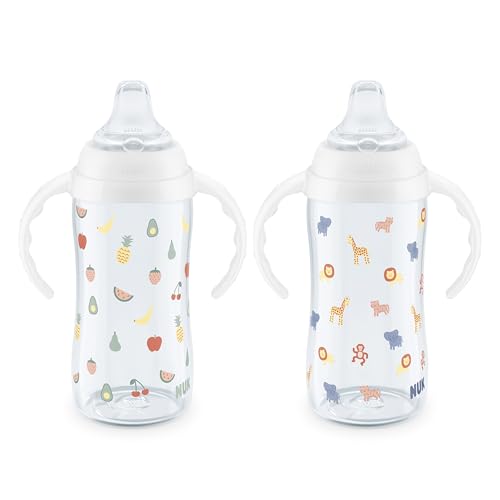
NUK Learner Cup
The NUK Learner Cup sits squarely in the first-cup category for 6-12 month olds. Its soft silicone spout, ergonomic handles, and anti-colic valve make it one of the most complete first-cup designs available at an accessible price point. The angled spout reduces how far a baby needs to tilt the cup to get liquid flowing, which is a small but meaningful design decision that reduces spill-related frustration during the earliest sipping attempts.
Where it shines
- Angled soft spout reduces required tilt for liquid flow - beginner-friendly
- Anti-colic valve minimizes air ingestion during early sipping
- Spout cover included for hygiene in bags and diaper bags
Where it falls short
- Hard spout version (some configurations) should be avoided in favor of soft
- Transition away from spout cups recommended by 12-18 months for dental health
EZPZ Tiny Cup
The EZPZ Tiny Cup is unlike anything else on this list: it is a genuine open cup - no spout, no straw, no valve - designed for babies as young as 6 months with supervision. The cup is made from 100% food-grade silicone and has a weighted, suction base that resists tipping on flat surfaces. It holds only 1 oz, which makes supervised open cup practice at mealtimes very low-stakes from a spill perspective.
Where it shines
- 100% silicone - no plastic, BPA, or BPS in any component
- Suction base resists tipping during supervised mealtime sessions
- 1-oz size makes spills during open cup learning completely manageable
Where it falls short
- Requires direct supervision - not suitable for independent use or carrying
- Not a primary cup - works as a complement to a spill-proof everyday cup
Thermos Foogo Straw Bottle Sippy
The Thermos Foogo is the upgrade pick for toddlers who have already mastered straw drinking and are ready for a more adult-style insulated water bottle. The double-wall vacuum insulation keeps water cold for up to 8 hours, which matters significantly during outdoor activities, summer outings, and full days at daycare or preschool. The push-button lid opens with one finger and has a lock feature to prevent accidental opening in a bag.
Where it shines
- Vacuum insulation keeps drinks cold for 8 hours - practical for full days out
- Push-button open with locking mechanism prevents bag spills
- Silicone straw is replaceable - extends the useful life of the bottle significantly
Where it falls short
- Heavier than plastic cups when full - better suited to 14+ month toddlers with stronger grip
- Higher price than non-insulated alternatives
Before you buy
Match cup type to developmental stage
6-9 months: soft spout or 360 trainer with handles. 9-12 months: 360 cups, soft spouts, or assisted straw cups. 12 months: transition cups for bottle weaning (360 or straw). 14+ months: straw cups, open cups, insulated bottles.
360 cups vs. sippy cups
Traditional hard-spout sippy cups are increasingly considered developmental dead ends by pediatric specialists. They extend bottle-like sucking rather than building mature drinking skills. 360 cups and straw cups are developmentally preferable from 9 months onward.
Straw cups vs. 360 cups
Both are excellent from 12 months. Speech therapists slightly favor straw cups because straw sucking uses a more mature tongue position that better supports speech development. 360 cups are preferred by many pediatricians for their complete spill resistance and intuitive design.
Open cups
Supervised open cup practice from 9 months onward builds coordination that sippy and straw cups cannot teach alone. The EZPZ Tiny Cup makes this practical at any stage.
Material safety
BPA-free plastic is the baseline. Silicone bodies and straws, and stainless steel cups, provide additional peace of mind for parents who prefer to minimize plastic exposure.
The wrap-up
There is no single best baby cup - there is only the best cup for where your baby is right now. The Philips Avent Natural Transition Cup and NUK Learner Cup serve the earliest stage beautifully. The Munchkin Miracle 360 is the most versatile single cup across the 9-18 month range. The EZPZ Tiny Cup provides essential open cup practice that complements every other option. And the Thermos Foogo transitions the straw cu
Quick answers
The main types are sippy cups (hard or soft spout), 360 cups (spout-free rim valve), straw cups, and open cups. Soft spout and 360 cups suit early beginners (6-12 months). Straw cups and 360 cups support the 12-month bottle transition. Open cups build mature drinking skills from 12 months onward. There is no single best type - the right cup depends on your baby's age and developmental stage.
Most babies can begin learning straw drinking around 9-12 months with an assisted-flow training straw. By 12-14 months, many can use a standard straw independently. Introducing straw cups earlier than a standard sippy cup is often recommended by speech therapists because straws promote a more mature swallowing pattern that supports speech development.
From a developmental standpoint, 360 cups are generally preferred over hard-spout sippy cups because they encourage a more natural lip-sealing drinking motion rather than the sucking pattern associated with bottles and spout cups. Both pediatricians and speech-language pathologists increasingly recommend 360 cups or straw cups over traditional hard-spout sippy cups.
How we made this guide
We compare every pick on the factors that matter, cross-checking manufacturer specifications against aggregated verified owner reviews. We rank independently and never take payment for placement. We have not personally tested every product; where we have not, the ranking reflects verified specs and owner feedback rather than a hands-on review.
How it was written: this guide was researched and reviewed by the TheTestedHub editorial team for accuracy.
Affiliate disclosure: TheTestedHub is reader-supported. When you buy through links on our site, we may earn a commission at no extra cost to you.
More to explore

2026 Gentle Children’s Skin Care: Cetaphil Baby Lotion Pick

10 Best Childrens Health Products of 2026: Expert Picks

Build a Love of Reading: 2026’s Best Children’s Books

Gentle Baby Skincare: Dermatologist-Approved Picks for 2026

What’s the Best Baby Skin Care? 2026 Top Pick Plus Expert Tips

Parent Approved Baby Health: Braun ThermoScan 7+ & Top Picks

Expert-Recommended Baby Furniture: Top Convertible Cribs for Growth
