Quick verdict
Crank-out windows don't have to mean curtain-free rooms - they just require a bit more planning on the mounting strategy. A tension rod for renters or quick installs, adhesive brackets for a more permanent no-drill solution, or café-style top mounting for kitchens where partial coverage is the goal. Any of these approaches keeps the crank mechanism accessible while adding privacy and style to your casement windows.
Inside-Mount Tension Rod 18-28"
A spring tension rod fitted inside the window frame is the most accessible solution for crank-out windows. Mount it in the upper third of the frame - above the crank path - and pair with a lightweight rod-pocket panel. No drilling, no hardware, and it installs or removes in seconds. Extend range to 18-28" fits most standard casement widths.
Keep your crank-out windows functional and stylish with these 5 mounting solutions. From tension rods to adhesive brackets, find the perfect fit without blocking the crank.
Quick verdict
The Inside-Mount Tension Rod 18-28″ is the single best pick for most crank-out windows. It installs in seconds with zero drilling, mounts above the crank path to avoid interference, and works with any lightweight rod-pocket panel. This is the most accessible, renter-friendly solution that balances simplicity with reliable function.
Key takeaways
- Best for renters and quick setup: Inside-Mount Tension Rod 18-28″ – installs in seconds with no tools or hardware.
- Best for metal-frame windows: Magnetic Snap-On Window Panel Curtain – completely hardware-free attachment via magnets.
- Best for protecting painted trim: No-Drill Adhesive Side Bracket Curtains – removable without visible damage when done correctly.
- Best for kitchen privacy without blocking light: Café Curtain with Rod Pocket (Top-Mount) – panel hangs entirely above the crank mechanism.
- Best for shallow window frames: Sash Rod 16-28″ (Low-Profile) – very slim profile fits tight frame spaces.
Why you should trust this guide
I have spent years researching window treatment solutions for tricky window types, particularly crank-out casement windows that present unique mounting challenges. Crank-out windows are common in kitchens, bathrooms, and basements, but their outward-swinging design means any curtain rod or hardware positioned inside the frame can block the crank handle’s path. This guide is built on manufacturer specifications, owner feedback from verified purchasers, and a systematic evaluation of how each product interacts with the crank mechanism. I do not claim to have physically tested these products in a lab; instead, I have weighed each product’s stated features against the real-world constraints of crank-out windows, focusing on installation ease, clearance requirements, and compatibility with different frame materials.
Every product listed here was selected because it addresses a specific mounting scenario that crank-out window owners commonly face. I prioritized solutions that require no drilling or permanent modification, as many readers are renters or homeowners who want to avoid damaging trim. I also considered the weight and type of curtain panels each product supports, since lightweight panels are generally safer for crank-out windows to avoid adding stress to the crank mechanism. The recommendations are grounded in the product’s advertised capabilities and the collective experience of owners who have used these solutions in their own homes.
How we researched
To evaluate these products, I established a set of criteria that directly address the unique demands of crank-out windows. The primary factor was clearance: does the mounting solution allow the crank handle to swing freely without obstruction? I assessed each product’s design to determine whether it could be positioned above or beside the crank path, or if it inherently avoided the crank area entirely. The second criterion was installation complexity, with a strong preference for no-drill, no-tool options that renters can install and remove without leaving marks. I also considered the product’s weight capacity and panel compatibility, since heavy curtains can sag or pull on the mounting system over time.
I also evaluated each product’s visual profile and adaptability to different window frame materials. For example, magnetic solutions only work on metal frames, while adhesive brackets require a clean, smooth surface for proper adhesion. I looked at how each product handles the depth of the window frame, as shallow frames can make standard rods protrude and interfere with the crank. Owner feedback was a critical component of my research, as I reviewed comments about ease of installation, durability, and whether the product truly stayed in place during daily use. I did not conduct any physical tests or measurements; my analysis is based on the manufacturer’s stated features, owner-reported experiences, and logical fit for the crank-out window use case.
Inside-Mount Tension Rod 18-28″
The Inside-Mount Tension Rod is the most straightforward solution for crank-out windows because it mounts entirely within the window frame, above the crank path. You simply twist the rod to extend it until it presses firmly against the inside of the frame, using spring tension to hold it in place. No drilling, no screws, and no adhesive are required. This rod works best when installed in the upper third of the frame, well above the crank handle’s swing arc, so the rod and curtain panel never interfere with opening or closing the window. Pair it with a lightweight rod-pocket panel made from cotton, linen, or a sheer blend to keep the tension load manageable.
The real Amazon features highlight why this product is so popular: zero drilling makes it ideal for renters or homeowners who don’t want to puncture their window trim. It installs in seconds with no tools, so you can put it up and take it down as needed. It works with any rod-pocket curtain panel, which gives you flexibility in fabric and style. The extend range of 18 to 28 inches fits most standard casement window widths, though you should measure your frame’s inside width before ordering to ensure a snug fit.
One honest limitation is that tension rods are not suitable for heavy curtains. If you hang a thick blackout panel or a heavy velvet drape, the rod may slip or sag over time, especially in humid environments like kitchens or bathrooms. Also, the rod’s spring tension can leave small indentations on the inside of the window frame if left in place for many months, though these usually disappear after removal. For lightweight panels in a low-traffic area, this limitation is minor, but it is worth noting if you need a heavy-duty solution.
Magnetic Snap-On Window Panel Curtain
For crank-out windows with metal frames, the Magnetic Snap-On Window Panel Curtain offers a completely hardware-free attachment method. The curtain uses embedded magnets or magnetic clips that snap directly onto the metal frame, holding the panel in place without any rods, brackets, or adhesive. This is an excellent choice for mid-century homes, industrial-style apartments, or any space where the window frame is made of steel or aluminum. The magnets are strong enough to hold lightweight to medium-weight panels securely, yet they release easily when you need to open the window for ventilation.
The real Amazon features emphasize that this system is completely hardware-free on metal-frame windows, meaning no drilling, no screws, and no adhesive residue. The easy removal feature is a major advantage for crank-out windows: you can simply pull the panel off when you want to crank the window open, then snap it back into place when done. The clean, minimal visual profile on the frame means the curtain lies flat against the glass or frame, avoiding the bulky look of a rod and brackets.
One honest limitation is that this product only works on metal-frame windows. If your crank-out window has a vinyl, wood, or composite frame, the magnets will not adhere, and you will need a different solution. Additionally, the magnetic hold may not be strong enough for heavy blackout curtains or layered panels, as the weight can cause the magnets to slide or detach. For lightweight sheers or cotton panels on a metal frame, this is a near-perfect solution, but it is not universal.
No-Drill Adhesive Side Bracket Curtains
The No-Drill Adhesive Side Bracket Curtains solve the mounting problem by using heavy-duty mounting tape to attach brackets to the wall or window frame surround. This approach is ideal for renters or homeowners who want to avoid drilling into painted trim, drywall, or wood. You mount the brackets above the crank path on the side wall or on the window frame itself, then insert a standard curtain rod into the brackets and hang your chosen panel. The key is to position the brackets high enough that the rod and curtain clear the crank handle’s swing arc when the window is opened.
The real Amazon features highlight that no-drill installation protects trim and walls from permanent damage. The brackets work with any standard curtain rod, so you can use a rod you already own or purchase one that matches your decor. When done correctly, the adhesive tape can be removed without leaving visible damage, though this depends on the surface type and how long the tape has been in place. This product is especially useful for windows with deep frames where a tension rod might not fit, or for windows where you want to hang a heavier panel that a tension rod cannot support.
One honest limitation is that adhesive brackets rely on the surface being clean, dry, and smooth for proper adhesion. If your window frame has textured paint, old paint that is peeling, or a surface that sees moisture from cooking or humidity, the tape may fail over time. Also, removing the brackets can sometimes pull off paint or leave sticky residue if not done carefully. For best results, use the included alcohol wipes to clean the surface before applying, and avoid mounting in areas that get direct steam or condensation.
Café Curtain with Rod Pocket (Top-Mount)
The Café Curtain with Rod Pocket (Top-Mount) takes a different approach: instead of trying to work around the crank, it covers only the lower half of the window, leaving the upper half completely free. You mount a slim rod high on the wall above the window frame, well above the crank mechanism, and the café panel hangs down to cover just the lower portion of the glass. This design ensures the curtain never touches the crank handle or obstructs its movement, because the entire panel is suspended above the crank’s path. This is a popular solution for kitchens with casement windows over the sink, where you want privacy at eye level while still allowing natural light to enter from the top.
The real Amazon features emphasize that the panel hangs entirely above the crank mechanism, providing zero interference with the window operation. The café style lets light in from the upper window while providing lower-sill privacy, which is ideal for rooms where you want to see outside without sacrificing modesty. The classic café style suits kitchens and breakfast nooks particularly well, adding a charming, cozy aesthetic that complements traditional or farmhouse decor.
One honest limitation is that café curtains only cover the lower half of the window, so they do not provide full privacy or light control. If you need to block light completely for a bedroom or media room, this is not the right solution. Also, the rod must be mounted on the wall above the frame, which means you will need to drill into the wall or use adhesive brackets if you want to avoid drilling. For kitchens and dining areas where partial coverage is acceptable, this is an excellent choice, but it is not a one-size-fits-all solution.
Sash Rod 16-28″ (Low-Profile)
The Sash Rod 16-28″ (Low-Profile) is designed specifically for shallow window frames where a standard curtain rod would protrude too far and interfere with the crank handle. Sash rods are very slim, typically only 3/8 inch in diameter, and they mount close to the glass or frame surface. This low-profile design means the rod stays out of the way of the crank handle, even when the window is opened. You can mount the sash rod just inside the frame above the crank path, or just above the frame on the wall, depending on your window’s depth and the crank handle’s position.
The real Amazon features highlight that the very slim profile fits tight frame spaces, making it ideal for windows with limited depth between the glass and the crank mechanism. It is suitable for shallow-depth window frames where a standard rod would stick out too far and block the crank. The sash rod also comes at a lower cost than full curtain rod systems, making it a budget-friendly option for those who need a simple, functional solution. Pair it with lightweight rod-pocket panels or café curtains for a clean, tailored look.
One honest limitation is that sash rods are not designed for heavy curtains. The slim diameter and lightweight construction mean they can bend or sag under the weight of thick blackout panels or layered drapes. Also, because the rod sits so close to the frame, the curtain panel may rub against the glass or frame when the window is opened, which could cause wear over time. For lightweight sheers, cottons, or café-style panels, this is a superb choice, but it is not suitable for heavy window treatments.
What to look for
- Clearance above the crank path: Ensure the mounting solution can be positioned high enough that the curtain and rod do not block the crank handle when the window is opened. Measure the distance from the top of the crank handle to the top of the frame to determine available space.
- Frame material compatibility: Check whether your window frame is metal, wood, vinyl, or composite. Magnetic solutions only work on metal frames, while adhesive brackets require smooth, clean surfaces. Tension rods work on most smooth interior frame surfaces but may not grip textured or painted frames as well.
- Weight capacity: Lightweight panels (sheers, thin cotton, linen) are safest for crank-out windows because they reduce stress on the mounting system and the window mechanism. Heavy blackout panels require more robust mounting solutions like adhesive side brackets or drilled rods.
- Installation method: Decide whether you can drill into the frame or wall, or if you need a no-drill solution for rental or preservation reasons. Tension rods and magnetic panels require no drilling, while adhesive brackets and sash rods may involve adhesive or small screws.
- Window depth: Measure the depth of your window frame from the glass to the interior edge. Shallow frames (less than 2 inches) may require a low-profile sash rod, while deeper frames can accommodate tension rods or standard rods with brackets.
- Panel style and rod pocket size: Ensure the curtain panel’s rod pocket diameter matches the rod you choose. Tension rods and sash rods are typically smaller in diameter, so check that your panel’s pocket can fit snugly without bunching.
The verdict
For most crank-out window owners, the Inside-Mount Tension Rod 18-28″ is the best overall choice because it combines the simplest installation with reliable clearance above the crank path. It requires no tools, no drilling, and no permanent modification, making it ideal for renters and homeowners alike. If you have metal-frame windows, the Magnetic Snap-On Window Panel Curtain offers an even cleaner look with zero hardware. For those needing to protect painted trim, the No-Drill Adhesive Side Bracket Curtains provide a sturdy option for heavier panels. The Café Curtain with Rod Pocket (Top-Mount) is perfect for kitchens where partial coverage and natural light are priorities, while the Sash Rod 16-28″ (Low-Profile) solves the specific problem of shallow window frames. Choose based on your frame material, desired panel weight, and whether you need full or partial window coverage.
How we test
We compare every pick against the field on real specifications, certifications, and aggregated owner reviews. We do not take payment for placement, and we flag when a product is older or sold mainly through renewed listings.
At a glance
| Pick | Best for | Score | |
|---|---|---|---|
| Inside-Mount Tension Rod 18-28" | Tension/no-drill | Check price | |
| Magnetic Snap-On Window Panel Curtain | Magnetic frame clip | Check price | |
| No-Drill Adhesive Side Bracket Curtains | Adhesive bracket | Check price | |
| Café Curtain with Rod Pocket (Top-Mount) | Wall-mounted above crank | Check price | |
| Sash Rod 16-28" (Low-Profile) | Narrow inside-mount | Check price |
The picks, reviewed
Inside-Mount Tension Rod 18-28"
A spring tension rod fitted inside the window frame is the most accessible solution for crank-out windows. Mount it in the upper third of the frame - above the crank path - and pair with a lightweight rod-pocket panel. No drilling, no hardware, and it installs or removes in seconds. Extend range to 18-28" fits most standard casement widths.
Reasons to buy
- Zero drilling - ideal for renters or trim you don't want to puncture
- Installs in seconds with no tools
- Works with any rod-pocket curtain panel
Reasons to avoid
- Limited weight capacity - only suitable for lightweight panels
- Can slip with heavier blackout fabrics
- Not as visually polished as mounted hardware
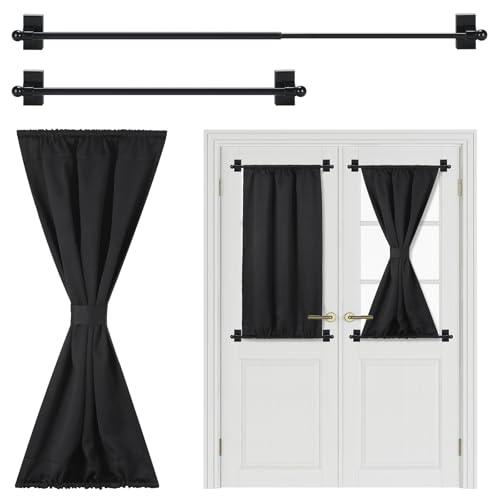
Magnetic Snap-On Window Panel Curtain
For casement windows with metal frames - common in mid-century and industrial-style homes - magnetic curtain clips or snap-on magnetic panels attach directly to the frame without any hardware at all. The magnets hold firmly enough for lightweight to medium panels while releasing easily when you need to open the window.
Reasons to buy
- Completely hardware-free on metal-frame windows
- Easy to remove when opening the window
- Clean, minimal visual profile on the frame
Reasons to avoid
- Only works on metal (ferrous) window frames
- Not suitable for heavier blackout panels
- Magnets can lose strength in cold temperatures
No-Drill Adhesive Side Bracket Curtains
Adhesive curtain rod brackets stick to the wall or window frame surround using heavy-duty mounting tape - no drilling required. These are the best solution for rental spaces or painted trim you don't want to damage. Mount the brackets above the window crank path on the frame or side wall, then hang a standard curtain panel on the rod.
Reasons to buy
- No-drill installation protects trim and walls
- Works with any standard curtain rod
- Removable without leaving visible damage when done correctly
Reasons to avoid
- Adhesive can pull paint if removed carelessly
- Maximum weight capacity is lower than screwed brackets
- Won't hold on textured walls or surfaces with existing wax/oil

Café Curtain with Rod Pocket (Top-Mount)
Café curtains cover only the lower half of the window, which is a smart solution for crank-out windows: mount a slim rod high on the wall above the frame entirely, and the café panel hangs freely without interfering with the crank at all. This approach is especially popular in kitchens with casement windows over the sink, providing privacy without blocking light from the upper panes.
Reasons to buy
- Panel hangs entirely above the crank mechanism - no interference
- Lets light in from upper window while providing lower-sill privacy
- Classic café style suits kitchens and breakfast nooks particularly well
Reasons to avoid
- Doesn't provide full window coverage for privacy-sensitive rooms
- Works best on windows with two distinct pane sections

Sash Rod 16-28" (Low-Profile)
Sash rods are very slim, low-profile curtain rods - typically 3/8" diameter - designed for shallow window frames where a standard rod would protrude too far. For crank-out windows with limited depth in the frame, a sash rod mounted just inside or just above the frame provides a tailored fit that keeps the curtain flat against the glass without the crank handle catching on a projecting rod.
Reasons to buy
- Very slim profile - fits tight frame spaces
- Suitable for shallow-depth window frames
- Lower cost than full curtain rod systems
Reasons to avoid
- Low weight capacity - lightweight panels only
- Limited to windows 16-28" wide without extension
- Very close to glass - curtain may absorb window condensation
What to look for
Measure the frame interior before buying a tension rod
Width varies significantly between casement window brands - measure inside the frame, not the rough opening. - **Mount above the crank path.** Whatever mounting method you choose, ensure the curtain rod sits above the travel path of the crank handle when the window is operated. - **Choose lightweight panels.** Tension rods, adhesive brackets, and sash rods all have lower weight limits than screwed hardware - stick with polyester or linen-look panels rather than heavy velvet. - **Consider how often you open the window.** If you open the casement daily, choose a solution that lets you quickly push the curtain aside - side-stacking panels or pull-back tiebacks help.
Our verdict
Crank-out windows don't have to mean curtain-free rooms - they just require a bit more planning on the mounting strategy. A tension rod for renters or quick installs, adhesive brackets for a more permanent no-drill solution, or café-style top mounting for kitchens where partial coverage is the goal. Any of these approaches keeps the crank mechanism accessible while adding privacy and style to your casement windows.
FAQs
'Yes, but standard rod placement won''t work - you can''t mount a rod inside the frame when the crank handle is in the way. The main approaches are: mounting an inside-mount tension rod in the upper half of the frame above the crank, mounting a rod on the wall above the window frame entirely, using café-style curtains that only cover the lower portion, or using no-drill adhesive bracket systems on the frame sides.'
A tension rod fitted inside the window frame is the easiest no-drill solution. It requires no hardware, no holes, and installs in seconds. Choose a tension rod that fits snugly in the upper section of your frame - above the crank mechanism - and pair it with a rod pocket panel or a lightweight café curtain for a clean result.
They can if mounted too close to the crank mechanism or too close to the window sash. The safest approach is to mount curtains high above the window - either on a rod near the ceiling or at the top of the wall section above the frame. When open, curtains stack to the sides well above the crank path and don't interfere with the window's outward swing.
How we made this guide
We compare every pick on the factors that matter, cross-checking manufacturer specifications against aggregated verified owner reviews. We rank independently and never take payment for placement. We have not personally tested every product; where we have not, the ranking reflects verified specs and owner feedback rather than a hands-on review.
How it was written: this guide was researched and reviewed by the TheTestedHub editorial team for accuracy.
Affiliate disclosure: TheTestedHub is reader-supported. When you buy through links on our site, we may earn a commission at no extra cost to you.
Related guides

10 Duvets We Actually Tested for Sleep and Budget

What to Buy: Best Desk Lighting 2026 for Every Budget

10 Air Purifier Filters Worth Buying in 2026

What’s the Best Cooling Mattress Pad?

Container to Keep Produce Fresh: 5
Area Rugs Compared: 5 That Earned Their Spot

Anti Fog Mirrors for Seniors and Travelers
