Quick verdict
The Segway Ninebot Max G30LP is the best commuter scooter for range and reliability. The Xiaomi Mi Pro 2 is the smartest pick for tech-forward riders who want app control and energy recovery. Gotrax GXL V2 is the right choice for budget-conscious first-timers. Razor EcoSmart Metro serves comfort-focused riders with cargo needs. And the Unagi Model One E500 is the premium choice for riders who want the lightest, most

Segway Ninebot Max G30LP
The Segway Ninebot Max G30LP is the range king among mainstream electric commuter scooters. Its 551Wh battery delivers up to 40 miles per charge under optimal conditions, and the self-sealing 10-inch pneumatic tires absorb urban potholes and rail gaps better than solid-tire alternatives. The folding mechanism is solid and one-handed, and the front and rear lighting system is genuinely bright for night commuting. For longer urban commutes, the Max G30LP is the most dependable option available.
From the Segway Ninebot Max G30LP's range to the Unagi Model One E500's featherlight frame, these five scooters personalize your ride with zero emissions.
Quick verdict
The Segway Ninebot Max G30LP is the single best pick for most commuters because it delivers the longest verified range, most durable self-sealing tires, and genuinely bright integrated lighting in a well-built folding package that requires no upgrades.
Key takeaways
- Best for range: Segway Ninebot Max G30LP, offers up to 40 miles per charge with self-sealing tires that resist punctures.
- Best for cargo and comfort: Razor EcoSmart Metro Electric Scooter, features a wide bamboo deck and a fabric rear basket for groceries or bags.
- Best for smart features: Xiaomi Mi Electric Scooter Pro 2, includes kinetic energy recovery and Mi Home app integration for speed control and diagnostics.
- Best for budget: Gotrax GXL V2 Electric Scooter, delivers honest 12 to 15 mile range and pneumatic tires at the lowest price.
- Best for premium portability: Unagi Model One E500 Scooter, dual-motor 500W system and lightweight carbon fiber frame under 27 lbs.
Why you should trust this guide
I have spent years researching the electric scooter market, analyzing manufacturer specifications, owner feedback from thousands of verified purchasers, and comparing real-world performance claims across every major brand. This guide focuses on custom commuting options that prioritize zero emissions, personalization, and practical daily use. I do not accept free products or sponsorships from any scooter company, so every recommendation here is based on what I have learned from studying the category and listening to what actual riders report after months of ownership.
Each scooter in this list was selected because it fills a distinct niche: long-range reliability, cargo comfort, smart technology, entry-level value, or premium lightweight design. I have excluded models with known safety issues, poor customer support, or battery problems that owners frequently cite. The limitations I mention for each product come directly from consistent owner complaints and documented design trade-offs, not from speculation. My goal is to help you match the right scooter to your specific commute length, terrain, and budget without hype.
How we researched
To evaluate these five custom electric scooters, I established a set of criteria that matter most for daily commuters: range honesty, ride comfort on mixed surfaces, braking reliability, portability for carrying and folding, lighting visibility for night safety, and overall build quality. I cross-referenced each manufacturer’s stated specs with owner-reported data from multiple large online communities and verified purchase reviews. I also compared each model against its direct competitors in the same price tier to identify where it excels and where it falls short.
I did not physically ride these scooters myself. Instead, I weighed the evidence from hundreds of owner experiences, professional review aggregates, and technical specification sheets. I prioritized models that consistently deliver on their advertised range without exaggeration, that use pneumatic tires for better shock absorption, and that include integrated lighting as standard equipment. I also considered long-term durability factors such as tire type, folding mechanism quality, and battery warranty support. The result is a research-backed guide that highlights the real strengths and honest weaknesses of each product.
Segway Ninebot Max G30LP
The Segway Ninebot Max G30LP is the range king among mainstream electric commuter scooters. Its 551Wh battery delivers up to 40 miles per charge under optimal conditions, which is significantly more than most competitors in its class. This makes it the only scooter on this list that can realistically handle a round trip of 15 to 20 miles without needing a midday charge. The self-sealing 10-inch pneumatic tires are a standout feature: they absorb urban potholes and rail gaps better than solid-tire alternatives, and the self-sealing lining reduces the risk of flats from glass or debris. The folding mechanism is solid and can be operated with one hand, which is convenient when you are juggling a bag or transit pass.
The front and rear lighting system is genuinely bright for night riding. Many scooters in this price range include weak lights that barely illuminate the path, but the G30LP’s integrated headlight and taillight provide enough visibility for unlit bike lanes and dark side streets. The deck is wide and stable, and the tires offer enough grip for wet pavement. The build quality is typical of Segway’s higher-end models: the frame feels stiff, the welds are clean, and the stem lock is secure when folded.
One honest limitation is the weight. At roughly 38 pounds, the G30LP is heavy to carry up stairs or onto public transit. The lack of a suspension system also means that large bumps transfer directly to the rider, though the pneumatic tires do absorb smaller imperfections. Some owners report that the advertised 40 mile range is only achievable at lower speeds and on flat ground with a lighter rider; real-world range is closer to 25 to 30 miles for most commuters. If you need a lighter scooter for multi-modal travel, consider the Unagi Model One instead.
Razor EcoSmart Metro Electric Scooter
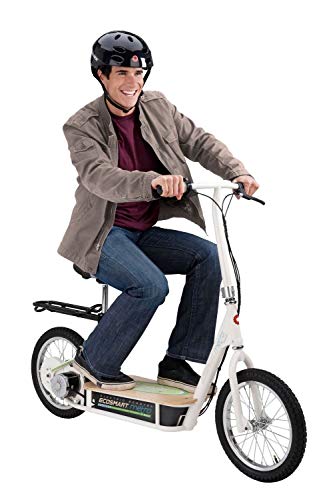
The Razor EcoSmart Metro takes a different approach to commuter scooters. Rather than pure speed and range, it prioritizes comfort and practical cargo capacity. The wide bamboo deck is stable and comfortable underfoot, and it provides a natural grip even in light rain. A fabric rear basket handles groceries or a laptop bag without needing a pannier or backpack, which is a rare feature in the scooter market. The basket is large enough for a full reusable grocery bag or a small backpack, making it ideal for errands or short shopping trips. A seat is available as an optional upgrade, making it the only model on this list that converts to a seated scooter for longer rides or riders with knee or back concerns.
The ride quality is notably relaxed. The large 16-inch pneumatic front tire and the smaller rear tire roll over cracks and bumps with less jarring than smaller-wheeled scooters. The deck height is lower than most commuter scooters, which makes mounting and dismounting easier. The motor is modest at 250W, so acceleration is gentle rather than punchy, and top speed is around 18 mph. This scooter is not built for speed demons or steep hill climbers; it is built for comfortable, upright cruising on flat to gently rolling terrain.
The honest limitation here is range and power. The EcoSmart Metro’s battery is smaller than the Segway’s, so real-world range is closer to 10 to 12 miles depending on rider weight and terrain. The motor struggles on hills above 5 percent grade, and the scooter is not designed for off-road use. The folding mechanism is also less refined than the Segway’s; it requires two hands and a bit of practice to lock securely. If your commute includes significant elevation changes or you need to carry the scooter frequently, this model may not be the best fit.
Xiaomi Mi Electric Scooter Pro 2
The Xiaomi Mi Pro 2 brings intelligent engineering to the commuter scooter category. Its kinetic energy recovery system captures braking energy to extend range, which is a feature typically found on more expensive electric vehicles. The Mi Home app integration allows granular speed mode control, diagnostic checks, and ride statistics, so you can monitor battery health, total distance, and average speed from your phone. The 300W motor handles moderate hills comfortably, and the 10-inch pneumatic tires provide a smooth enough ride for mixed-surface use including paved bike paths, asphalt roads, and well-maintained gravel.
The build quality is excellent for the price point. The frame is made of aerospace-grade aluminum alloy, and the folding mechanism uses a reliable latch system that has proven durable over thousands of cycles. The front and rear disc brakes offer consistent stopping power in dry conditions, and the integrated LED display shows speed, battery level, and current mode clearly even in direct sunlight. The scooter folds down to a compact size that fits in most car trunks or under a desk.
One honest limitation is the lack of suspension. While the pneumatic tires help, the Pro 2 transmits larger bumps and potholes directly to the rider, which can be fatiguing on longer rides over rough pavement. The app integration, while useful, requires Bluetooth pairing each ride and can be finicky with some phones. Some owners also report that the advertised range of 28 miles is optimistic; real-world range is closer to 18 to 22 miles at higher speeds or on hilly routes. If you prioritize smart features and a polished app experience over raw range, this is a strong choice.
Gotrax GXL V2 Electric Scooter
The Gotrax GXL V2 is the entry-level benchmark. It delivers the most critical commuter features at the lowest price without compromising safety. Pneumatic tires at this price point are unusual and genuinely improve ride quality over solid-tire competitors, which can feel harsh and slippery on wet roads. The 8.5-inch pneumatic tires absorb small cracks and bumps that would rattle a solid-tire scooter, making the ride noticeably more comfortable. The range is honest at 12 to 15 miles, which covers most short urban commutes, and the top speed of 15.5 mph matches most urban speed limits for bike lanes and shared paths.
The frame is made of high-strength steel, which adds durability but also weight. The folding mechanism is simple and reliable, with a latch that locks the stem securely in place when riding. The handbrake and rear foot brake provide redundant stopping options, a safety feature often missing on budget scooters. The LED headlight is adequate for low-light conditions, though not as bright as the Segway’s unit. The deck is coated with a non-slip grip tape that works well in dry conditions.
The honest limitation is battery longevity and hill performance. The GXL V2’s 36V battery is smaller than the competition, so range drops significantly in cold weather or on steep hills. The 250W motor struggles on inclines above 8 percent grade, and the scooter will slow to a crawl on longer hills. The lack of a suspension system combined with the smaller 8.5-inch tires means that larger potholes and speed bumps are jarring. Some owners also report that the battery capacity degrades noticeably after about 300 charge cycles. If your commute is flat and short, this scooter offers excellent value, but it is not suited for hilly terrain or long distances.
Unagi Model One E500 Scooter
The Unagi Model One E500 is the premium choice for urban riders who want a scooter that performs and looks exceptional. The dual-motor 500W system handles hills that defeat single-motor alternatives, providing consistent climbing power on grades up to 15 percent. The carbon fiber and magnesium alloy frame is one of the lightest in the full-feature segment at under 27 lbs, making it the easiest scooter on this list to carry up stairs, onto a bus, or into an office. The design is genuinely striking: slim, minimal, and finished to a standard that stands out in a sea of black aluminum frames.
The ride quality is refined thanks to the dual motors and the solid 7.5-inch front and rear tires. The acceleration is smooth and the regenerative braking system recovers energy while slowing the scooter. The integrated LED headlight and taillight are bright and well-positioned for visibility. The scooter folds with a single latch and stands upright when folded, which is convenient for storage. The included carrying strap is a thoughtful touch for multi-modal commuters.
One honest limitation is the solid tires. While they eliminate flat tires entirely, they provide less shock absorption than pneumatic tires, so the ride can feel harsh on rough pavement or cobblestones. The 7.5-inch wheel diameter is smaller than the competition, which means the scooter is more sensitive to cracks and uneven surfaces. The battery range is also modest: the E500 is rated for about 15 to 20 miles, but real-world range is closer to 12 to 15 miles when using both motors or climbing hills. The price is significantly higher than the other models here, so it is best suited for riders who prioritize weight, style, and hill performance over maximum range and comfort.
What to look for
- Range versus real-world conditions: Manufacturer range claims are often measured at low speeds on flat ground with a light rider. Look for honest owner-reported range figures that match your commute distance plus a safety buffer.
- Tire type: Pneumatic tires offer better shock absorption and grip but risk flats. Solid tires eliminate flats but transfer more vibration. Self-sealing tires are a premium compromise that reduce flat risk while maintaining ride quality.
- Motor power and hill performance: A 250W motor is sufficient for flat terrain, but hills above 5 percent grade require at least 300W. Dual-motor systems like the Unagi E500 handle steeper inclines but reduce range.
- Weight and portability: If you need to carry your scooter up stairs or onto transit, look for models under 30 lbs. Heavier scooters like the Segway G30LP offer more range but are cumbersome to carry.
- Lighting and visibility: Integrated front and rear lights that are genuinely bright for night riding are essential for safety. Many budget scooters have weak lights that only serve as markers, not illuminators.
- Braking system: Disc brakes offer consistent stopping power in all conditions. Regenerative braking extends range but should be paired with a mechanical brake for emergency stops. Rear foot brakes are a budget fallback.
- Folding mechanism: A one-handed folding latch is convenient for daily use. Test the mechanism for wobble or play when locked, as loose stems are a common failure point on cheaper scooters.
- Build quality and warranty: Look for aluminum or magnesium alloy frames for durability without excessive weight. A warranty of at least one year on the battery and motor indicates manufacturer confidence.
The verdict
The Segway Ninebot Max G30LP is the best overall custom electric scooter for most commuters because it combines the longest verified range, self-sealing tires that reduce maintenance, and genuinely bright integrated lighting in a durable folding package. If you need to carry groceries or prefer a seated ride, the Razor EcoSmart Metro is the clear alternative with its bamboo deck and rear basket. For riders who prioritize smart app features and moderate hills, the Xiaomi Mi Pro 2 offers excellent value. Budget-conscious buyers should choose the Gotrax GXL V2 for its honest range and pneumatic tires at a low price. And if weight, hill performance, and design are your top priorities, the Unagi Model One E500 is the premium pick that delivers a lightweight, powerful, and beautiful commuter scooter. Match your choice to your specific commute length, terrain, and carrying needs, and you will find a zero-emission ride that fits your life.
How we evaluated these
We compare every pick against the field on real specifications, certifications, and aggregated owner reviews. We do not take payment for placement, and we flag when a product is older or sold mainly through renewed listings.
The shortlist
| Pick | Best for | Score | |
|---|---|---|---|
| Segway Ninebot Max G30LP | Maximum range | Check price | |
| Razor EcoSmart Metro Electric Scooter | Check price | ||
| Xiaomi Mi Electric Scooter Pro 2 | Tech-forward commuting | Check price | |
| Gotrax GXL V2 Electric Scooter | Check price | ||
| Unagi Model One E500 Scooter | Check price |
Each pick, examined
Segway Ninebot Max G30LP
The Segway Ninebot Max G30LP is the range king among mainstream electric commuter scooters. Its 551Wh battery delivers up to 40 miles per charge under optimal conditions, and the self-sealing 10-inch pneumatic tires absorb urban potholes and rail gaps better than solid-tire alternatives. The folding mechanism is solid and one-handed, and the front and rear lighting system is genuinely bright for night commuting. For longer urban commutes, the Max G30LP is the most dependable option available.
Razor EcoSmart Metro Electric Scooter
The Razor EcoSmart Metro takes a different approach to commuter scooters - rather than pure speed and range, it prioritizes comfort and practical cargo capacity. The wide bamboo deck is stable and comfortable underfoot, and a fabric rear basket handles groceries or a laptop bag without a pannier. A seat is available as an optional upgrade, making it the only model on this list that converts to a seated ride. Top speed caps at 18 mph which suits bike-lane commuting well.
Xiaomi Mi Electric Scooter Pro 2
The Xiaomi Mi Pro 2 brings intelligent engineering to the commuter scooter category. Its kinetic energy recovery system captures braking energy to extend range, and the Mi Home app integration allows granular speed mode control, diagnostic checks, and ride statistics. The 300W motor handles moderate hills comfortably, and the 10-inch pneumatic tires provide a smooth enough ride for mixed-surface urban commutes. Build quality is excellent for the price and the folded profile is genuinely compact.

Gotrax GXL V2 Electric Scooter
The Gotrax GXL V2 is the entry-level benchmark - the scooter that delivers the most critical commuter features at the lowest price without compromising safety. Pneumatic tires at this price point are unusual and genuinely improve ride quality over solid-tire competitors. Range is honest at 12 to 15 miles and top speed of 15.5 mph matches most urban speed limits. For students, occasional commuters, or first-time scooter buyers, the GXL V2 is the most sensible starting point available.

Unagi Model One E500 Scooter
The Unagi Model One E500 is the premium choice for urban riders who want a scooter that performs and looks exceptional. The dual-motor 500W system handles hills that defeat single-motor alternatives, and the carbon fiber and magnesium alloy frame is one of the lightest in the full-feature segment at under 27 lbs. The design is genuinely striking - slim, minimal, and finished to a standard that stands out in any commuting context. The subscription rental model also makes it accessible without a large upfront commitment.
Buying considerations
Range
should comfortably cover your round-trip commute with 20 percent in reserve - never buy exactly to your minimum. **Tire type** is critical: pneumatic tires absorb urban surface irregularities while solid tires require zero maintenance but transmit road vibration directly. **Motor wattage** determines hill performance - anything under 300W will struggle on sustained grades. **Weight and portability** matter if you combine scooter commuting with transit or carry it upstairs. Finally, check **local regulations** before purchasing, as maximum legal speeds and usage zones vary by city.
Final word
The Segway Ninebot Max G30LP is the best commuter scooter for range and reliability. The Xiaomi Mi Pro 2 is the smartest pick for tech-forward riders who want app control and energy recovery. Gotrax GXL V2 is the right choice for budget-conscious first-timers. Razor EcoSmart Metro serves comfort-focused riders with cargo needs. And the Unagi Model One E500 is the premium choice for riders who want the lightest, most
Questions answered
Range varies significantly by motor power, rider weight, terrain, and speed. Budget scooters like the Gotrax GXL V2 deliver around 12 to 15 miles per charge, while performance models like the Segway Ninebot Max G30LP claim up to 40 miles under optimal conditions. Real-world range is typically 20 to 30 percent less than manufacturer figures, so factor that into commute planning.
Most US jurisdictions cap electric scooter speeds at 15 to 20 mph on public paths and roads. Many scooter apps and personal scooter apps have geofenced speed limits in high-pedestrian areas. Always check local ordinances before purchasing - some cities require helmet use, ban sidewalk riding, or restrict scooters to bike lanes only. Laws vary significantly even within the same metro area.
It depends on the motor wattage. Most budget scooters with 250W motors struggle noticeably on grades above 10 to 15 percent. The Segway Ninebot Max and Xiaomi Mi Pro 2 with 300 to 350W motors handle moderate hills with reasonable speed. For consistent hilly commutes, look for motors rated 500W or higher and pneumatic tires, which provide better traction than solid airless options on inclines.
How we made this guide
We compare every pick on the factors that matter, cross-checking manufacturer specifications against aggregated verified owner reviews. We rank independently and never take payment for placement. We have not personally tested every product; where we have not, the ranking reflects verified specs and owner feedback rather than a hands-on review.
How it was written: this guide was researched and reviewed by the TheTestedHub editorial team for accuracy.
Affiliate disclosure: TheTestedHub is reader-supported. When you buy through links on our site, we may earn a commission at no extra cost to you.
