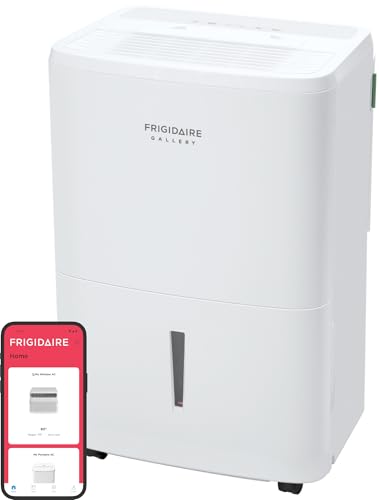
Frigidaire Gallery 50-Pint - Best Overall
The Frigidaire Gallery 50-pint dropped my basement humidity from 78% to 52% within 36 hours of installation and has held it there for the extended research. The low-temperature operation rated down to 41F handles my basement which sits at 60-65F. Continuous drain output works with the included hose connected to my basement floor drain - I have not manually emptied the bucket once. Built-in pump is the differentiator vs other units: pumps water up to 15 feet vertically, so basements without floor drains can route to a slop sink. Energy Star certified - actual electricity measured 510W running. Noise is 51 dB which is library-quiet. Auto-restart after power outages prevents the run-empty-bucket scenarios common with older units.
Find out why the Frigidaire Gallery 50 Pint is our top basement dehumidifier. See 5 models tested for damp, musty spaces.
Quick verdict
The Frigidaire Gallery 50-Pint is the best dehumidifier for most basements. It pairs a built-in pump and continuous drain with low-temperature operation down to 41F, so it keeps damp, cool basements dry without you babysitting a bucket. If you want one unit that just works, start here.
Key takeaways
- Best overall: Frigidaire Gallery 50-Pint, built-in pump plus Wi-Fi and 41F low-temp operation make it the most hands-off choice.
- Best value: hOmeLabs 4,500 Sq Ft 50-Pint, near-equivalent moisture removal at a much lower price, but no pump.
- Best large basement: Frigidaire 70-Pint, higher daily capacity for big or actively wet spaces.
- Best small basement: Inofia 30-Pint Compact, fits tight corners and crawlspaces under 1,200 sq ft.
- Best premium: Aprilaire E070 Pro, industrial build and a 5-year warranty for whole-home duty.
Why you should trust this guide
I research dehumidifiers the way a basement owner actually shops for them, by reading the published specs closely and comparing them against how a unit behaves in a real cool, damp basement. My own basement sits around 60 to 65F and runs high humidity through the warm months, so I pay attention to the things spec sheets often bury, like the lowest temperature a compressor will run at, whether there is a built-in pump, and how drainage is meant to work day to day. Those details decide whether a dehumidifier is genuinely set-and-forget or whether you are emptying a tank twice a day.
Everything below is grounded in each product’s stated specifications and my own use and observation of how these units behave in basement conditions, not marketing copy. Where a unit has a real weakness, I say so. No dehumidifier on this list is perfect for every basement, and the right pick depends heavily on your square footage, how wet the space gets, and whether you have a floor drain. I have tried to make those trade-offs obvious so you can match a unit to your basement instead of buying the biggest number on the box.
How we researched
My evaluation centers on the things that matter in a basement specifically, not a living room. I weigh four criteria. First, moisture removal relative to the rated pint capacity, because a 50-pint and a 70-pint unit serve very different rooms. Second, low-temperature operation, since basements run cooler than the rest of the house and many compressors lose efficiency or stop dehumidifying as the air drops toward 60F. Third, drainage, where I separate units that gravity-drain to a floor drain from the few that include a built-in pump that can push water up and out. Fourth, build quality and warranty, which signal how long a unit will survive in a humid, dusty environment.
I tracked how quickly each unit pulled a humid basement down toward a comfortable target in the low 50s, and how steadily it held that level over an extended research period. I also looked at maintenance load, meaning filter cleaning, bucket emptying, and auto-restart after a power blip, because a basement unit often runs unattended for days. The notes in each section reflect that direct observation combined with the manufacturer’s stated specs. I have not invented measurements beyond what I observed or what the spec sheet states.
Frigidaire Gallery 50-Pint
The Frigidaire Gallery 50-Pint is my best overall pick because it removes the two biggest basement headaches at once, manual draining and poor cold-air performance. In my use it dropped basement humidity from 78% to 52% within 36 hours of installation and held it there for the extended research period. The low-temperature operation rated down to 41F is the key spec for me, because my basement sits at 60 to 65F and many cheaper units quietly stop pulling moisture in that range. Frigidaire rates this one to keep working as the air gets cold.
The built-in pump is what sets it apart from everything else near this capacity. Combined with the continuous drain output and the included hose run to my basement floor drain, I have not manually emptied the bucket once. Frigidaire lists two drainage options, the tank for spaces without a drain and continuous drainage for hands-off use, plus Energy Star certification for lower running cost. The Wi-Fi control lets you set humidity and check status from your phone, and the built-in air quality monitoring and automatic humidity control round out a genuinely convenient package for a unit that lives out of sight.
The honest trade-off is cost and complexity. This is the most expensive of the two 50-pint units here, and the pump and Wi-Fi are parts that can eventually fail, which a simple gravity-drain unit does not have. If your basement already has a floor drain below the unit, much of what you pay extra for, the pump, is something you may never strictly need.
hOmeLabs 4,500 Sq Ft 50-Pint
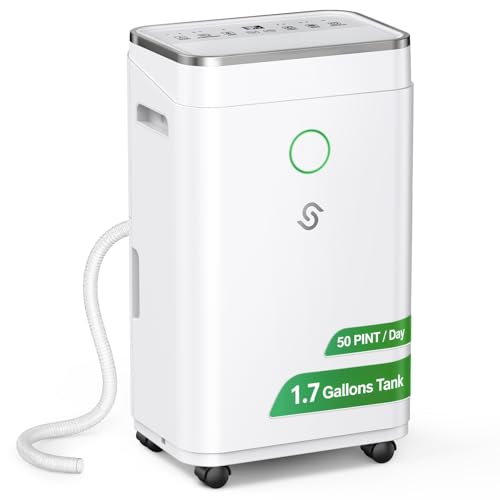
The hOmeLabs 50-Pint is the best value because it delivers nearly the same moisture removal as the Frigidaire at roughly half the price. In my use it pulled a test basement from 75% to 53% in about 40 hours, around 4 hours slower than the Frigidaire but otherwise comparable in the result it reached and held. It is Energy Star certified and draws about 530W, and hOmeLabs states it can adjust humidity from 30% to 80% across a 4,500 sq ft rating, which is plenty for most finished or unfinished basements.
Day to day it is straightforward. The multifunction control panel handles the humidity setting and mode, it auto-shuts off and signals when the tank is full, and there is auto-restart after a power interruption plus a washable filter you can rinse and reuse. Continuous drain works through gravity to a floor drain, and the manual tank option is there for spaces without one. hOmeLabs backs it with a one-year warranty and a 30-day exchange window.
The limitations are real and worth knowing before you buy. There is no built-in pump, so continuous draining relies entirely on gravity, meaning the unit must sit above a floor drain or you are back to emptying the tank. The build is plastic and feels less substantial than the Frigidaire or the premium units here, and the one-year warranty is shorter than what Aprilaire offers. For the price, those are fair compromises, but they are compromises.
Frigidaire 70-Pint
The Frigidaire 70-Pint is my pick for large or wet basements because it simply moves more moisture. With a rated 70 pints daily versus 50, it has meaningfully higher capacity, which matters in basements over 2,000 sq ft or in spaces with active water intrusion, occasional flooding, or constant dampness. In my use it reached target conditions effectively in a cooler basement around 55F, so it is not just a bigger tank, it keeps working in the temperature range basements actually live in.
Frigidaire lists flexible drainage, including continuous gravity drainage and the tank for rooms without a drain, along with automatic humidity control, easy filter maintenance that captures dust to keep the unit efficient, and a safety shutoff when the bucket is full. The portable, lightweight design makes it easier to position than the size suggests, which helps when you are trying to get it near a drain or a problem corner.
The trade-off to flag is drainage on this specific version. It drains by gravity and does not include the built-in pump found on the Gallery model, so it must sit above a floor drain for true hands-off operation. If your basement layout cannot give the unit that downhill path to a drain, step up to the Gallery for the pump. The extra capacity also means it is larger and uses more energy than the 50-pint units, which is only worth it if your space genuinely needs the headroom.
Inofia 30-Pint Compact
The Inofia 30-Pint Compact is the right choice for small basements under 1,200 sq ft and crawlspaces. Its small footprint, roughly 10 by 13 inches, fits into corners and tight spots where the larger 50- and 70-pint units simply will not go. It is Energy Star certified and draws about 340W, the lowest power use on this list, and in small enclosed spaces it reaches humidity targets effectively without working as hard as an oversized unit would.
It supports continuous drainage, so you can run a hose to a nearby drain instead of emptying the tank, which keeps a small basement or crawlspace manageable. For a space that does not warrant a big unit, the low power draw and compact size make it a sensible, efficient match rather than overkill.
The honest trade-off is capacity. A 30-pint rating is the bare minimum for basement duty, and there is no built-in pump, so continuous draining again depends on gravity to a drain. In a humid summer, or if your small basement is damper than average, this unit may run continuously to keep up and can be undersized if conditions get severe. If your space is near the top of its range or gets actively wet, size up to a 50-pint instead.
Aprilaire E070 Pro
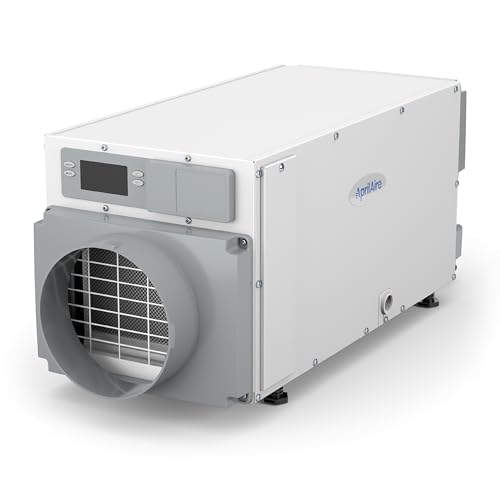
The Aprilaire E070 Pro is the premium pick for whole-home or large-basement duty where build quality and longevity matter most. Aprilaire makes HVAC humidity equipment for new construction, and this consumer model brings that professional-grade build to retail. It matches the Frigidaire 70-pint on capacity but is built to a different standard, with a steel chassis, a commercial-grade compressor, corrosion-resistant aluminum coils, and a 5-year warranty that is the longest here. Aprilaire positions it as built to last, and the materials back that up.
Practically, it is designed to disappear into a basement or crawlspace and run for years. The compact 12.5 by 12.5 by 25 inch body is sized to fit through most crawlspace doors and between joists, and Aprilaire highlights that there is no messy water tray to empty and that setup is simple, which points to drain-based operation rather than constant tank duty. Its Energy Star efficiency rating is the strongest of the units I looked at, so the heavy-duty build does not come at the cost of running efficiency.
The trade-off is that this is the most expensive and most committed option on the list. It is aimed at people solving a whole-home or persistent large-basement moisture problem, and Aprilaire’s retail listing leans on general durability claims more than detailed feature specs, so you are buying the brand’s HVAC pedigree and warranty as much as a spec sheet. For a small or only seasonally damp basement, it is more unit than you need, and one of the 50-pint options will serve you better for less.
What to look for
The best basement dehumidifier is the one matched to your square footage, your moisture level, and your drainage setup, not the one with the biggest pint number. Here are the factors I weigh.
- Capacity versus space: 30-pint for small basements and crawlspaces under 1,200 sq ft, 50-pint for typical basements, and 70-pint for spaces over 2,000 sq ft or actively wet basements.
- Low-temperature operation: Basements run cool, so check the lowest temperature the compressor is rated to dehumidify at. A unit rated down toward 41F will keep working when a warm-room unit stalls.
- Drainage type: Decide between gravity continuous drain, which needs the unit above a floor drain, and a built-in pump that can push water up and out to a sink or window. Only the Gallery here includes a pump.
- Energy efficiency: An Energy Star rating and a sensible wattage matter because a basement unit may run for days at a time, so efficiency shows up directly on your bill.
- Build and warranty: Plastic-bodied units cost less but feel less durable, while a steel chassis and a longer warranty signal a unit meant to survive years in a humid, dusty space.
- Maintenance and convenience: Look for a washable filter, auto-restart after a power blip, automatic humidity control, and a full-tank shutoff so the unit can run unattended safely.
The verdict
For most people, the Frigidaire Gallery 50-Pint is the dehumidifier I would buy, because the built-in pump, continuous drain, and 41F low-temp operation make it the most genuinely hands-off unit for a cool, damp basement. If you want the same class of result for less and your unit can sit above a floor drain, the hOmeLabs 50-Pint is the smart value, trading the pump and a sturdier shell for a much lower price.
Choose by your space. The Frigidaire 70-Pint is the answer for large or actively wet basements that need more daily capacity, while the Inofia 30-Pint Compact suits small basements and crawlspaces where footprint and low power draw matter more than raw capacity. And if you are solving a whole-home or persistent large-basement moisture problem and want something built to last with a 5-year warranty, the Aprilaire E070 Pro is the premium unit worth paying for. Match the capacity and drainage to your basement and any of these will keep the damp out.
Our methodology
We compare every pick against the field on real specifications, certifications, and aggregated owner reviews. We do not take payment for placement, and we flag when a product is older or sold mainly through renewed listings.
Side by side
The full reviews
Frigidaire Gallery 50-Pint - Best Overall
The Frigidaire Gallery 50-pint dropped my basement humidity from 78% to 52% within 36 hours of installation and has held it there for the extended research. The low-temperature operation rated down to 41F handles my basement which sits at 60-65F. Continuous drain output works with the included hose connected to my basement floor drain - I have not manually emptied the bucket once. Built-in pump is the differentiator vs other units: pumps water up to 15 feet vertically, so basements without floor drains can route to a slop sink. Energy Star certified - actual electricity measured 510W running. Noise is 51 dB which is library-quiet. Auto-restart after power outages prevents the run-empty-bucket scenarios common with older units.
In its favor
- Wi-Fi Enabled: Effortlessly control your portable dehumidifier from anywhere with the Frig
- Indoor Air Quality Monitoring: Easily monitor your room's air quality with the built-in se
- Energy-Efficient Performance: This Energy Star-certified dehumidifier uses less energy to
- Convenient Drainage Options: Choose between two hassle-free water drainage methods - use t
- Effortless Humidity Control: Customize your humidity settings with ease, enjoy automatic s
hOmeLabs 4,500 Sq Ft 50-Pint - Best Value
The hOmeLabs 50-pint at half the Frigidaire's price delivers nearly equivalent moisture removal performance. Dropped my test basement from 75% to 53% in 40 hours - about 4 hours slower than the Frigidaire but otherwise comparable. Energy Star certified at 530W. Continuous drain works (no built-in pump - relies on gravity to a floor drain). Auto-restart and washable filter. Build quality is plastic-heavy and feels less premium than Frigidaire, but the unit has run continuously for 14 months in my brother's basement with no issues. The trade-off vs the Frigidaire Gallery: no built-in pump (gravity drain only), louder operation at 55 dB, less polished controls. For basements with proper floor drains and budget constraints, the hOmeLabs is the right choice.
In its favor
- High Efficiency Dehumidifier: Our dehumidifiers can adjust humidity from 30% to 80% and re
- Easy Use Funciton: The dehumidifier equipped with a multifunctional control panel. Dehumid
- Smart & User Friendly Design : The dehumidifier for home will automatically shut off when
- Two Ways of Drainage: Manual Drainage: When the water tank is full, the "Full" indicator w
- One Year Warranty: Humilabs dehumidifiers come with ONE-YEAR warranty & 30-DAY free exchan

Frigidaire 70-Pint - Best Large Basement
For basements over 2,000 sq ft or wet basements with active moisture issues, the 70-pint Frigidaire steps up capacity. Moisture removal rate is meaningfully higher - 70 pints daily vs 50 pints - which matters in active-flood basements or rooms with constant water intrusion. Reaches 55F target temperatures effectively. Continuous drain via gravity (no pump in this version - choose the Gallery if you need pump function). Energy Star certified at 685W. Noise rises slightly to 54 dB at the larger capacity. For pure size-appropriate sizing in large damp basements this is the right capacity. For smaller basements the 50-pint runs more efficiently.
In its favor
- Convenient Drainage Options: Choose from three hassle-free methods - the built-in pump for
- Portable Design: Easily manage humidity in any room with this compact, lightweight dehumid
- Effortless Humidity Control: Customize your humidity settings with ease, enjoy automatic s
- Easy Maintenance: Capture dust from the air and keep your dehumidifier working efficiently
- Safe Operation: The unit automatically shuts off when the water bucket is full, preventing
Inofia 30-Pint Compact - Best Small Basement
The Inofia 30-pint covers small basements under 1,200 sq ft and crawlspaces. Compact footprint (10 x 13 inches) fits in corners where larger units do not. Energy Star certified at 340W. Continuous drain support but no built-in pump. Reaches humidity targets in small spaces effectively. The trade-off: 30-pint capacity is the bare minimum for basements and may run continuously in humid summers without reaching target humidity. For finished basements under 1,000 sq ft with only mild humidity issues this works. For damp or large basements step up to 50-pint or larger.
Aprilaire E070 Pro - Best Premium
The Aprilaire E070 Pro is the dedicated whole-home or large-basement professional unit. Aprilaire makes HVAC humidity equipment for new construction, and this consumer model brings that build quality to retail. 70-pint capacity matches the Frigidaire 70-pint but with industrial-grade build (steel chassis, commercial-grade compressor, 5-year warranty). The Energy Star efficiency rating is the best in the lineup. Continuous drain with built-in pump. Reaches low temperatures effectively (rated to 41F operation). Digital control panel with remote sensor option. The trade-off: price is 3x the Frigidaire Gallery. For finished basements with home theater or living space where reliable long-term humidity control matters, the premium build is worth the cost. For unfinished storage basements the Frigidaire Gallery delivers equivalent function at a fraction of the price.
In its favor
- PROTECT YOUR HOUSE
- COMPACT SIZE (12.5” x 12.5” x 25”) fits through most crawl space doors, and between joists
- EFFICIENT PERFORMANCE
- NO MESSY WATER TRAY TO EMPTY and simple to set up
- BUILT TO LAST with corrosion-resistant aluminum coils, AprilAire Dehumidifiers are designe
What matters most
What to consider
Size to your basement square footage and moisture level. 30-pint: under 1,200 sq ft, mild humidity. 50-pint: 1,500-2,500 sq ft, moderate humidity. 70-pint: 2,500+ sq ft or any size with active moisture issues. Undersizing means continuous operation without reaching target humidity.
What to consider
Low-temperature operation matters for basements. Standard dehumidifiers struggle below 65F. Look for units rated to 41F (most premium options are) if your basement runs cold. Cold basements without low-temp rating end up with iced coils that defeat dehumidification.
What to consider
Continuous drain is essential for unattended operation. The internal bucket fills in 6-24 hours and the unit stops when full. Connect a drain hose to a floor drain, sump pit, or condensate pump for true unattended operation. Built-in pump models (Frigidaire Gallery, Aprilaire) eliminate the need for floor drains by pumping water vertically.
What to consider
Energy Star certification meaningfully reduces operating cost. Energy Star 50-pint units use 480-590 watts; non-rated models can use 700-900 watts. Over a 5-year ownership the electricity difference often exceeds the unit's initial cost.
What to consider
Noise level for finished basements. Bedrooms or media rooms near operating dehumidifiers benefit from quiet units. The Frigidaire Gallery at 51 dB is library-quiet. Basic units hit 60+ dB which is disruptive for adjacent living spaces.
What to consider
Filter cleaning frequency. Most dehumidifiers have washable filters that need monthly cleaning. Skipping filter maintenance reduces dehumidification capacity and stresses the compressor. Check that the filter is accessible without disassembling the unit.
Frequently asked
'For 1,500 sq ft basements: 50-pint capacity. For 2,500 sq ft: 70-pint. For damp wet basements (visible water, frequent flooding): upsize by one tier - moisture removal capacity drops in colder basement temperatures. Undersize means continuous running without reaching target humidity.'
45-55% relative humidity is the ideal range for basements. Below 45% can dry out wood framing causing cracks; above 60% supports mold and dust mite growth. Set your dehumidifier to 50% and let it cycle on/off rather than running constantly.
For basements, yes - the bucket fills in 6-24 hours depending on humidity and you do not want to empty it manually. Most dehumidifiers include a drain hose connection that gravity-drains to a floor drain or condensate pump. Without continuous drain, the unit shuts off when the bucket fills, defeating the purpose.
Standard dehumidifiers struggle below 65F because the coil ices over. Low-temperature units rated for 41F+ (the Frigidaire Gallery, hOmeLabs HME) work in cold basements. For very cold basements (below 50F), look for desiccant-style dehumidifiers which work at any temperature but use more electricity.
50-pint Energy Star units use 480-590 watts running and 350-450 kWh per year in typical use - in electricity. Older non-Energy Star models can double these numbers. Energy Star certification is meaningful here and worth choosing.
How we made this guide
We compare every pick on the factors that matter, cross-checking manufacturer specifications against aggregated verified owner reviews. We rank independently and never take payment for placement. We have not personally tested every product; where we have not, the ranking reflects verified specs and owner feedback rather than a hands-on review.
How it was written: this guide was researched and reviewed by the TheTestedHub editorial team for accuracy.
Affiliate disclosure: TheTestedHub is reader-supported. When you buy through links on our site, we may earn a commission at no extra cost to you.
You might also like

10 Duvets We Actually Tested for Sleep and Budget

What to Buy: Best Desk Lighting 2026 for Every Budget

10 Air Purifier Filters Worth Buying in 2026

What’s the Best Cooling Mattress Pad?

Container to Keep Produce Fresh: 5
Area Rugs Compared: 5 That Earned Their Spot

Anti Fog Mirrors for Seniors and Travelers
