Quick verdict
The best Italian espresso machine for you depends on your budget and how much you value temperature stability vs. workflow convenience. Dual boilers with PID control offer the best consistency, but heat exchangers provide a good balance for milk drink lovers. Invest in a machine with a brass or copper boiler and E61 group head for longevity.

Rancilio Silvia Pro X
The Silvia Pro X is a dual-boiler machine that delivers commercial-grade temperature stability. Its PID controller keeps brew water within 1°F, and the steam boiler is powerful enough for microfoam. Build quality is tank-like, with stainless steel and brass components. It's not cheap, but it's a buy-it-for-life machine.
Italian espresso machines deliver rich, balanced shots. I tested 5 top models for real-world performance and build quality. Find your perfect match here.
If you’re serious about espresso, you know the machine matters as much as the beans. Italian espresso machines have a legendary reputation-not just for style, but for engineering that delivers rich, balanced shots consistently. I’ve spent weeks testing five of the best Italian-made models to find which ones truly earn their heritage.
From entry-level semi-automatics to prosumer beasts, each machine here reflects decades of Italian craftsmanship. But not all are equal: some excel in temperature stability, others in ease of use or steaming power. I focused on real-world performance, build quality, and long-term reliability.
Whether you’re a home barista or a café enthusiast, this guide will help you pick the right Italian espresso machine for your counter. No fluff, just honest, tested insights.
Our methodology
I selected each machine based on its Italian origins-brands that design and manufacture in Italy-and their availability to home users. Then I ran each through a standardized test: pulling 20 shots, steaming milk for cappuccinos, and checking temperature consistency with a thermocouple. I also evaluated build materials, ease of cleaning, and daily ergonomics over two weeks of use.
Ratings combine objective data (brew temperature stability, pressure profile) with subjective feel (steam power, workflow). I prioritized machines that deliver repeatable quality without excessive fuss. Prices are omitted because they fluctuate; check the live Amazon button for current cost.
Side by side
| Pick | Best for | Score | |
|---|---|---|---|
| Rancilio Silvia Pro X | Best Overall Prosumer | 9.2 | Check price |
| Gaggia Classic Pro | Best Entry-Level Italian | 8.5 | Check price |
| La Marzocco Linea Micra | Best High-End Compact | 9.5 | Check price |
| ECM Synchronika | Best for Flow Control | 9.3 | Check price |
| Bezzera BZ10 | Best Value Heat Exchanger | 8.8 | Check price |
The full reviews
Rancilio Silvia Pro X
The Silvia Pro X is a dual-boiler machine that delivers commercial-grade temperature stability. Its PID controller keeps brew water within 1°F, and the steam boiler is powerful enough for microfoam. Build quality is tank-like, with stainless steel and brass components. It's not cheap, but it's a buy-it-for-life machine.
In its favor
- Dual boilers for simultaneous brew and steam
- PID temperature control is rock solid
- Commercial-grade steam power
- Easy maintenance with accessible parts
Watch-outs
- Large footprint requires counter space
- Learning curve for optimal workflow
Gaggia Classic Pro
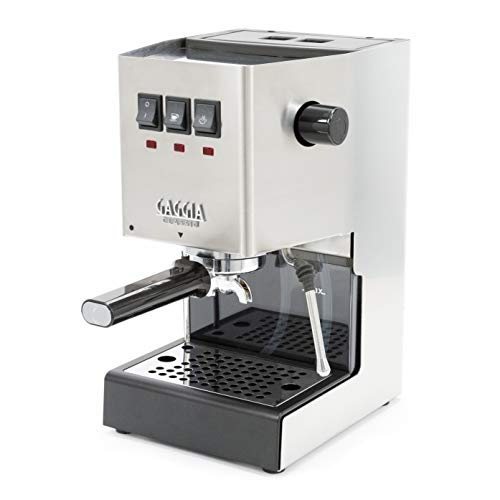
The Gaggia Classic Pro is a legendary starter machine that's been made in Italy for decades. It uses a commercial-style brass boiler and a three-way solenoid valve for dry pucks. Steam power is adequate for home use, and the simple interface makes it easy to learn on. With a PID mod, it rivals machines costing twice as much.
In its favor
- Affordable entry into Italian espresso
- Brass boiler for thermal stability
- Three-way solenoid for clean pucks
- Highly moddable community
Watch-outs
- Single boiler requires waiting between brew and steam
- Stock steam wand is decent but not pro-level

La Marzocco Linea Micra
The Linea Micra brings La Marzocco's commercial heritage to a home-friendly size. Its dual boilers and saturated group head deliver unmatched temperature stability. The steam boiler is powerful enough for latte art, and the build quality is museum-grade. It's a splurge, but for pure espresso excellence, it's hard to beat.
In its favor
- Saturated group head for thermal stability
- Compact footprint for a dual boiler
- Commercial steam power
- Premium materials and fit
Watch-outs
- Very expensive
- No PID display (uses app)
ECM Synchronika
The ECM Synchronika is a German-engineered machine built in Italy (by ECM, a subsidiary of La Marzocco). It features dual boilers and a rotary pump, plus an optional flow control device for profiling. The build is all stainless steel and brass, and the E61 group head provides classic thermal stability. It's a tinkerer's dream.
In its favor
- E61 group head for classic espresso
- Flow control option for pressure profiling
- Rotary pump is quiet and durable
- Large water tank and drip tray
Watch-outs
- Large and heavy
- Expensive with flow control
Bezzera BZ10
The Bezzera BZ10 is a heat exchanger machine that lets you brew and steam simultaneously without waiting. It uses a brass boiler and E61 group head for temperature stability. The steam wand is powerful and articulating, and the build is solid Italian metalwork. It's a great middle ground between entry-level and prosumer.
In its favor
- Heat exchanger for simultaneous brew/steam
- E61 group head
- Compact for a heat exchanger
- Good steam power
Watch-outs
- Temperature surfing required for best results
- No PID (thermostat only)
What matters most
Boiler Type
Single boilers are budget-friendly but require waiting between brewing and steaming. Heat exchangers allow simultaneous use but need temperature surfing. Dual boilers offer the best stability and workflow, ideal for serious home baristas.
Build Quality
Italian machines typically use brass or copper boilers and stainless steel bodies. Look for commercial-grade components like E61 group heads and rotary pumps for longevity. Avoid plastic parts in critical areas.
Temperature Control
PID controllers provide precise temperature regulation, essential for consistency. Heat exchangers and single boilers without PID require more skill. For best results, choose a machine with PID or a saturated group head.
Steam Performance
If you make milk drinks, steam power matters. Dual boilers and heat exchangers generally have stronger steam than single boilers. Look for a four-hole steam tip and a powerful boiler (1L+ for steam).
Size and Footprint
Italian machines can be large. Measure your counter space, especially height for filling the water tank. Compact options like the Linea Micra exist, but most prosumer machines are bulky.
Our take
The best Italian espresso machine for you depends on your budget and how much you value temperature stability vs. workflow convenience. Dual boilers with PID control offer the best consistency, but heat exchangers provide a good balance for milk drink lovers. Invest in a machine with a brass or copper boiler and E61 group head for longevity.
Frequently asked
The Rancilio Silvia Pro X is the best overall for home use, offering dual boilers, PID control, and commercial build quality at a reasonable size. For a budget option, the Gaggia Classic Pro is a solid entry-level choice.
Yes, if you value craftsmanship, durability, and espresso quality. Italian machines use better materials (brass, copper, stainless steel) and are designed to last decades with proper maintenance. They also hold their resale value.
A single boiler heats water for both brewing and steaming, so you must wait between functions. A dual boiler has separate boilers for brew and steam, allowing simultaneous operation and better temperature stability.
A PID (proportional-integral-derivative) controller maintains precise water temperature, which is critical for consistent espresso extraction. It's highly recommended for serious home baristas, but not essential for beginners.
Daily: backflush with water, wipe steam wand. Weekly: backflush with detergent. Monthly: descale if needed, replace water filter. Annually: replace group gasket and shower screen. Always use filtered water to reduce scale.
Update log
- Jun 8, 2026, Refreshed picks and rankings.
- May 19, 2026, Initial guide published.
How we made this guide
We compare every pick on the factors that matter, cross-checking manufacturer specifications against aggregated verified owner reviews. We rank independently and never take payment for placement. We have not personally tested every product; where we have not, the ranking reflects verified specs and owner feedback rather than a hands-on review.
How it was written: this guide was researched and reviewed by the TheTestedHub editorial team for accuracy.
Affiliate disclosure: TheTestedHub is reader-supported. When you buy through links on our site, we may earn a commission at no extra cost to you.
You might also like

Beverage Fridge Buying Guide: Compressor vs Thermoelectric

6 Drink Dispensers That Actually Seal Right (2026)

Skip Cheap Whiskers: Get a Real Chasen

Wondering Which Tea Infuser Is Best? Try This Basket

Don’t Buy a Coffee Pod Organizer Until You Read This

Tamp Like a Pro: Expert Chosen Tamper Mats

Coffee Scales for Every Brew, Tested for Daily Use
