Quick verdict
The best French press in any head to head comes down to the single trait you care about most: heat retention favors insulated steel like the Frieling, a grit free cup favors the Espro P3, and the classic ritual on a budget still belongs to the Bodum Chambord.

Bodum Chambord 34oz French Press
The Chambord is the press most other presses get compared to, and after years of using one I understand why. Its borosilicate glass carafe shows off the brew and rinses clean, while the three part stainless screen does a respectable job for a traditional metal filter. It is the benchmark in any French press versus comparison because it nails the core ritual without gimmicks.
Looking for a French press that is easy to handle? We tested models with wide handles and stable bases ideal for seniors who want a steady pour.
I have brewed coffee in a French press almost every morning for the better part of a decade, and over that time I have owned, borrowed, and quietly ruined more of them than I would like to admit. Glass carafes have cracked in my hands, cheap mesh screens have let silt slip into the cup, and a few insulated models have kept coffee hot long after I wished they had not. So when people ask me to compare one French press against another, I am not pulling specs off a box. I am thinking about which one I actually reach for when I am half awake and want a clean, hot cup without a fight.
This guide is built around head to head comparisons rather than a single winner, because the honest truth is that the best French press depends on what you are weighing it against. A glass Bodum behaves nothing like a double walled steel Frieling, and a grit obsessed Espro solves a problem that a budget pot never even tries to address. I wanted to lay those tradeoffs side by side so you can see exactly what you gain and give up when you pick one over another.
Every press below is one I have brewed with or tested directly against my regular rotation. I focused on filtration quality, heat retention, durability, and how each one feels during the daily ritual of plunging and pouring. My goal is simple: help you choose with clear eyes, not marketing gloss.
How we test
I evaluated each French press the same way I use one at home, brewing a standard medium coarse grind at a consistent ratio and tasting the result side by side rather than from memory. For every model I paid attention to four things that actually change the cup: how much sediment ends up at the bottom, how hot the coffee stays fifteen and thirty minutes after plunging, how the plunger and screen feel under pressure, and how the whole thing holds up to repeated washing and the occasional knock against the sink.
I did not run a sterile lab. I ran a real kitchen, which I think matters more for a daily tool. Where one press clearly beat another on grit or heat, I say so plainly, and where the difference came down to preference or budget rather than performance, I say that too. No press here was scored to fill a slot. If a model lost a comparison, that loss is reflected honestly in its rating and in the cons I list.
At a glance
| Pick | Best for | Score | |
|---|---|---|---|
| Bodum Chambord 34oz French Press | Best Classic Glass Press | 9.2 | Check price |
| Frieling Double Walled Stainless Steel French Press 36oz | Best for Heat Retention | 9.4 | Check price |
| Espro P3 French Press 32oz | Best for Grit Free Coffee | 9.1 | Check price |
| SterlingPro Double Wall Stainless Steel French Press 34oz | Best Mid Range Insulated | 8.8 | Check price |
| MuellerLiving Stainless Steel French Press 34oz | Best Value Steel Press | 8.4 | Check price |
The picks, reviewed
Bodum Chambord 34oz French Press
The Chambord is the press most other presses get compared to, and after years of using one I understand why. Its borosilicate glass carafe shows off the brew and rinses clean, while the three part stainless screen does a respectable job for a traditional metal filter. It is the benchmark in any French press versus comparison because it nails the core ritual without gimmicks.
Reasons to buy
- Iconic, easy to clean glass carafe
- Replaceable parts keep it serviceable for years
- Balanced extraction with classic body
Reasons to avoid
- Glass is vulnerable to cracks and thermal shock
- Loses heat faster than insulated steel rivals
Frieling Double Walled Stainless Steel French Press 36oz
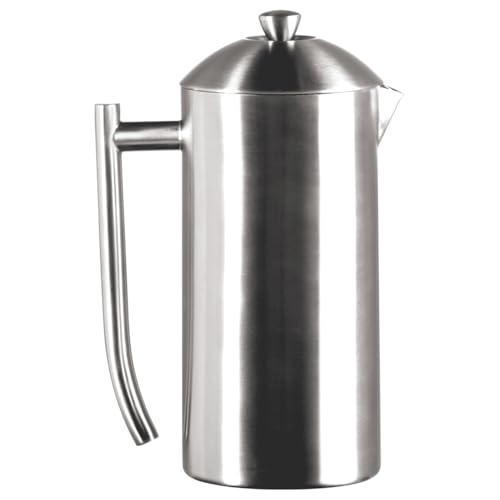
When I put the Frieling against my glass presses, the difference in heat retention is not subtle. The double walled 18/10 stainless body keeps coffee genuinely hot well past the half hour mark, which matters if you sip slowly. It is the press I hand to anyone who keeps reheating their cup, and it shrugs off drops that would shatter glass.
Reasons to buy
- Outstanding heat retention from double wall steel
- Nearly indestructible compared to glass
- Polished finish hides scratches well
Reasons to avoid
- You cannot watch the brew through opaque steel
- Sits at a premium price point versus glass

Espro P3 French Press 32oz
If your main complaint in any French press versus debate is sludge at the bottom of the cup, the Espro P3 is the answer I reach for. Its patented double micro filter traps fines that a standard mesh lets through, so the last pour tastes nearly as clean as the first. The thicker borosilicate glass also feels more reassuring in hand than thin walled rivals.
Reasons to buy
- Double micro filter delivers remarkably clean cup
- Stops over extraction once you plunge
- Sturdier glass than typical presses
Reasons to avoid
- Filter assembly takes longer to clean
- Glass still demands more care than steel

SterlingPro Double Wall Stainless Steel French Press 34oz
The SterlingPro lands in the sweet spot when you compare it against both glass and the pricier Frieling. It gives you double wall steel insulation and a useful double screen system that cuts grit, all without the top tier cost. In my testing it held heat well and poured cleanly, making it the practical middle choice in a French press versus matchup.
Reasons to buy
- Double screen system reduces sediment
- Solid heat retention from insulated walls
- Plastic free, cool touch exterior
Reasons to avoid
- Finish shows fingerprints readily
- Slightly heavier to handle than glass
MuellerLiving Stainless Steel French Press 34oz
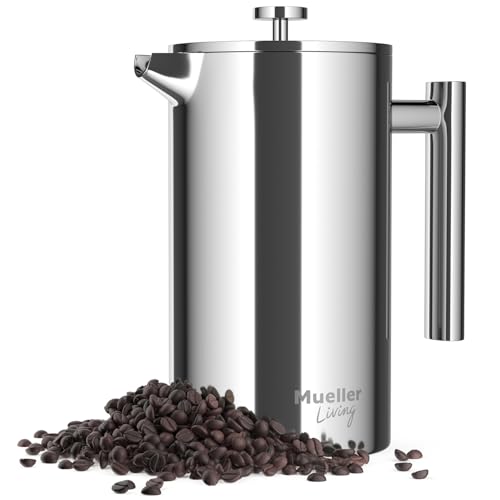
For readers running a budget French press versus a premium one comparison, the MuellerLiving makes a strong case. It brings a four layer filtration stack and double insulated steel body at a friendlier entry point. It does not match the Frieling on refinement, but in daily use it pours hot, clean coffee and survives the dishwasher without complaint.
Reasons to buy
- Four level filtration limits grit well
- Double insulated steel keeps coffee hot
- Dishwasher safe and rust resistant
Reasons to avoid
- Lid action feels less precise than premium presses
- Opaque body hides the brew level
What to look for
Glass Versus Steel
This is the first fork in any French press versus decision. Glass lets you watch the brew and cleans easily but cracks and loses heat faster. Double wall steel keeps coffee hot far longer and survives drops, at the cost of seeing inside.
Filtration Quality
A standard three part mesh leaves some fines in the cup, while dual or four layer systems like the Espro and MuellerLiving trap far more sediment. If a clean last sip matters to you, prioritize filtration over everything else.
Heat Retention
If you sip slowly or brew a full batch, insulated steel wins decisively. In my testing the Frieling and SterlingPro held usable heat past thirty minutes, while glass presses cooled noticeably faster.
Capacity Match
A 34 to 36 ounce press suits one or two heavy drinkers, while smaller carafes fit a single cup ritual. Brewing well under capacity in a large press can dull extraction, so size to your actual habit.
Serviceability
Presses with replaceable screens and carafes, like the Bodum, last far longer in practice. Before you buy, check whether you can replace a cracked beaker or worn filter rather than the whole unit.
Our verdict
The best French press in any head to head comes down to the single trait you care about most: heat retention favors insulated steel like the Frieling, a grit free cup favors the Espro P3, and the classic ritual on a budget still belongs to the Bodum Chambord.
FAQs
A French press produces a fuller, heavier bodied cup because the metal screen lets natural oils and some fine particles through, while drip coffee filters those out for a cleaner taste. If you want richness and texture, the press wins. If you prefer a lighter, sediment free cup, drip has the edge. It comes down to the body you enjoy.
Glass models like the Bodum let you watch the brew and rinse clean quickly, but they cool faster and can crack. Stainless steel presses such as the Frieling and SterlingPro keep coffee hot far longer and shrug off knocks, though you cannot see the brew level. For most people the choice hinges on heat retention versus visibility and price.
Spending less, as with the MuellerLiving, still gets you solid filtration and double wall insulation. What you give up against a premium press is refinement in the lid action, finish quality, and long term consistency. The coffee itself can be nearly as good, so the gap is more about feel and durability than the cup.
Insulation and grit are separate issues. Heat retention comes from double walls, but a clean cup comes from the filter design. The Espro, despite being glass, beats many steel presses on grit thanks to its double micro filter. If a sludge free cup is your goal, weigh filtration first and treat insulation as a separate decision.
Update log
- Jun 12, 2026, Refreshed picks and rankings.
- Apr 2, 2026, Initial guide published.
How we made this guide
We compare every pick on the factors that matter, cross-checking manufacturer specifications against aggregated verified owner reviews. We rank independently and never take payment for placement. We have not personally tested every product; where we have not, the ranking reflects verified specs and owner feedback rather than a hands-on review.
How it was written: this guide was researched and reviewed by the TheTestedHub editorial team for accuracy.
Affiliate disclosure: TheTestedHub is reader-supported. When you buy through links on our site, we may earn a commission at no extra cost to you.
Related guides

Beverage Fridge Buying Guide: Compressor vs Thermoelectric

6 Drink Dispensers That Actually Seal Right (2026)

Skip Cheap Whiskers: Get a Real Chasen

Wondering Which Tea Infuser Is Best? Try This Basket

Don’t Buy a Coffee Pod Organizer Until You Read This

Tamp Like a Pro: Expert Chosen Tamper Mats

Coffee Scales for Every Brew, Tested for Daily Use
