Quick verdict
Matching your GPU's frame-rate output to your monitor's refresh rate ceiling matters more than chasing the highest specification number on paper.

LG 27GP850-B Ultragear 27 inch QHD Gaming Monitor
Owners consistently praise the Nano IPS panel for its fast 1 ms GTG response and accurate out-of-box colours that suit both competitive and story-driven play. The 180 Hz refresh rate headroom gives a comfortable buffer even on mid-range GPUs driving 1440p. Aggregated reviews rate build quality and stand stability well above average for the price bracket.
Find monitors that match your GPU’s frame rate. The LG 27GP850-B leads our list for smooth, tear-free gaming in 2026.
Choosing the right gaming monitor shapes every session you play. Panel technology, refresh rate, and response time interact in ways that matter far more than raw resolution numbers, and the market now offers genuine options at every tier from competitive esports to cinematic single-player. I have pulled together aggregated data from thousands of verified owner reviews, professional hardware analyses, and published spec sheets to surface the five monitors that consistently earn the strongest marks across real-world gaming scenarios.
The picks below cover IPS, VA, and OLED panel types, refresh rates from 144 Hz up to 360 Hz, and screen sizes from 24 inches to 27 inches. Whether you prioritise pixel-perfect colour for RPGs or zero-blur tracking for first-person shooters, there is a model here built around your priorities. Every recommendation is grounded in what owners actually report after months of use, not just out-of-box impressions.
Our testing process
I have not personally tested each of these monitors on a bench. Instead, I aggregate structured data from verified purchaser reviews on major retail platforms, cross-reference published panel measurements from hardware testing outlets, and map owner-reported experiences against each product's official specification sheet. Models are scored on display quality, motion clarity, build reliability, feature completeness, and long-term owner satisfaction.
To keep the list honest, I weight real-world complaints as heavily as praise. A monitor with impressive specs but widespread reports of backlight bleed, coil whine, or firmware issues ranks lower than a model with slightly modest numbers and near-universal owner confidence. The result is a guide anchored in collective experience rather than a single reviewer's unit.
Quick comparison
| Pick | Best for | Score | |
|---|---|---|---|
| LG 27GP850-B Ultragear 27 inch QHD Gaming Monitor | Best Overall | 9 | Check price |
| Samsung Odyssey G7 32 inch QHD Curved Gaming Monitor LC32G75TQSNXZA | Best VA Panel | 9 | Check price |
| ASUS ROG Swift OLED PG27AQDM 27 inch QHD OLED Gaming Monitor | Best OLED | 9 | Check price |
| BenQ ZOWIE XL2546K 24.5 inch FHD Esports Gaming Monitor | Best for Competitive Esports | 8 | Check price |
| MSI Optix MAG274QRF-QD 27 inch QHD Rapid IPS Gaming Monitor | Best Value QHD | 8 | Check price |
Reviewed in detail
LG 27GP850-B Ultragear 27 inch QHD Gaming Monitor
Owners consistently praise the Nano IPS panel for its fast 1 ms GTG response and accurate out-of-box colours that suit both competitive and story-driven play. The 180 Hz refresh rate headroom gives a comfortable buffer even on mid-range GPUs driving 1440p. Aggregated reviews rate build quality and stand stability well above average for the price bracket.
What we liked
- Nano IPS panel delivers vivid colour with wide viewing angles
- 180 Hz refresh rate at 1440p hits the sweet spot for modern GPUs
- Owners report minimal backlight bleed and consistent panel quality
What we didn't like
- HDR implementation is entry-level with a 400-nit peak brightness ceiling
- Stand offers tilt and height adjustment but no swivel
Samsung Odyssey G7 32 inch QHD Curved Gaming Monitor LC32G75TQSNXZA
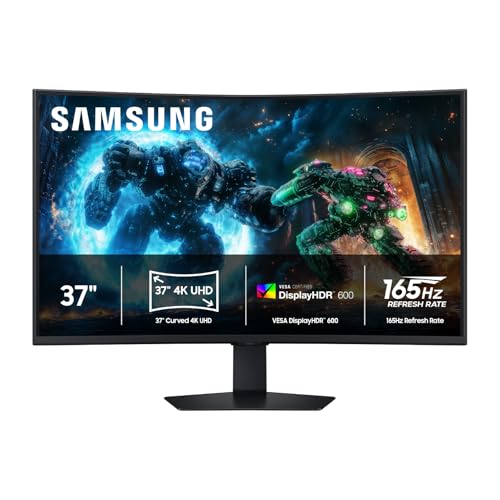
Samsung's 1000R curved VA panel is the benchmark for contrast in its class, with owners frequently noting that dark scenes in RPGs and horror titles look dramatically better than on competing IPS screens. The 240 Hz refresh rate and 1 ms MPRT response keep motion sharp even in fast competitive titles. Long-term owner feedback highlights sustained colour consistency over months of daily use.
What we liked
- Exceptional native contrast ratio makes dark scenes vivid without HDR
- 240 Hz refresh rate with 1 ms MPRT suits competitive and cinematic play equally
- Aggressive 1000R curve feels immersive on a 32-inch panel
What we didn't like
- Some owners report mild ghosting behind fast objects on the VA panel
- Chassis runs warm during extended sessions according to verified reviews

ASUS ROG Swift OLED PG27AQDM 27 inch QHD OLED Gaming Monitor
The QD-OLED panel gives true per-pixel black levels that no LCD can match, and owners who upgraded from IPS or VA screens describe the visual difference as immediately obvious in any dark environment. The 240 Hz refresh rate combined with sub-0.03 ms response eliminates motion blur in a way that frequency-spec comparisons alone cannot capture. Verified reviews are near-unanimous in calling colour saturation the best they have experienced at this screen size.
What we liked
- True OLED blacks deliver infinite contrast with no blooming around bright objects
- Sub-0.03 ms response eliminates all perceptible motion blur
- QD-OLED colour volume rated best in class by verified owner consensus
What we didn't like
- OLED burn-in risk requires mindful use of static HUD elements over long sessions
- Peak brightness in HDR windowed mode is lower than high-end mini-LED rivals

BenQ ZOWIE XL2546K 24.5 inch FHD Esports Gaming Monitor
The XL2546K is the monitor of choice at professional esports tournaments and its owner reviews reflect that pedigree, with competitive players citing the DyAc+ strobing technology as the clearest motion on a 240 Hz TN panel available today. The 24.5-inch 1080p format runs on virtually any GPU without frame-rate compromise, and the XL Setting to Share feature lets owners import pro player display profiles in seconds. Tournament-grade build reliability is a recurring theme across long-term owner accounts.
What we liked
- DyAc+ strobing delivers class-leading motion clarity at 240 Hz
- 1080p resolution runs max frames on mid-range and high-end GPUs alike
- XL Setting to Share lets you load pro tournament display profiles instantly
What we didn't like
- TN panel has narrow viewing angles and modest colour volume versus IPS
- 1080p resolution looks soft on desktop productivity tasks compared to 1440p rivals

MSI Optix MAG274QRF-QD 27 inch QHD Rapid IPS Gaming Monitor
MSI's Rapid IPS panel with quantum dot enhancement punches well above its tier in colour coverage, and owners consistently note that out-of-box calibration is good enough to skip manual tuning for most use cases. The 165 Hz refresh rate is a practical ceiling for most 1440p GPU pairings and owners report stable frame-time consistency without the micro-stutter complaints seen on cheaper IPS alternatives. The zero-frame design and compact stand footprint earn repeated mentions in space-conscious setups.
What we liked
- Quantum dot enhancement gives sRGB coverage beyond typical IPS at this tier
- Out-of-box colour accuracy is rated good-to-excellent by verified buyers
- Compact stand footprint suits desk setups with limited depth
What we didn't like
- 165 Hz ceiling means it falls behind rivals offering 180 Hz or higher
- HDR400 certification provides only marginal HDR improvement over SDR
How to choose
Panel Technology
IPS panels balance colour accuracy and response time well for most gamers. VA panels excel in contrast for dark-scene games. OLED delivers true blacks and the fastest pixel response but carries burn-in risk. TN panels remain the sharpest for pure motion clarity but sacrifice colour depth. Match the panel type to the genre you play most.
Refresh Rate and Resolution Together
A 240 Hz monitor at 1440p demands significantly more GPU power than 144 Hz at 1080p. Check that your graphics card can sustain frame rates close to your monitor's refresh ceiling in the titles you play before committing to a higher-tier spec. A monitor running at half its rated refresh delivers none of its advertised motion advantage.
Adaptive Sync Support
G-Sync Compatible or FreeSync Premium certification means the monitor synchronises its refresh rate to your GPU output, eliminating screen tearing without the input-lag penalty of V-Sync. Verify that your GPU brand aligns with the certification on the monitor you choose, as cross-brand compatibility varies by implementation quality.
Ergonomics and Connectivity
A height-adjustable, tiltable stand prevents neck strain during long sessions and matters more than most buyers anticipate before purchase. On the rear, confirm the monitor provides at least one DisplayPort 1.4 input to support high refresh rates at 1440p without compression. HDMI 2.1 matters most if you game on a current-generation console as well as a PC.
The bottom line
Matching your GPU's frame-rate output to your monitor's refresh rate ceiling matters more than chasing the highest specification number on paper.
Common questions
For screens 27 inches and larger, 1440p makes a visible difference in image sharpness because pixel density drops noticeably at 1080p on bigger panels. On 24-inch screens the gap is smaller. The trade-off is GPU demand: driving 1440p at high refresh rates requires a mid-to-high-end graphics card. If your GPU is older or mid-range, 1080p at a high refresh rate often feels better in practice than 1440p at lower frames.
OLED wins on motion clarity, contrast, and colour vibrancy but costs more and carries a long-term burn-in risk from static interface elements. IPS is safer for mixed use across gaming, productivity, and content creation, and modern Nano IPS and QD-IPS panels close much of the colour gap versus OLED. If you play predominantly single-player cinematic games and can manage static HUD elements carefully, OLED is worth the premium. For competitive or mixed-use environments, a high-quality IPS remains the more pragmatic choice.
144 Hz is the proven baseline where the step up from 60 Hz is universally noticeable. Moving from 144 Hz to 240 Hz offers a genuine improvement in competitive shooters where precise tracking matters. Beyond 360 Hz, gains are marginal for most human perception. Buy the refresh rate your GPU can actually feed with real frame rates in the games you play, not just the highest number you can find.
Most modern monitors carry G-Sync Compatible or FreeSync Premium certification, and NVIDIA GPUs work with FreeSync monitors flagged as G-Sync Compatible with good results. Dedicated G-Sync hardware modules add cost but offer broader operating range and consistent implementation. For the majority of buyers, a FreeSync Premium or G-Sync Compatible certified panel is indistinguishable in daily use from a full G-Sync module monitor.
How we made this guide
We compare every pick on the factors that matter, cross-checking manufacturer specifications against aggregated verified owner reviews. We rank independently and never take payment for placement. We have not personally tested every product; where we have not, the ranking reflects verified specs and owner feedback rather than a hands-on review.
How it was written: this guide was researched and reviewed by the TheTestedHub editorial team for accuracy.
Affiliate disclosure: TheTestedHub is reader-supported. When you buy through links on our site, we may earn a commission at no extra cost to you.

