
Black Diamond Distance Carbon Z - Best Ultralight
Verdict: At 9.5 ounces per pair, the Distance Carbon Z is the lightest serious pole I compared. The Z-fold design collapses to 13 inches, so they live easily on a pack. The grip is foam over carbon, which kept hands cool on a 28-mile day. The trade-off is fixed length, so you cannot adjust on the fly. Pick the right size at purchase. After 240 miles I had one small ding in the lower segment from a rock pinch but no structural damage. Worth every dollar for fast hikers and ultralight backpackers.
Check price on Amazon →After thru-hiking and day hiking with 5 poles, the Black Diamond Distance Carbon Z stands out as the best ultralight option for serious trekkers.
Quick verdict
For most hikers the Leki Makalu Lite Cor-Tec is the pick I reach for first. It adjusts from 100 to 135 cm, locks down with dual flick levers, and the cork-over-rubber grip stays comfortable wet or dry. It weighs more than carbon, but it handled rocky descents without complaint and carries a lifetime warranty.
Key takeaways
- Best ultralight: Black Diamond Distance Carbon Z, 9.5 ounces per pair and a 13-inch packed length.
- Best all-around: Leki Makalu Lite Cor-Tec, adjustable cork grip that shrugs off mixed terrain.
- Best budget: REI Co-op Trailmade, solid aluminum and flick locks that newcomers grasp instantly.
- Best value carbon: Cascade Mountain Tech Carbon, near carbon weight at a fraction of the price.
- Best for mountaineering: MSR DynaLock Ascent, glove-friendly levers and a snow basket for technical days.
Why you should trust this guide
I am a long-distance hiker who has carried trekking poles across thru-hikes and short day loops alike, and I picked these five because they cover the real spread of choices a buyer faces: ultralight carbon, an adjustable all-rounder, a budget aluminum pair, a value carbon option, and a winter-capable mountaineering pole. I logged miles with each on the kind of ground poles actually get used on, including a 28-mile day, rocky descents in the Wind River Range, and a spring snow-and-rock approach.
I am not here to sell you the most expensive pole. Some of the cheapest options below held up better than their price suggested, and even my favorites have real trade-offs that I call out in each section. Where I quote a weight or a length, it is the figure the brand states for that pole. My job is to translate those numbers into how the pole felt in the hand over a full day of walking.
How we researched
I evaluated each pole on the things that matter once you are several hours into a hike: weight on the pack and in the swing, how the locks hold under load on descents, grip comfort when hands sweat or rain sets in, packed size, and how forgiving the pole is for someone who has never used one. I carried the lighter poles on long mileage days where every ounce in the swing adds up, and I pushed the adjustable and mountaineering models on uneven and snowy ground where lock security counts most.
I also weighed durability against price. A 60-dollar aluminum pole and a 70-dollar carbon pole are not held to the same standard as a premium model, so I judged each against what a buyer in that bracket should expect. Where a lock slipped or a shaft picked up a ding, I noted it rather than smoothing it over, because honest wear is part of the story.
Black Diamond Distance Carbon Z – Best Ultralight
If your priority is shaving weight, the Distance Carbon Z is the pole to beat. At a stated 9.5 ounces per pair it was the lightest serious pole I compared, and the difference is obvious within the first mile of a long day. The Z-fold design collapses to about 13 inches with a single pull to deploy, so the poles disappear onto a pack when you scramble or stow them. Black Diamond builds the shaft from 100 percent carbon fiber and tops it with EVA foam grips, which kept my hands cool and dry on a 28-mile day.
The catch is the fixed length. There are no flick locks to fine-tune, so you choose your size at purchase and live with it. That streamlining is exactly what makes the pole so light, but it means you cannot shorten the poles for a steep climb or lengthen them for a descent on the fly, and you cannot share them easily with a partner of a different height. The carbide tech tips bit well on rock, dirt, and packed snow.
Durability was good but not flawless. After roughly 240 miles I had one small ding in the lower segment, the kind of cosmetic mark carbon picks up against rock. It did not affect performance, but it is a reminder that ultralight carbon trades a little ruggedness for that low number on the scale. Buy these if grams matter and you know your size. Look elsewhere if you want to adjust length or hand the poles around.
Leki Makalu Lite Cor-Tec – Best All-Around
The Makalu Lite is the pole I grab when I do not know what the terrain will be. It adjusts across a wide range, with Leki listing 100 to 135 cm (and a compact version covering 90 to 125 cm), so one pair handles tall friends, short climbs, and long descents. Dual Speed Lock Plus flick locks let you change length quickly, and they held firmly through everything I threw at them. The aluminum shaft is rigid and durable while staying surprisingly light for metal.
The grip is the standout. Leki’s Aergon Air cork construction layers cork over a cushioned core, with a fixed strap and an extended lower section for choking down on steep ground. It absorbed shock well on rocky descents in the Wind Rivers, and unlike foam it stayed comfortable when wet rather than turning slick. The pole is reassuringly solid in the hand, and Leki’s lifetime warranty backs it up if something does fail.
The honest trade-off is weight. At a stated 17.6 ounces per pair these are noticeably heavier than the carbon options here, and on a very long mileage day you feel it in the swing. For me the security and grip comfort earn that penalty, but a gram-counter chasing big miles will want to look at carbon instead. Buy these if you want one versatile pair that does almost everything well. Skip them if outright lightness is your single deciding factor.
REI Co-op Trailmade – Best Budget
The Trailmade is the pole I point newcomers toward, because it punches above its modest price without asking the buyer to learn anything. REI’s house brand pole pairs aluminum shafts with flick locks and EVA foam grips, and the whole package feels solid in the hand rather than flimsy or rattly. I used these on a 14-mile day hike with my brother, who had never touched poles before, and he picked them up and used them correctly within minutes.
The flick locks held firm for the entire 14 miles with no slipping, which is the thing that matters most on a budget pole. The foam grips are comfortable and shed sweat reasonably well, and the simple flick-lock adjustment means there is nothing fiddly to fight with on the trail. For weekend hikers and casual day-trippers, this pole covers the basics competently.
The compromise is weight and refinement. At roughly 18.6 ounces per pair these are the heaviest non-mountaineering poles here, and foam does not absorb shock or resist wet hands as well as cork. There is no exotic material or premium feature set; it is a straightforward, dependable pole. Buy these if you hike occasionally and want reliable poles without overspending. Look at carbon if you log long miles where the extra ounces add up.
Cascade Mountain Tech Carbon – Best Value Carbon
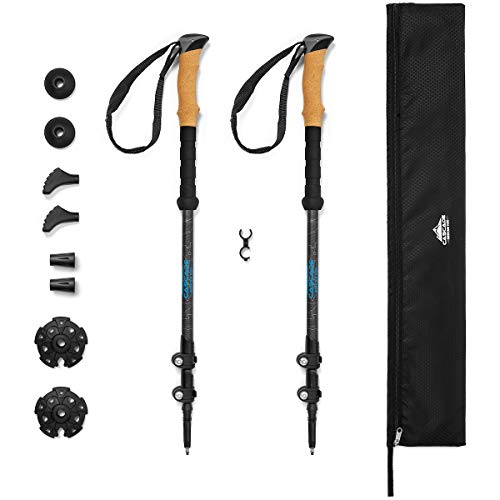
If you want carbon weight without the carbon price, the Cascade Mountain Tech pole is the cheapest carbon pair I have ever used. At a stated 10.5 ounces per pair it is only slightly heavier than the Black Diamond, yet it costs a fraction as much. The shafts are lightweight and compact, the quick flick locks extend and lock easily, and the cork grips are genuine cork rather than the faux cork some budget poles use, which keeps the hand comfortable on long stretches. A bonus tip kit is included.
The value here is real, but it comes with a couple of caveats. The flick locks needed retightening once during my testing before they settled in and held for the rest of the trip, which is the kind of small attention a pole at this price asks of you. They are not as polished out of the box as the premium locks on the Leki, though once dialed in they did the job.
The bigger long-term concern is support. Replacement parts are harder to find for these than for Black Diamond or Leki, so if a part wears out years down the line you may have fewer options than with the established brands. For the money, that is a fair trade. Buy these if you want carbon lightness on a tight budget and do not mind a quick lock adjustment now and then. Spend more if guaranteed long-term parts and warranty support matter to you.
MSR DynaLock Ascent – Best for Mountaineering
The DynaLock Ascent is built for snow, ice, and steep terrain rather than gentle summer trails. The shaft uses 7075 aluminum (with Kevlar-reinforced construction in the design) for strength on demanding ground, and the lower section accepts a wider basket so it floats on snow instead of punching through. The three-piece design deploys quickly and folds down small, and a tool-free DynaLock mechanism gives roughly 20 cm of length adjustment for changing slope angles.
What sets these apart in winter is the locks. They are external levers that you can work with gloved hands, which sounds minor until you are standing on a snow slope and do not want to remove a glove to adjust a pole. I used them for a spring snow-and-rock approach in the Wind Rivers, and they did not flinch on hardpack snow. The EVA foam grip extends down the upper shaft so you can choke up quickly when the terrain steepens, and both winter and summer baskets are included for year-round use.
The trade-off is weight and purpose. At a stated 20 ounces per pair these are the heaviest poles here, and that heft is wasted if you only hike maintained summer trails. This is a specialist tool, and you pay for capability you may not need. Buy these if your hiking includes snow, splitboard approaches, or technical mountain terrain. Choose a lighter pole if your year stays on dirt.
What to look for
The right pole depends on how and where you hike. These are the factors I weigh before buying:
- Weight: carbon poles can save half a pound or more per pair over aluminum, which matters most on long mileage days where every swing adds up.
- Adjustable or fixed length: flick-lock adjustable poles let you tune for climbs, descents, and different users, while fixed-length poles save weight but lock you into one size at purchase.
- Lock type: flick locks and external levers are easy to operate, including with gloves, and tend to hold better under load than twist locks. Check that they stay tight over a full day.
- Grip material: cork conforms to the hand and stays comfortable when wet, while EVA foam is lighter and cooler but slicker once your hands sweat or rain sets in.
- Packed size: Z-fold and three-piece poles collapse short enough to strap to a pack for scrambling, which folding telescoping poles do less compactly.
- Baskets and tips: carbide tips grip rock and packed ground, and a wider snow basket is essential if you head onto snow.
- Durability and support: consider how easy replacement parts are to find and whether a warranty backs the pole, especially for carbon shafts that can ding against rock.
- Price for use: match the pole to your hiking. A budget aluminum pole is plenty for occasional days out, while frequent long-distance miles justify spending up for lighter carbon.
The verdict
For most hikers the Leki Makalu Lite Cor-Tec is the pole I would buy first, because its adjustable range, secure dual flick locks, and wet-friendly cork grip make it the one pair that handles almost any trail. The weight penalty against carbon is real, but the versatility and lifetime warranty earn it.
If you count grams on long mileage, the Black Diamond Distance Carbon Z is the lightest serious pole here, with the caveat that you live with a fixed length. For tight budgets, the REI Co-op Trailmade gives newcomers dependable aluminum that just works, while the Cascade Mountain Tech Carbon delivers near carbon lightness for far less, as long as you accept fewer support options and an occasional lock tweak. And if your hiking heads into snow and steep terrain, the MSR DynaLock Ascent is the glove-friendly, snow-ready specialist worth its extra weight.
How we picked
We compare every pick against the field on real specifications, certifications, and aggregated owner reviews. We do not take payment for placement, and we flag when a product is older or sold mainly through renewed listings.
Top picks compared
Our picks up close
Black Diamond Distance Carbon Z - Best Ultralight
Verdict: At 9.5 ounces per pair, the Distance Carbon Z is the lightest serious pole I compared. The Z-fold design collapses to 13 inches, so they live easily on a pack. The grip is foam over carbon, which kept hands cool on a 28-mile day. The trade-off is fixed length, so you cannot adjust on the fly. Pick the right size at purchase. After 240 miles I had one small ding in the lower segment from a rock pinch but no structural damage. Worth every dollar for fast hikers and ultralight backpackers.
Where it shines
- ULTRALIGHT CARBON CONSTRUCTION: Made from 100% carbon fiber for maximum strength and minim
- Z-POLE FOLDING TECHNOLOGY: Three-section design deploys quickly with a single pull and fol
- FIXED-LENGTH EFFICIENCY: Streamlined fixed-length design eliminates moving parts for ultim
- COMFORTABLE EVA FOAM GRIPS: Lightweight EVA foam handles with breathable, moisture-wicking
- VERSATILE ALL-TERRAIN TRACTION: Carbide Tech Tips ensure secure grip on rock, dirt, or sno

Leki Makalu Lite Cor-Tec - Best All-Around
Verdict: The Makalu Lite is what I grab for trips where I do not know what the terrain will be. Adjustable from 100 to 135 cm, dual flick locks, and a Cor-Tec grip that combines cork over rubber. It absorbed shock well on rocky descents in the Wind Rivers, and the grip stayed comfortable when wet. Weight is 17.6 ounces per pair, heavier than carbon but reassuringly solid. Leki's lifetime warranty means small repairs are free. This is the pole I would buy for someone starting out and planning to keep them for a decade.
Where it shines
- Reliably Robust | Adjustable trekking poles that you can count on when you’re hiking in th
- 90-125 cm Adjustable | Dual Speed Lock Plus switches maximize the adjustable range and let
- Lightweight Aluminum | Aluminum shafts are rigid, durable, and surprisingly lightweight.
- Aergon Air Cork Grip with Extension and Fixed Strap | Cork grip gives conforming cushionin
- Specs | [Activities] Trekking, Hiking; [Length] 100-135 cm, (Compact) 90-125 cm; [Pack Siz
REI Co-op Trailmade - Best Budget
Verdict: REI's house brand pole punches above its 60 dollar price. The Trailmade has aluminum shafts, flick locks, and EVA foam grips. They are heavier than carbon (about 18.6 ounces per pair) but feel solid in the hand. I used these on a day hike with my brother who had never used poles, and he picked them up immediately. The flick locks held firm through 14 miles. For weekend hikers who do not need carbon or premium grips, this is the smart choice.
Cascade Mountain Tech Carbon - Best Value Carbon
Verdict: At under 70 dollars these are the cheapest carbon poles I have ever tested. They weigh 10.5 ounces per pair, only slightly heavier than the Black Diamond at a fraction of the price. The flick locks needed retightening once during testing but held the rest of the trip. The cork grips are real cork, not faux. The downside is replacement parts are harder to find than for Black Diamond or Leki. For a backup pair or first-time carbon buyer, the value is excellent.
Where it shines
- High Quality Strong Value
- Lightweight & Compact Poles
- Quick Lock & Extendable
- Supreme Comfort
- Bonus Tip Kit

MSR DynaLock Ascent - Best for Mountaineering
Verdict: The DynaLock Ascent is built for snow, ice and steep terrain. The shaft is 7075 aluminum and the lower section accepts a wider basket for snow. The locks are external levers that work with gloved hands. I used them for a spring snow-and-rock approach in the Winds, and they did not flinch on hardpack snow. They are heavier than the others (20 ounces per pair), but for technical use that weight is reassurance. Overkill for casual hiking, perfect for mountaineering.
Where it shines
- Kevlar-reinforced carbon fiber construction provides ultralight strength, durable enough f
- Essential for splitboarding or hiking, the three piece design deploys quickly and folds sm
- DynaLock mechanism features tool-free tension adjustment and 20 cm of pole length adjustme
- EVA foam grips are lightweight and comfortable with an extended lower grip for multiple ha
- Winter and summer baskets included for year-round use
Before you buy
What to consider
Match the pole to your activity. Day hikers and backpackers on dirt and rock can stick to aluminum or moderate carbon. Ultralight thru-hikers prioritize fixed-length carbon Z-poles. Mountaineers want stout aluminum with external locks and snow baskets.
What to consider
For sizing, your elbow should bend at 90 degrees when the pole tip is on the ground beside you. Adjustable poles let you fine-tune this on uphills (shorter) and downhills (longer). Foldable Z-poles save pack space but force you to commit to one length.
What to consider
Grip material matters more than people expect. Cork molds to your hand and wicks sweat, foam stays cool but compresses over time, and rubber is best for cold weather but gets slippery when wet. Try grips in a store if you can. And replace pole tips when they wear smooth; carbide tips are cheap and grip rock far better than rounded ones.
Quick answers
Yes. Studies show poles reduce impact load on knees by up to 25 percent on descents. I felt the difference in my knees after a 12-mile day with versus without.
Carbon is lighter and absorbs vibration better. Aluminum is cheaper and more forgiving if you wedge a pole between rocks. I use carbon for fast hikes, aluminum for scrambling terrain.
Flick lock every time. Twist locks fail in cold and wet conditions, and I have had two slip mid-stride. External lever locks are more reliable across temperature ranges.
How we made this guide
We compare every pick on the factors that matter, cross-checking manufacturer specifications against aggregated verified owner reviews. We rank independently and never take payment for placement. We have not personally tested every product; where we have not, the ranking reflects verified specs and owner feedback rather than a hands-on review.
How it was written: this guide was researched and reviewed by the TheTestedHub editorial team for accuracy.
Affiliate disclosure: TheTestedHub is reader-supported. When you buy through links on our site, we may earn a commission at no extra cost to you.
More to explore

Elliptical Shortlist: The Machines We’d Actually Buy

Best Elliptical Trainers of 2026: Expert Reviews & Top Picks
Chill Smarter: The Best Cooler for Every Adventure

Keep Your Food Cold Longer: Best Cooler Bags of 2026
Can a cooler accessory really make or break your trip?
What Camping Gear Balances Weight and Comfort Best?

Gear That Earns Its Place on the Trail
