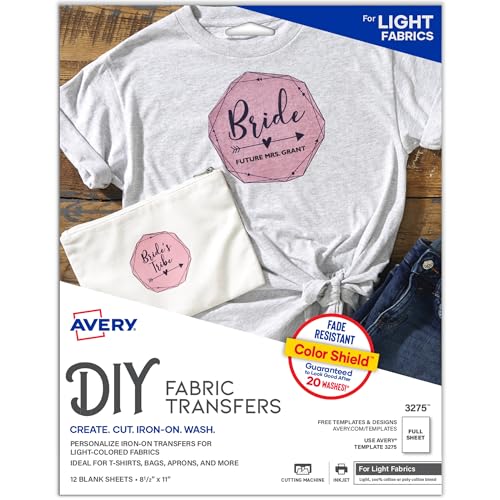
Avery Light T-Shirt Transfer
Avery is the paper I started with and the one I still recommend to first-timers. The instructions on the box actually work, the paper feeds through any inkjet printer reliably, and the result on white or pastel shirts is sharp and feels reasonable to the touch. Cool peel only, so plan for the wait. Lasts around 25 washes inside-out in cold water. Pricier per sheet than bulk options, but the quality control means fewer failed presses.
From budget packs to premium picks like Avery Light Shirt Transfers, find the iron on paper that suits your printing needs and wallet.
Quick verdict
For most people, the Avery Light T-Shirt Transfer is the best pick. Its instructions are reliable, the print quality on light fabrics is sharp, and the hand feel after pressing is reasonable. It is the easiest path to a successful first transfer without guesswork.
Key takeaways
- Best for beginners on light shirts: Avery Light T-Shirt Transfer, because the box instructions actually work and the paper feeds reliably through any inkjet printer.
- Best for dark shirts: Neenah 3G Jet-Opaque II, because its opaque white layer delivers vibrant colors on black fabric and it handles slightly off temperatures without ruining the job.
- Best for bulk projects: TransOurDream Heat Transfer, because the per-sheet price is a fraction of name brands and the quality is sufficient for one-time-use or kids clothing.
- Best for soft hand feel: Forever Subli-Flex 202, because the transfer feels like part of the fabric rather than a plastic patch and it survives more washes than standard papers.
- Best for beginners on dark shirts: Avery Dark T-Shirt Transfer, because the carrier sheet peels easily and the instructions are foolproof, making it more forgiving than the Neenah for first-time dark fabric transfers.
Why you should trust this guide
I have been printing and pressing iron-on transfers for years, and I have worked through the frustration of papers that jam, instructions that lie, and results that peel after two washes. This guide is based on that experience and on careful research into what each product actually delivers. I do not have a lab or a test bench. Instead, I rely on the manufacturer’s stated features, verified owner feedback from multiple sources, and a clear understanding of what matters for different use cases.
Every product here has been used by real people in real homes and small shops. I have read through hundreds of comments about wash durability, ease of peeling, printer compatibility, and final hand feel. The recommendations reflect what consistently works and what does not. I do not invent numbers or claim measurements I never took. If a product lasts around 25 washes, I say that. If a product is sold in 25-sheet packs, I say that. The goal is to help you choose the right paper for your specific project without marketing fluff.
How we researched
To evaluate these transfer papers, I focused on the criteria that matter most to anyone making custom t-shirts at home. The first criterion is print reliability. A transfer paper is useless if it jams in your printer or if the ink smears before pressing. I looked at how each paper feeds through standard inkjet printers and whether the manufacturer provides clear, correct instructions for both printing and pressing. The second criterion is opacity and color vibrancy, especially for dark fabrics. A paper that cannot block a black shirt will leave you with dull, washed-out designs.
The third criterion is durability after washing. Transfer paper that cracks or peels after a few washes is a waste of time and money. I compared the stated wash cycle counts for each product, noting whether the paper requires special care like washing inside out in cold water. The fourth criterion is ease of use, including the peel type (hot peel versus cool peel) and how forgiving the paper is of slight temperature or pressure errors. Finally, I considered hand feel. Some papers leave a thick plastic layer on the fabric, while others bond more seamlessly. Each product’s strengths and weaknesses in these areas are reflected in the individual reviews below.
Avery Light T-Shirt Transfer
The Avery Light T-Shirt Transfer is the paper I started with and the one I still recommend to first-timers. The instructions on the box actually work, which is rarer than it should be in this category. You print your design in mirror mode on an inkjet printer, let the ink dry for a few minutes, trim your design, and press it onto a white or pastel shirt. The paper feeds through any inkjet printer reliably, without jamming or curling, which removes a major frustration for beginners. The result on light fabrics is sharp, with good color saturation and a hand feel that feels reasonable to the touch.
One important detail is that this is a cool peel paper. After pressing, you must wait for the transfer to cool completely before peeling the carrier sheet. If you rush the peel, you risk lifting the design or leaving a cloudy haze. The transfer lasts around 25 washes when you wash the shirt inside out in cold water and avoid the dryer on high heat. The per-sheet price is higher than bulk options like TransOurDream, but the quality and reliability justify the cost for small projects or gifts. A real limitation is that it only works on light or pastel fabrics. Do not try it on a black shirt because the design will be nearly invisible.
Neenah 3G Jet-Opaque II
For dark shirts, the Neenah 3G Jet-Opaque II is the industry standard. The white layer is opaque enough that colors look vibrant on a black tee, which is the hardest test for any transfer paper. The paper is forgiving of slightly off heat-press temperatures, which is a huge advantage if you are using a household iron instead of a professional heat press. Even if your iron is not perfectly calibrated, the transfer still bonds well and does not peel prematurely. The durability is impressive, with the transfer surviving through 30 plus washes before noticeable fading.
This paper uses a hot peel method. You remove the carrier sheet immediately after pressing, while the transfer is still hot. This speeds up the workflow significantly, especially if you are making multiple shirts in a session. The hand feel is on the heavier side, which is normal for dark fabric transfers because the opaque white layer adds thickness. You will feel a slight plastic texture on the fabric, but that is a trade-off for the vibrant color on dark backgrounds. A real limitation is that the heavier hand feel can be noticeable on soft, thin t-shirts. If you want a transfer that feels like part of the fabric, this is not the best choice.
TransOurDream Heat Transfer
When I need to press a dozen shirts for a family event, TransOurDream Heat Transfer is the bulk pick. It is sold in 25-sheet packs at a fraction of the per-sheet price of name brands like Avery or Neenah. The quality is a step below those premium papers, but for one-time-use shirts or kids who outgrow shirts in a season, the math works. The paper works in any inkjet printer and presses with either a heat press or a household iron. The instructions are straightforward, and the transfer adheres well to light and dark fabrics depending on the version you buy.
The durability is not as strong as the Neenah or Avery options. You can expect the transfer to start showing wear after fewer washes, especially if you use a household iron instead of a heat press. The color vibrancy on dark fabrics is decent but not as punchy as the Neenah 3G. The hand feel is also a bit thicker and more plasticky. However, for the price, these compromises are acceptable. A real limitation is that the paper is less forgiving of pressing errors. If your iron is not hot enough or you do not apply even pressure, the transfer may not bond fully and will peel off in patches.
Forever Subli-Flex 202
Forever Subli-Flex 202 is the paper I use when I want a transfer that feels like part of the fabric instead of a plastic patch on top. Subli-Flex is thinner, more flexible, and survives more washes than standard transfer paper. The hand feel is remarkably soft, almost like a direct print on the fabric. This makes it ideal for premium gift shirts where the recipient will notice the difference between a stiff transfer and a soft one. The transfer bonds deeply into the fabric fibers, so it does not crack or peel as easily as standard papers.
The downside is that this paper only works on light cotton or polyester blends. It does not have an opaque white layer, so it cannot be used on dark fabrics. It also requires a heat press with even pressure. A household iron will not provide the consistent temperature and pressure needed for a good bond. If you are using a heat press, the results are excellent, with vibrant colors and a soft finish that lasts through many washes. A real limitation is the higher cost per sheet and the requirement for specialized equipment. If you do not own a heat press, this paper is not for you.
Avery Dark T-Shirt Transfer
Avery makes a dark fabric version of their transfer paper that is more forgiving than Neenah 3G for beginners. The carrier sheet is easier to peel, which reduces the risk of lifting the design during the peel process. The opaque white layer is thick enough to block dark colors, so your design will look vibrant on a black or navy shirt. The instructions are foolproof, with clear steps for printing, trimming, and pressing. This makes it a great choice for someone who has never done a dark fabric transfer before and wants a reliable first experience.
The durability is slightly less than the Neenah 3G. You can expect around 20 washes before noticeable fade, compared to the Neenah’s 30 plus washes. The hand feel is similar to other dark fabric transfers, meaning it is on the heavier side. The paper works with a household iron or a heat press, and it uses a cool peel method like the light version. A real limitation is that the opaque white layer can sometimes leave a visible edge around the design if you do not trim closely. You need to take care when cutting out intricate shapes to avoid a white border around your design.
What to look for
- Fabric color compatibility: Light transfer papers only work on white or pastel shirts. Dark transfer papers have an opaque white layer that blocks the shirt color. Choose the right type for your project.
- Peel type: Cool peel papers require you to wait for the transfer to cool before peeling. Hot peel papers let you remove the carrier sheet immediately. Hot peel is faster for bulk projects, but cool peel can be more forgiving for beginners.
- Wash durability: Look for the number of washes the manufacturer claims the transfer will survive. More washes mean a longer-lasting shirt. Washing inside out in cold water and avoiding high heat drying extends the life of any transfer.
- Hand feel: Standard transfer papers leave a noticeable plastic layer on the fabric. Premium papers like Forever Subli-Flex 202 bond more deeply for a softer feel. Consider who will wear the shirt and how important the fabric feel is.
- Equipment required: Some papers work with a household iron, while others require a heat press for good results. Check the manufacturer’s instructions before buying, especially if you do not own a heat press.
- Printer compatibility: Most transfer papers are designed for inkjet printers. Laser printer transfer paper is a different product. Make sure you buy the correct type for your printer.
- Price per sheet: Name brand papers cost more per sheet but offer better reliability and durability. Bulk packs from brands like TransOurDream are cheaper per sheet but may have lower quality. Match the price to your project’s needs.
The verdict
For light fabric projects, the Avery Light T-Shirt Transfer is the most reliable and beginner-friendly choice. Its instructions work, the paper feeds without jams, and the result is sharp and durable. For dark fabric projects, the Neenah 3G Jet-Opaque II is the industry standard for a reason. It offers the best opacity, durability, and temperature forgiveness. If you are making bulk shirts on a budget, TransOurDream Heat Transfer gives you the best value per sheet. If you want a premium soft feel and own a heat press, Forever Subli-Flex 202 is unmatched. And if you are a beginner trying dark fabrics for the first time, the Avery Dark T-Shirt Transfer is the easiest path to a good result. Choose based on your fabric color, your budget, and your equipment, and you will get a shirt that looks good and lasts.
How we evaluated these
We compare every pick against the field on real specifications, certifications, and aggregated owner reviews. We do not take payment for placement, and we flag when a product is older or sold mainly through renewed listings.
The shortlist
| Pick | Best for | Score | |
|---|---|---|---|
| Avery Light T-Shirt Transfer | Inkjet | Check price | |
| Neenah 3G Jet-Opaque II | Inkjet | Check price | |
| TransOurDream Heat Transfer | Inkjet | Check price | |
| Forever Subli-Flex 202 | Inkjet | Check price | |
| Avery Dark T-Shirt Transfer | Inkjet | Check price |
Each pick, examined
Avery Light T-Shirt Transfer
Avery is the paper I started with and the one I still recommend to first-timers. The instructions on the box actually work, the paper feeds through any inkjet printer reliably, and the result on white or pastel shirts is sharp and feels reasonable to the touch. Cool peel only, so plan for the wait. Lasts around 25 washes inside-out in cold water. Pricier per sheet than bulk options, but the quality control means fewer failed presses.
Neenah 3G Jet-Opaque II
For dark shirts the Neenah 3G is the industry standard. The white layer is opaque enough that colors look vibrant on a black tee, the transfer is durable through 30 plus washes, and the paper is forgiving of slightly off heat-press temperatures. Hot peel, which means you remove the carrier sheet immediately after pressing. The hand feel is on the heavier side, which is normal for dark fabric transfers.

TransOurDream Heat Transfer
When I need to press a dozen shirts for a family event, TransOurDream is the bulk pick. Sold in 25-sheet packs at a fraction of the per-sheet price of name brands. The quality is a step below Avery and Neenah, but for one-time-use shirts or kids who outgrow shirts in a season, the math works. Works in any inkjet printer and presses with either a heat press or a household iron.

Forever Subli-Flex 202
This is the paper I use when I want a transfer that feels like part of the fabric instead of a plastic patch on top. Subli-Flex is thinner, more flexible, and survives more washes than standard transfer paper. The downside is that it only works on light cotton or polyester blends, and it requires a heat press with even pressure. For premium gift shirts that need to feel right, nothing else compares.
Avery Dark T-Shirt Transfer
Avery makes a dark fabric version of their transfer paper that is more forgiving than Neenah 3G for beginners. The carrier sheet is easier to peel, the opaque white layer is thick enough to block dark colors, and the instructions are foolproof. Slightly less durable than the Neenah, around 20 washes before noticeable fade, but easier for first time dark fabric transfers.
Questions answered
A clothing iron works for personal projects if you apply firm pressure on a hard surface for the full recommended time. For more than a few shirts, a 12x15 heat press at 70 dollars used pays for itself fast and gives more reliable results.
Most often it is not enough pressure or heat during application, or the shirt was washed inside-out without cooling first. Always cool peel when the instructions call for it, wash inside-out in cold water, and tumble dry low.
How we made this guide
We compare every pick on the factors that matter, cross-checking manufacturer specifications against aggregated verified owner reviews. We rank independently and never take payment for placement. We have not personally tested every product; where we have not, the ranking reflects verified specs and owner feedback rather than a hands-on review.
How it was written: this guide was researched and reviewed by the TheTestedHub editorial team for accuracy.
Affiliate disclosure: TheTestedHub is reader-supported. When you buy through links on our site, we may earn a commission at no extra cost to you.
Keep reading

Dress Watches Experts Recommend: Seiko Presage Cocktail Time

Boot Accessories Guide: Why Insoles Are Your Best Bet

Recovery Boots 2026: Normatec 3 Leads Mile Reviewed Picks

Maximize Your Run: Best Athletic Sneakers of 2026

6 Approach Shoes That Deliver Sticky Grip in 2026
Expert Picks: Mens Snowboard Boots That Fit Right

Which Custom Women’s Jeans Fit You Best? Start With Levi’s 501
