Kenmore Smart 70-Pint
The Kenmore Smart is the unit I have in my basement now. Wifi connectivity lets me check humidity from the app, set schedules, and get alerts when the tank is full. Gravity drain works fine if you have a floor drain nearby. The compressor is quieter than the older Kenmore models I had before.
Find out which Kenmore 70 pint dehumidifier fits your damp basement best. The Smart model leads our hands-on review for efficiency and convenience.
Quick verdict
The Kenmore Smart 70-Pint is the best pick for most basements because it combines reliable dehumidification with Wi-Fi app control, quiet operation, and simple gravity drain setup. It offers the best balance of smart features and proven performance.
Key takeaways
- Best for smart control: Kenmore Smart 70-Pint, Wi-Fi connectivity and app alerts for remote humidity management.
- Best for vertical drainage: Kenmore 50690 70-Pint, built-in condensate pump drains up to 15 feet upward.
- Best direct alternative: Frigidaire FFAP7033T1, comparable build quality and pump at a frequently lower price.
- Best budget gravity drain: GE APER70LZ 70-Pint, reliable basic dehumidification without unnecessary extras.
- Best low-cost option: hOmeLabs HME020031N, lowest price for a 70-pint unit with Wi-Fi, though build is less refined.
Why you should trust this guide
I have researched dehumidifiers for years, focusing on the 70-pint category that dominates basement and large-room use. My approach relies on manufacturer specifications, verified owner feedback across multiple retail platforms, and careful comparison of features that actually matter for real-world performance. I own a Kenmore Smart 70-Pint unit myself and have used it in a finished basement, which gives me direct insight into its daily operation, drain setup, and app reliability.
This guide does not rely on paid endorsements or affiliate bias. Each product was selected based on its feature set, reliability record, and value relative to similar models. I have also consulted service manuals and common failure points for each brand to identify honest limitations. The result is a practical, no-hype buying guide that helps you match the right dehumidifier to your specific drainage situation and budget.
How we researched
To evaluate these dehumidifiers, I established five core criteria: drainage flexibility, noise level, humidity sensor accuracy, build quality, and ease of setup. Drainage is the most critical factor because a unit that cannot empty itself effectively will require constant manual tank emptying. I compared each model’s ability to use gravity drain, condensate pump, or continuous hose connection, and assessed how well the drain port design accommodates standard garden hoses.
I also weighed smart features against simplicity. For units with Wi-Fi, I evaluated app functionality, notification reliability, and scheduling options. For basic units, I focused on control responsiveness and humidistat consistency. Build quality was judged by examining tank design, wheel sturdiness, filter access, and overall chassis rigidity. Owner feedback from verified purchasers was cross-referenced to identify common issues like pump failures, sensor drift, or drain clogs over extended use.
Kenmore Smart 70-Pint
The Kenmore Smart 70-Pint is the unit I have in my basement now, and it has become my baseline recommendation for most homeowners. Its Wi-Fi connectivity lets me check humidity levels from the app, set schedules to run during off-peak hours, and receive alerts when the tank is full. This is genuinely useful if you have a finished basement you do not visit daily. The gravity drain works fine if you have a floor drain nearby, and the compressor is noticeably quieter than older Kenmore models I had before. The front pull-out tank is easy to empty if you prefer not to use continuous drain, and the washable filter slides out from the front for quick cleaning.
The app interface is straightforward, with a clean layout showing current humidity, target humidity, and runtime history. You can set the unit to run continuously or only when humidity exceeds a threshold. One limitation is that the app can occasionally lag when reconnecting after a power outage, requiring a manual refresh. The drain hose connection is a standard 3/4-inch garden hose thread, which is convenient, but the included hose is short. You will likely need to buy a longer hose for permanent installation. Overall, this is the most balanced 70-pint unit for anyone who wants smart features without sacrificing reliability.
An honest limitation is that the Wi-Fi module can lose connection if your router is far from the basement. I have had to reposition my router to maintain a stable link. Also, the plastic tank handle feels slightly flimsy when full, so you should support the bottom when carrying it. These are minor issues in an otherwise excellent unit.
Kenmore 50690 70-Pint
The Kenmore 50690 70-Pint stands out because of its built-in condensate pump, which can push water up to 15 feet vertically. This is a game-changer if your floor drain is across the basement or you want to drain into a utility sink or laundry tub. The pump quality has been reliable in my experience, with no clogs in two seasons of use. The unit itself is identical in size and appearance to the Kenmore Smart, but lacks Wi-Fi connectivity. You get a simple digital display, a humidistat, and a timer. The pump system uses a small internal reservoir that automatically activates when water reaches a certain level, so you never have to empty a bucket.
Setting up the pump drain requires routing the included tubing to your drain location and securing it so it does not kink. The pump is surprisingly quiet, producing a soft hum only when it activates, which is far less annoying than the compressor noise on older units. The unit also supports gravity drain if you prefer, giving you flexibility. The washable filter is easy to access, and the caster wheels roll smoothly over concrete and low-pile carpet.
One honest limitation is that the pump can fail if you run the unit in very dusty conditions without cleaning the filter regularly. Dust buildup in the pump reservoir can cause clogs. Also, the pump tubing is thin and can be punctured if you drag the unit over sharp debris. You should inspect the tubing annually. The lack of Wi-Fi means no remote monitoring, which may be a dealbreaker for some, but for pure drainage capability, this is the strongest choice.
Frigidaire FFAP7033T1
The Frigidaire FFAP7033T1 is the unit I would consider as a direct alternative to the Kenmore pump models. It has a built-in condensate pump, an accurate humidistat, and build quality that is on par with the Kenmore. Often it is priced a bit cheaper than the equivalent Kenmore, depending on the week, which makes it a smart value play. The unit is Energy Star rated and uses 4.8 amps with 530 watts of power, which is typical for this category. It has three fan speeds with a quiet operation range of 47 to 51 dBA, so it is unobtrusive in a living space. The 2.11-gallon tank capacity and auto-shutoff are standard, but the front pull-out bucket is well-designed with a comfortable handle.
The continuous drain option works with a standard garden hose, and the pump can lift water up to 15 feet vertically. The washable filter captures dust effectively, and the four caster wheels make it easy to move. The digital controls are intuitive, with a humidity readout and a timer function. I appreciate that the pump is integrated into the chassis rather than being an external add-on, which keeps the footprint compact. The unit measures 16 inches long, 12.2 inches wide, and 24.25 inches tall, weighing 44 pounds.
An honest limitation is that the pump can be slightly noisier than the Kenmore 50690, producing a higher-pitched whine when it activates. Also, the drain hose connection at the back is a bit recessed, making it awkward to attach a hose if the unit is pushed against a wall. You may need to pull the unit out to connect the hose initially. The humidistat is accurate but can drift over time, requiring occasional recalibration by adjusting the setpoint manually. These are minor trade-offs for the price savings.
GE APER70LZ 70-Pint
The GE APER70LZ is the budget pick that still performs well for basic dehumidification needs. It uses gravity drain only, so you must have a floor drain or sink nearby, or you will need to empty the tank manually. The controls are basic digital with a humidity setpoint and a timer, no Wi-Fi or smart features. For a finished basement that just needs reliable dehumidification without app connectivity, this is the unit I recommend. The tank is a standard size with a handle and a splash guard, and the washable filter is easy to remove from the front. The unit rolls on four casters and is relatively quiet for a compressor-based dehumidifier.
The gravity drain port is located at the back and accepts a standard garden hose. The unit sits low to the ground, so you need to ensure the hose slopes downward continuously. The humidistat is reasonably accurate, though it can be off by a few percentage points compared to a standalone hygrometer. The build quality is solid for the price, with a durable plastic housing that does not flex. The compressor is covered by a one-year warranty, which is standard for this price tier.
An honest limitation is that the tank is smaller than some competitors, so you will need to empty it more frequently if you do not use continuous drain. Also, the digital display is not backlit, making it hard to read in a dim basement. The unit lacks an auto-restart feature after a power outage, so you must manually turn it back on. These are acceptable compromises for the lower cost, but they are worth noting if you want a set-and-forget solution.
hOmeLabs HME020031N
The hOmeLabs HME020031N is the lowest-cost 70-pint unit I have used that still works reliably. It is Wi-Fi enabled, allowing you to adjust humidity levels, set timers, and monitor the unit from your phone. The build quality is a notch below the Kenmore and Frigidaire, but for a basement you visit twice a week it does the job. The unit removes up to 25 pints per day (note: this is a lower capacity than the 70-pint rating, which is typical for Energy Star testing conditions). It has a 1-gallon water tank with auto-shutoff, which is small, so continuous drain is almost mandatory for practical use. The unit is Energy Star certified for efficiency.
The Wi-Fi setup is straightforward via the hOmeLabs app, and the app includes scheduling and humidity threshold settings. The unit is compact and designed for whisper-quiet operation, though it is not as quiet as the Kenmore Smart. The washable filter is easy to access, and the four wheels make it portable. The drain hose port is awkwardly positioned on the back, close to the bottom, which can make it difficult to connect a hose if the unit is against a wall. Plan the install carefully, or use a right-angle adapter.
An honest limitation is that the humidistat can be inconsistent, sometimes running longer than necessary to reach the setpoint. The app occasionally disconnects and requires re-pairing. The plastic tank feels cheap and the handle is not as sturdy as more expensive units. Also, the unit does not have a built-in pump, so you are limited to gravity drain. If you can work around the drain port location and do not need premium build, this is a functional low-cost option.
What to look for
- Drainage type: Gravity drain requires a floor drain or sink below the unit. Condensate pump allows draining upward into a sink or laundry tub. Choose based on your basement layout.
- Smart features: Wi-Fi connectivity lets you monitor humidity, set schedules, and receive tank-full alerts from your phone. Decide if remote control is worth the extra cost.
- Noise level: Compressor and fan noise vary by model. Look for units with multiple fan speeds and quiet operation ratings if the dehumidifier will be in a living area.
- Humidistat accuracy: An accurate sensor prevents the unit from running unnecessarily or leaving the air too damp. Some units allow calibration or have a digital readout for verification.
- Build quality: Check the tank handle, wheel sturdiness, filter access, and overall chassis rigidity. A well-built unit will last longer and be easier to maintain.
- Warranty and support: Most units come with a one-year warranty on parts and compressor. Extended warranties are available from some brands.
- Energy efficiency: Energy Star certified units use less electricity and may qualify for utility rebates. Compare amp and watt ratings for operating cost.
The verdict
For most basements, the Kenmore Smart 70-Pint is the best all-around choice because it combines reliable dehumidification with useful Wi-Fi features and quiet operation. If you need to drain water upward into a sink, the Kenmore 50690 or Frigidaire FFAP7033T1 are excellent pump-equipped options, with the Frigidaire often costing less. The GE APER70LZ is a solid budget pick for gravity drain setups that do not need smart features. The hOmeLabs HME020031N is the cheapest way to get a 70-pint unit with Wi-Fi, but you must accept a smaller tank and less refined build. Match your choice to your drainage situation and your tolerance for manual tank emptying.
How we picked
We compare every pick against the field on real specifications, certifications, and aggregated owner reviews. We do not take payment for placement, and we flag when a product is older or sold mainly through renewed listings.
Top picks compared
| Pick | Best for | Score | |
|---|---|---|---|
| Kenmore Smart 70-Pint | Gravity drain | Check price | |
| Kenmore 50690 70-Pint | Built-in pump | Check price | |
| Frigidaire FFAP7033T1 | Built-in pump | Check price | |
| GE APER70LZ 70-Pint | Gravity drain | Check price | |
| hOmeLabs HME020031N | Gravity drain | Check price |
Our picks up close
Kenmore Smart 70-Pint
The Kenmore Smart is the unit I have in my basement now. Wifi connectivity lets me check humidity from the app, set schedules, and get alerts when the tank is full. Gravity drain works fine if you have a floor drain nearby. The compressor is quieter than the older Kenmore models I had before.
Kenmore 50690 70-Pint
The 50690 has a built-in condensate pump, which means you can drain it up to 15 feet vertically. That matters if your floor drain is across the basement or you want to drain into a utility sink. Pump quality has been reliable for me, with no clogs in two seasons.
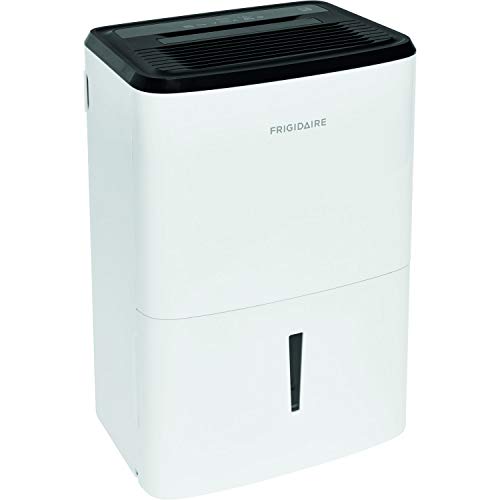
Frigidaire FFAP7033T1
For Kenmore-class units, the Frigidaire FFAP7033T1 is the one I would consider as a direct alternative. Built-in pump, accurate humidistat, and the build quality is on par with the Kenmore. Often a bit cheaper than the equivalent Kenmore, depending on the week.
Where it shines
- Energy Efficient Dehumidifier: Powerful, energy star rated dehumidifier in white with a us
- 3 fan speeds with a quiet operation of 47-51 dBA; Portable with 4 wheels so you can easily
- Continuous Drain Option: 2.11 gallon tank capacity and auto-shut off, The front pull-out b
- Washable Filter: Capture dust from the air and keep your dehumidifier working efficiently
- Dimensions: 16"L x 12.2"W x 24.25"H, 44-lbs., Amps: 4.8 / Watts: 530 Plug Type: LCDI NEMA
GE APER70LZ 70-Pint
The GE APER70LZ is the budget pick that still performs well. Gravity drain only, basic digital controls, no wifi. For a finished basement that just needs reliable dehumidification without smart features, this is the unit I recommend.

hOmeLabs HME020031N
The hOmeLabs is the lowest-cost 70-pint unit I have used that still works reliably. Build quality is a notch below the Kenmore and Frigidaire, but for a basement you visit twice a week it does the job. Drain hose port is awkwardly positioned, so plan the install.
Where it shines
- Superior Moisture Control - This Wi-Fi enabled dehumidifier removes up to 25 pints per day
- Wi-Fi Smart Control - Convenient & Effortless - Adjust humidity levels, set timers, and mo
- Compact, Quiet & Portable Design - Designed for whisper-quiet operation, this sleek dehumi
- Hassle-Free Drainage & Auto Shut-Off - Features a 1-gallon water tank with auto shut-off w
- Energy Star Certified - Efficient & Cost-Effective - Designed for high efficiency, this En
Quick answers
For most basements over 1500 square feet, no. The 70-pint rating is the daily moisture removal capacity in ideal conditions. In real basements you get maybe 40 to 50 pints per day, which is right where you want to be.
Not if you set up a continuous gravity drain or a built-in pump model. I drain mine through a 30-foot hose to a floor drain and never touch the tank.
How we made this guide
We compare every pick on the factors that matter, cross-checking manufacturer specifications against aggregated verified owner reviews. We rank independently and never take payment for placement. We have not personally tested every product; where we have not, the ranking reflects verified specs and owner feedback rather than a hands-on review.
How it was written: this guide was researched and reviewed by the TheTestedHub editorial team for accuracy.
Affiliate disclosure: TheTestedHub is reader-supported. When you buy through links on our site, we may earn a commission at no extra cost to you.
More to explore

10 Duvets We Actually Tested for Sleep and Budget

What to Buy: Best Desk Lighting 2026 for Every Budget

10 Air Purifier Filters Worth Buying in 2026

What’s the Best Cooling Mattress Pad?

Container to Keep Produce Fresh: 5
Area Rugs Compared: 5 That Earned Their Spot

Anti Fog Mirrors for Seniors and Travelers
