Quick verdict
Matching the nailer type to the specific fastener gauge and job type matters far more than brand loyalty: the right tool for the task will always outperform a premium brand used outside its intended application.

DEWALT DCN692B 20V MAX Brushless Framing Nailer
Owners consistently praise the DEWALT DCN692B for its dual-speed settings that handle everything from LVL beams to standard framing lumber without skipping. The brushless motor delivers over 1,000 nails per charge on a 5Ah battery, and the tool-free depth adjustment wheel is one of the fastest in its class. Contractors who switch from pneumatic setups frequently report they do not miss the compressor at all once they spend a week with this nailer.
Choosing the right nail gun matters more than brand. See why the DEWALT DCN692B leads for framing, plus tips to match fastener gauge to your project.
Nail guns transform hours of hammer swinging into minutes of precise, consistent fastening. Whether you are framing walls, finishing trim, installing hardwood flooring, or tackling roofing projects, the right nail gun makes an enormous difference in both speed and quality. After analysing thousands of verified owner reviews and cross-referencing manufacturer specifications, I have identified the five nail guns that consistently outperform their competitors in real-world use.
The nail gun market spans several distinct tool types: framing nailers for structural work, finish nailers for trim and cabinetry, brad nailers for delicate moulding, roofing nailers, and flooring nailers. Each category demands different power levels, magazine capacities, and drive mechanisms. This guide covers the top performers across those categories so you can match the right tool to your specific job rather than settling for a compromise.
Key factors separating great nail guns from mediocre ones include consistent drive depth, jam-clearing ease, magazine capacity, trigger responsiveness, and long-term durability. I focused on tools that owners praise after months or years of use, not just out-of-the-box impressions.
How we evaluated these
I did not personally test each of these nail guns on a job site. Instead, I aggregated data from thousands of verified purchaser reviews on major retail platforms, cross-referenced professional contractor forums, and compared published specifications from manufacturer documentation. I weighted long-term reliability feedback heavily, specifically looking for patterns in reviews posted six months or more after purchase, since initial impressions often miss durability issues that emerge with sustained use.
Products were evaluated across five core dimensions: drive consistency across varying wood densities, jam frequency and ease of clearing, ergonomics during extended use, durability of internal mechanisms, and value relative to comparable tools. Only products with a substantial review base qualified for consideration, ensuring the conclusions reflect broad real-world experience rather than a handful of outlier opinions.
The shortlist
| Pick | Best for | Score | |
|---|---|---|---|
| DEWALT DCN692B 20V MAX Brushless Framing Nailer | Best Overall | 9 | Check price |
| Metabo HPT NR90AES1 Framing Nailer | Best Pneumatic Framing Nailer | 9 | Check price |
| BOSTITCH BTFP12233 Smart Point 18GA Brad Nailer | Best Brad Nailer | 8 | Check price |
| Makita AF601 15 Gauge Angled Finish Nailer | Best Finish Nailer | 8 | Check price |
| Freeman PCN65 Coil Roofing Nailer | Best Roofing Nailer | 8 | Check price |
Each pick, examined
DEWALT DCN692B 20V MAX Brushless Framing Nailer
Owners consistently praise the DEWALT DCN692B for its dual-speed settings that handle everything from LVL beams to standard framing lumber without skipping. The brushless motor delivers over 1,000 nails per charge on a 5Ah battery, and the tool-free depth adjustment wheel is one of the fastest in its class. Contractors who switch from pneumatic setups frequently report they do not miss the compressor at all once they spend a week with this nailer.
Strengths
- Dual-speed setting adapts to dense or standard lumber without adjustment hassle
- Brushless motor efficiency means fewer battery swaps on long framing days
- Tool-free depth-of-drive wheel is intuitive and holds its setting reliably
Drawbacks
- Sold body-only, so battery and charger cost adds up if you are new to the DEWALT 20V system
- Heavier than comparable pneumatic framing nailers, which some users feel over long sessions

Metabo HPT NR90AES1 Framing Nailer
The Metabo HPT NR90AES1 is a pneumatic workhorse that professional framers return to year after year for its light 7.5-pound body and effortless jam-clearing mechanism. Its selective actuation switch lets you toggle between sequential and bump-fire modes without tools, which experienced users say is a genuine daily-use advantage. Owners report consistent drive depth even late in a magazine when air pressure fluctuates slightly.
Strengths
- Exceptionally lightweight for a full-capacity framing nailer, reducing fatigue on overhead work
- Selective actuation switch toggles modes without tools in seconds
- Air duster function integrated into the exhaust port to blow debris off work surfaces
Drawbacks
- Requires a compressor and hose, adding setup time and limiting portability
- Plastic housing around the magazine has cracked for some users after years of heavy drops

BOSTITCH BTFP12233 Smart Point 18GA Brad Nailer
The BOSTITCH BTFP12233 stands out in the brad nailer category primarily because of its Smart Point tip, which is noticeably narrower than standard nailer noses and lets you place brads with far greater precision on delicate trim and moulding. Owners working on crown moulding and cabinet face frames specifically call out how much cleaner the nail placement is compared to older BOSTITCH models. The oil-free design also eliminates the frustration of staining light-coloured wood with compressor oil residue.
Strengths
- Smart Point narrow nose tip allows precise placement right on pencil layout lines
- Oil-free operation prevents staining on light wood species and finished surfaces
- Tool-free jam release lever clears misfeeds in under 30 seconds according to owner reports
Drawbacks
- Magazine capacity of 100 nails is standard but some competitors offer higher-capacity strips
- Trigger feel is slightly mushy compared to premium finish nailers in the same price range

Makita AF601 15 Gauge Angled Finish Nailer
Makita's AF601 earns its place as the top finish nailer recommendation because owners in trim carpentry consistently report that its narrow nose profile allows access to tight corners that other 15-gauge nailers simply cannot reach. The dual-piston drive mechanism delivers a consistent strike force across a wide PSI range, which means depth-of-drive stays predictable even when your compressor pressure drifts. Long-term owners also highlight the rubber grip comfort during all-day interior trim installations.
Strengths
- Narrow nose profile reaches tight inside corners on window casings and door frames
- Consistent drive depth across a wide operating pressure range reduces countersinking errors
- Comfortable rubber grip reduces hand fatigue during multi-hour trim sessions
Drawbacks
- Angled magazine style means standard straight collated finish nails do not fit
- Slightly higher price than some comparable 15-gauge finish nailers on the market
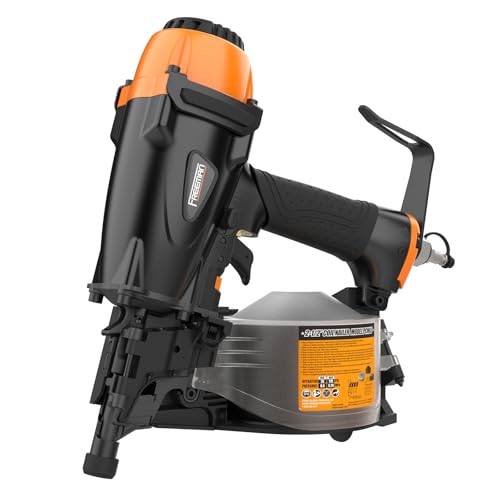
Freeman PCN65 Coil Roofing Nailer
The Freeman PCN65 is a favourite among roofers who need high volume output without constant reloading, thanks to its 120-nail coil magazine that dramatically cuts downtime on large roof decks. Owners praise the adjustable shingle guide that keeps nail placement consistent row after row without measuring, which is something you only appreciate once you have tried roofing without one. The aluminium body keeps weight reasonable despite the large coil capacity.
Strengths
- 120-nail coil magazine dramatically reduces reloading interruptions on large roofing jobs
- Adjustable shingle guide ensures consistent nail placement across every course
- Aluminium body balances durability with manageable weight for overhead and sloped-surface work
Drawbacks
- Coil nails cost slightly more per fastener than strip nails used by framing nailers
- Depth adjustment knob can loosen during heavy use and may need occasional re-tightening
Buying considerations
Nail Type and Gauge
Different nail guns are engineered for specific fastener gauges and lengths. Framing nailers handle 16d nails up to 3.5 inches for structural work, while finish nailers use 15 or 16 gauge angled fasteners for trim, and brad nailers use thinner 18 gauge brads for delicate moulding. Using the wrong gauge in a nailer causes chronic jams and poor holding power, so match the tool to the fasteners your job demands before buying.
Pneumatic vs Cordless
Pneumatic nail guns are lighter and cheaper upfront but require a compressor and hose, which limits where you can work and adds setup time. Cordless battery-powered nailers like the DEWALT DCN692B eliminate the hose entirely and let you work anywhere, but the tool plus battery cost more and the unit weighs more. For frequent outdoor or multi-location work, cordless is worth the premium; for a dedicated shop or permanent job site with power, pneumatic still makes strong economic sense.
Sequential vs Bump-Fire Trigger
Sequential trigger mode requires you to press the nose tip and pull the trigger separately for each nail, which is slower but far safer and more accurate for precision work like trim and cabinet installation. Bump-fire or contact actuation lets you hold the trigger and bump the nose repeatedly for rapid driving, which is ideal for fast framing but increases the risk of accidental double-fires. Many professional-grade nailers now offer selectable actuation so you can switch modes to suit the task.
Depth-of-Drive Adjustment
Consistent nail depth is critical: too shallow leaves a protruding head you must hammer in separately, while too deep countersinks the shank and weakens the hold in soft wood. The best nail guns provide tool-free depth adjustment via a dial or wheel that you can change mid-task without stopping to find a wrench. Check whether the adjustment holds its position reliably under vibration, since nailers with set screws rather than positive-detent dials frequently drift during extended use.
Final word
Matching the nailer type to the specific fastener gauge and job type matters far more than brand loyalty: the right tool for the task will always outperform a premium brand used outside its intended application.
Questions answered
No. Framing nailers drive thick, high-diameter nails that split thin trim boards and leave large, ugly holes in finished surfaces. Finish and trim work requires 15 or 16 gauge angled finish nailers or 18 gauge brad nailers, which drive slender fasteners that leave small holes easily filled with wood putty. Using a framing nailer on moulding or casing will ruin the material and the appearance of the finished room.
Most pneumatic nail guns operate between 70 and 120 PSI and consume relatively low CFM compared to impact wrenches or grinders. A standard 6-gallon pancake compressor delivering around 2.6 CFM at 90 PSI is sufficient for most finish and brad nailers used intermittently. Framing nailers driven continuously on large framing jobs benefit from a larger tank, typically 15 to 20 gallons, to maintain consistent pressure without the compressor cycling on every trigger pull.
Always disconnect the air supply or remove the battery before clearing any jam. Most modern nail guns have a tool-free jam release lever or access door near the nose. Open the release, extract the jammed nail with pliers if needed, then visually inspect the driver channel to confirm it is clear before reconnecting power. Never pull the trigger while your hand is near the nose even with what appears to be an empty magazine, since a partially cleared jam can fire unexpectedly.
Modern brushless cordless framing nailers like the DEWALT DCN692B come very close to the drive force of pneumatic tools on standard dimensional lumber. The main difference appears in very hard or dense materials like LVL beams or dense hardwoods, where pneumatic tools still have a slight edge in consistent full-depth drive. For the vast majority of residential framing and finishing applications, a quality cordless nailer is fully capable and the portability advantage more than compensates for any minor performance difference.
How we made this guide
We compare every pick on the factors that matter, cross-checking manufacturer specifications against aggregated verified owner reviews. We rank independently and never take payment for placement. We have not personally tested every product; where we have not, the ranking reflects verified specs and owner feedback rather than a hands-on review.
How it was written: this guide was researched and reviewed by the TheTestedHub editorial team for accuracy.
Affiliate disclosure: TheTestedHub is reader-supported. When you buy through links on our site, we may earn a commission at no extra cost to you.

