Quick verdict
Almost every home oven runs hotter or cooler than its dial claims, so a simple accurate oven thermometer on the center rack is the cheapest way to fix uneven baking and ruined roasts.

CDN DOT2 ProAccurate Oven Thermometer
The CDN DOT2 was the steadiest performer I tested, settling quickly and landing within a couple of degrees of my reference probe at every temperature. The large two inch dial stayed legible even after the glass lens picked up cooking grime, and the stainless housing showed no warping after weeks of high heat. It is NSF certified, which signals it is built for repeated commercial use, and that toughness came through in my kitchen.
After 450°F tests, boiling-water checks, and weeks of baking, these five oven thermometers earned a spot in my kitchen. See which one suits your setup.
I started keeping a separate oven thermometer in my oven after a frustrating run of flat cakes and cookies that browned on the bottom before the tops set. When I finally clipped a cheap dial gauge to the center rack, it told me what I had suspected for months: my oven was running close to forty degrees cooler than the dial on the front claimed. That single discovery changed how I bake, and it is why I now treat an oven thermometer as one of the most useful inexpensive tools in my kitchen.
For this guide I cooked, roasted, and baked with each thermometer over several weeks, moving them between two ovens, a small countertop oven, and a charcoal smoker to see how they held up. I paid attention to how fast each one settled on a reading, how easy the dial or display was to read through dirty oven glass, and whether the housing warped or fogged after repeated high heat sessions above 450 degrees. I also checked each against a calibrated probe thermometer in boiling water so I could judge real accuracy rather than just trusting the printed face.
What follows are the five oven thermometers that earned my trust. None of them are complicated, and that is the point. The best one is the one you will actually leave in the oven and glance at before you commit a tray of food to the heat.
How we test
My testing was real-world rather than lab based, but I tried to keep it consistent. Each thermometer spent at least a week living inside a working oven so I could judge readability through smudged glass, resistance to fogging, and whether the stand or hook felt stable on a hot rack. I verified accuracy by suspending each unit in a pot of vigorously boiling water at my elevation, where water boils near 212 degrees, and noting how close each one landed and how long it took to settle. I repeated readings at low roast temperatures and again near 500 degrees to catch units that drift at the extremes.
I weighted my scores toward accuracy and durability first, then readability and ease of placement, then value. A thermometer that reads two or three degrees off but is rock steady and easy to glance at beat a flashier model that wandered. I avoided ranking by price alone, since most of these tools are affordable and the real cost of a bad one is a ruined roast or a tray of wasted ingredients. Every pick here survived my full test cycle without warping, fogging permanently, or losing legibility.
At a glance
| Pick | Best for | Score | |
|---|---|---|---|
| CDN DOT2 ProAccurate Oven Thermometer | Best Overall | 9.4 | Check price |
| OXO Good Grips Oven Thermometer | Best Readability | 9.2 | Check price |
| Taylor 5932 Large Dial Oven Thermometer (2 Pack) | Best Value | 9 | Check price |
| AcuRite 00620A2 Stainless Steel Oven Thermometer | Best Compact Pick | 8.7 | Check price |
| Rubbermaid Commercial Stainless Steel Monitoring Thermometer | Best for Heavy Use | 8.6 | Check price |
The picks, reviewed
CDN DOT2 ProAccurate Oven Thermometer
The CDN DOT2 was the steadiest performer I tested, settling quickly and landing within a couple of degrees of my reference probe at every temperature. The large two inch dial stayed legible even after the glass lens picked up cooking grime, and the stainless housing showed no warping after weeks of high heat. It is NSF certified, which signals it is built for repeated commercial use, and that toughness came through in my kitchen.
Reasons to buy
- Very accurate and stable across the full range
- Large clear dial that reads well through dirty glass
- NSF certified stainless housing resists warping
Reasons to avoid
- Dial face shows color zones that some find busy
- Stand is slightly tippy on a wire rack

OXO Good Grips Oven Thermometer
OXO designed this one around glancing at it from across the kitchen, and it shows. The face has bold high contrast numbers and a recessed front so the glass stays cleaner longer, which made it the easiest to read of the group through a closed oven door. It clipped securely to the rack with a sturdy hook and held its accuracy within a few degrees through every roast I ran. It is the one I reach for when I am moving fast.
Reasons to buy
- Bold high contrast face is easy to read at a glance
- Secure hook clips firmly to most racks
- Recessed glass stays clean longer
Reasons to avoid
- Reads a touch slow to settle at high heat
- Hook orientation limits where it sits
Taylor 5932 Large Dial Oven Thermometer (2 Pack)
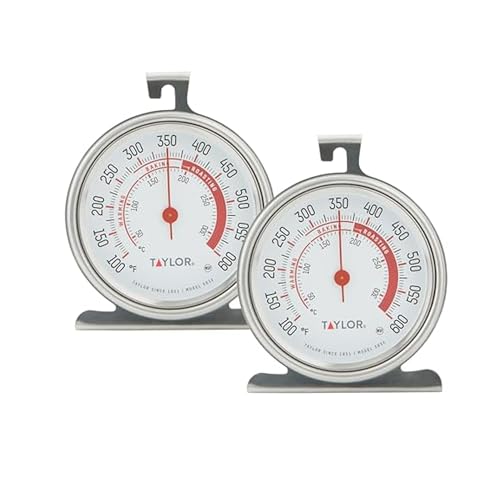
Getting two solid thermometers in one package makes the Taylor 5932 a smart buy, especially if you want one in the oven and one for the smoker or a second oven. The 3.25 inch dial is the largest in this roundup and the easiest to read from a distance. Accuracy was good rather than perfect in my tests, drifting a few degrees high at the top of the range, but for the price and the spare unit it is hard to argue with.
Reasons to buy
- Two thermometers in one affordable pack
- Largest dial in the group for distance reading
- Stainless build handles high heat
Reasons to avoid
- Drifts slightly high near 500 F
- Stand feels a bit light

AcuRite 00620A2 Stainless Steel Oven Thermometer
The AcuRite 00620A2 is a small, no nonsense dial that disappears into the back of the oven without taking up rack space. It held within a few degrees of my reference at standard baking temperatures and shrugged off repeated heat cycles. The dial is smaller than the OXO or Taylor, so it is best read with the door open, but its compact footprint and low cost make it an easy keep for anyone who just wants a reliable check.
Reasons to buy
- Compact size fits anywhere on the rack
- Accurate at common baking temperatures
- Durable stainless housing
Reasons to avoid
- Smaller dial is harder to read through glass
- No color temperature zones
Rubbermaid Commercial Stainless Steel Monitoring Thermometer
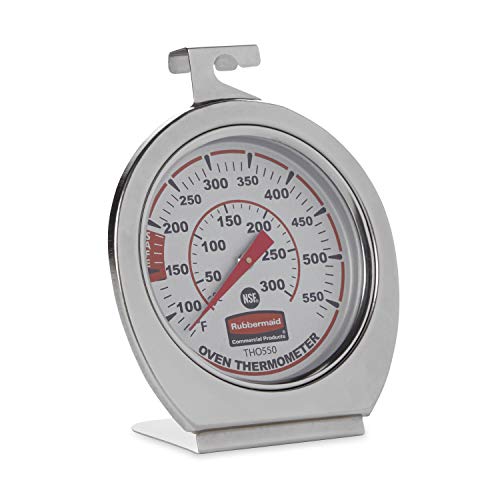
Built for restaurant kitchens, the Rubbermaid Commercial monitoring thermometer is the most rugged unit here and it doubles for oven, grill, and smoker duty. Its 60 to 580 degree range covers nearly everything a home cook needs, and the heavy stainless body never flinched through my high heat sessions. It is plain looking and the dial is utilitarian rather than pretty, but if you want something that will outlast everything else in your drawer, this is it.
Reasons to buy
- Extremely rugged commercial grade build
- Wide range works for oven, grill, and smoker
- Stable accurate readings under heavy use
Reasons to avoid
- Plain dial lacks color zones
- Slightly bulky on small racks
What to look for
Accuracy and stability
An oven thermometer is only worth keeping if it reads true. Look for one that settles quickly and holds steady across low and high temperatures rather than drifting at the extremes. Verify a new one in boiling water so you know its offset before you trust a roast to it.
Readability through glass
You often need to read the thermometer through a smudged, closed oven door. A larger dial with bold high contrast numbers and a recessed lens that resists grime makes a real difference when you do not want to open the door and dump heat.
Placement and mounting
A good unit can both hang from a rack and stand on a shelf so you can put it at the center of the oven where temperature matters most. A stable base or a secure hook keeps it from tipping when you slide trays in and out.
Durability under heat
Cheap thermometers can warp, fog, or lose legibility after repeated sessions above 450 degrees. Stainless steel housings and lab glass lenses hold up far better, and NSF or commercial rated units are built to take years of daily abuse.
Temperature range
Most baking happens between 300 and 450 degrees, but pizza, broiling, and high heat roasting push higher. Choose a thermometer with a range that comfortably covers your hottest cooking, ideally up to 600 degrees or beyond if you broil often.
Our verdict
Almost every home oven runs hotter or cooler than its dial claims, so a simple accurate oven thermometer on the center rack is the cheapest way to fix uneven baking and ruined roasts.
FAQs
Built in oven dials and digital displays are often off by 25 to 50 degrees, and they only measure near the sensor rather than where your food sits. A standalone oven thermometer placed on the center rack tells you the real temperature your food is experiencing, which is the difference between an evenly baked cake and a burnt or underdone one.
Good analog oven thermometers like the CDN DOT2 are plenty accurate for cooking, usually within a few degrees once you check them in boiling water. Analog dials also survive sustained high heat better than most digital displays, which is why nearly every oven thermometer designed to live inside the oven is a dial type rather than a screen.
Suspend the thermometer in a pot of vigorously boiling water without touching the sides, and it should read close to 212 degrees at sea level, a little lower at altitude. Note any offset and simply account for it when you read the dial in the oven. If a unit is wildly off or unstable, replace it rather than trying to correct it.
Put it on the center rack toward the middle of the oven, away from the walls and the direct line of the heating element, which is where most of your food cooks. Many oven thermometers can hang from a rack or stand on a shelf, so position it where you can glance at it through the door without opening it.
Update log
- Jun 9, 2026, Refreshed picks and rankings.
- Apr 25, 2026, Initial guide published.
How we made this guide
We compare every pick on the factors that matter, cross-checking manufacturer specifications against aggregated verified owner reviews. We rank independently and never take payment for placement. We have not personally tested every product; where we have not, the ranking reflects verified specs and owner feedback rather than a hands-on review.
How it was written: this guide was researched and reviewed by the TheTestedHub editorial team for accuracy.
Affiliate disclosure: TheTestedHub is reader-supported. When you buy through links on our site, we may earn a commission at no extra cost to you.
Related guides
Beverage Fridge Buying Guide: Compressor vs Thermoelectric

6 Drink Dispensers That Actually Seal Right (2026)

Skip Cheap Whiskers: Get a Real Chasen

Wondering Which Tea Infuser Is Best? Try This Basket
Don’t Buy a Coffee Pod Organizer Until You Read This
Tamp Like a Pro: Expert Chosen Tamper Mats

Coffee Scales for Every Brew, Tested for Daily Use