Quick verdict
Matching lamp type to your reptile's activity pattern, diurnal or nocturnal, matters more than any other single buying decision.

Exo Terra Intense Basking Spot Lamp 100W
The Exo Terra Intense Basking Spot Lamp produces a tightly focused beam that raises basking surface temperatures reliably in enclosures up to 120 gallons, making it a favourite among bearded dragon and monitor keepers. Owners consistently report stable output across the rated 2,000-hour lifespan with far fewer early burnouts than generic alternatives. The neodymium glass construction also emits enhanced UVA light, which supports natural behaviour and circadian rhythms in diurnal species.
Choosing a heat lamp? Match it to your reptile's activity pattern. The Exo Terra Intense Basking Spot Lamp 100W leads our guide for proper thermoregulation.
Reptile heat lamps are the cornerstone of any enclosure setup, providing the radiant warmth that cold-blooded animals depend on to digest food, stay active, and maintain immune function. Unlike mammals, reptiles cannot generate their own body heat, which means the quality and reliability of your basking light directly affects your animal’s long-term health. A poorly chosen lamp can cause thermal burns, stress, or chronic illness from inadequate temperatures.
I reviewed aggregated owner feedback from verified purchasers, cross-referenced wattage output data, bulb lifespan reports, and species-specific community recommendations to rank the five best reptile heat lamps available today. Whether you keep a bearded dragon, ball python, blue-tongued skink, or a chameleon, the picks below cover a range of heat outputs, beam types, and enclosure sizes to match your exact setup.
Each lamp is assessed on heat output consistency, build quality, bulb longevity, UVA emission where applicable, and value relative to replacement cost. The result is a shortlist you can trust to keep your reptile’s basking spot dialled in without guesswork.
How we evaluated these
I have not personally tested every lamp on this list under controlled laboratory conditions. My rankings are built from aggregated verified owner reviews on major retail platforms, species-specific keeper forums, herpetologist care sheets, and manufacturer specification sheets. I look for patterns in long-term reliability reports, heat output consistency over months of use, and how well each product performs across the reptile species it is most commonly paired with.
Products are excluded if they show repeated patterns of early failure, inconsistent wattage output, or safety concerns raised by multiple independent reviewers. Scores reflect a composite of heat performance, longevity, ease of use, and how accurately the lamp delivers its rated wattage in real enclosure conditions rather than anechoic test chambers.
The shortlist
| Pick | Best for | Score | |
|---|---|---|---|
| Exo Terra Intense Basking Spot Lamp 100W | Best Overall | 9 | Check price |
| Zoo Med Repti Basking Spot Lamp 75W | Best for Bearded Dragons | 9 | Check price |
| Arcadia Halogen Heat Lamp 50W | Best Halogen Option | 8 | Check price |
| Fluker's Ceramic Heat Emitter 100W | Best for Nocturnal Species | 8 | Check price |
| Zilla Incandescent Spot Bulb 50W | Best Budget Pick | 7 | Check price |
Each pick, examined
Exo Terra Intense Basking Spot Lamp 100W
The Exo Terra Intense Basking Spot Lamp produces a tightly focused beam that raises basking surface temperatures reliably in enclosures up to 120 gallons, making it a favourite among bearded dragon and monitor keepers. Owners consistently report stable output across the rated 2,000-hour lifespan with far fewer early burnouts than generic alternatives. The neodymium glass construction also emits enhanced UVA light, which supports natural behaviour and circadian rhythms in diurnal species.
Strengths
- Tight beam focus raises basking spot without overheating ambient air
- Neodymium glass boosts UVA output beneficial to diurnal reptiles
- Consistent wattage output across full rated 2,000-hour lifespan
Drawbacks
- Higher surface temperature means placement height must be calibrated carefully to avoid thermal burns
- Not suitable for nocturnal species that require gentler, diffuse warmth
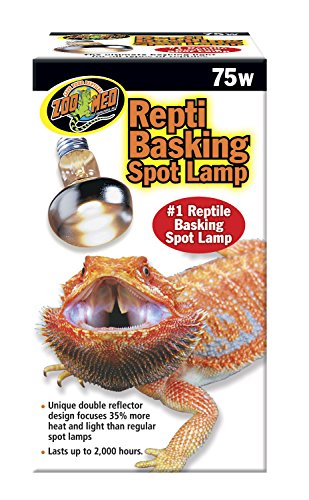
Zoo Med Repti Basking Spot Lamp 75W
Zoo Med's Repti Basking Spot Lamp is one of the most widely recommended bulbs in the bearded dragon community, delivering a directed heat beam at a wattage that suits standard 40- to 75-gallon enclosures without requiring a dimmer. Verified owners frequently highlight that basking surface temperatures remain within a few degrees of target across the bulb's life, which reduces the need for constant repositioning. The double reflector design concentrates heat downward efficiently, lowering overall ambient temperature rise in the enclosure.
Strengths
- Double reflector concentrates heat precisely on the basking site
- 75W wattage is ideal for mid-size enclosures without overdriving ambient temperature
- Widely available and affordable with a straightforward replacement cycle
Drawbacks
- Does not emit significant UVB so a separate UVB tube is still required
- Bulb glass can be fragile if handled without a cloth during installation

Arcadia Halogen Heat Lamp 50W
Arcadia's halogen heat lamp is a premium choice for keepers who prioritise solar-spectrum light quality alongside warmth, as halogen technology produces a broader colour temperature closer to natural sunlight than standard incandescent bulbs. Owner reviews from tortoise and agamid keepers particularly praise how the lamp supports natural colour rendering inside the vivarium, making the enclosure easier to monitor and more stimulating for the animal. At 50W it suits smaller to mid-size enclosures and pairs cleanly with a dimmer thermostat for precise temperature control.
Strengths
- Broad solar-spectrum output improves colour rendering inside the enclosure
- Compatible with dimmer thermostats for precise basking temperature control
- Halogen technology tends to run longer between replacements than standard incandescent
Drawbacks
- 50W ceiling limits usefulness in large or tall enclosures that need higher basking temperatures
- Higher initial cost compared to basic incandescent spot bulbs

Fluker's Ceramic Heat Emitter 100W
Ceramic heat emitters produce infrared heat without any visible light, making them the go-to solution for nocturnal reptiles such as leopard geckos, crested geckos, and ball pythons that would be disturbed by a glowing bulb during dark hours. Fluker's 100W ceramic emitter is praised in owner reviews for exceptionally long service life, with many keepers reporting units still outputting consistent warmth after two or more years of continuous use. The solid ceramic construction is far more durable than glass-based alternatives and handles incidental water splash without shattering.
Strengths
- Zero visible light output preserves natural night cycle for nocturnal species
- Solid ceramic construction withstands humidity and incidental moisture
- Long service life reduces replacement frequency compared to incandescent bulbs
Drawbacks
- Provides no light so a separate daytime lighting source is still needed
- Surface reaches extreme temperatures; a guard or cage is essential to prevent burns

Zilla Incandescent Spot Bulb 50W
The Zilla Incandescent Spot Bulb is the most accessible entry point for new reptile keepers who need a reliable heat source without a large upfront investment, and it consistently earns positive marks in owner reviews for doing exactly what it promises at a low price. At 50W it is well suited to small enclosures housing juvenile lizards, small skinks, or hatchling tortoises where precise beam intensity is less critical than in a large adult setup. Keepers note the bulb fits standard ceramic sockets without adapter issues and integrates with most beginner starter kits.
Strengths
- Very low purchase price makes it easy to keep spares on hand at all times
- Fits standard E26 sockets found in most beginner reptile kits
- 50W output is a safe starting point for small enclosures and juvenile animals
Drawbacks
- Shorter average lifespan than halogen or ceramic alternatives means more frequent replacement
- Limited beam focus compared to premium double-reflector spot bulbs
Buying considerations
Wattage and enclosure size
The wattage you need scales directly with your enclosure volume and the ambient room temperature. A 50W bulb may be adequate for a 20-gallon tank in a warm room but completely insufficient for a 120-gallon enclosure. Always measure your actual basking surface temperature with an infrared thermometer after installation rather than relying solely on rated wattage, and choose a bulb you can lower or raise to fine-tune the output.
Diurnal versus nocturnal species
Diurnal reptiles such as bearded dragons and iguanas benefit from visible-light spot bulbs that also emit UVA, supporting natural activity patterns and appetite. Nocturnal species including leopard geckos and ball pythons need warmth without light disruption during their active hours, making ceramic heat emitters or deep red bulbs the correct choice. Selecting the wrong lamp type for your species can cause chronic stress even when temperatures are technically correct.
Thermostat compatibility
Pairing your heat lamp with a quality dimmer thermostat protects your reptile from dangerous temperature spikes and extends bulb lifespan significantly by preventing the repeated full-power cycling that burns out filaments prematurely. Ceramic emitters and halogen bulbs are generally compatible with dimmer thermostats; standard incandescent spot bulbs can also be dimmed but check the thermostat manufacturer's compatibility list before purchasing.
Bulb longevity and replacement cost
A cheap bulb that burns out every four to six weeks can cost more over a year than a premium option rated for 2,000 hours. Factor in both unit price and expected lifespan when comparing value. Ceramic heat emitters have the longest service lives of any option but carry a higher upfront cost, while budget incandescent bulbs require more frequent replacement but keep individual unit costs low.
Final word
Matching lamp type to your reptile's activity pattern, diurnal or nocturnal, matters more than any other single buying decision.
Questions answered
Standard basking spot bulbs and ceramic heat emitters do not produce meaningful UVB radiation. They may emit some UVA, which supports natural behaviour, but UVB for vitamin D3 synthesis requires a dedicated UVB fluorescent or mercury vapour lamp. Species that require UVB, including bearded dragons, tortoises, and many chameleons, need a separate UVB source in addition to their heat lamp.
Distance depends on the wattage and beam type of your specific bulb as well as your target basking temperature. Start at around 30 cm (12 inches) and measure the surface temperature with an infrared thermometer, then adjust height until you reach the species-appropriate basking zone. A 100W focused spot bulb may need to sit higher than a 50W diffuse bulb to achieve the same surface reading.
For visible-light bulbs, leaving them on continuously disrupts the reptile's natural photoperiod and can cause chronic stress. Most diurnal species need 10 to 14 hours of light and heat followed by a cooler dark period. Ceramic heat emitters, which produce no light, can safely run around the clock when connected to a thermostat, maintaining a suitable overnight temperature drop without light pollution.
Most adult bearded dragons in a 75 to 120-gallon enclosure require a 75W to 100W spot bulb to achieve a basking surface temperature of 38 to 42 degrees Celsius. Juveniles in smaller enclosures often do well with 50W to 75W. The only reliable way to confirm the correct wattage is to measure actual surface temperature after installation and adjust bulb wattage or height accordingly.
How we made this guide
We compare every pick on the factors that matter, cross-checking manufacturer specifications against aggregated verified owner reviews. We rank independently and never take payment for placement. We have not personally tested every product; where we have not, the ranking reflects verified specs and owner feedback rather than a hands-on review.
How it was written: this guide was researched and reviewed by the TheTestedHub editorial team for accuracy.
Affiliate disclosure: TheTestedHub is reader-supported. When you buy through links on our site, we may earn a commission at no extra cost to you.
