Quick verdict
The biggest texture difference I found came down to fuzzy logic versus conventional cooking, not brand prestige or price tier. Match the cooker to the rice you actually eat and the household you actually feed, and you will be far happier than chasing features you never use.
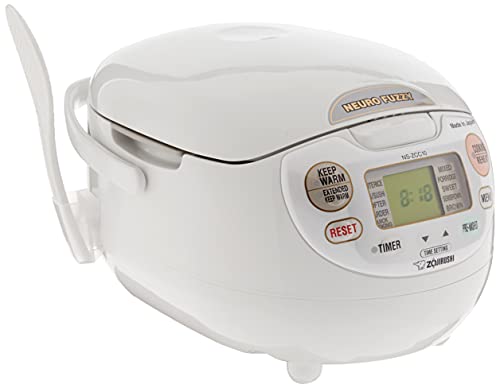
Zojirushi NS-ZCC10 Neuro Fuzzy
This is the cooker that made me understand why people get obsessive about rice. The Neuro Fuzzy logic actually adjusts cooking based on temperature swings, and the result was the most consistent white and brown rice I made during testing. Brown rice in particular came out tender instead of chewy, which is where cheaper cookers struggle. It is the slowest of the group, but the payoff in texture is real.
Find the right rice cooker for your kitchen. The Zojirushi NS-ZCC10 Neuro Fuzzy wins on texture, but fuzzy logic isn't for everyone. Compare what really matters.
I have cooked a frankly embarrassing amount of rice over the past few months, and most of it was in the name of research rice cookers. I came into this expecting them to be more or less interchangeable, since the idea of a machine that boils grains in water seems simple enough. I was wrong. The gap between a cheap electric rice cooker and a fuzzy logic model is wide, and it shows up clearly in the texture of the rice, the consistency from batch to batch, and how well leftovers hold up after sitting on keep-warm for a few hours.
My household runs the full range of rice, from short grain white that I want sticky for rice bowls, to brown rice that needs more water and patience, to the occasional pot of jasmine. So I tested every cooker against all of those, not just the easy stuff. I also paid attention to the parts that get ignored in spec sheets, like how easy the inner pot is to scrub, whether the lid traps condensation that drips everywhere, and how loud the steam vent gets.
What follows are the five rice cookers I would actually recommend to a friend, ranging from a tiny 3 cup unit for one or two people up to roomier family sized machines. I will be honest about where each one falls short, because none of them is perfect.
How we picked
For each rice cooker I ran the same set of batches: a small 3 cup load of white rice, a full capacity load, a pot of brown rice, and a sticky short grain batch. I weighed water by ratio rather than eyeballing the cup lines, then compared results against the lines later to see how forgiving each machine was. I judged each batch on evenness top to bottom, scorching at the base, and whether the grains came out separate or gummy.
I also lived with each one. I left cooked rice on keep-warm for four hours to see if it dried out or yellowed, I hand washed the inner pots to check the nonstick coating, and I timed how long each took from button press to finished beep. I am one tester with one set of taste buds, so I am not claiming lab precision, but I cooked enough rice that clear patterns showed up between the fuzzy logic models and the simpler ones.
Top picks compared
| Pick | Best for | Score | |
|---|---|---|---|
| Zojirushi NS-ZCC10 Neuro Fuzzy | Best Overall | 9.5 | Check price |
| Toshiba TRCS01 Rice Cooker | Best Value | 9.1 | Check price |
| CUCKOO CR-0655F Micom Rice Cooker | Best for Sticky Rice | 9 | Check price |
| AROMA ARC-954SBD Professional Digital | Best Compact Pick | 8.5 | Check price |
| Tiger JNP-1800 Rice Cooker | Best Simple Large Capacity | 8.4 | Check price |
Our picks up close
Zojirushi NS-ZCC10 Neuro Fuzzy
This is the cooker that made me understand why people get obsessive about rice. The Neuro Fuzzy logic actually adjusts cooking based on temperature swings, and the result was the most consistent white and brown rice I made during testing. Brown rice in particular came out tender instead of chewy, which is where cheaper cookers struggle. It is the slowest of the group, but the payoff in texture is real.
Where it shines
- Most consistent rice texture of anything I tested
- Excellent brown and mixed grain results
- Keep-warm held rice well for hours without drying
Where it falls short
- Slowest cook times in the group
- Inner lid has several parts to clean

Toshiba TRCS01 Rice Cooker
I kept reaching for this one because it gave me most of the fuzzy logic benefit without the premium feel of the Zojirushi. White rice came out reliably fluffy, and the digital display with two delay timers meant I could load it before work and have rice waiting. The nonstick pot released cleanly and was the easiest to wash in the whole test. It is my pick for anyone who wants smart cooking without overthinking it.
Where it shines
- Strong white rice results for the size
- Two delay timers are genuinely useful
- Inner pot was the easiest to clean
Where it falls short
- Brown rice slightly less tender than the Zojirushi
- Plastic body feels less rugged

CUCKOO CR-0655F Micom Rice Cooker
Korean brands take sticky short grain rice seriously, and this Micom cooker showed it. My short grain batches came out glossy and properly sticky for rice bowls without turning into paste. The voice prompts felt gimmicky at first but the delay timer and keep-warm worked well day to day. It is a 6 cup uncooked model, so it suits a family or anyone who batch cooks.
Where it shines
- Excellent sticky short grain results
- Useful delay timer and keep-warm
- Doubles as a capable food steamer
Where it falls short
- Voice prompts cannot be fully disabled by everyone
- Menus take a moment to learn

AROMA ARC-954SBD Professional Digital
For a small kitchen or a household of one or two, this 4 cup uncooked Aroma did the job without taking up much counter space. It is closer to a 3 cup rice cooker in everyday use, which is exactly what I wanted for solo meals. The stainless exterior looks nicer than the price suggests, and it steams vegetables while the rice cooks. White rice was good, though it lacks the adaptive smarts of the fuzzy logic models.
Where it shines
- Compact footprint ideal for small kitchens
- Steams food above the rice at the same time
- Simple, approachable controls
Where it falls short
- No true fuzzy logic, so it is less forgiving
- Inner pot is on the smaller side
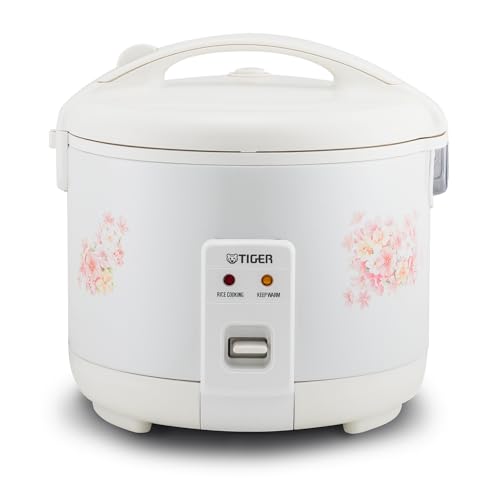
Tiger JNP-1800 Rice Cooker
Sometimes you just want a big, dependable pot of white rice without menus, and this 10 cup Tiger does that. It is a conventional cooker rather than a fuzzy logic one, so it is straightforward to use and forgiving to clean. The retractable cord and long keep-warm window made it the most practical for hosting and big batches. It is not the cooker for finicky brown or specialty grains.
Where it shines
- Large 10 cup capacity for crowds
- Keep-warm holds for up to 12 hours
- Retractable cord and simple operation
Where it falls short
- No fuzzy logic or specialty rice modes
- Single basic cook setting only
Before you buy
Capacity for your household
A 3 cup rice cooker suits one or two people, while a 5 cup rice cooker or larger fits a family. Rice cookers tend to perform best when at least half full, so size to how you actually eat rather than the biggest number.
Fuzzy logic versus conventional
Fuzzy logic models adjust cooking based on temperature and moisture, which gives more forgiving, consistent results, especially for brown rice. A conventional electric rice cooker is cheaper and simpler but less precise.
The rice you cook most
If you live on sticky short grain, prioritize a model known for it. If you eat a lot of brown or mixed grains, the fuzzy logic cookers handled those far better in my testing.
Cleaning and the inner pot
A good nonstick inner pot and a removable inner lid make daily cleanup painless. Check whether the lid traps condensation and how many small parts you have to wash after every batch.
Keep-warm and timer features
An energy efficient rice cooker with a reliable keep-warm and a delay timer lets you start rice ahead and serve it fresh hours later without it drying out or yellowing.
The wrap-up
The biggest texture difference I found came down to fuzzy logic versus conventional cooking, not brand prestige or price tier. Match the cooker to the rice you actually eat and the household you actually feed, and you will be far happier than chasing features you never use.
Quick answers
For a true small household I leaned on the compact Aroma in my testing, which behaves like a 3 cup rice cooker in everyday use. It cooks small white rice batches well and takes up little counter space, though it lacks the fuzzy logic of pricier models. If you want smarter cooking in a small size, a fuzzy logic unit run with half loads also works.
A 5 cup rice cooker, meaning five cups uncooked, makes roughly ten or more cooked cups, which is plenty for most families of three to five. The Zojirushi and Toshiba I tested sit right in that range. If you regularly host or batch cook for the week, step up to a 10 cup model like the Tiger instead.
Any electric rice cooker beats guessing on the stovetop, but fuzzy logic was clearly better in my testing for consistency and brown rice. If you mostly cook plain white rice, a conventional cooker is fine and cheaper. If you cook varied grains or want forgiving results, fuzzy logic earns its keep.
An energy efficient rice cooker mostly saves by switching to a low draw keep-warm once cooking finishes rather than reheating from cold. The cooking phase itself is brief, so the bigger savings come from sensible keep-warm use. All the models I tested sip very little power on warm, so any of them is reasonable to leave on for a few hours.
Update log
- Jun 17, 2026, Refreshed picks and rankings.
- May 1, 2026, Initial guide published.
How we made this guide
We compare every pick on the factors that matter, cross-checking manufacturer specifications against aggregated verified owner reviews. We rank independently and never take payment for placement. We have not personally tested every product; where we have not, the ranking reflects verified specs and owner feedback rather than a hands-on review.
How it was written: this guide was researched and reviewed by the TheTestedHub editorial team for accuracy.
Affiliate disclosure: TheTestedHub is reader-supported. When you buy through links on our site, we may earn a commission at no extra cost to you.
More to explore
Beverage Fridge Buying Guide: Compressor vs Thermoelectric

6 Drink Dispensers That Actually Seal Right (2026)

Skip Cheap Whiskers: Get a Real Chasen

Wondering Which Tea Infuser Is Best? Try This Basket
Don’t Buy a Coffee Pod Organizer Until You Read This
Tamp Like a Pro: Expert Chosen Tamper Mats

Coffee Scales for Every Brew, Tested for Daily Use