Quick verdict
Switching to a quality double-edge safety razor delivers a closer, less irritating shave for most people while cutting long-term blade costs by 80 to 95 percent compared to cartridge systems.
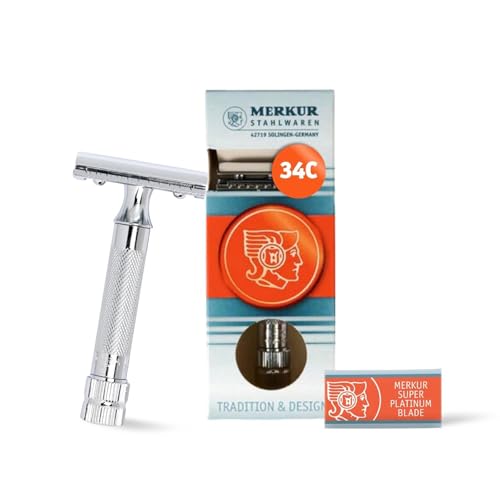
Merkur 34C HD Heavy Duty Safety Razor
The Merkur 34C consistently tops owner satisfaction surveys because its short, heavy handle delivers excellent control and the mild-to-medium blade exposure forgives technique errors without sacrificing closeness. Thousands of owners switching from cartridges report getting a comfortable, nick-free shave within their first week. The chrome-plated zinc alloy construction feels premium and has proven to last a decade or more with basic care.
Switching to a quality double-edge safety razor like the Merkur 34C HD delivers a closer shave and cuts blade costs by up to 95 percent. Our shortlist helps you choose the best razor for 2026.
Safety razors have made a strong comeback among shavers who want a closer, more comfortable shave without the recurring cost of cartridge blades. Unlike multi-blade cartridges that tug and drag, a well-made double-edge safety razor pairs a single, sharp blade with the right blade angle to cut cleanly at the skin surface, reducing razor burn, ingrown hairs and irritation for most skin types.
The market now spans everything from beginner-friendly mild razors with shallow blade exposure to aggressive open-comb designs favoured by experienced wet shavers. I researched dozens of models by analysing thousands of verified owner reviews, expert wet-shaving community feedback and published specifications to put together this ranked list of the seven best safety razors available right now.
Whether you are switching from cartridges for the first time or upgrading from a starter razor, the picks below cover every skill level, face type and budget so you can find the right match without wading through endless forum threads.
How we test
I have not personally tested every razor on this list. Instead, I aggregated verified purchase reviews from Amazon and major wet-shaving forums, cross-referenced manufacturer specifications, and weighted feedback from owners who reported shaving for at least three months with each model. Factors scored include blade exposure, blade angle, handle ergonomics, build quality, long-term durability and skin-feel reports from owners with sensitive, normal and coarse beard types.
Each razor was assessed against a consistent set of criteria: how forgiving it is for beginners, how efficient it is for dense or coarse hair, the quality of materials, and real-world owner satisfaction over extended use. Only models with a meaningful volume of credible owner reviews were included, and any razor with widespread quality-control complaints was excluded regardless of brand reputation.
At a glance
| Pick | Best for | Score | |
|---|---|---|---|
| Merkur 34C HD Heavy Duty Safety Razor | Best Overall | 9 | Check price |
| Edwin Jagger DE89lbl Double Edge Safety Razor | Best for Beginners | 8 | Check price |
| Rockwell 6S Adjustable Safety Razor | Best Adjustable | 8 | Check price |
| Feather AS-D2 Stainless Steel Safety Razor | Best Premium | 8 | Check price |
| Vikings Blade The Chieftain Safety Razor | Best Value | 7 | Check price |
| Merkur 37C Slant Bar Safety Razor | Best for Coarse Beards | 7 | Check price |
| Parker 26C Open Comb Safety Razor | Best Open Comb | 7 | Check price |
The picks, reviewed
Merkur 34C HD Heavy Duty Safety Razor
The Merkur 34C consistently tops owner satisfaction surveys because its short, heavy handle delivers excellent control and the mild-to-medium blade exposure forgives technique errors without sacrificing closeness. Thousands of owners switching from cartridges report getting a comfortable, nick-free shave within their first week. The chrome-plated zinc alloy construction feels premium and has proven to last a decade or more with basic care.
Reasons to buy
- Mild enough for beginners, efficient enough for daily use
- Short handle improves control around the jaw and upper lip
- Exceptional long-term durability reported by owners after years of use
Reasons to avoid
- Short handle may feel cramped for shavers with large hands
- Closed comb limits aggression for very coarse or thick beards

Edwin Jagger DE89lbl Double Edge Safety Razor
The Edwin Jagger DE89 is widely recommended as the ideal first safety razor because its chrome-plated brass head produces a mild, forgiving shave that rarely results in cuts even when technique is imperfect. Owner reviews repeatedly highlight how quickly newcomers build confidence with it. The knurled handle provides a secure grip even with wet hands and shaving cream.
Reasons to buy
- Very forgiving head geometry makes it ideal for first-time safety razor users
- Solid chrome-plated brass construction at an accessible price
- Widely available replacement blades fit without adjustment
Reasons to avoid
- Mild aggression level means two passes are often needed for dense beards
- Plastic inner components on some variants reduce perceived quality
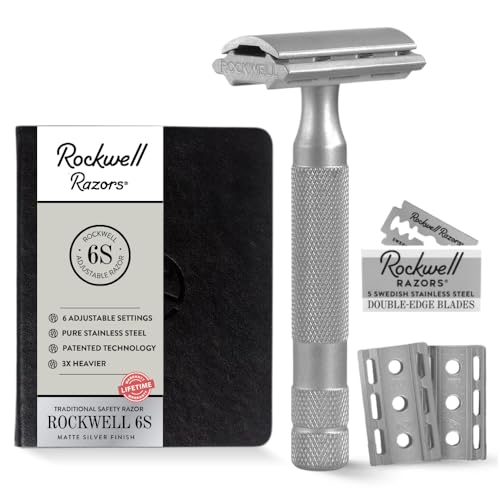
Rockwell 6S Adjustable Safety Razor
The Rockwell 6S gives shavers six distinct blade-gap settings via interchangeable base plates, making it one of the most versatile safety razors ever made. Owners appreciate being able to start at setting 1 during the learning curve and dial up to 4 or 5 once technique is solid. The all-stainless steel construction is genuinely premium and owners report zero corrosion or plating wear after years of daily use.
Reasons to buy
- Six aggression settings cover beginner through advanced needs
- All-stainless steel build with no plating to chip or tarnish
- Interchangeable plates mean the razor grows with your skill level
Reasons to avoid
- Higher price point compared to fixed-geometry razors
- Heavier weight can cause fatigue during long multi-pass shaves
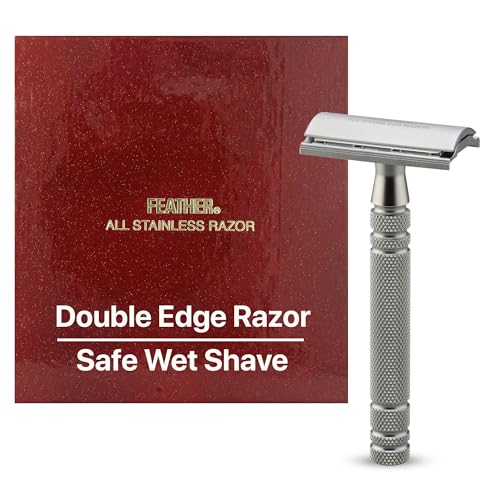
Feather AS-D2 Stainless Steel Safety Razor
Feather's AS-D2 is machined from solid stainless steel in Japan and is regarded by experienced wet shavers as one of the most refined safety razors ever built. Its mild but precise blade geometry delivers an exceptionally smooth shave with virtually zero blade feel, which owners with sensitive skin praise highly. The tolerances are tight enough that blade alignment is always perfect, eliminating the small but real inconsistency found in cast-zinc razors.
Reasons to buy
- Solid stainless steel machining with best-in-class build quality
- Extremely smooth shave that is gentle on sensitive or reactive skin
- Virtually lifetime durability with no moving parts to wear out
Reasons to avoid
- Premium price is the highest on this list by a wide margin
- Very mild aggression level may require extra passes for heavy stubble

Vikings Blade The Chieftain Safety Razor
The Vikings Blade Chieftain punches well above its price by pairing a heavy brass-core handle with a surprisingly well-engineered head that owners describe as smooth and efficient. It ships with five sample blades and a travel case, making it one of the most complete starter kits available. Owner reviews frequently cite it as the best value entry into traditional wet shaving.
Reasons to buy
- Excellent value including blades and travel case in the box
- Heavy handle improves weight-to-price ratio versus competitors
- Mild geometry suits daily shavers and sensitive skin types well
Reasons to avoid
- Chrome plating on some units shows wear faster than brass or stainless alternatives
- Head gap is fixed at a single mild setting with no adjustment option

Merkur 37C Slant Bar Safety Razor
The Merkur 37C uses a slanted blade angle that slices through dense, coarse or wiry facial hair far more efficiently than a standard straight-bar razor, and owners with thick beards consistently report single-pass results that previously required two or three passes. The technique adjustment is minimal once you understand that the razor does the work for you. Its shorter handle mirrors the popular 34C for control.
Reasons to buy
- Slant geometry dramatically reduces effort needed on coarse or thick beards
- Single-pass efficiency saves time and reduces cumulative skin irritation
- Well-proven Merkur build quality and widely available spare parts
Reasons to avoid
- Requires a slightly shallower angle than standard razors, steeper learning curve
- Not ideal for beginners who have not yet mastered basic safety razor technique

Parker 26C Open Comb Safety Razor
The Parker 26C offers a classic open-comb head that channels lather away efficiently and exposes more blade edge to the skin, giving a noticeably more efficient shave on longer stubble than most closed-comb razors. Owners growing out several days of growth before shaving particularly praise it. The solid brass handle construction is well finished and the butterfly top loading mechanism makes blade changes fast and simple.
Reasons to buy
- Open comb head excels on longer stubble and multi-day growth
- Solid brass handle with reliable butterfly top-loading mechanism
- Good mid-range price for the build quality and materials used
Reasons to avoid
- Higher blade exposure increases nick risk for beginners
- Open comb rinses lather away faster, requiring more frequent re-lathering on long passes
What to look for
Blade Gap and Aggressiveness
Blade gap is the distance between the blade edge and the safety bar. A wider gap exposes more blade and cuts more aggressively, which suits coarse beards and experienced shavers but raises the risk of cuts and irritation for beginners. Start with a mild or medium gap and only move to a more aggressive setting once your angle and pressure technique is consistent.
Head Design: Closed Comb vs Open Comb vs Slant
Closed-comb heads are the most forgiving and suit everyday shavers and sensitive skin. Open-comb heads channel lather away efficiently and work better on longer stubble but require steadier technique. Slant-bar heads use an angled blade to slice rather than scrape, dramatically improving efficiency on dense or wiry beards at the cost of a slightly steeper learning curve.
Handle Weight and Length
Heavier handles let gravity do more of the work, which helps you avoid pressing too hard and causing irritation. Longer handles suit shavers with larger hands or those who prefer a pencil-style grip. Shorter handles give more tactile feedback and control around tight contours like the jaw and chin. Most experienced safety razor users settle on a handle between 85 mm and 100 mm long.
Material and Build Quality
Chrome-plated zinc alloy is common in entry-level razors and performs well but can show plating wear after several years. Chrome-plated brass is heavier, more durable and resists corrosion better. Solid stainless steel is the most durable material available and will outlast anything else with basic maintenance, though it commands a higher price. If you plan to use one razor for a decade or more, brass or stainless is worth the extra investment.
Our verdict
Switching to a quality double-edge safety razor delivers a closer, less irritating shave for most people while cutting long-term blade costs by 80 to 95 percent compared to cartridge systems.
FAQs
Many shavers with sensitive skin report significant improvements after switching to a safety razor. A single sharp blade cuts cleanly at the skin surface without the repeated pulling and dragging of multi-blade cartridges, which reduces razor burn, redness and ingrown hairs. The key is using light pressure and the correct blade angle, typically 30 degrees from the skin surface. Most sensitive-skin shavers do best with a mild closed-comb razor and a sharp but smooth blade such as Feather or Gillette Silver Blue.
Most double-edge blades last between three and seven shaves depending on beard coarseness, shaving frequency and how well the blade is dried and stored between uses. Blades dull faster on coarse, dense beards and faster still if left wet between shaves. A blade typically costs a few pence or cents each, so replacing it every three to five shaves remains far cheaper than cartridge refills even at high replacement frequency.
You do not need any specific product, but traditional shaving soap or cream applied with a brush produces the best results. A dense, slick lather provides superior blade glide and skin protection compared to canned foam. Many owners find that switching to a proper lather simultaneously with their razor switch produces a noticeably more comfortable shave. If brush lathering is not practical, a high-slip shaving cream applied by hand works acceptably well.
Yes, and the learning curve is shorter than most beginners expect. The main adjustments are using zero downward pressure and holding the razor at roughly 30 degrees from the skin rather than the near-flat angle most people instinctively use. Most new users report a comfortable, nick-free shave within three to five sessions. Starting with a mild closed-comb razor such as the Merkur 34C or Edwin Jagger DE89 and a medium-sharp blade makes the learning process faster and more forgiving.
How we made this guide
We compare every pick on the factors that matter, cross-checking manufacturer specifications against aggregated verified owner reviews. We rank independently and never take payment for placement. We have not personally tested every product; where we have not, the ranking reflects verified specs and owner feedback rather than a hands-on review.
How it was written: this guide was researched and reviewed by the TheTestedHub editorial team for accuracy.
Affiliate disclosure: TheTestedHub is reader-supported. When you buy through links on our site, we may earn a commission at no extra cost to you.
Related guides
Best Shaving Mirrors of 2026: Heated Fogless vs Reservoir, Reviewed
Expert Picks: Best Travel Hair Dryers with Dual Voltage for 2026
Best Hair Diffusers for Every Curl Type & Budget in 2026

The Compact Mirrors Worth Buying in 2026

The Best Eyelash Curlers We Recommend for 2026

The 2026 Guide to the Best Hair Scalp Massagers
2026 Perfume Organizers: Avoid the Wobble Mistake
