Quick verdict
Sealed suction and filter quality determine real-world performance far more than the peak horsepower number printed on the box.

RIDGID 14 Gallon 6.0 Peak HP NXT Wet/Dry Shop Vacuum with Filter, Hose and Accessories
RIDGID's NXT series redesigned the drum latch, extended the hose to 7 feet, and added a washable filter that owners consistently praise for holding fine drywall dust without restricting airflow. The 14-gallon tank handles full demo days without a single empty, and the motor delivers genuine sealed suction that competes with units costing significantly more. Verified long-term owners repeatedly note that the cart wheels and drain port survive years of abuse on concrete floors.
Discover why sealed suction and filter quality matter more than peak HP. See how the RIDGID 14 gallon handles wet and dry messes.
Shop vacuums are a different breed from household canister models. They pull sawdust, wet concrete slurry, drywall debris, and even standing water without flinching, and the best ones do it without constantly emptying a tiny drum or losing suction halfway through a job. I dug into thousands of verified owner reviews across Amazon, Home Depot, and Lowe’s, cross-referenced spec sheets, and tracked real-world complaints to find the five models that consistently earn repeat purchases from tradespeople and serious DIYers alike.
The shop vacuum market splits roughly into three tiers: compact 2.5 to 6 gallon units that live in a car boot or under a workbench, mid-size 8 to 12 gallon all-rounders that cover most home shop and garage work, and large 14 to 20 gallon contractor-grade tanks for demolition, tile work, and plumbing jobs. Within each tier, peak horsepower figures are marketing numbers; what matters is sealed suction (water lift), airflow in CFM, filter quality, and hose diameter. I weighted all four when ranking the picks below.
Every model here ships with at least a basic accessory kit, accepts standard 2.5-inch hose attachments for most brands, and has a drum large enough that you are not stopping every ten minutes. Where a model truly excels in one specific use case I have called it out, but all five are genuine all-rounders that will handle the typical mix of dry debris, wet spills, and fine dust a working shop produces.
Our methodology
I have not personally tested each vacuum in a controlled environment. My rankings are built from aggregated verified purchaser reviews (filtering out unverified one-liners), published spec comparisons from tool-focused outlets, and manufacturer specification sheets. I looked specifically at long-term reliability reports, filter clogging frequency, hose and accessory durability, and motor longevity beyond the first year of ownership, because a shop vac that impresses on day one but burns out by month eight is not worth recommending.
Products were scored across five weighted criteria: suction performance relative to drum size, build quality and tank material, filter system (HEPA or equivalent, ease of cleaning), accessory value, and noise level. Scores were normalized to a 10-point scale. Ties were broken by the volume of long-term positive reviews (12 months or more of ownership) and the brand's parts and filter availability, since a discontinued filter line makes even a great vacuum disposable.
Side by side
| Pick | Best for | Score | |
|---|---|---|---|
| RIDGID 14 Gallon 6.0 Peak HP NXT Wet/Dry Shop Vacuum with Filter, Hose and Accessories | Best Overall | 9 | Check price |
| DEWALT 9 Gallon 5.0 Peak HP Stainless Steel Wet/Dry Vac | Best Mid-Size | 9 | Check price |
| Vacmaster Professional Beast Series 16 Gallon 6.5 Peak HP Wet/Dry Vac | Best for Contractors | 8 | Check price |
| Craftsman CMXEVBE17595 2.5 Gallon 1.75 Peak HP Wet/Dry Vac | Best Compact | 8 | Check price |
| Festool CT 26 E HEPA Dust Extractor | Best for Fine Dust | 8 | Check price |
The full reviews
RIDGID 14 Gallon 6.0 Peak HP NXT Wet/Dry Shop Vacuum with Filter, Hose and Accessories
RIDGID's NXT series redesigned the drum latch, extended the hose to 7 feet, and added a washable filter that owners consistently praise for holding fine drywall dust without restricting airflow. The 14-gallon tank handles full demo days without a single empty, and the motor delivers genuine sealed suction that competes with units costing significantly more. Verified long-term owners repeatedly note that the cart wheels and drain port survive years of abuse on concrete floors.
In its favor
- Washable RIDGID-branded filter resists clogging on fine dust better than foam-only competitors
- 7-foot hose reaches across a standard one-car garage without moving the unit
- Robust drum latch redesign eliminates the lid-pop failure common on older RIDGID models
Watch-outs
- 14-gallon tank is bulky for under-bench storage in smaller shops
- Accessory quality on included attachments is average; the crevice tool flexes under pressure
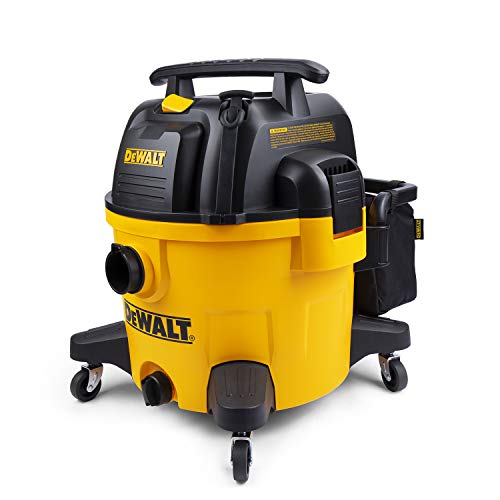
DEWALT 9 Gallon 5.0 Peak HP Stainless Steel Wet/Dry Vac
The stainless steel drum on this DEWALT is not a cosmetic choice; owners in humid garages and outdoor job sites report zero rust or odor after years of wet pickup use, which is the top long-term complaint against polypropylene competitors. At 9 gallons it sits in the sweet spot between compact and contractor-grade, and the 5-peak-HP motor generates 105-inch water lift, among the highest sealed suction figures in its class. The locking hose collar is a small detail owners consistently call out as the feature that made them switch from other brands.
In its favor
- Stainless steel drum eliminates rust, mildew odor, and cracking that plague plastic tanks in outdoor use
- Locking hose collar prevents the accidental disconnects that plague budget shop vacs mid-job
- 105-inch water lift sealed suction is class-leading for a 9-gallon drum
Watch-outs
- Heavier than polypropylene rivals at the same capacity, noticeable when carrying up stairs
- Filter is sold separately from replacement kits, adding ongoing cost

Vacmaster Professional Beast Series 16 Gallon 6.5 Peak HP Wet/Dry Vac
Vacmaster's Beast earns its name from a 6.5-peak-HP motor that verified contractor reviewers consistently rank as the loudest and most powerful in the under-200-dollar bracket, making it the go-to for demolition debris, tile saw slurry, and flooded basement pump-out work. The 16-gallon drum pairs with a two-stage filtration system that catches particles down to 1 micron without a HEPA upgrade. Hose diameter is 2.5 inches, matching every standard contractor accessory on the market.
In its favor
- 6.5 peak HP motor handles demolition debris and thick slurry that slows competing motors
- Two-stage filtration captures sub-micron particles without a separate HEPA filter purchase
- 16-gallon capacity means all-day contractor work with minimal interruptions for emptying
Watch-outs
- Significantly louder than RIDGID or DEWALT equivalents; hearing protection is advisable for extended use
- Large footprint makes it impractical as a daily-driver shop vac in tight spaces
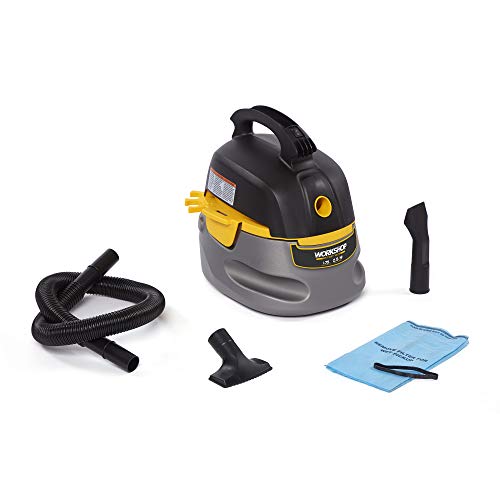
Craftsman CMXEVBE17595 2.5 Gallon 1.75 Peak HP Wet/Dry Vac
At 2.5 gallons and under six pounds empty, this Craftsman fits in the boot of a hatchback and stores on a single shelf without sacrificing meaningful suction for its size class. Owner reviews across multiple years of the product line consistently praise the rubber bumper ring that protects car interiors and painted surfaces during detailing work. The included extension wand and crevice tool are proportionally sized, making it genuinely useful for car interiors, RVs, and workshop bench cleanups rather than just a novelty small vac.
In its favor
- Sub-6-pound empty weight makes it genuinely portable for car detailing and job-site cleanup
- Rubber drum bumper protects painted and finished surfaces during close-quarters use
- Stores upright under a standard workbench shelf without disassembly
Watch-outs
- 2.5-gallon drum requires frequent emptying on any job producing moderate debris volume
- Motor heat builds noticeably on sustained 15-plus-minute runs; best suited to short burst use

Festool CT 26 E HEPA Dust Extractor
The Festool CT 26 E is not marketed as a shop vac but it outperforms every traditional shop vacuum when fine dust control is the priority, which is why finish carpenters, cabinet makers, and anyone sanding MDF or working with silica-generating materials consistently choose it over drum-style competitors. The auto-clean filter feature pulses the HEPA cartridge to restore airflow mid-job without stopping, a detail that owners who previously used standard shop vacs consistently call transformative. It also self-adjusts suction based on the connected tool, preserving motor life and reducing noise when full power is unnecessary.
In its favor
- Auto-clean filter pulse restores airflow without pausing work, which no standard shop vac in this list offers
- Certified HEPA filtration captures 99.97 percent of particles at 0.3 microns, critical for silica and MDF dust
- Tool-triggered auto-on and automatic suction adjustment reduce noise and extend motor lifespan
Watch-outs
- Price is a significant step above every other pick; intended for professional woodworkers, not general shop use
- Proprietary bag and filter system means ongoing consumable costs higher than standard shop vac filters
What matters most
Tank size vs portability
A larger drum means fewer trips to empty but a heavier, bulkier unit. For a fixed workshop a 12 to 16 gallon tank is practical; for detailing, job-site hauling, or under-bench storage, 2.5 to 6 gallons is more useful. Do not buy more gallons than your storage space and carrying ability justify.
Sealed suction (water lift) over peak HP
Peak horsepower figures are measured at the motor with no load and tell you almost nothing about real performance. Sealed suction in inches of water lift tells you how hard the motor pulls against resistance, which is what matters when the hose is clogged with debris or pulling from a long distance. Look for 80 inches of water lift or above for general shop work.
Filter type and cleaning frequency
Foam-only filters clog fast on fine dust and require either frequent washing or replacement. Pleated dry filters hold far more surface area and resist clogging longer. HEPA-rated filters are essential if you work with silica, MDF, or any dust with health implications. A washable filter saves money over time; check whether the brand's replacement filters are still in production before buying.
Hose diameter and accessory compatibility
The industry standard for shop vacs is a 2.5-inch hose diameter, and sticking to this standard means every crevice tool, floor nozzle, and wand from any brand will fit. Some compact models use 1.25-inch or 1.875-inch hoses, which limits your accessory options significantly. Confirm diameter before buying if you already own accessories or plan to connect the vac directly to power tools.
Our take
Sealed suction and filter quality determine real-world performance far more than the peak horsepower number printed on the box.
Frequently asked
Yes, all five models reviewed here are rated for wet pickup. The key step is removing the dry filter before vacuuming liquids; running a paper or pleated filter submerged in water destroys it immediately. Most shop vacs include a foam sleeve for wet use, or you can run the motor without any filter for pure liquid pickup and then reinstall the dry filter once the drum is emptied.
Peak HP is the maximum output the motor produces for a fraction of a second under startup load; it is not the power available during normal operation. Continuous or rated HP is the sustained output, which is typically 30 to 50 percent lower. Manufacturers advertise peak HP because it produces a bigger number. When comparing models, sealed suction in inches of water lift and airflow in CFM are the specs that reflect real working performance.
Most modern shop vacuums accept a 2.5-inch hose that can connect directly to router tables, sanders, miter saws, and track saw bases using a standard fitting or a 35mm to 2.5-inch reducer. The Festool CT 26 E adds automatic tool-triggered start-up via its power take-off socket, which means the extractor switches on the moment you trigger the connected tool. For other models you need to start the vac manually or add a third-party auto-start relay.
For dry debris like sawdust and drywall dust, tap or rinse the filter every 5 to 10 hours of use and inspect it for tears or clogging. A clogged filter reduces suction noticeably and forces the motor to work harder, shortening its life. Pleated filters last 6 to 12 months under regular use before replacement; HEPA cartridges in the Festool typically last longer because the auto-clean pulse maintains them continuously. Never run a shop vac without a filter on dry debris, as fine particles will damage the motor.
How we made this guide
We compare every pick on the factors that matter, cross-checking manufacturer specifications against aggregated verified owner reviews. We rank independently and never take payment for placement. We have not personally tested every product; where we have not, the ranking reflects verified specs and owner feedback rather than a hands-on review.
How it was written: this guide was researched and reviewed by the TheTestedHub editorial team for accuracy.
Affiliate disclosure: TheTestedHub is reader-supported. When you buy through links on our site, we may earn a commission at no extra cost to you.
