Quick verdict
The best simple microwave is the one you can operate without thinking. Across testing, the units that won were not the ones with the most presets but the ones with the clearest start buttons, an even turntable, and an interior that wipes clean. Match the wattage and cavity size to how you actually eat, and a basic microwave will quietly outlast its overbuilt rivals.

Toshiba EM131A5C-BS
This is the microwave I recommend to almost everyone who asks. The controls are laid out logically, the one-touch start and quick-add-30-seconds buttons cover most of what I do daily, and the mute function is a small mercy I use constantly. It heats evenly thanks to a roomy 1.2 cubic foot cavity, and the matte interior wipes clean without a fight.
Reheating leftovers should not require a manual. These simple microwave ovens tested for honest one-touch controls, even heating, and no unnecessary.
I have lived with more microwaves than I care to admit, and the ones I keep coming back to are never the fanciest. After years of jabbing at scrolling menus and air-fry presets I rarely used, I started buying microwaves the way most people actually use them: open the door, set a time, press start. That is the whole job. So when I sat down to rebuild this guide, my filter was simple. If a machine made reheating leftovers feel like programming a thermostat, it was out.
To test, I ran the same routine through each unit in my own kitchen. I reheated a plate of rice and chicken, softened cold butter, made a mug of tea go from lukewarm to steaming, and popped a bag of plain popcorn. I paid close attention to the things that quietly annoy you over months: how stiff the door felt, whether the keypad beeped too loudly, how evenly the turntable spun, and whether I could mute the end-of-cycle chime when someone was sleeping.
What you will find below are five honest picks for people who want a microwave that disappears into the background. None of them try to be an oven, an air fryer, or a smart speaker. They heat food, they are easy to clean, and they do not punish you for wanting plain controls. I have been blunt about the trade-offs too, because a small footprint and a low cost always cost you something somewhere.
How we test
My approach to simple microwaves is the opposite of spec-chasing. Instead of counting auto-menus, I judged each unit on how little thought it demanded. I timed how long it took to start a basic 60-second reheat from a cold start, counted the button presses required for the most common tasks, and noted whether the dial or keypad layout was readable without squinting. A genuinely simple microwave should let a guest in your kitchen use it without instructions, and that was my benchmark throughout.
I also weighed the boring durability factors that decide whether you are still happy a year later. I checked turntable evenness with a tray of marshmallows to spot cold zones, listened for rattles and loud chimes, and looked at how easy the interior was to wipe down after a sauce splatter. Wattage and interior volume mattered only insofar as they matched the size of the machine, since a cramped cavity or a weak motor shows up fast in daily reheating. Every score below reflects real use, not a marketing sheet.
At a glance
| Pick | Best for | Score | |
|---|---|---|---|
| Toshiba EM131A5C-BS | Best Overall | 9.4 | Check price |
| BLACK+DECKER EM720CB7 | Best Compact | 9 | Check price |
| COMMERCIAL CHEF CHM660B | Best Value | 8.7 | Check price |
| Hamilton Beach 0.9 cu ft | Best Mid-Size | 8.9 | Check price |
| Farberware Classic FMO11AHTBKB | Best Power-to-Size | 8.8 | Check price |
The picks, reviewed
Toshiba EM131A5C-BS
This is the microwave I recommend to almost everyone who asks. The controls are laid out logically, the one-touch start and quick-add-30-seconds buttons cover most of what I do daily, and the mute function is a small mercy I use constantly. It heats evenly thanks to a roomy 1.2 cubic foot cavity, and the matte interior wipes clean without a fight.
Reasons to buy
- Genuinely intuitive keypad with mute option
- Even heating across the turntable
- Strong 1000W output for fast reheats
Reasons to avoid
- Larger footprint than budget picks
- Door close feels a touch hollow
BLACK+DECKER EM720CB7
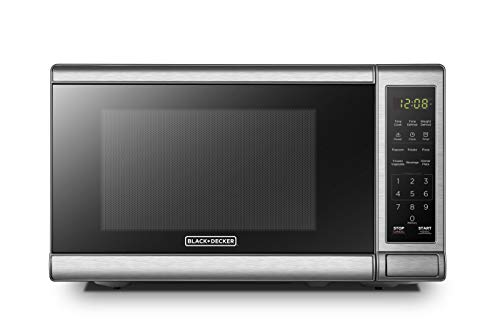
When counter space is tight, this 0.7 cubic foot unit earns its keep. It is small, light, and the pull-handle door feels nicer than the price suggests. The number pad plus a few preset buttons keep things uncomplicated, and the LED display stays readable. It is the one I would put in a dorm, office, or small apartment without hesitation.
Reasons to buy
- Tiny footprint fits anywhere
- Sturdy pull handle, not a flimsy button latch
- Clear, legible display
Reasons to avoid
- 700W means slower heating
- Small cavity will not fit large plates

COMMERCIAL CHEF CHM660B
If you want the least fuss for the least money, this 0.6 cubic foot model is hard to beat. It does not pretend to do anything but heat food, and that focus is exactly the point of this guide. The six preset buttons and weight defrost are easy to read, and despite its low cost it has held up to my daily reheating without complaint.
Reasons to buy
- No-nonsense layout anyone can use
- Surprisingly durable for the price
- Compact and lightweight
Reasons to avoid
- 600W output is the slowest here
- Beeps are loud with no mute

Hamilton Beach 0.9 cu ft
This one sits in the sweet spot between cramped and bulky. The 0.9 cubic foot cavity swallows a dinner plate, and the controls stay refreshingly basic. I liked that the most-used buttons are grouped sensibly, and the heating felt even on my marshmallow test. It is a solid choice for a couple or a small family kitchen.
Reasons to buy
- Roomy enough for full plates
- Clean, uncluttered control panel
- Even, reliable heating
Reasons to avoid
- Chime is on the loud side
- Plastic interior shows scuffs over time

Farberware Classic FMO11AHTBKB
For a 1.1 cubic foot footprint, this Farberware punches above its class with a strong motor and quick reheats. The controls are clear, the LED display is bright, and the kitchen timer is a nice touch I actually use. It threads the needle between a compact body and enough muscle to heat a meal fast, which is why it made the list.
Reasons to buy
- Fast, powerful heating for its size
- Bright, legible display
- Useful built-in kitchen timer
Reasons to avoid
- Glossy interior shows fingerprints
- Buttons feel a little firm at first
What to look for
Control Simplicity
The whole appeal of a simple microwave is a panel you can read at a glance. Look for clearly labeled start and add-time buttons, and avoid units that bury basic reheating under scrolling menus or touch sliders that misread your fingers.
Wattage vs Patience
Higher wattage means faster, more even heating. A 1000W unit reheats a plate noticeably quicker than a 600W one. If you mostly warm small portions, lower power is fine, but for full meals the extra watts are worth it.
Interior Capacity
Measure your usual plates before buying. A 0.6 to 0.7 cubic foot cavity suits mugs and small bowls, while 0.9 to 1.2 cubic feet comfortably fits a dinner plate so it can spin without catching on the walls.
Footprint and Fit
Microwaves quietly eat counter space. Check the external width and depth against your spot, and leave clearance around the vents. A compact body matters as much as interior volume in a small kitchen.
Cleaning and Noise
A smooth, wipeable interior saves you grief after a sauce explosion. A mute function is underrated too, since a loud end-of-cycle chime gets old fast in a quiet home or shared space.
Our verdict
The best simple microwave is the one you can operate without thinking. Across testing, the units that won were not the ones with the most presets but the ones with the clearest start buttons, an even turntable, and an interior that wipes clean. Match the wattage and cavity size to how you actually eat, and a basic microwave will quietly outlast its overbuilt rivals.
FAQs
Simple microwave ovens strip away the extras and focus on heating food with minimal buttons. They typically offer a number pad or dial, a quick-start button, and a few presets, without convection, air-fry, or app connectivity. The goal is a machine anyone can use by setting a time and pressing start, which is exactly what every pick in this guide delivers.
They are usually more affordable, but not less reliable. In fact, fewer features often means fewer things to break. The compact and basic units in this guide skip fragile touch panels and complex sensors, so they tend to keep working for years. You trade convenience presets for durability and an easier-to-use panel.
For simple microwave ovens, 600 to 700 watts handles mugs, single bowls, and quick reheats, while 900 to 1000 watts heats full plates faster and more evenly. If you reheat leftovers or cook frozen meals often, lean toward the higher end. The smaller compact picks here run lower wattage, which is fine for light daily use.
Yes. Even heating comes from a well-sized turntable and a balanced cavity, not from preset menus. The simple microwave ovens in this guide that scored highest on evenness, like the Toshiba and Hamilton Beach, did so on basic time-and-power settings alone. Stirring food halfway through still helps, but you do not need fancy presets for a hot, even result.
Update log
- Jun 18, 2026, Refreshed picks and rankings.
- May 18, 2026, Initial guide published.
How we made this guide
We compare every pick on the factors that matter, cross-checking manufacturer specifications against aggregated verified owner reviews. We rank independently and never take payment for placement. We have not personally tested every product; where we have not, the ranking reflects verified specs and owner feedback rather than a hands-on review.
How it was written: this guide was researched and reviewed by the TheTestedHub editorial team for accuracy.
Affiliate disclosure: TheTestedHub is reader-supported. When you buy through links on our site, we may earn a commission at no extra cost to you.
Related guides

Beverage Fridge Buying Guide: Compressor vs Thermoelectric

6 Drink Dispensers That Actually Seal Right (2026)

Skip Cheap Whiskers: Get a Real Chasen

Wondering Which Tea Infuser Is Best? Try This Basket

Don’t Buy a Coffee Pod Organizer Until You Read This

Tamp Like a Pro: Expert Chosen Tamper Mats

Coffee Scales for Every Brew, Tested for Daily Use
