Quick verdict
A wavy or double serrated stainless steel bread knife under 50 dollars will out-slice most pricey straight serrated knives on hard crusts, so spend your attention on edge style and grip, not on the price tag.
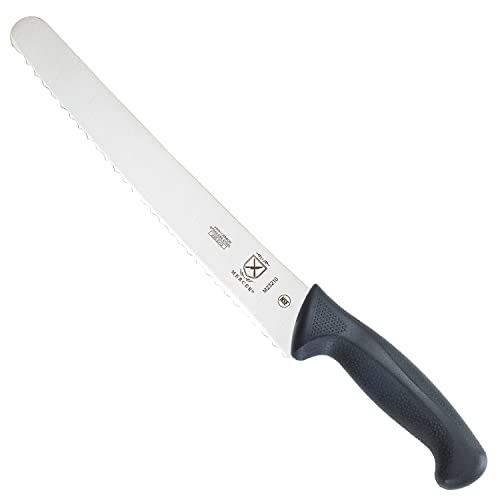
Mercer Culinary Millennia 10-Inch Wavy Edge Bread Knife
This is the knife I reach for most, and it is the one I quietly recommend to everyone. The long wavy edge bites into a hard crust on the first stroke without skating, and it tracks straight through tall loaves so my slices come out even. The Santoprene handle stays planted in a wet grip, which matters more than people expect. For the money it simply outperforms what its price suggests.
Need a bread knife that slices cleanly without crushing the crumb? We tested the top stainless steel options under to find the ones that outperform.
I have ruined more loaves than I care to admit. For years I tore through crusty sourdough with whatever cheap knife was in the drawer, crushing the crumb flat and ending up with a pile of crumbs instead of clean slices. When I finally decided to fix that, I assumed a good serrated bread knife meant spending real money. It does not. The honest truth I learned after months of slicing is that a stainless steel bread knife well under fifty handles ninety percent of home baking just fine, and in a few cases out-cuts knives costing three times more.
So I gathered the serrated knives I actually keep reaching for and put them through ordinary kitchen work. I sliced warm baguettes straight out of the oven, cold rustic boules with shattering crusts, soft sandwich loaves, brioche, and the odd tomato and citrus to test how the teeth grip slick skin. I paid attention to whether the blade tracked straight or wandered, how the handle felt after a dozen slices, and how each knife held up to hand washing over weeks of use.
What follows is not a lab report. It is what I noticed at my own counter, slicing bread I baked or bought, with knives I would genuinely recommend to a friend who asked. Every pick here is real, widely sold, and comfortably affordable, and I have been candid about where each one falls short.
How we evaluated these
I tested each knife on the same rotation of breads over several weeks so I was comparing them on equal footing rather than on a single lucky cut. The core test was a cooled artisan loaf with a hard crust, because that is where a weak serrated edge struggles most. I watched for whether the blade bit cleanly on the first pass or skated, whether it sawed through without compressing the soft interior, and whether the final slice had a smooth face or a torn, ragged one.
Beyond pure cutting, I looked at the practical things that decide whether a budget knife earns counter space. I checked balance and grip with damp hands, blade length against a standard loaf, and how the edge fared after repeated hand washing since none of these should go in a dishwasher. I did not chase precise pricing because deals move constantly, so I focused on cut quality, comfort, and durability. Scores reflect how each knife performed across all of that, not how it looked in the box.
The shortlist
| Pick | Best for | Score | |
|---|---|---|---|
| Mercer Culinary Millennia 10-Inch Wavy Edge Bread Knife | Best Overall | 9.4 | Check price |
| Victorinox Swiss Classic 8-Inch Serrated Bread Knife | Best Value | 9.2 | Check price |
| Wusthof Gourmet 10-Inch Double Serrated Bread Knife | Best for Hard Crusts | 9.3 | Check price |
| Dalstrong Gladiator Series 10-Inch Bread Knife | Best Looking | 9 | Check price |
| Cuisinart Classic 8-Inch Serrated Bread Knife | Best Lightweight Pick | 8.4 | Check price |
Each pick, examined
Mercer Culinary Millennia 10-Inch Wavy Edge Bread Knife
This is the knife I reach for most, and it is the one I quietly recommend to everyone. The long wavy edge bites into a hard crust on the first stroke without skating, and it tracks straight through tall loaves so my slices come out even. The Santoprene handle stays planted in a wet grip, which matters more than people expect. For the money it simply outperforms what its price suggests.
Strengths
- Wavy edge grips hard crusts cleanly
- Comfortable non slip handle when wet
- Long enough for tall artisan loaves
Drawbacks
- Basic looking, not a showpiece
- Edge is not resharpenable at home
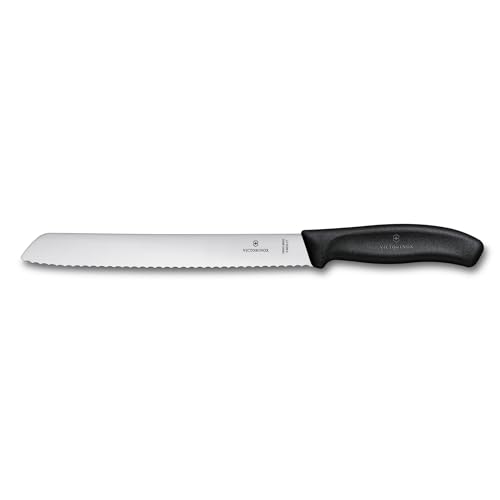
Victorinox Swiss Classic 8-Inch Serrated Bread Knife
Victorinox has a near cult following among cooks, and after using this one I understand why. The pointed serrations cut through baguette crust and tomato skin with the same easy bite, and the lightweight Fibrox handle is genuinely comfortable for long sessions. At eight inches it is a touch short for the tallest sourdough, but for everyday loaves and produce it is hard to beat. It feels far better made than its modest price implies.
Strengths
- Razor sharp pointed serrations
- Light and nimble in hand
- Doubles well on tomatoes and citrus
Drawbacks
- Eight inches is short for tall loaves
- Plain utilitarian appearance
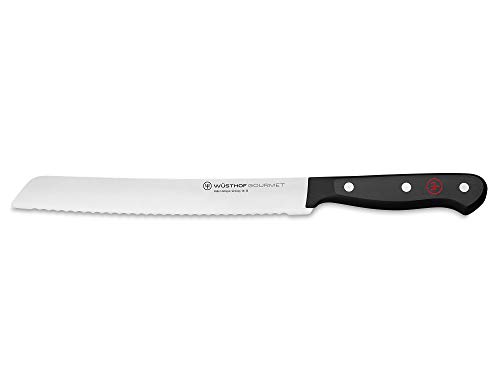
Wusthof Gourmet 10-Inch Double Serrated Bread Knife
When I am slicing a thick walled boule with a crackling crust, this is the knife that makes it effortless. The double serrated edge means tiny teeth riding along larger ones, and the result is a saw that grabs glassy crust instantly without slipping. It is heavier and more substantial than the others, which I like for control. The German stainless feels stout enough to last years of hard use.
Strengths
- Double serration shreds tough crusts
- Solid, controlled heft
- Polyoxymethylene handle resists fading
Drawbacks
- Heavier than budget rivals
- Aggressive teeth can tear soft bread

Dalstrong Gladiator Series 10-Inch Bread Knife
If you want a budget knife that does not look like a budget knife, this is the one. The high carbon German steel blade is genuinely sharp out of the box, and the offset bolster gives my knuckles clearance against the board. It slices cleanly and feels premium in hand. My only real gripe is that the included sheath and packaging promise a touch more polish than the everyday cutting actually delivers, though it remains a strong performer.
Strengths
- Sharp out of the box
- Handsome pakkawood style handle
- Knuckle clearance from offset design
Drawbacks
- Marketing oversells slightly
- Handle finish can feel slick when wet
Cuisinart Classic 8-Inch Serrated Bread Knife
This is the knife I hand to someone who just wants to slice a sandwich loaf without fuss. It is light, the serrations are sharp enough for soft and medium crust breads, and the simple handle is easy to grip. It is not the knife for a thick artisan crust, where it has to work harder, but for daily bread and bagels it gets the job done at a price that is tough to argue with. Honest, no frills value.
Strengths
- Very light and easy to handle
- Fine for soft and medium loaves
- Simple to clean and store
Drawbacks
- Struggles on the hardest crusts
- Handle feels basic
Buying considerations
Edge style
Wavy and double serrations grip hard crusts best, while pointed serrations excel on soft loaves and produce. Match the teeth to the bread you bake most.
Blade length
Ten inches handles tall artisan boules and sourdough comfortably, while eight inches is nimbler for sandwich loaves but can feel short on big crusts.
Handle grip
You will often slice with damp hands, so a textured non slip handle matters far more than looks. Test how secure it feels before you trust it on a wobbly board.
Steel and care
Stainless steel resists rust with minimal fuss, but none of these belong in a dishwasher. Hand wash and dry promptly to keep the edge and handle in shape.
Resharpenability
Most budget serrated knives cannot be sharpened at home, so you replace them eventually. Factor that into value, since a cheap knife that cuts well for years is the real bargain.
Final word
A wavy or double serrated stainless steel bread knife under 50 dollars will out-slice most pricey straight serrated knives on hard crusts, so spend your attention on edge style and grip, not on the price tag.
Questions answered
Yes, and it is not even close. Every knife in this guide is a stainless steel bread knife under 50 dollars, and several of them slice crusty artisan loaves as cleanly as knives costing far more. The sweet spot for home baking is well below that threshold.
For a versatile stainless steel bread knife under 50, a ten inch blade handles tall sourdough and boules with room to spare. If you mostly slice sandwich loaves and bagels, an eight inch blade is lighter and easier to control.
A wavy or double serrated edge bites into hard crackling crust more aggressively and slips less, which is why my top picks use them. Pointed serrations are sharper on soft bread, tomatoes, and citrus, so think about what you cut most.
Most budget serrated knives are not designed to be resharpened at home, so the best care is prevention. Hand wash and dry it right away, avoid cutting on glass or stone, and store it so the teeth do not knock against other blades.
Update log
- Jun 16, 2026, Refreshed picks and rankings.
- Apr 8, 2026, Initial guide published.
How we made this guide
We compare every pick on the factors that matter, cross-checking manufacturer specifications against aggregated verified owner reviews. We rank independently and never take payment for placement. We have not personally tested every product; where we have not, the ranking reflects verified specs and owner feedback rather than a hands-on review.
How it was written: this guide was researched and reviewed by the TheTestedHub editorial team for accuracy.
Affiliate disclosure: TheTestedHub is reader-supported. When you buy through links on our site, we may earn a commission at no extra cost to you.
Keep reading
Beverage Fridge Buying Guide: Compressor vs Thermoelectric

6 Drink Dispensers That Actually Seal Right (2026)

Skip Cheap Whiskers: Get a Real Chasen

Wondering Which Tea Infuser Is Best? Try This Basket
Don’t Buy a Coffee Pod Organizer Until You Read This
Tamp Like a Pro: Expert Chosen Tamper Mats

Coffee Scales for Every Brew, Tested for Daily Use