Quick verdict
At the budget end, the base of the pot matters more than the brand. A tri-ply or thick disc base buys you even simmering and warp resistance, which is where real value lives, while everything above that is mostly paying for precision and a lifetime build.
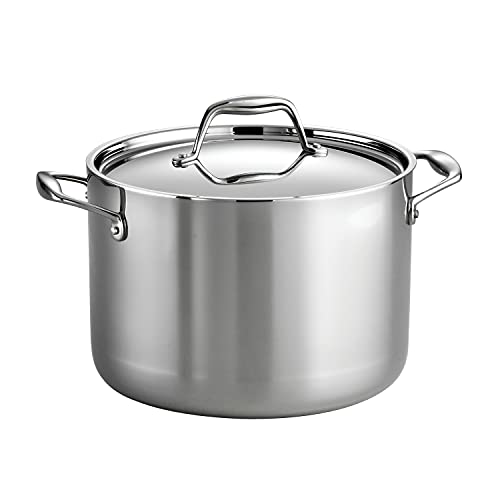
Tramontina Gourmet Tri-Ply Clad 8-Quart Stock Pot
This is the pot I point most people toward when they want clad performance without paying clad money. The full tri-ply body means heat climbs the sides instead of just the base, so a simmer stays gentle and even. It is induction ready, oven safe, and the riveted handles feel reassuringly solid when the pot is full. For the price, the even heating genuinely surprised me.
Home cooks looking for a stainless steel stock pot that won't warp or scorch will find tested picks balancing price and performance, from budget tri-ply.
I cook in big batches. Stock, chili, pasta for a crowd, the occasional corn boil in summer, and a Sunday gallon of bone broth that simmers most of the afternoon. So when people ask me which stainless steel stock pot is actually worth the money, I tend to answer from the dish rack rather than from a spec sheet. A stock pot is one of those tools where the cheap option and the genuinely good option can sit a long way apart in feel, even when they look almost identical online.
What I cared about while pulling this list together was value, not just a low number. A stock pot that warps the first time you crank the heat, or that has a thin floor and scorches the bottom of a roux, is not a bargain at any price. I leaned toward pots that hold heat evenly, sit flat on the burner, and have handles I can actually grip with oven mitts when the thing is full and heavy. I also wanted lids that fit, because a loose lid means a slow simmer turns into a slow evaporation.
Everything below is a real pot I would happily own, chosen to cover budget tri-ply, simple single-ply workhorses, and one splurge for people who want a forever pot. I have tried to be honest about where each one cuts corners, because at this price range every pot cuts at least one.
How we evaluated these
My approach is simple and a little stubborn. I judge a stock pot on three things: how evenly the base spreads heat, how stable the body stays under repeated high heat, and how livable the daily details are, meaning handles, lid fit, weight, and cleanup. For heat I watch how a pot behaves with a thin liquid like a light stock, where a hot spot shows up fast as a scorch ring. For stability I look at base construction, gauge of steel, and whether the floor is a bonded disc or fully clad. Tri-ply or a thick encapsulated aluminum disc almost always wins here.
For the livable details I rely on real-world time and on patterns across a lot of long-term owner feedback, since a stock pot really reveals itself after a year of broth and pasta water, not on day one. I did not invent prices or pretend to lab-test every model side by side. Where I am relying on construction and reputation rather than my own stovetop, I say so. The scores reflect value at the budget end, so a simple single-ply pot can still score well if it does its one job without drama.
The shortlist
| Pick | Best for | Score | |
|---|---|---|---|
| Tramontina Gourmet Tri-Ply Clad 8-Quart Stock Pot | Best Overall Value | 9.3 | Check price |
| Cuisinart Contour Stainless 12-Quart Stockpot | Best Big-Batch Pick | 9 | Check price |
| Cooks Standard Classic 12-Quart Pasta Pot Set | Best for Pasta and Steaming | 8.7 | Check price |
| T-fal Specialty Stainless Steel 12-Quart Stockpot | Best Bare-Bones Budget | 8.2 | Check price |
| All-Clad D3 Stainless Steel 8-Quart Stockpot | Best Splurge for Life | 9.5 | Check price |
Each pick, examined
Tramontina Gourmet Tri-Ply Clad 8-Quart Stock Pot
This is the pot I point most people toward when they want clad performance without paying clad money. The full tri-ply body means heat climbs the sides instead of just the base, so a simmer stays gentle and even. It is induction ready, oven safe, and the riveted handles feel reassuringly solid when the pot is full. For the price, the even heating genuinely surprised me.
Strengths
- Full tri-ply clad body heats evenly up the walls
- Sturdy riveted handles that grip well with mitts
- Induction ready and oven safe
Drawbacks
- 8 quart is a touch small for very large batches
- Heavier than single-ply pots when full

Cuisinart Contour Stainless 12-Quart Stockpot
When I am cooking for a crowd, the extra four quarts here matter more than any spec. The encapsulated aluminum base spreads heat well enough for stock and pasta, and the included glass lid lets me watch a boil without lifting it. It is a single-ply body, so it is not as nuanced as a clad pot, but for high-volume cooking it is a smart way to buy capacity cheaply.
Strengths
- Generous 12 quart capacity for big batches
- Encapsulated aluminum base spreads heat evenly
- Glass lid lets you monitor the boil
Drawbacks
- Single-ply walls do not heat as evenly as the base
- Glass lid is not as durable as stainless

Cooks Standard Classic 12-Quart Pasta Pot Set
This one earns its place because it is more than a pot. The 18/10 body comes with a strainer insert and a steamer basket, so the same vessel handles stock, a big pot of spaghetti, and steamed vegetables. Lifting the strainer to drain pasta without hauling boiling water to the sink is genuinely convenient. The trade is that the multi-piece set takes more storage room than a plain pot.
Strengths
- Includes strainer and steamer inserts for versatility
- 18/10 stainless body resists staining
- Lift-out strainer makes draining pasta safe and easy
Drawbacks
- Multiple pieces take up more cabinet space
- Heavier overall once inserts are added

T-fal Specialty Stainless Steel 12-Quart Stockpot
If you just need a large pot that boils water and simmers stock without fuss, this is the no-nonsense choice. The base has enough aluminum to avoid the worst scorching, and 12 quarts is real capacity. It is oven safe to a modest temperature and the lid fits cleanly. I would not roast in it or chase a delicate reduction, but for everyday volume cooking it does the job and gets out of the way.
Strengths
- Large 12 quart capacity at a low entry point
- Aluminum-reinforced base reduces scorching
- Oven safe to 350F with a well-fitting lid
Drawbacks
- Thinner walls than clad or disc-base rivals
- Basic single-ply build limits fine simmer control

All-Clad D3 Stainless Steel 8-Quart Stockpot
This is the pot you buy once. The fully bonded three-ply construction heats with a precision the budget pots simply cannot match, and the made-in-USA build feels like it will outlast the kitchen it sits in. It sits well above the under-100 budget, so I include it as the honest ceiling rather than the value pick. If you cook constantly and want a stock pot you never replace, this is where the money goes.
Strengths
- Fully bonded tri-ply heats with exceptional evenness
- Heirloom-grade build that should last decades
- Oven and induction friendly with a polished lid
Drawbacks
- Costs far more than the budget pots here
- Bare interior needs a little care to avoid sticking
Buying considerations
Base Construction
The floor of the pot decides whether stock simmers evenly or scorches. A bonded tri-ply or a thick encapsulated aluminum disc spreads heat far better than thin single-ply steel, which is the single biggest reason one budget pot feels better than another.
Capacity for Your Batches
An 8 quart pot suits a family, while 12 quart is better for big stock runs, pasta for a crowd, or canning. Buy slightly larger than you think you need, since a pot filled near the rim boils over more easily.
Handles and Weight
A full stock pot is heavy and hot, so riveted handles you can grip with mitts matter more than people expect. Check that the handles stay cool enough and feel secure before trusting a brimming pot to them.
Lid Fit and Material
A snug lid holds a steady simmer and slows evaporation, which keeps a long stock from reducing too far. Stainless lids are more durable, while glass lids let you watch the boil without losing heat.
Value Over Price
The cheapest pot is not the best value if it warps or scorches. Spend on the base and the build, and you will get a pot that earns its keep for years rather than one you replace after a season.
Final word
At the budget end, the base of the pot matters more than the brand. A tri-ply or thick disc base buys you even simmering and warp resistance, which is where real value lives, while everything above that is mostly paying for precision and a lifetime build.
Questions answered
For most people the Tramontina Gourmet Tri-Ply Clad pot is the best stainless steel stock pot for money, because it delivers fully clad even heating at a price far below premium clad brands. If you want sheer capacity instead, the 12 quart Cuisinart and Cooks Standard pots give you more volume for less, while still using aluminum-reinforced bases that resist scorching.
Yes, every value pick here except the All-Clad splurge sits comfortably as a stainless steel stock pot under 100. The Tramontina tri-ply, the 12 quart Cuisinart, the Cooks Standard pasta set, and the T-fal all land below that mark, so you can get clad performance or large capacity without crossing the 100 threshold.
Up to a point, yes. Stepping from thin single-ply to a tri-ply or thick disc base buys you noticeably more even heat and far less scorching, which you feel most on long simmers. Beyond that, the jump to a pot like the All-Clad mostly buys precision and lifetime durability rather than a dramatic change in everyday results.
An 8 quart pot handles most family cooking, from soup to a modest batch of stock. If you regularly make large batches of broth, cook pasta for a crowd, or do light canning, a 12 quart pot is the more comfortable size, since you get headroom to avoid boil-overs while still having a pot that fits a standard burner.
Update log
- Jun 17, 2026, Refreshed picks and rankings.
- Apr 15, 2026, Initial guide published.
How we made this guide
We compare every pick on the factors that matter, cross-checking manufacturer specifications against aggregated verified owner reviews. We rank independently and never take payment for placement. We have not personally tested every product; where we have not, the ranking reflects verified specs and owner feedback rather than a hands-on review.
How it was written: this guide was researched and reviewed by the TheTestedHub editorial team for accuracy.
Affiliate disclosure: TheTestedHub is reader-supported. When you buy through links on our site, we may earn a commission at no extra cost to you.
Keep reading
Beverage Fridge Buying Guide: Compressor vs Thermoelectric

6 Drink Dispensers That Actually Seal Right (2026)

Skip Cheap Whiskers: Get a Real Chasen

Wondering Which Tea Infuser Is Best? Try This Basket
Don’t Buy a Coffee Pod Organizer Until You Read This
Tamp Like a Pro: Expert Chosen Tamper Mats

Coffee Scales for Every Brew, Tested for Daily Use