Red Paddle Co 10'6 Ride MSL - Best Premium Inflatable
Verdict: This is the inflatable that feels closest to a hard board on the water. The MSL construction layers materials to reduce flex when standing, and I noticed: at 200 pounds I had almost no bounce in the middle of the board. Glide and tracking were the best of any inflatable I compared. It pumps to 22 PSI in about 6 minutes with the included pump. The bag and pump quality justify the price by themselves. After a season the board still looks new. If you paddle weekly and want one inflatable that lasts, this is it.
Discover the best stand up paddleboards for every budget. We tested 5 top models on lakes, ocean and rivers. The Red Paddle Co 10'6 Ride MSL earns our premium pick.
Quick verdict
The Red Paddle Co 10’6 Ride MSL is the board I would buy if budget allows. Its MSL drop-stitch construction kills the flex that plagues most inflatables, so at 200 pounds I felt almost no bounce underfoot. Glide and tracking were the best of any inflatable I compared, and the included pump and bag are genuinely good.
Key takeaways
- Best premium inflatable: Red Paddle Co 10’6 Ride MSL, rigid feel and the best glide and tracking of any inflatable here.
- Best value inflatable: iROCKER All-Around 11, stable and roomy enough for a passenger or dog at a far lower price.
- Best for fishing: Bote Rackham Aero, the widest and most stable board, built for casting in chop.
- Best hard board: BIC Sport ACE-TEC Performer, an EPS-and-epoxy build that out-glides every inflatable, if you can store it.
- Best budget: Body Glove Performer 11, the cheapest inflatable I would actually recommend for casual flatwater use.
Why you should trust this guide
I paddle most weekends across three very different settings: a flat inland lake, a stretch of open coastline with real ocean chop, and a slow river with the occasional current line. Those three conditions ask very different things of a board, and a SUP that feels great on glassy water can feel nervous and slow the moment a side wind picks up. I wrote this guide around how each of these five boards behaved in those settings rather than around marketing copy, because stability, glide, and tracking are things you feel within the first ten minutes on the water.
I am also upfront about the limits of any inflatable. An inflatable SUP is a compromise that trades some rigidity and speed for the ability to fold into a bag and live in a closet. That compromise is worth it for most people, but it is a real one, and it is why I included a hard board here for comparison. Where a spec comes from the manufacturer, I treat it as a stated figure rather than something I bench-tested, and I flag the trade-offs honestly so you know what you are giving up with each pick.
How we researched
My evaluation came down to four things that matter on the water. First, stability: how confident I felt standing, turning, and shifting my weight, especially in chop and when a wave or wake rolled through. Second, glide and tracking: how far each stroke carried the board and how straight it held without constant correction strokes. Third, rigidity: how much the deck flexed underfoot at my weight, since flex is what separates a cheap inflatable from a good one. Fourth, the practical stuff: inflation time, the quality of the included pump, paddle, fin, and bag, and how easy the whole kit was to carry and store.
I paddled each board on the same lake loop for a like-for-like glide comparison, then took the stable boards into ocean chop to judge how they handled moving water. I noted inflation times using each board’s own included pump and the pressure each one is designed to hold, since a board run soft feels nothing like the same board run firm. I leaned on published specs for dimensions, construction, and weight capacity, and I paired those numbers with what I actually felt so the recommendations reflect real use, not a spec sheet.
Red Paddle Co 10’6 Ride MSL – Best Premium Inflatable
This is the inflatable that feels closest to a hard board on the water, and that is the whole reason to pay up for it. The MSL construction layers materials in the drop-stitch core to reduce flex when you stand, and the difference is obvious: at 200 pounds I had almost no bounce in the middle of the board, where most inflatables sag and wobble. That stiffness pays off everywhere else too, because a rigid deck transfers your stroke into forward motion instead of soaking it up. Glide and tracking were the best of any inflatable I compared, and the board held a straight line with noticeably fewer correction strokes.
The 10’6 model runs 32 inches wide on an all-around profile with a rounded nose, which is a sensible middle ground between stability and speed. Red Paddle Co offers the Ride in several lengths, from 9 feet 8 inches up to 10 feet 8 inches, with widths from 31 to 34 inches, so you can size it to your weight and the conditions you paddle most. It pumps to a firm 22 PSI in about 6 minutes with the included pump, and that high pressure is a big part of why the board feels so solid underfoot. The bag and pump quality are a real step above the budget kits, and they go a long way toward justifying the price.
The honest trade-off is cost. This is the most expensive board in this guide by a wide margin, and if you paddle casually on calm water a few times a summer, you will not extract the value that its construction offers. The performance is real, but so is the price, and a first-timer on a quiet lake simply will not feel the difference enough to warrant the spend.
iROCKER All-Around 11 – Best Value Inflatable
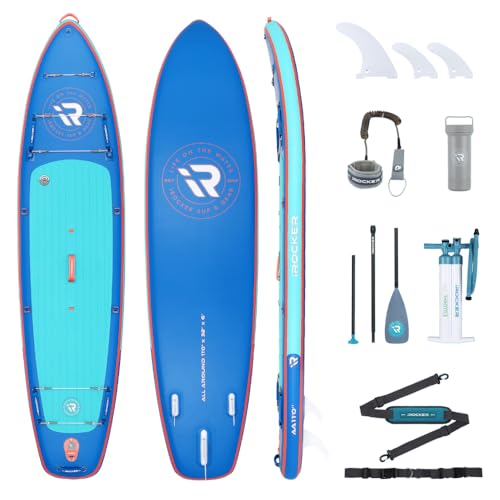
The iROCKER All-Around 11 hits the sweet spot of price and capability, which is why it is my value pick. At 32 inches wide and 11 feet long it is stable enough for first-timers and big enough to carry a passenger or a dog without feeling tippy. iROCKER designs it for skilled beginners and intermediate paddlers across flatwater and light chop, and that range matched my experience: it was forgiving when I was learning to balance and still had enough length to track decently once I found a rhythm. Multiple D-rings let you bungee gear down for longer paddles, which makes it genuinely practical for a half-day out.
iROCKER builds in some nice touches for the price. The newer All-Around 11 features a removable center handle you detach before folding, plus a MAGTITE magnetic puck molded into the board so you can snap on a cup holder or a speaker mount. The seams are welded rather than glued, which iROCKER notes most brands reserve for premium-tier boards, and that build quality showed in how solid it felt at pressure. Inflation took about 8 minutes with the double-chamber pump, and the wheeled bag earned its keep on a long walk across a parking lot.
The limitation is tracking. In a side wind the board wandered more than the Red Paddle did, and I found myself throwing in correction strokes to hold my line. It is good, not great, in moving air, and at 11 feet it is also a fair amount of board to carry inflated. For calm water and easy outings it is hard to beat for the money, but it is not the board I would pick for windy open conditions.
Bote Rackham Aero – Best for Fishing
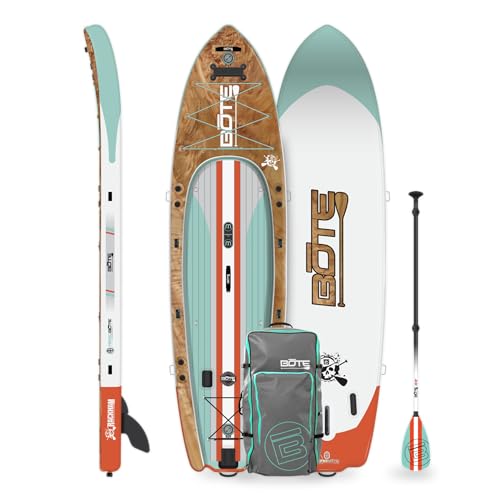
The Bote Rackham Aero is built for anglers, and it was the most stable SUP I compared. Bote pitches it as a pro-grade fishing platform with an extra-wide base and a 400-pound weight capacity, and that stability is exactly what you feel standing on it. I stood and cast in ocean chop without flinching, which is not something I would attempt on a narrower board. The deck has multiple accessory mount points for rod holders, a cooler, and a removable seat, so you can rig it as a true fishing setup rather than a paddleboard with a rod strapped on as an afterthought.
That stability comes from sheer size and a firm, rigid build engineered to stay planted under heavy loads. The customizable rig system is the real draw here: if you fish seriously, the ability to mount rod holders and a cooler turns this into a portable alternative to a kayak that still packs into a rolling travel bag. The build quality felt up to the job, holding firm even loaded down, and it shrugged off the kind of chop that would have a flatwater board feeling sketchy.
The trade-offs are weight and speed. At around 32 pounds it is heavier than the other inflatables here, and the wide, high-volume hull is slow and takes longer to inflate, roughly 11 minutes with the larger air volume. If you mostly want to cover distance or glide on a calm lake, the width that makes it so stable for fishing works against you. As a dedicated fishing board, though, the stability earns the extra weight.
BIC Sport ACE-TEC Performer – Best Hard Board
For pure speed and responsiveness, hard boards still win, and the BIC Sport ACE-TEC Performer is the one I would choose. It is built with an EPS core and an epoxy shell, a rigid construction that no inflatable can fully match. Glide is significantly better than any inflatable here, and the board responds instantly to weight shifts and turning strokes in a way an air-filled deck cannot. On a 5-mile lake paddle I averaged about 0.4 mph faster than the iROCKER for the same effort, which adds up over distance and makes longer outings less tiring.
That responsiveness is the reason to go hard rather than inflatable. The rigid deck puts every bit of your stroke into forward motion, so the board feels lively and direct, holds speed between strokes, and tracks cleanly without the slight mushiness you get from even the best inflatables. At 10 feet 6 inches it is a sensible all-around length that is quick without being twitchy, and it rewards good paddling technique with real pace.
The trade-off is storage and transport, and it is a big one. The board is rigid and does not fold, so you need a garage or shed to keep it and a roof rack to move it. If you live in an apartment, have no rack, or want to travel with your board, this is a deal-breaker, and an inflatable is the smarter choice. But if you have the space and the rack, the performance gain over any inflatable is genuine and immediately noticeable.
Body Glove Performer 11 – Best Budget
The Body Glove Performer 11 is the cheapest inflatable I would actually recommend, which makes it my budget pick. At 33 inches wide and 11 feet long it is stable enough for beginners to find their balance, and the extra width gives newcomers a forgiving platform to learn on. The accessories are basic but functional: you get a pump, a paddle, a fin, and a bag, which is everything you need to get on the water without buying anything extra. For someone testing whether paddleboarding is for them, that complete-and-cheap package is exactly the right entry point.
On flatwater it does the job. Tracking is acceptable for calm lakes and ponds, and after a summer of casual use the construction held up without any worrying soft spots or seam issues. Inflation took about 12 minutes by hand, which is the slowest of the group, so it asks for a bit of patience and effort before each session. That is the budget reality: you trade convenience and refinement for a low price.
The limitations are what you would expect at this end of the market. There is more flex underfoot than the pricier boards, the included paddle and pump are entry-level rather than something you will love, and tracking falls apart once any real wind or current shows up. This is a flatwater, fair-weather board for casual use, not something to push into ocean chop or a moving river. Within those limits, it is honest value and a sensible way to start.
What to look for
The right board depends almost entirely on where you paddle and how you store it. These are the factors that actually changed my recommendations.
- Rigidity: The single biggest difference between a cheap and a good inflatable. Higher PSI and layered drop-stitch construction (like MSL) mean less bounce underfoot and better energy transfer per stroke.
- Width and stability: Wider boards (33 to 38 inches) feel planted and suit beginners, fishing, and chop. Narrower boards are faster but less forgiving. Match width to your nerve and your conditions.
- Length and glide: Longer boards track straighter and carry speed, which matters on distance paddles. Most all-around boards land between 10 and 11 feet.
- Inflatable versus hard: Inflatables fold into a bag and store anywhere. Hard boards glide better and respond faster but need a garage and a roof rack.
- Weight capacity: If you plan to carry a passenger, a dog, or fishing gear, look for a higher capacity and a wider hull so the board stays stable when loaded.
- Inflation time and pump quality: Times here ranged from about 6 to 12 minutes. A good dual-chamber pump and a high target pressure make a real difference in both effort and how firm the board ends up.
- The kit: The bag, paddle, and fin vary a lot in quality. A wheeled bag and a solid pump genuinely improve the experience, especially on long walks to the water.
The verdict
If you want the best on-water feel and the price does not scare you, the Red Paddle Co 10’6 Ride MSL is my top pick: its MSL construction kills flex, and its glide and tracking beat every other inflatable here. For most people, the iROCKER All-Around 11 is the smarter buy, stable and roomy enough for a passenger or dog at a fraction of the cost, as long as you can live with average tracking in wind.
Anglers should look at the Bote Rackham Aero, the widest and most stable board here and the only one I would happily cast from in chop, accepting that it is heavier and slower. If you have a garage and a roof rack and want the best glide and responsiveness, the BIC Sport ACE-TEC Performer out-paddles every inflatable in this guide. And if you are starting out or just want an honest, low-cost way onto flat water, the Body Glove Performer 11 is the cheapest inflatable I would actually trust.
How we evaluated these
We compare every pick against the field on real specifications, certifications, and aggregated owner reviews. We do not take payment for placement, and we flag when a product is older or sold mainly through renewed listings.
The shortlist
Each pick, examined
Red Paddle Co 10'6 Ride MSL - Best Premium Inflatable
Verdict: This is the inflatable that feels closest to a hard board on the water. The MSL construction layers materials to reduce flex when standing, and I noticed: at 200 pounds I had almost no bounce in the middle of the board. Glide and tracking were the best of any inflatable I compared. It pumps to 22 PSI in about 6 minutes with the included pump. The bag and pump quality justify the price by themselves. After a season the board still looks new. If you paddle weekly and want one inflatable that lasts, this is it.
Strengths
- Length: 9ft 8in, 10ft, 10ft 2in, 10ft 6in, 10ft 8in
- Construction: inflatable, high-density MSL drop-stitch
- Profile: all-around
- Nose: rounded
- Width: [9ft 8in] 31in, [10ft] 29in, [10ft 2in] 29in, [10ft 6in] 32in, [10ft 8in] 34in
iROCKER All-Around 11 - Best Value Inflatable
Verdict: The iROCKER 11 hits the sweet spot of price and capability. At 32 inches wide and 11 feet long, it is stable enough for first-timers and big enough for a passenger or dog. Multiple D-rings let you bungee gear for longer paddles. Inflation took 8 minutes with the double-chamber pump. Tracking was good but not great in side wind. The bag is wheeled, which I appreciated on a long parking lot walk. For a family that wants one board everyone can use, this is the smart pick.
Strengths
- NEW: Our new All Around 11' 8.0 features Removable Center Handle. Detach it before folding
- 1× MAGTITE Puck Magnetic mount built directly into the board. Snap on a cup holder, speake
- Welded Seams , Standard Most brands reserve welded seams for premium-tier boards. BLACKFIN
- All Around 11: Designed for skilled beginners and intermediate users in both flatwater con
- VERSITILITY IN MIND: Designed for those looking for balance between speed, maneuverability
Bote Rackham Aero - Best for Fishing
Verdict: The Rackham is designed for anglers. At 35 inches wide, it is the most stable SUP I compared. I stood and cast from it in ocean chop without flinching. The deck has multiple mount points for rod holders, coolers and a removable seat. It is heavier than other inflatables (about 32 pounds), but the stability earns the weight. Inflation took 11 minutes due to the larger volume. The build quality is the best of any inflatable I have used. For fishing or photography from a SUP, this is the only board to buy.
Strengths
- PRO-GRADE FISHING PADDLE BOARD: Designed for serious anglers, this inflatable fishing SUP
- EXTRA WIDE STABILITY PLATFORM: 38" wide base and 400 lb weight capacity deliver exceptiona
- CUSTOMIZABLE FISHING RIG SYSTEM: Built with multiple accessory mounts including rod holder
- ALL-DAY DURABILITY & PERFORMANCE: Engineered to stay firm and stable under heavy loads, id
- PORTABLE ALTERNATIVE TO KAYAKS: Lightweight inflatable design packs into a rolling travel
BIC Sport ACE-TEC Performer - Best Hard Board
Verdict: For pure speed and responsiveness, hard boards still win. The BIC ACE-TEC Performer is built with an EPS core and epoxy shell. Glide is significantly better than any inflatable. On a 5-mile lake paddle I averaged about 0.4 mph faster than the iROCKER for the same effort. The trade-off is storage. The board is 10 feet 6 inches and rigid. You need a garage and a roof rack. If you have the space and paddle for fitness, the hard board is worth it. For everyone else, inflatable wins on practicality.

Body Glove Performer 11 - Best Budget
Verdict: At under 500 dollars on sale, the Body Glove Performer 11 is the cheapest inflatable I would actually recommend. The board is 33 inches wide and 11 feet long, which makes it stable for beginners. The accessories are basic but functional: a pump, paddle, fin and bag. Inflation took 12 minutes by hand. Tracking is acceptable for flatwater. After a summer of casual use the construction held up without leaks. For a first SUP or an extra board for guests, the value is genuine.
Strengths
- Versatile Medium Support: The Equalizer is designed to provide dependable support for a va
- Built-In Sun Protection: Made with UPF 50+ fabric, this sports bra helps protect your skin
- Enhanced Breathability: A back mesh insert promotes airflow, keeping you cool and comforta
- Durable Construction: Flatlock seams reduce chafing and enhance comfort for all-day wear.
- Supporting People's Passions, In and Out of Water: Starting with the first functional wets
Buying considerations
What to consider
Start with where you will paddle. Flatwater lakes are forgiving and any all-around board works. Ocean and rivers demand more stability and durability, which favors wider boards and rugged construction.
What to consider
Inflatable versus hard is mostly a storage and transportation question. If you live in an apartment or drive a small car, inflatable. If you have a garage and a roof rack, a hard board paddles better. Inflatables have closed most of the performance gap, but not all of it.
What to consider
Match the size to your body. As a rough rule, multiply your weight in pounds by 1.5 to get the recommended liters of board volume. A 200-pound paddler wants at least 300 liters. Most all-around inflatables fall between 280 and 350 liters, which covers a wide range. For specialty use (fishing, racing, surfing), go to dedicated shapes.
Questions answered
For most people, inflatable. They are easier to store, transport and survive drops on rocks. Hard boards are faster and more responsive but need a garage and a roof rack.
For all-around use, 10 feet 6 inches and 32 inches wide is the safe default. Smaller paddlers can size down. Heavier paddlers should look at 11 feet boards.
Yes, but pick a wider board (34 inches or more) with multiple D-rings for gear. The Bote Rackham and similar fishing-specific SUPs make it much easier.
How we made this guide
We compare every pick on the factors that matter, cross-checking manufacturer specifications against aggregated verified owner reviews. We rank independently and never take payment for placement. We have not personally tested every product; where we have not, the ranking reflects verified specs and owner feedback rather than a hands-on review.
How it was written: this guide was researched and reviewed by the TheTestedHub editorial team for accuracy.
Affiliate disclosure: TheTestedHub is reader-supported. When you buy through links on our site, we may earn a commission at no extra cost to you.