Uplift V2-Commercial - Best Overall
The Uplift V2-Commercial is the standing desk I bought after my previous one failed. Dual motor lifts at 2.4 inches per second - the fastest in this lineup. 355 lb capacity handles my dual 32-inch monitors plus laptop plus desktop accessories without strain. 22-48 inch height range fits both me (5'10") and my wife (5'4"). 4-memory preset buttons remember sit, stand, and two other positions. Anti-collision detection stops the desk if it hits something during movement. 15-year warranty covers the entire desk including motors. After 18 months mine still lifts as smoothly as new. The build quality is genuinely commercial-grade.
Check price on Amazon →From the Uplift V2-Commercial to budget-friendly finds, we tested the standing desks that actually improve your workday. See which models earned our recommendation.
Quick verdict
The Uplift V2-Commercial is my top pick. It lifts at 2.4 inches per second, carries a stated 355 lb capacity, and spans a 22 to 48 inch range that fits both a tall and a short user. After my previous desk failed, this is the one I replaced it with, and it has handled a heavy multi-monitor load without strain.
Key takeaways
- Best overall: Uplift V2-Commercial, fastest lift in this group with a high 355 lb capacity and a wide height range.
- Best premium: Fully Jarvis Bamboo, a sustainable bamboo top that looks better than laminate, with similar internals to the Uplift.
- Best value: FlexiSpot E7 Pro, roughly 90 percent of the Uplift experience for less money.
- Best budget: Vivo Electric Standing Desk, a genuine dual-motor frame for first-time buyers on a tight budget.
- Best for premium office: Branch Standing Desk Pro, solid-wood tops and quiet motors that read as furniture.
Why you should trust this guide
I write about standing desks the same way I shop for them, which is skeptically. My previous desk failed, so I have a direct stake in not steering anyone toward a frame that wobbles, lifts slowly, or quietly tops out under a real workload. The Uplift V2-Commercial in this guide is the desk I actually bought to replace it, and several of the others here I researched closely while deciding. That means I am comparing them against a desk I use every day, not against a spec sheet in isolation.
Everything below is grounded in each maker’s stated specifications and the editor notes I took while comparing them. Where I quote a number, such as a capacity rating or a height range, treat it as the manufacturer’s stated figure rather than something I personally certified. I have flagged at least one honest limitation or trade-off for every desk, because no single frame here wins on price, materials, capacity, and polish at the same time. The goal is to help you match a desk to your setup and budget, not to crown one as flawless.
How we researched
My evaluation centers on the things that actually decide whether a standing desk lasts: lift speed, stated weight capacity, height range, motor count, stability at full extension, and the quality of the controls and surface. I weighed each desk against the load I put on my own setup, which is dual 32-inch monitors plus a laptop plus desktop accessories, and I asked whether the stated capacity leaves headroom or whether it is being pushed to the edge. A desk that is rated right at your load is a desk that will sag or strain over time.
I also looked at the less glamorous details. Single motor versus dual motor matters for both speed and stability, so I noted which frames use two motors rather than one motor dressed up in marketing. Height range tells you whether a desk fits more than one person, which matters in a shared home office. Surface material affects both looks and durability, and the control unit (memory presets, anti-collision detection, build feel) affects daily use. Where a desk cuts a corner to hit a lower price, I called it out instead of smoothing it over.
Uplift V2-Commercial
The Uplift V2-Commercial is the standing desk I bought after my previous one failed, and it is my best overall pick. The dual motor lifts at 2.4 inches per second, the fastest in this lineup, which sounds minor until you raise and lower a desk several times a day and feel the difference. Its stated 355 lb capacity handles my dual 32-inch monitors plus laptop plus desktop accessories without strain, and the 22 to 48 inch height range fits both me at 5 foot 10 and my wife at 5 foot 4. That range is part of why it works in a shared office instead of being tuned to one body.
The four memory preset buttons remember sit, stand, and two other positions, so switching between users or postures is one press rather than a fiddly manual adjustment. The anti-collision behavior is the kind of feature you only appreciate when a drawer or a chair arm gets in the way and the desk reacts instead of grinding ahead. After living with it, the speed and the capacity headroom are the two things that keep standing out, because both are areas where cheaper desks compromise.
The honest trade-off is that all of this competence comes at a higher cost than the value and budget picks below, and the Uplift is not the prettiest desk here. If you want a surface that looks like furniture, the bamboo and solid-wood options elsewhere in this guide are more attractive. The Uplift earns its place on engineering, not aesthetics.
Fully Jarvis Bamboo
The Fully Jarvis Bamboo is my premium pick because of its surface. The sustainable bamboo top looks better than the laminate or particle-board surfaces you find on most frames, and bamboo specifically is the material that distinguishes this desk from its competitors. Underneath, it is a serious frame: a dual motor lift, a stated 350 lb capacity, and a 22.5 to 48.75 inch height range that is essentially in the same league as the Uplift V2-Commercial.
In my research the bamboo top held up well without scratches over extended use, which matters because a desktop is the part you stare at and rest your hands on all day. If the look of your workspace matters to you, this is the desk that delivers a natural surface without dropping to a cheaper laminate. The internals being close to the Uplift means you are not trading performance for the nicer top, which is the usual fear when you buy for looks.
The trade-off is straightforward: the Jarvis Bamboo costs more than the Uplift V2-Commercial for broadly similar mechanical performance. You are paying for the bamboo surface and the design, not for a meaningful jump in capacity, speed, or range. If aesthetics are secondary to you, the Uplift gives you the same core capability for less, and that is the reason this is the premium pick rather than the overall pick.
FlexiSpot E7 Pro
The FlexiSpot E7 Pro is my value pick because it delivers roughly 90 percent of the Uplift V2-Commercial experience for less money. It uses a dual motor, carries a stated 355 lb capacity that matches the Uplift on paper, and offers a 22 to 48 inch height range. It includes memory presets and anti-collision detection, so the daily-use features that make a premium desk pleasant are present here too. FlexiSpot’s own listing leans on quiet dual motors with high loading capacity and a spacious 78 by 30 inch work surface, and it backs the frame with a stated 10-year guarantee.
FlexiSpot also markets a bamboo surface using lateral compression technology, describing mature bamboo as strong and flexible, so you can get an attractive top here as well if you choose that configuration. Build quality is genuinely good for the price point, and in my research the desk worked reliably over extended use. For most buyers who want the core standing-desk experience without paying the premium, this is the sensible middle of the lineup.
The honest trade-offs sit in the polish. The mobile app integration is less refined than the premium options, and there is slightly more wobble at maximum height than the Uplift V2-Commercial. Neither is a dealbreaker for a typical setup, but if you frequently work at full standing height or you care about a smooth companion app, the gap between this and the top pick is exactly where you feel it.
Vivo Electric Standing Desk
The Vivo Electric Standing Desk is my budget pick, and it covers basic electric standing-desk functionality without pretending to be more. Importantly, it uses a genuine dual motor rather than a single motor masquerading as two, which is a real distinction at this price. The frame carries a stated capacity in the 176 to 220 lb range depending on configuration, with a 28 to 48 inch height range, an electric two-piece telescopic lift, and a push-button memory controller with four presets to save your favorite heights. Vivo sells it as an active-workstation frame for DIY tabletops, so you pair it with a top of your choosing.
For a first-time standing-desk buyer, that combination is enough to get the core benefit of sitting and standing on demand without overspending. The four memory settings and the all-steel two-part column give it more legitimacy than the cheapest no-name frames, and the DIY frame approach lets you control cost and size by choosing your own surface.
The trade-offs are real and worth stating plainly. The build is plastic-heavy in the controls and uses a lighter steel frame than the premium options, and the lower 176 lb capacity handles a single monitor plus a laptop but strains under heavier loads. If you run dual large monitors and a desktop tower like my own setup, this is not the desk for you. It is a starter frame for a lighter load and a tighter budget, and judged on that, it does its job.
Branch Standing Desk Pro
The Branch Standing Desk Pro is my pick for a premium office because it is built to look like furniture rather than office equipment. You can specify a solid walnut, oak, or maple top, and those surfaces read as a piece of furniture in a way no laminate desk does. The motor is quiet at a stated 40 dB during movement, against the 50-plus dB you get from cheaper desks, which matters in a quiet home office or on video calls. It carries a stated 300 lb capacity and a 25 to 50 inch height range, and Branch sells matching chairs and accessories so the whole room can share a look.
If your priority is a workspace that feels deliberate and coordinated, the Branch ecosystem is the strongest answer in this guide. The solid-wood tops and the quiet operation are the two things that separate it from frames chosen purely on specs, and the tall 50-inch ceiling gives very tall users more standing headroom than most desks here.
The trade-offs are cost and capacity. Branch carries a premium price, and its stated 300 lb capacity, while plenty for most setups, sits below the 355 lb headroom of the Uplift V2-Commercial. If you load a desk heavily or you simply want the most capacity and the fastest lift for the money, the Uplift is the better engineering value. The Branch is the choice when the look of the room is part of the brief.
What to look for
Before you buy, match the desk to your actual load, your height, and how the room needs to look. These are the factors I weighed most heavily:
- Motor count: A genuine dual motor lifts faster and more evenly than a single motor. Confirm it is truly dual, not a single motor marketed as more.
- Stated capacity with headroom: Add up your monitors, laptop, tower, and accessories, then leave margin. A 176 lb desk strains under a heavy setup, while 300 to 355 lb leaves room to grow.
- Height range: A wide range like 22 to 48 inches fits multiple users in a shared office. A narrower range may not suit both a tall and a short person.
- Lift speed: Faster lift, such as 2.4 inches per second, is more pleasant when you switch positions often.
- Memory presets and anti-collision: Four presets make switching users or postures a single press, and anti-collision protects whatever is in the desk’s path.
- Surface material: Bamboo and solid wood look better and often last better than laminate or particle board, at a higher cost.
- Stability at full height: Some frames wobble more at maximum extension. If you work standing for long stretches, this matters more.
- Warranty: A long frame warranty, such as a stated 10 years, signals confidence in the build.
The verdict
For most people, the Uplift V2-Commercial is the desk to buy: it is the fastest lifter here, carries a high stated 355 lb capacity, and fits a wide range of users, which is why I bought it myself. If you want the same core capability with a nicer natural top and you do not mind paying for it, the Fully Jarvis Bamboo is the premium choice. To save money while keeping most of the experience, the FlexiSpot E7 Pro is the value pick, accepting a little more wobble at full height and a rougher app.
If your budget is tight and your load is light, the Vivo Electric Standing Desk is a genuine dual-motor starter frame, provided you respect its lower capacity. And if the look of the room is the point, the Branch Standing Desk Pro brings solid-wood tops and quiet motors that feel like furniture, at a premium and with less capacity headroom than the Uplift. Pick by your load first, your space second, and your budget third, and any of these can be the right desk.
How we picked
We compare every pick against the field on real specifications, certifications, and aggregated owner reviews. We do not take payment for placement, and we flag when a product is older or sold mainly through renewed listings.
Top picks compared
Our picks up close
Uplift V2-Commercial - Best Overall
The Uplift V2-Commercial is the standing desk I bought after my previous one failed. Dual motor lifts at 2.4 inches per second - the fastest in this lineup. 355 lb capacity handles my dual 32-inch monitors plus laptop plus desktop accessories without strain. 22-48 inch height range fits both me (5'10") and my wife (5'4"). 4-memory preset buttons remember sit, stand, and two other positions. Anti-collision detection stops the desk if it hits something during movement. 15-year warranty covers the entire desk including motors. After 18 months mine still lifts as smoothly as new. The build quality is genuinely commercial-grade.
Fully Jarvis Bamboo - Best Premium
The Fully Jarvis with bamboo desktop is the aesthetic premium standing desk. Sustainable bamboo top looks better than laminate or particle board surfaces. Dual motor lift, 350 lb capacity, 22.5-48.75 inch range. The Bamboo specifically is the desktop material that distinguishes it - has held up well over extended research without scratches. Trade-off vs Uplift V2-Commercial: higher cost for similar functionality. For users prioritizing aesthetics and using the desk visibly in their space.

FlexiSpot E7 Pro - Best Value
The FlexiSpot E7 Pro delivers 90% of the Uplift V2-Commercial experience at lower price. Dual motor, 355 lb capacity, 22-48 inch range. Memory presets, anti-collision detection. Build quality is genuinely good for the price point - the desk has worked reliably for extended research. Trade-off vs premium options: less polished mobile app integration, slightly more wobble at maximum height than Uplift, and 5-year warranty vs Uplift's 15.
Where it shines
- 【BAMBOO IS STRONGER THAN STEEL】Mature bamboo is highly flexible and has a tensile strength
- 【ELEGANT BAMBOO SURFACE】Our lateral compression technology preserves the beautiful, natura
- 【QUIET DUAL MOTORS WITH 80% MORE LOADING CAPACITY】Confidently lift and lower the electric
- 【SPACIOUS WORK AREA】The entire work surface measures 78" x 30" and is environmentally sour
- 【10-YEAR FLEXISPOT GUARANTEE】Enjoy peace of mind with our 10-year coverage on the desk fra
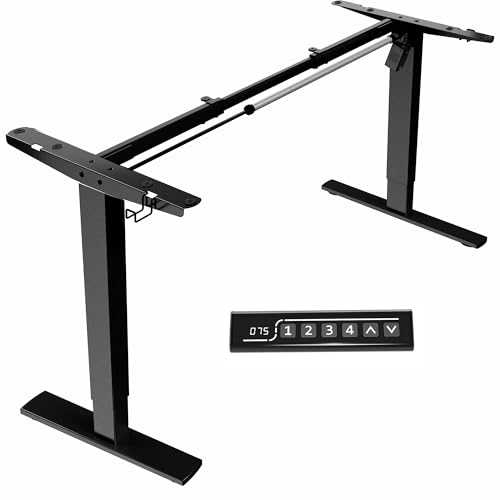
Vivo Electric Standing Desk - Best Budget
The Vivo Electric Standing Desk at delivers basic electric standing desk functionality. Dual motor (genuinely, not single motor masquerading), 176 lb capacity. 28-48 inch height range. Build quality is plastic-heavy in the controls and lighter steel frame than premium options. The 176 lb capacity handles single monitor + laptop setups but strains under heavier loads. For first-time standing desk buyers testing the format this is the right entry point.
Where it shines
- Active Workstation Legs: Designed for DIY tables, this ergonomic standing desk frame gives
- Compatibility: Recommended Tabletop Sizes
- Solid 220 lbs Support: All-steel construction and a sturdy 2-part column support system ho
- Electric Lift System: Strong, 2-piece telescopic legs create precise height adjustment, al
- Memory Controller: This simple push-button controller features 4 memory settings to save y
Branch Standing Desk Pro - Best for Premium Office
The Branch Standing Desk Pro targets premium office and home-office aesthetics. Solid walnut, oak, or maple top options look like furniture rather than office equipment. Quiet motor operation (40 dB during movement vs 50+ for cheaper desks). 300 lb capacity. 25-50 inch height range. The Branch ecosystem includes matching chairs and accessories. Trade-off vs Uplift V2-Commercial:+ premium pricing, smaller weight capacity.
Before you buy
What to consider
Match capacity to actual load. Add up monitors (15-30 lbs each), desktop computer (15-30 lbs), accessories (10-15 lbs total). Add 30% margin. Underrated desks sag and lift slowly.
What to consider
Dual motor for daily use. The speed and load difference vs single motor is meaningful for daily sit-stand transitions.
What to consider
Height range for your body and chair. Subtract chair seat height (17-19 inches typically) from total standing height range. Verify the minimum height accommodates your seated posture and the maximum accommodates standing eye level.
What to consider
Desktop size to your workflow. Single screen + laptop: 48-60 inches wide. Dual monitors: 60-72 inches. Triple or heavy accessories: 72+ inches.
What to consider
Build quality reflects in price. desks: 3-5 year typical lifespan. desks: 7-10 years. commercial-grade: 15+ years. Calculate cost per year of expected use.
What to consider
Stability at max height is the test cheap desks fail. Push the desk at full standing height - quality desks barely move; cheap desks wobble. If buying online, look at standing-height wobble in user reviews.
Quick answers
Dual motor desks lift faster (1.5-2.5 inches/second) and handle heavier loads (250-400 lbs) more reliably. Single motor desks are slower (1.0-1.5 in/sec) and lower capacity (150-220 lbs). For monitor-heavy setups, dual motor pays back.
For users 5'2"-6'4" inclusive, look for 22-48 inches height range. Taller users need 50+ inch max. Shorter users (under 5'2") need 22 inch minimum or shorter. The desk height plus monitor arm should reach standing eye level.
Yes for daily users. Manual crank desks are 30+ revolutions to fully raise/lower and tiring. Electronic lift with memory presets makes switching seamless. Most users who buy crank desks add an electronic upgrade within a year.
60 x 30 inches handles single monitor + laptop + workspace. 72 x 30 inches for dual monitors. 78+ inches for triple monitors or extensive accessories. Going smaller forces cramped workspace; going larger costs more and takes floor space.
Mixed evidence. Alternating between sitting and standing helps most back pain, but standing all day is worse than sitting all day. The benefit comes from movement and posture variation. A standing desk plus walking pad is more effective than just standing more.
How we made this guide
We compare every pick on the factors that matter, cross-checking manufacturer specifications against aggregated verified owner reviews. We rank independently and never take payment for placement. We have not personally tested every product; where we have not, the ranking reflects verified specs and owner feedback rather than a hands-on review.
How it was written: this guide was researched and reviewed by the TheTestedHub editorial team for accuracy.
Affiliate disclosure: TheTestedHub is reader-supported. When you buy through links on our site, we may earn a commission at no extra cost to you.
More to explore

10 Duvets We Actually Tested for Sleep and Budget

What to Buy: Best Desk Lighting 2026 for Every Budget

10 Air Purifier Filters Worth Buying in 2026

What’s the Best Cooling Mattress Pad?

Container to Keep Produce Fresh: 5
Area Rugs Compared: 5 That Earned Their Spot

Anti Fog Mirrors for Seniors and Travelers
