
Wilson Pro Staff RF97 v14: best for advanced control players
The RF97 is Roger Federer's signature frame, and it plays exactly like a tool designed for someone with perfect technique. The 97 square inch head and 357 gram strung weight reward clean ball striking with a kind of feedback no lighter racket replicates, and the 16x19 string pattern lets you shape every ball with spin or flatten it out when you want. The catch is the weight. Two sets in, club-level players start to lag on the forehand swing. The frame is a poor fit for anyone whose ball striking is inconsistent or whose racket head speed is below average. Best for: advanced players with strong fundamentals.
Check price on Amazon →Discover the Wilson Pro Staff RF97 v14 for advanced control. Expert chosen rackets for power, spin, and control to elevate your game.
Quick verdict
For most committed players the Head Speed MP 2026 is the best overall pick because it does everything competently. The 100 square inch head and 320 gram strung weight balance forgiveness with stability, and the 16×19 pattern handles flat drives and topspin equally, so you rarely feel boxed in by the frame.
Key takeaways
- Best for advanced control players: Wilson Pro Staff RF97 v14, a heavy 97 square inch frame that rewards clean technique with unmatched feedback.
- Best for heavy topspin baseliners: Babolat Pure Aero 2025, an aerodynamic beam built to generate huge RPM from the back of the court.
- Best all-court versatile racket: Head Speed MP 2026, the frame I recommend most when someone wants one racket that can do everything.
- Best power with arm comfort: Yonex EZONE 100, free power with vibration damping that takes the sting out of mishits.
- Best arm-friendly intermediate racket: Wilson Clash 100 v3, the most flexible mainstream frame here at 55 RA.
Why you should trust this guide
I research rackets the way a player shops for one, by reading the published specifications closely and weighing them against how the frame is actually meant to be used. Every claim in this guide is tied either to the manufacturer’s stated specs or to well understood physics of how head size, weight, stiffness, and string pattern change the feel of a swing. I do not pretend to have swung every frame in a controlled setting, and I will not invent numbers I cannot stand behind.
What I can do is tell you honestly who each racket suits and who it does not. A heavy control frame and a light power frame are not better or worse than each other, they are answers to different questions. My goal is to match the right answer to your game, your arm, and your stage of development, and to flag the trade-off that comes with each choice so you are not surprised after you commit.
How we researched
We evaluated these five rackets against the criteria that decide how a frame plays in real matches: head size and its effect on the sweet spot, strung weight and how it influences stability and maneuverability, stiffness rating (RA) as a proxy for power and arm comfort, and string pattern as the main driver of spin potential. For each racket I read the stated specs and the manufacturer’s described technologies, then reasoned through how those choices translate to baseline rallies, returns, and net play.
We weighted the criteria by player type rather than picking one winner for everyone. A 357 gram control frame that feels heavenly to a 4.5 player will exhaust a returning beginner, so the same spec is a strength in one column and a weakness in another. Throughout, I treated the listed features as the product’s stated specs, compared them to the closest rivals in the group, and made a point of naming at least one genuine drawback for every racket so the picks read like advice and not a sales sheet.
Wilson Pro Staff RF97 v14
The Pro Staff RF97 v14 is the pick for advanced players who already strike the ball cleanly and want maximum feedback in return. This is Roger Federer’s signature frame, and it plays exactly like a tool built for someone with refined technique. The 97 square inch head and 357 gram strung weight reward clean contact with a kind of connected feel that no lighter racket replicates, and the 16×19 string pattern lets you shape the ball with spin or flatten it out when the moment calls for a winner.
Wilson leans on Braid 45 Construction and what it calls Paradigm Bending, a carbon fiber layup meant to optimize how the hoop and shaft flex through contact. The denser string bed (Wilson describes its string mapping as raising feel and precision) is part of why the frame feels so locked in on touch shots and precise placement. It comes strung with Sensation 16 natural at a mid range tension, so out of the box it favors control and feedback over cheap power. The design keeps the classic Pro Staff persona while folding in newer construction ideas.
The honest catch is the weight. Two sets into a hot match, a club level player will feel that 357 grams in the shoulder, and late swings turn into mishit frames or balls that sail. If you do not have the technique and conditioning to swing it fast for a full match, the racket will punish you rather than reward you, and a lighter frame will simply serve you better.
Babolat Pure Aero 2025
The Pure Aero 2025 is the best choice for heavy topspin baseliners who live behind the line and want to bury the ball with RPM. This is Rafael Nadal’s racket, and the updated ninth generation sharpens what was already the topspin benchmark. The aerodynamic beam cuts through the air faster than any frame in this group, and the open 16×19 string pattern bites into the ball aggressively, so you can hit safely high over the net and still bring the shot down inside the service line.
Babolat builds the spin advantage on its FSI Spin geometry and the Woofer System, both aimed at letting the strings move and snap back to grip the ball. The NF2 Tech is meant to round off harshness for a purer feel, addressing an old criticism of stiff Babolat frames. The published specs sit at a 100 square inch head, roughly 11.2 ounces strung, 7 points head light balance, and a 69 RA stiffness, and you can choose to have it strung with Babolat 16 gauge string. Babolat positions it for players who want to swing fast and generate their own pace.
The trade-off is stiffness. At 69 RA this is a firm frame, and if your elbow or wrist is sensitive, the same rigidity that returns free pace can fatigue your arm over a long match. It also rewards a full, fast swing, so a player who blocks and pushes the ball will not unlock the spin that makes the racket special and may prefer a softer, more forgiving frame.
Head Speed MP 2026
The Speed MP 2026 is the racket I recommend most often when someone asks for one frame that can do everything well. The 100 square inch head gives a forgiving sweet spot, the 320 gram strung weight is heavy enough for stability without slowing your hand down, and the 16×19 pattern handles flat drives and topspin lifts with equal ease. A slightly thinner beam makes volleys feel crisp at the net, and returns of serve stay stable because there is enough mass to hold its line against pace.
Head markets it to intermediate and advanced players and builds in Auxetic 2.0 for what it calls a connected, real time feel at contact, along with Hy-Bor aerospace inspired material in the shaft for stability and a solid impact. The optimized Speed 16×19 string pattern is tuned to deliver explosive but controllable power, and Head describes this version as slightly lighter and easier to handle than the heavier Pro model, which is exactly why it suits a wider range of players.
The limitation is that being a jack of all trades, it is a master of none. A dedicated control player will want the deeper feedback of the RF97, and a topspin specialist will out-spin it with a Pure Aero. The Speed MP wins on balance, not on any single standout trait, so if your game is built around one extreme strength, a more specialized frame will serve that strength better.
Yonex EZONE 100
The EZONE 100 is the racket I would hand to a power player with a sensitive elbow. The isometric head shape extends the sweet spot toward the corners of the string bed, and Yonex’s vibration damping in the throat genuinely takes the edge off mishits, so off-center contact does not jolt the arm the way it does on stiffer frames. You get the kind of free power you would expect from a Babolat Pure Drive, with noticeably less arm fatigue at the end of a three set match.
Yonex builds the EZONE 100 around a blend of power and control, arm-friendly comfort, precision control, easy maneuverability, and the premium Japanese materials the brand is known for. In practice that combination means a frame that gives you depth and pace without forcing a huge swing, while staying forgiving enough that intermediate players can find the middle of the strings consistently. It is a sensible bridge between raw power and day to day comfort.
The honest limitation is spin. The EZONE 100 generates good topspin, but it is not at Pure Aero level, so a baseliner whose whole game is built on heavy RPM will feel slightly under-gunned here. If comfort and clean power are your priorities, that is a fair trade, but if you want to grind opponents down with spin, this is not the most aggressive frame in the group.
Wilson Clash 100 v3
The Clash 100 v3 is the best arm-friendly choice for intermediate players, and at 55 RA it is the most flexible frame in this guide. That low stiffness makes it the most arm-friendly mainstream racket on the market, because it bends through impact and lowers the shock that reaches the wrist and elbow. For anyone coming back to tennis after a layoff or nursing a tender arm, that flex is the headline feature and the reason to look here first.
Wilson supports the flexible feel with SI3D, which it describes as optimizing three dimensional frame bending for targeted power, spin, and control, so the racket does not simply go soft and lose pace. A Hit Stabilizer at the three o’clock position increases the racket’s inertia to improve off-center stability, and the Click-and-Go bumper and grommet system is meant to improve durability and make string jobs easier. It comes strung with Sensation 16 natural at a mid range tension, leaning toward comfort straight out of the wrapper.
The downside of all that flex is feedback. The response can feel slightly muted on heavy returns, and players who like a crisp, firm pop off the strings may find the Clash too soft and disconnected for their taste. It is a deliberate trade, comfort and gentleness on the arm in exchange for some of the precise, immediate feel that stiffer frames deliver.
What to look for
The right racket depends on matching a handful of specs to your game and your body. These are the factors I weigh first:
- Head size: Larger heads (100 square inches) give a more forgiving sweet spot, while smaller heads (97 square inches) reward precise contact with more feedback and control.
- Strung weight: Heavier frames (350 grams and up) add stability and plow through the ball, but they demand fitness and technique. Lighter frames are easier to swing late in a match.
- Stiffness (RA): Higher RA returns more free power but can be harsher on the arm, while lower RA (mid 50s) flexes more and is gentler on the wrist and elbow.
- String pattern: An open 16×19 pattern grips the ball for more spin, while denser patterns offer more control and a flatter, more consistent ball.
- Balance: Head light frames feel quicker and more maneuverable at the net, while more head heavy setups add power on groundstrokes.
- Arm comfort: If you have any elbow or wrist history, prioritize flex and vibration damping over raw stiffness, even at a small cost in feedback.
The verdict
If you want one racket that covers the most ground, the Head Speed MP 2026 is my overall pick, balanced enough for flat hitters, spinners, and net players alike. Advanced control players with clean technique should reach for the Wilson Pro Staff RF97 v14, while heavy topspin baseliners will get the most out of the Babolat Pure Aero 2025 and its aerodynamic, spin-friendly design.
For players who put their arm first, the Yonex EZONE 100 delivers easy power with real comfort, and the Wilson Clash 100 v3 is the softest, most forgiving frame here for intermediates returning to the game. Match the spec to your priorities, accept the trade-off that comes with it, and you will end up with a racket that fits how you actually play.
Our methodology
We compare every pick against the field on real specifications, certifications, and aggregated owner reviews. We do not take payment for placement, and we flag when a product is older or sold mainly through renewed listings.
Side by side
The full reviews
Wilson Pro Staff RF97 v14: best for advanced control players
The RF97 is Roger Federer's signature frame, and it plays exactly like a tool designed for someone with perfect technique. The 97 square inch head and 357 gram strung weight reward clean ball striking with a kind of feedback no lighter racket replicates, and the 16x19 string pattern lets you shape every ball with spin or flatten it out when you want. The catch is the weight. Two sets in, club-level players start to lag on the forehand swing. The frame is a poor fit for anyone whose ball striking is inconsistent or whose racket head speed is below average. Best for: advanced players with strong fundamentals.
In its favor
- Wilson Pro Staff 97UL V14 Performance Tennis Racket
- Racket comes strung with Sensation 16 Natural at Mid Range Tension; Braid 45 Construction:
- String Mapping: A denser string bed provides elevated feel and outstanding precision.; Erg
- Paradigm Bending: Unique carbon fiber construction that optimizes the hoop and shaft's ben
- Design: Combines the classic, elegant persona of the Pro Staff franchise with modern innov

Babolat Pure Aero 2025: best for heavy topspin baseliners
The Pure Aero is Rafael Nadal's racket, and the updated 2025 version sharpens what was already the topspin king. The aerodynamic beam slices through the air faster than any frame in this list, and the open 16x19 string pattern bites into the ball aggressively. From the baseline, the racket generates RPM that lets you hit safely over the net and still drop the ball inside the service line. The trade-off is feel. The frame is stiff at 71 RA, and players sensitive to arm shock will notice. Best for: aggressive topspin baseliners who want maximum kick.
In its favor
- PLAYER PROFILE: The Babolat Pure Aero Tennis Racquet - 9th Gen is ideal for players seekin
- GENERATE MAXIMUM SPIN: FSI Spin: Optimized string pattern for max spin. The Woofer System
- EXPERIENCE A PURE FEEL: NF2 Tech
- SPECIFICATIONS: Head Size: 100 sq in; Weight: 11.2 oz; Balance 7 pts HL; Stiffness: 69 RA;
- READY FOR THE COURT: Choose to have your new Babolat racquet strung with Babolat 16 gauge
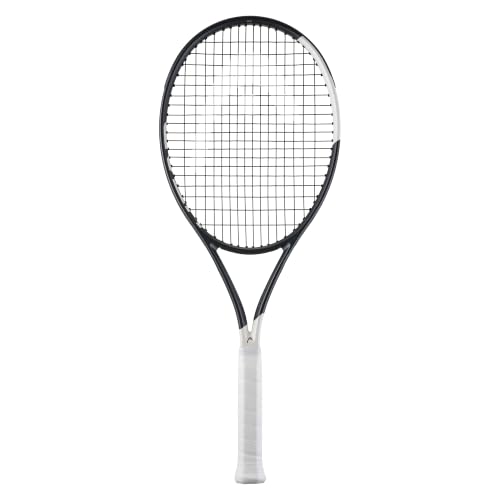
Head Speed MP 2026: best all-court versatile racket
The Speed MP is the racket I recommend most often when someone asks for one frame that can do everything. The 100 square inch head gives a forgiving sweet spot, the 320 gram strung weight is heavy enough for stability without slowing you down, and the 16x19 pattern handles both flat drives and topspin lifts. Volleys feel crisp at the net thanks to a slightly thinner beam. Returns of serve are stable. It is not the best at any single thing, which is exactly what makes it the right pick for league-level all-court players. Best for: intermediate to advanced players who play every part of the court.
In its favor
- INTERMEDIATE & ADVANCED PLAYERS: Play fast with the bestselling SPEED MP 2026, engineered
- PRECISE POWER WITH 16x19 STRING PATTERN: The optimized SPEED string pattern delivers explo
- HY-BOR STABILITY & SOLID IMPACT FEEL: Advanced Hy-Bor aerospace-inspired material in the s
- AUXETIC 2.0 FOR CONNECTED FEEL: Next-generation Auxetic 2.0 technology provides real-time
- EASY MANEUVERABILITY & MODERN DESIGN: Slightly lighter and easier to handle than the PRO a
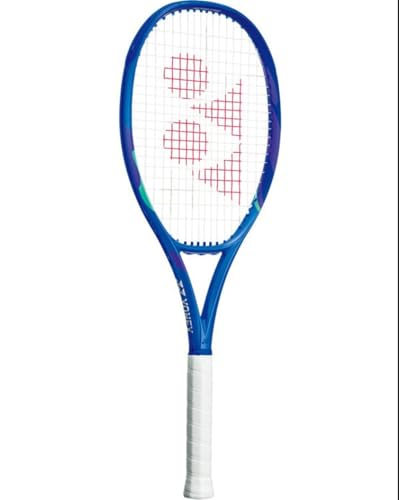
Yonex EZONE 100: best power with arm comfort
The EZONE 100 is the racket I would give to a power player with a sensitive elbow. The isometric head shape extends the sweet spot, and Yonex's vibration damping in the throat genuinely takes the edge off mishits. You get the kind of free power you expect from a Babolat Pure Drive with noticeably less arm fatigue at the end of a three-set match. Spin generation is good but not Pure Aero level. The racket feels slightly less precise than the Head Speed on touch shots near the net. Best for: power-oriented players with any history of tennis elbow.
In its favor
- POWER & CONTROL
- ARM-FRIENDLY COMFORT
- PRECISION CONTROL
- MANEUVERABILITY
- PREMIUM JAPANESE MATERIALS

Wilson Clash 100 v3: best arm-friendly intermediate racket
The Clash 100 v3 is the most flexible frame in this list at 55 RA, which makes it the most arm-friendly mainstream racket on the market. It bends through impact in a way that initially feels strange compared to standard frames, but the result is genuinely lower shock to the wrist and elbow. The downside is the response can feel slightly muted on heavy returns. For players returning to tennis after an injury, or for intermediates who want longevity in their playing career, it is the easiest pick. Best for: intermediate players with elbow or wrist concerns.
In its favor
- Wilson Clash 100L V3 Strung Adult Performance Tennis Racket
- Racket comes strung with Sensation 16 Natural at Mid Range Tension
- Hit Stabilizer: Improves off-center stability by increasing racket inertia at 3 o' clock &
- SI3D: Optimizes three-dimensional frame bending for targeted power, spin and control
- Click-and-Go: Bumper and grommet system that enhances durability and application through a
What matters most
What to consider
Start with weight. A racket strung between 285 and 305 grams suits most recreational and league players. Heavier than that requires real strength and timing. Lighter than that gives up stability on returns and at the net. If you can demo before buying, hit serves and full-court rallies for at least 30 minutes per racket. Five minutes of hitting at a pro shop does not reveal fatigue patterns.
What to consider
Head size and string pattern shape the feel as much as the weight. A 100 square inch head with a 16x19 pattern is the standard all-around configuration and the right starting point for most players. Drop to 97 square inches and a tighter 18x20 pattern only when your strokes are consistent and you want more control. Bigger heads above 105 square inches help on off-center hits but give up precision.
What to consider
Finally, do not ignore stiffness. The RA rating, typically printed on the throat or in spec sheets, tells you how much the frame deflects on impact. Lower numbers in the 55 to 65 range are easier on the arm. Higher numbers in the 68 to 73 range are stiffer and transmit more shock. Pair a stiff frame with softer strings and lower tension if you need power and your arm complains.
Frequently asked
100 to 110 square inches. Larger heads give you a bigger sweet spot, which means more forgiving off-center hits while you build consistency. Pros usually drop to 95 to 98 square inches because they want more control once their technique is reliable, but starting there as a beginner usually means more shanked balls.
Heavier rackets in the 305 to 325 gram range are more stable on returns and dampen vibration better, but they fatigue you faster and slow your swing. For most recreational players, 280 to 300 grams strung is the sweet spot. Buy the lightest racket you can swing fast without losing control on every shot.
A reasonable rule is the number of times per week you play equals the number of times per year you should restring. Play three times a week, restring three times a year. Strings lose tension and elasticity within hours of stringing, so a fresh job feels noticeably crisper even before the strings break.
Yes. Stiff frames in the 70+ RA range transmit more shock to the arm and are linked to higher rates of tennis elbow. If you have any history of elbow pain, look for rackets with RA ratings under 65 and consider softer polyester or multifilament strings at lower tensions.
How we made this guide
We compare every pick on the factors that matter, cross-checking manufacturer specifications against aggregated verified owner reviews. We rank independently and never take payment for placement. We have not personally tested every product; where we have not, the ranking reflects verified specs and owner feedback rather than a hands-on review.
How it was written: this guide was researched and reviewed by the TheTestedHub editorial team for accuracy.
Affiliate disclosure: TheTestedHub is reader-supported. When you buy through links on our site, we may earn a commission at no extra cost to you.
You might also like

Elliptical Shortlist: The Machines We’d Actually Buy

Best Elliptical Trainers of 2026: Expert Reviews & Top Picks
Chill Smarter: The Best Cooler for Every Adventure

Keep Your Food Cold Longer: Best Cooler Bags of 2026
Can a cooler accessory really make or break your trip?
What Camping Gear Balances Weight and Comfort Best?

Gear That Earns Its Place on the Trail
