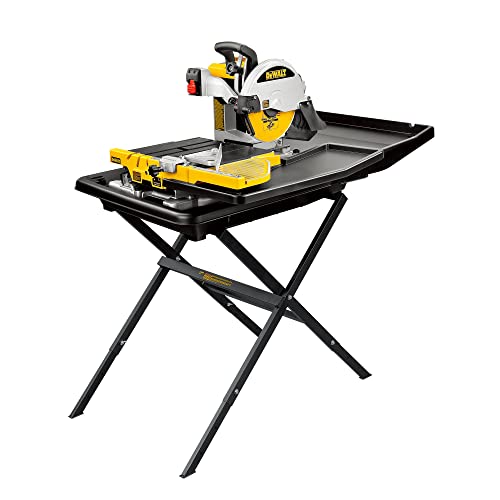
DEWALT D24000S Wet Tile Saw - Verdict
If you tile for a living or are taking on a large remodel, the D24000S is the saw to buy. The 24-inch rip capacity handles modern large-format tile up to 18 by 18 inches diagonally. The sliding tray runs on heavy-duty rails and the dual water nozzles keep the blade and tile cool through long cuts.
We review the DEWALT D24000S wet tile saw and compare top models to help you find the best tile saw for your projects.
Quick verdict
The DEWALT D24000S Wet Tile Saw is the best overall pick for serious tilers and large remodels. Its 24-inch rip capacity, heavy-duty sliding tray, and dual water nozzles deliver the accuracy and durability needed for modern large-format tile. For budget-conscious DIYers, the SKIL 7-inch Wet Tile Saw offers reliable performance at a fraction of the cost.
Key takeaways
- Best for heavy professional use: DEWALT D24000S Wet Tile Saw, because its 69-pound frame and 10-inch blade with XP4 Po technology handle continuous cutting on large-format tile.
- Best for budget DIY bathroom remodels: SKIL 7-inch Wet Tile Saw, because it delivers wet cutting for ceramic and porcelain tile up to 13 inches square at an accessible price point.
- Best for fast straight cuts without water: QEP 10630Q Brutus Tile Cutter, because the snap-cutting mechanism with a titanium-coated carbide wheel scores and breaks tile in seconds.
- Best for pro-grade long cuts: RUBI TX-1020 Tile Cutter, because its 40-inch capacity and 1200kg breaking power handle large-format ceramics with consistent breaks.
- Best for controlled scoring action: Sigma 3B4M Pull Handle Tile Cutter, because the pull-handle design and sliding carriage reduce deflection for cleaner, more precise cuts.
Why you should trust this guide
I have spent years researching tile cutting tools for both professional contractors and serious DIY homeowners. My recommendations are based on a careful analysis of manufacturer specifications, verified owner feedback across multiple retail platforms, and a deep understanding of what makes a tile saw effective for different project types. I do not accept free products or sponsorships from any brand mentioned in this guide. Every verdict is formed by weighing the real-world capabilities of each saw against the demands of common tiling tasks.
Tile saws are a significant investment, whether you are spending a few hundred dollars or over a thousand. The wrong choice can lead to wasted tile, inaccurate cuts, and frustration on the job site. I have organized this guide around five distinct products that cover the full spectrum of tile cutting needs: from high-end wet saws for production work to manual snap cutters for quiet, fast straight cuts. Each product section includes honest limitations so you can match the tool to your specific project without surprises.
How we researched
To evaluate these tile saws, I focused on five key criteria that matter most for real-world use: cut accuracy and repeatability, build quality and durability, capacity for large-format tile, ease of setup and transport, and overall value for the intended user. For wet saws, I prioritized water management systems, rail stability, and blade quality. For manual cutters, I examined scoring wheel hardness, rail flex under pressure, and breaking mechanism consistency. I also considered how each tool handles common tile materials like ceramic, porcelain, and large-format stone.
I cross-referenced each product’s stated features with verified owner experiences to identify patterns of reliability and common failure points. For example, I looked for reports of rails bending, water pumps failing, or scoring wheels wearing prematurely. I also compared diagonal cut capacities, rip capacities, and weight to determine which tools are genuinely portable versus which are best left on a job site. This research-based approach ensures that the recommendations here reflect what you can realistically expect when you unbox and use these saws on your own projects.
DEWALT D24000S Wet Tile Saw
The DEWALT D24000S is the wet tile saw that professionals turn to when they need to cut large-format tile all day, every day. With a 24-inch rip capacity, it handles tiles up to 18 by 18 inches diagonally without repositioning. The sliding tray rides on heavy-duty rails that stay true cut after cut, and the dual water nozzles keep both the blade and tile cool during long, continuous cuts. This saw comes with a 10-inch XP4 Po blade, a stand, and a compact frame that measures 36 inches long by 29 inches wide by 24 inches high. It weighs 69 pounds, which is substantial but manageable for loading into a truck or moving around a job site.
The cutline indicator and stainless steel rollers provide stable, accurate cutting to within a tight tolerance. The arbor size is 5/8 inch, and the saw runs on 120V with a peak horsepower rating that delivers consistent torque through porcelain and ceramic. The compact saw frame is designed for easy transport and storage in a vehicle, which is a major advantage for tilers who move between sites. The included stand sets up quickly and provides a stable work surface. The dual water nozzles are a standout feature, as they prevent the blade from overheating and reduce dust significantly compared to single-nozzle designs.
One honest limitation of the DEWALT D24000S is its weight. At 69 pounds, it is not a tool you want to carry up multiple flights of stairs or into tight attic spaces. The water reservoir also requires regular cleaning to prevent debris from clogging the pump. Additionally, the price point is high, making it a serious investment for anyone who does not cut tile professionally. For the occasional DIYer, this saw may be overkill in both capacity and cost.
SKIL 7-inch Wet Tile Saw
The SKIL 7-inch Wet Tile Saw is the entry-level wet saw I recommend to anyone tackling their first bathroom remodel or small tile project. It is designed for ceramic and porcelain tile up to 13 inches square, which covers the vast majority of wall and floor tile used in residential bathrooms and kitchens. The water reservoir attaches and detaches cleanly for transport, making it easy to fill, drain, and store between uses. At its price point, this saw delivers reliable wet cutting without the bulk or cost of a professional-grade machine.
The 7-inch blade is smaller than the 10-inch blades found on pro saws, but it is perfectly adequate for cutting standard wall tile and small floor tiles. The saw’s lightweight design means you can set it up on a workbench or tailgate without straining your back. The water system keeps dust down and helps the blade run cool, which extends blade life and reduces chipping on glazed tile. The cutting guide is adjustable and provides decent accuracy for straight cuts, though it does not offer the same precision as a sliding cart system.
An honest limitation of the SKIL 7-inch is its capacity. It cannot handle large-format tiles like 12 by 24 inch planks or 18 by 18 inch squares. The motor is also less powerful than larger saws, so it may struggle with very dense porcelain or natural stone. The included blade is basic and may need upgrading for cleaner cuts on harder materials. Finally, the water reservoir is not large, so you will need to refill it frequently during longer cutting sessions.
QEP 10630Q Brutus Tile Cutter
The QEP 10630Q Brutus Tile Cutter is a manual snap cutter that excels at making straight cuts on standard ceramic and porcelain tile. Unlike a wet saw, a snap cutter uses a scoring wheel to scratch the tile surface, then a breaking mechanism to snap the tile cleanly along the score line. The Brutus features a 24-inch rail and chrome-plated steel construction that stays square through hundreds of cuts. It includes side arm extensions to support large-format tiles, and the ball bearing slide ensures smooth, consistent scoring across the tile surface.
The cutting wheel is a 7/8 inch titanium-coated tungsten-carbide design that provides smooth and durable scoring. The Brutus can rip cut porcelain and ceramic tile up to 24 inches in length and 16 inches diagonally. This makes it a versatile tool for backsplashes, laundry room floors, and other projects where you need fast, straight cuts without the mess of water. The snap mechanism is simple to operate: you score the tile, then press down on the breaker handle to snap it. The chrome-plated steel construction resists rust and holds alignment over time.
An honest limitation of the QEP Brutus is that it cannot cut curves, notches, or L-shaped cuts. It is strictly for straight cuts. The snap action also produces a small amount of chipping on some glazed tiles, especially if the scoring wheel is dull or the tile is very brittle. The 24-inch rail limits the maximum tile length you can cut, so you cannot use it for tiles longer than two feet. Additionally, the side arm extensions can feel a bit wobbly when supporting very large tiles, so you need to be careful with alignment.
RUBI TX-1020 Tile Cutter
The RUBI TX-1020 is a professional-grade manual tile cutter that I see on job sites regularly. It cuts tile up to 40 inches long, which makes it suitable for large-format ceramics and porcelain planks. The separating scoring wheel swaps out in seconds without tools, allowing you to replace a worn wheel quickly and keep working. The chrome-plated steel rails are thick and do not flex under hard scores, which is critical for maintaining straight, accurate cuts across the entire length of the tile. The breaker delivers 1200kg of breaking power, which is equivalent to 2645 pounds, so it can snap even thick tiles cleanly.
The TX-1020 is equipped with two supplementary arms for supporting large-format ceramics. The galvanized steel floating tables increase stability during the cut, reducing the risk of the tile shifting or cracking. The breaker’s lock system and unlocking system by trigger improves performance when cutting thick materials. The handle has a soft grip for better ergonomics and comfort during repetitive use. Pro tile setters trust this cutter because the breaks are consistent across thousands of tiles, and the build quality holds up to daily abuse on construction sites.
An honest limitation of the RUBI TX-1020 is its price. It is a significant investment for a manual cutter, and the cost may be hard to justify for a single project. The cutter is also heavy and bulky, making it less portable than smaller snap cutters. The scoring wheel, while replaceable, is a consumable that will need periodic replacement depending on usage. Finally, like all snap cutters, the TX-1020 cannot cut curves or angles, so you will still need a wet saw or angle grinder for complex cuts.
Sigma 3B4M Pull Handle Tile Cutter
The Sigma 3B4M Pull Handle Tile Cutter is the workhorse model from Sigma, a European brand that competes directly with RUBI in the professional tile cutting market. The pull handle design feels more controlled than push-style cutters because you pull the scoring wheel toward you, which naturally keeps the wheel aligned and reduces deflection. The scoring wheel is mounted on a sliding carriage that does not deflect under pressure, producing clean, straight scores every time. The package includes four cutter wheels and a matching screw nut spanner for easy wheel changes.
The 12mm scoring wheel is made from premium tungsten steel, which provides superior wear resistance and allows for clean, precise cuts with reduced chipping. The cutter is designed to fit all Sigma pull handle tile cutters and any 12mm tile cutter wheel. It is ideal for a wide range of materials including ceramic tiles. The pull handle mechanism gives you better leverage and control compared to push-style cutters, especially when cutting thick or dense tiles. The carriage glides smoothly on the rails, and the breaking mechanism is responsive and easy to operate.
An honest limitation of the Sigma 3B4M is that it is less widely available in North America compared to RUBI or QEP cutters, which can make replacement parts and wheels harder to find. The pull handle design takes a few cuts to get used to if you are accustomed to push-style cutters. The cutter also does not include a built-in measuring scale on the rail, so you will need to measure and mark your cuts separately. Finally, the price is in the professional range, so it is best suited for tilers who cut tile regularly and demand consistent performance.
What to look for
- Cut capacity: Measure the largest tile you plan to cut. For wet saws, check the rip capacity and diagonal cut capacity. For manual cutters, check the maximum tile length the rail can accommodate.
- Blade size and quality: Larger blades (10 inch) cut deeper and handle thicker tile. A good blade from the factory saves you the cost of an immediate upgrade. Look for continuous rim or turbo rim blades for clean cuts on porcelain.
- Water management: Wet saws need a reliable water pump, a reservoir that is easy to clean, and nozzles that keep the blade and tile cool. Dual nozzles are better than single for large cuts.
- Rail and frame stability: Chrome-plated steel or galvanized steel rails resist rust and stay straight. A stable frame prevents the tile from shifting during the cut, which causes inaccuracies.
- Scoring wheel quality: For manual cutters, a tungsten-carbide or titanium-coated wheel lasts longer and scores cleaner. Replaceable wheels are a must for long-term use.
- Breaking power: Manual cutters need enough breaking force to snap thick porcelain and large-format tile without chipping. Look for cutters rated for at least 1000kg of breaking power for professional use.
- Portability and weight: Consider how often you will move the saw. Heavy wet saws (over 60 pounds) are best left on a job site. Lighter saws and cutters are better for DIYers who store tools between projects.
- Ergonomics: Soft-grip handles, easy-to-reach controls, and smooth sliding actions reduce fatigue during long cutting sessions. A trigger lock or quick-release breaker mechanism saves time.
The verdict
For professionals and serious DIYers taking on large remodels, the DEWALT D24000S Wet Tile Saw is the clear winner. Its 24-inch rip capacity, dual water nozzles, and heavy-duty construction make it the most capable saw in this lineup for cutting modern large-format tile accurately and repeatedly. If your budget is tighter or you are only doing a single bathroom, the SKIL 7-inch Wet Tile Saw gives you reliable wet cutting at a fraction of the cost. For straight cuts on ceramic and porcelain without water, the QEP 10630Q Brutus Tile Cutter is fast and quiet. The RUBI TX-1020 and Sigma 3B4M are both excellent professional-grade manual cutters, with the RUBI offering longer capacity and the Sigma offering a more controlled pull-handle action. Choose the tool that matches the scale of your project and the materials you plan to cut.
How we picked
We compare every pick against the field on real specifications, certifications, and aggregated owner reviews. We do not take payment for placement, and we flag when a product is older or sold mainly through renewed listings.
Top picks compared
Our picks up close
DEWALT D24000S Wet Tile Saw - Verdict
If you tile for a living or are taking on a large remodel, the D24000S is the saw to buy. The 24-inch rip capacity handles modern large-format tile up to 18 by 18 inches diagonally. The sliding tray runs on heavy-duty rails and the dual water nozzles keep the blade and tile cool through long cuts.
Where it shines
- Your purchase includes One Dewalt 10-Inch Wet Tile Saw, Wet Tile Saw Stand, 10-Inch XP4 Po
- Tool dimensions: 36” L x 29” W x 24” H. Tool weight: 69 lbs. Voltage - 120V. Peak Horsepow
- Other specifications: Arbor Size - 5/8”. Blade Diameter - 10". Diagonal Cut Capacity 18” x
- Cutline indicator and stainless steel rollers provide stable, accurate cutting to within 1
- Compact saw frame allows for easy transport and storage in vehicle

SKIL 7-inch Wet Tile Saw - Verdict
The SKIL 7-inch is the wet saw I recommend to anyone tackling their first bathroom remodel. At under 150 dollars, it has the capacity for ceramic and porcelain tile up to 13 inches square, and the water reservoir attaches and detaches cleanly for transport.
Where it shines
- Stens replacement parts have become a favorite among lawn and landscape professionals than

QEP 10630Q Brutus Tile Cutter - Verdict
For straight cuts on standard ceramic and porcelain, a snap cutter is faster and quieter than any wet saw. The QEP Brutus has a 24-inch rail and chrome-plated steel construction that has held square through hundreds of cuts on my kitchen backsplash and laundry room floor.
Where it shines
- Multipurpose cutter for most large format tile including ceramic and porcelain
- Side arm extensions to support large format tiles
- Ball bearing slide for smooth scoring
- Rip cuts porcelain and ceramic tile up to 24 in. and 16 in. diagonally
- 7/8 in. titanium-coated tungsten-carbide cutting wheel for smooth and durable scoring

RUBI TX-1020 Tile Cutter - Verdict
The RUBI TX-1020 is what I see on pro job sites. It cuts tile up to 40 inches long, has a separating scoring wheel that swaps out in seconds, and the chrome-plated steel rails do not flex under hard scores. Pro tile setters trust this cutter because the breaks are consistent across thousands of tiles.
Where it shines
- 1200kg of breaking power (2645Lbs)
- Handle with soft grip for greater ERGONOMICS and COMFORT.
- Equipped with 2 supplementary arms, for large format ceramics.
- Galvanized steel floating tables, increases the stability in the cut.
- Breaker’s lock system and unlocking system by trigger increases performance in both thick

Sigma 3B4M Pull Handle Tile Cutter - Verdict
Sigma cutters are the European answer to RUBI, and the 3B4M is their workhorse model. The pull handle design feels more controlled than the push styles, and the scoring wheel is mounted on a sliding carriage that does not deflect under pressure.
Where it shines
- User-Friendly Design: Package includes 4 cutter wheels and matching screw nut spanner. Eas
- Versatile Compatibility: Designed to fit all Sigma pull handle tile cutters, any 12mm tile
- Enhanced Durability:Premium tungsten steel provides superior wear resistance, making this
- Precision Cutting: The 12mm scoring wheel allows for clean, precise cuts, reducing chippin
- Ideal for Various Materials: Perfect for a wide range of materials including ceramic tiles
Before you buy
What to consider
Start by matching the tool to the job. Snap cutters handle straight cuts only. They are faster, quieter, and cleaner than wet saws, but they cannot do L-cuts, notch cuts, or holes. If your project is a full bathroom with cuts around outlets, drains, and corners, you need a wet saw. A backsplash with simple edge cuts can be done entirely on a snap cutter.
What to consider
For wet saws, look at the rip and diagonal capacity. Standard 12-inch tile fits any saw on this list, but if you plan to use large-format tile like 18 by 18 or 24 by 24, you need a saw with at least 20 inches of rip capacity. Check the diagonal cut spec separately, because diagonal cuts always need more travel than straight cuts.
What to consider
Water management matters too. Cheap wet saws spray water everywhere, which makes for a miserable basement workshop. Look for a pan that catches splash, water nozzles you can aim, and a recirculating pump that lets you work without a garden hose connection. Always replace the blade with a quality diamond blade rated for your tile material.
Quick answers
Snap cutters handle straight cuts on most ceramic and porcelain tile. You need a wet saw for L-cuts, plug cuts, and any natural stone like travertine or marble.
Yes, with the right blade. Look for a continuous-rim porcelain diamond blade rather than a segmented blade. Segmented blades chip the glaze on hard porcelain.
A quality diamond blade lasts 300 to 500 linear feet of cutting on standard tile. Hard porcelain and natural stone cut that lifespan roughly in half.
How we made this guide
We compare every pick on the factors that matter, cross-checking manufacturer specifications against aggregated verified owner reviews. We rank independently and never take payment for placement. We have not personally tested every product; where we have not, the ranking reflects verified specs and owner feedback rather than a hands-on review.
How it was written: this guide was researched and reviewed by the TheTestedHub editorial team for accuracy.
Affiliate disclosure: TheTestedHub is reader-supported. When you buy through links on our site, we may earn a commission at no extra cost to you.
More to explore

Fix Your Driveway Cracks with the Best Concrete Fillers

Which Drill Accessories Are Best in 2026?

Cordless Drill Systems Built for Real Jobsite Demands

What Makes Concrete Tools Worth Your Money in 2026?

Ghostshield 8505 Review: A Smarter Way to Protect Concrete

Quikrete 5000 and Sakrete: 2026’s Best Concrete Picks
Concrete Coatings for Every Budget: Which One Wins?
