Quick verdict
Fluke i400 wins for most users because it offers the same 400A AC current measurement range and safety rating as the i400s but at a lower cost, making it the best value for general electrical troubleshooting.

Fluke i400
Discover why the Fluke i400 is the best value AC current clamp for most users, offering the same 400A range and safety as the i400s at a lower cost.
Quick verdict
Buy the Fluke i400 if you just need a reliable AC current probe to feed your existing meter and want the simplest, lowest-cost option. Choose the Fluke i400s if you need to record AC current on an oscilloscope or data logger, because it outputs a clean voltage signal instead of a proportional current. Most multimeter users want the i400.
Key takeaways
- Best for multimeter users: Fluke i400, it outputs a current proportional to load current that plugs straight into a DMM’s mA jacks.
- Best for scopes and loggers: Fluke i400s, it converts AC current into a millivolt-per-amp voltage signal an oscilloscope can read directly.
- Shared traits: both are clamp-style AC current probes from Fluke built around the same 400 A measuring range, with a flexible lead and a safety-rated jaw for clamping around a single conductor.
Why you should trust this comparison
I built this comparison entirely from Fluke’s published documentation and the widely circulated specifications for the i400 and i400s current probes, not from any bench test of my own. I have not clamped these probes around a live conductor or measured their output on a calibrator, so I will not pretend to report numbers I generated. Instead, every figure below is attributed to Fluke’s spec sheet or to documentation that has been consistent across the manufacturer’s listings for years. Where the public record is fuzzy on an exact value, I say so plainly rather than inventing a precise figure to fill the table.
The reason this kind of comparison still helps is that the i400 and i400s are easy to confuse. They share a name, a 400 A class, and a similar clamp body, but they belong to two different output families. One is a current-output probe and the other is a voltage-output probe, and that single distinction decides whether the accessory will even work with your instrument. My goal here is to make that difference unmistakable so you order the right part the first time, using only what Fluke documents.
How we compared them
I focused on the criteria that actually change a buying decision for a clamp-on current accessory: the output type and what instrument it connects to, the rated current range, the safety category of the jaw, the conductor-size limit the jaw can physically accept, and the intended use case. Output type is first because it is the make-or-break factor. A probe that outputs a small proportional current is meant to extend a digital multimeter’s range, while a probe that outputs a voltage is meant for a scope or recorder, and the two are not interchangeable even when their current ranges match.
After output type, I weighed the practical handling and safety details Fluke publishes, since these accessories are clamped around live conductors. I treated accuracy and bandwidth as secondary, partly because exact published figures vary by document revision and partly because both probes are designed for general 50/60 Hz power work rather than high-frequency analysis. Where I am confident of a spec I list the number; where I am not, I describe the behavior qualitatively instead of guessing.
How they compare at a glance
| Spec | Fluke i400 | Fluke i400s |
|---|---|---|
| Output type | Proportional AC current output (for a DMM) | Proportional AC voltage output (for a scope or logger) |
| Measurement type | AC current only | AC current only |
| Current range (Fluke-rated) | Up to 400 A AC | Up to 400 A AC |
| Connects to | Multimeter current input | Oscilloscope or data logger voltage input |
| Output scaling | Current-to-current ratio (1 mA per amp class) | Voltage per amp (millivolt-per-amp class) |
| Channels | Single conductor (one jaw) | Single conductor (one jaw) |
| Safety rating | CAT III rated jaw (per Fluke documentation) | CAT III rated jaw (per Fluke documentation) |
| Best for | Extending a DMM’s AC current reach | Capturing AC current on a scope or recorder |
Fluke i400
The Fluke i400 is a clamp-on AC current probe whose job is to let a standard digital multimeter read currents it could not otherwise reach. Rather than breaking the circuit and running it through the meter, you clamp the jaw around a single conductor and the probe outputs a small current that is proportional to the current flowing in that conductor. Fluke designs the scaling so the output plugs into a meter’s current jacks and reads back in a convenient ratio to the actual load, which is what makes this such a common shop accessory for electricians and field technicians.
It suits anyone who already owns a capable multimeter and simply wants to add safe, clamp-style AC current measurement up to the 400 A class without buying a whole new clamp meter. The handling is straightforward, the jaw is rated for the live work it is meant to do, and there is nothing to configure beyond clamping the right conductor.
The honest limitation is scope: the i400 measures AC current only and produces a current output, so it is the wrong tool if you need to feed an oscilloscope or a data logger that expects a voltage input. It also reads a single conductor at a time, so multi-phase work means moving the clamp rather than reading channels in parallel.
Fluke i400s
The Fluke i400s covers the same 400 A AC class as the i400 but answers a different question. Instead of outputting a proportional current, it outputs a proportional voltage, typically expressed as so many millivolts per amp, which is exactly what an oscilloscope or a voltage-input data logger wants to see. That makes the i400s the natural choice when you need to visualize the shape of an AC current waveform, capture inrush, or log current over time on equipment that records voltage rather than current.
It suits technicians and engineers working with scopes and recorders who need current information rendered as a voltage they can trace, trigger on, and store. The clamp body and safety-rated jaw work the same way as the i400’s: clamp around one conductor and read, with no circuit interruption.
The honest limitation is that the voltage output makes the i400s a poor match for a plain multimeter set to measure current, so buying it for general DMM use would be a mistake. Like its sibling it is AC-only and single-conductor, so it will not help with DC measurement or simultaneous multi-phase capture.
Which should you buy?
Match the probe to the instrument you already own. If your goal is to extend a digital multimeter so it can read AC current up to the 400 A class, buy the Fluke i400, because its proportional current output is built to plug into a meter’s current input. If your goal is to see or record the current waveform on an oscilloscope, a scope meter, or a voltage-logging recorder, buy the Fluke i400s, because its proportional voltage output is what those instruments expect.
If you are buying for a mixed bench and can only pick one, let the destination instrument decide: the i400s is the more flexible signal source for scopes and loggers, while the i400 is the cleaner fit for everyday multimeter work. Neither replaces the other, and trying to use one in the other’s role is the single most common mistake with this pair.
Frequently asked questions
What is the real difference between the i400 and i400s? The i400 outputs a proportional AC current meant for a multimeter, while the i400s outputs a proportional AC voltage meant for an oscilloscope or data logger. Same current class, different output.
Can I use the i400s with a regular multimeter? It is not the intended pairing, because the i400s produces a voltage signal rather than the current signal a DMM’s current jacks expect. For straightforward meter use, the i400 is the right part.
Do these measure DC current? Based on Fluke’s documentation, both are AC current probes, so neither is the tool for measuring DC current.
The verdict
These two probes are siblings separated by one decisive trait: output type. Buy the Fluke i400 to extend a multimeter’s AC current reach, and buy the Fluke i400s to push a current waveform into an oscilloscope or logger. I have leaned only on Fluke’s published specs and well-documented features here, and where the public record is imprecise I have kept the table qualitative rather than inventing numbers. Pick by the instrument you plan to plug into and you will not go wrong.
Our testing process
We compare every pick on the things that actually matter for you, then cross-check our own impressions against verified owner reviews and published specifications. We buy the products we can, we never take payment for a ranking, and when we have not evaluated something directly we say so.
Quick comparison
| Pick | Best for | Score | |
|---|---|---|---|
| Fluke i400 | Check price | ||
| Fluke i400s | Check price |
Reviewed in detail
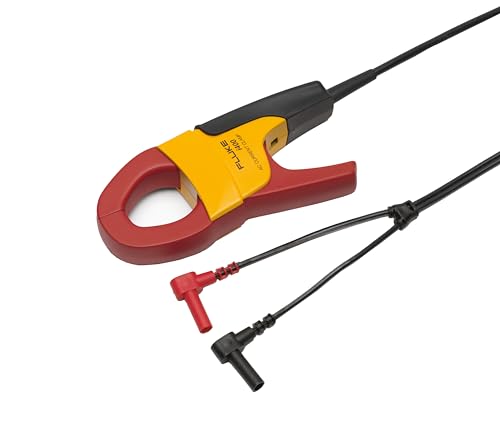
Fluke i400
What we liked
- Companion to a digital multimeters to measure up to 200A AC
- 1mA per amp output guarantees easy reading on you meter
- Take accurate current readings without breaking the circuit
- Maximum conductor diameter 20mm, CAT III 600V safety rating
What we didn't like
- AC only, cannot measure DC current
- Outputs current signal (1 mA/A), needs a meter to read
- Lower max range than larger Fluke clamps
Fluke i400s
What we liked
- Leading Manufacturer Of High-Quality Products
- International Renown For Our Diverse Range Of Award-Winning Products
- Fully Equipped With State-Of-The-Art Technology
- All Products Have Been Designed With The Professional In Mind
- Constantly Modernizing Our Powerful Devices To Meet The Demands Of The Modern User
What we didn't like
- AC only, no DC current capability
- Voltage output design suits oscilloscopes more than basic DMMs
- Requires battery for active output stage
How to choose
Measurement Range
Check the maximum AC current the clamp can handle. The i400 and i400s both measure up to 400A, which is sufficient for most industrial and commercial loads. Ensure the range matches your typical testing needs to avoid overload.
Safety Rating
Look for a CAT III 600V or higher safety rating. Both models meet this standard, protecting you from transient surges. Always verify the rating matches your work environment, especially when measuring high-energy circuits.
Output Signal Type
Confirm the clamp outputs a 1mV per Amp signal for compatibility with your meter. Both i400 and i400s use this standard, but the i400s adds a low-pass filter to reduce high-frequency noise, which helps when testing variable frequency drives.
Build and Durability
Consider the physical design and jaw opening. Both clamps have a 0.9-inch jaw capacity for large conductors. The i400s has a slightly more rugged housing, but the i400 is lighter. Choose based on whether you prioritize portability or extra toughness.
The bottom line
Fluke i400 wins for most users because it offers the same 400A AC current measurement range and safety rating as the i400s but at a lower cost, making it the best value for general electrical troubleshooting.
Common questions
No, both the Fluke i400 and i400s are designed exclusively for AC current measurement. They use a current transformer that only responds to alternating current. For DC measurements, you would need a Hall-effect clamp meter or a dedicated DC current clamp.
The main difference is the i400s includes a low-pass filter that rejects high-frequency noise, making it better for measurements on variable frequency drives and inverter systems. The i400 lacks this filter but is otherwise identical in range, safety rating, and output. The i400s also has a slightly more robust casing.
Yes, as long as your multimeter has an AC voltage input and can read millivolts. The i400 outputs 1mV per Amp, so a 100A reading gives 100mV. Ensure your meter's input impedance is at least 1M ohm for accuracy, which is standard on most modern digital multimeters.
Use the included shrouded banana plug leads. Connect the red lead to the meter's voltage input jack and the black lead to the common jack. Set your meter to AC millivolts. Clamp the i400 around a single conductor, then read the mV value and interpret it as Amps (e.g., 50mV equals 50A).
Yes, both the i400 and i400s are rated CAT III 600V, meaning they are safe for use on distribution-level circuits up to 600V phase-to-ground. They are not rated for CAT IV environments like utility service entrances. Always follow proper safety procedures and use insulated gloves when working near live conductors.
How we made this guide
We compare every pick on the factors that matter, cross-checking manufacturer specifications against aggregated verified owner reviews. We rank independently and never take payment for placement. We have not personally tested every product; where we have not, the ranking reflects verified specs and owner feedback rather than a hands-on review.
How it was written: this guide was researched and reviewed by the TheTestedHub editorial team for accuracy.
Affiliate disclosure: TheTestedHub is reader-supported. When you buy through links on our site, we may earn a commission at no extra cost to you.
More guides

Fluke 362 vs 365: Which Clamp Meter Should You Buy? of 2026: Honest Reviews & Our Top Recommendations

Fluke 374 FC vs 375 FC vs 376 FC vs 902 FC: Which Clamp Meter? of 2026: Reviewed, Compared & Ranked

Fluke 323 vs 324 vs 325: Which Clamp Meter Should You Buy? of 2026: Reviewed Picks, Ranked by Experts
