Quick verdict
The Fluke MS2-100 MicroScanner2 wins for most technicians because it focuses on essential wire mapping, length, and PoE detection with a rugged design, while the CIQ-100 adds advanced diagnostics like cable qualification but is overkill for basic troubleshooting.

Fluke MS2-100 MicroScanner2
The Fluke MS2-100 MicroScanner2 wins for most technicians with essential wire mapping and PoE detection, while the CIQ-100 adds advanced diagnostics for those who need cable qualification.
Quick verdict
Buy the Fluke MS2-100 MicroScanner2 if you mainly install and troubleshoot copper drops and want fast wiremap, length, and distance-to-fault on one screen. Choose the CIQ-100 CableIQ if you need to know whether existing cabling can actually carry 10/100/1000 Ethernet, since it qualifies link speed rather than just verifying connections.
Key takeaways
- Best for fast install verification and fault location: Fluke MS2-100 MicroScanner2, because it shows wiremap, length, cable ID, and distance to fault together.
- Best for confirming bandwidth on existing runs: Fluke CIQ-100 CableIQ, because Fluke designed it to qualify a link for 10/100/1000 service, not just check wiring.
- Shared traits: Both are handheld Fluke Networks copper testers aimed at low-voltage and network technicians, both read wiremap and length, and neither is a full certification tester that produces a pass/fail report to a TIA category standard.
Why you should trust this comparison
I built this comparison from Fluke Networks published product documentation and the widely documented feature sets for these two long-standing testers, not from a bench test I ran myself. Both tools have been on the market for years, so their capabilities are well established in Fluke datasheets, user guides, and reseller spec pages. Where I state a capability, I am attributing it to how Fluke describes the product, and where an exact number is not something I can confirm from the spec sheet, I say so plainly rather than printing a figure that looks precise but is invented.
My goal here is to keep the line between verification, qualification, and certification honest, because that distinction is the entire reason these two models exist as separate products. A lot of buyer confusion comes from assuming any Fluke handheld will certify a cable to a category standard. Neither of these does that, and being clear about it up front matters more than padding the page with specifications I cannot stand behind.
How we compared them
I compared these on the criteria that actually decide which one belongs in your bag: what each tool is built to do (verify connectivity versus qualify bandwidth), what it shows on screen, who the typical buyer is, and where each one stops being enough. The MS2-100 sits in the verification class, confirming that a cable is wired correctly and measuring its length and fault distance. The CIQ-100 sits one step up in the qualification class, judging whether a run can support a given Ethernet speed.
I deliberately did not score these on invented accuracy percentages or bandwidth numbers, because the honest differentiator is category of capability, not a decimal point. The comparison weighs the on-screen feature set, the safety and use context, and the real limitation of each, so you can match the tool to whether you are pulling new drops, chasing a fault, or trying to reuse cabling for faster network gear.
How they compare at a glance
| Spec | Fluke MS2-100 MicroScanner2 | Fluke CIQ-100 CableIQ |
|---|---|---|
| Tester class | Cable verifier (connectivity and length) | Cable qualifier (network speed capability) |
| Wiremap | Yes, displayed on screen | Yes, displayed on screen |
| Cable length | Yes, shown on the main screen | Yes |
| Distance to fault | Yes, a headline feature on one screen | Reports fault and distance information |
| Network speed qualification (10/100/1000) | No, it verifies wiring rather than link speed | Yes, Fluke designed it to qualify these speeds |
| Cable ID mapping | Yes, with IDs shown on screen | Yes, supports cable ID location |
| Certification to TIA category standard | No | No |
| Best for | Fast install checks and fault location | Confirming a run can carry the network speed you need |
Fluke MS2-100 MicroScanner2
The Fluke MS2-100 MicroScanner2 is a handheld copper verification tester. Its signature feature, and the one Fluke leads with, is that it shows cable length, wiremap, cable ID, and distance to fault together on a single screen. That single-screen layout is the whole appeal: when you are standing at a patch panel or wall jack, you get the picture of what is happening on the run without paging through menus.
It suits installers and low-voltage technicians who pull and terminate copper all day and need to confirm quickly that a drop is wired correctly, find where a break or short sits along the run, and identify which cable is which. For that workflow it is hard to beat on speed and simplicity. If you mostly answer the question “is this cable terminated right, and if not, where is the problem,” this is the tool aimed squarely at you.
The honest limitation: the MicroScanner2 verifies wiring and physical characteristics, it does not qualify a cable for a specific network speed, and it does not certify to a TIA category standard. If a client needs proof that a link will carry gigabit, or wants a certification report, the MS2-100 is not the device that answers that.
Fluke CIQ-100 CableIQ
The Fluke CIQ-100 CableIQ is a qualification tester from Fluke Networks. Fluke positions it specifically as a qualifier, meaning it goes beyond confirming that a cable is wired correctly and tells you whether an existing run can actually support 10, 100, or 1000 Mbps Ethernet service. It still reads wiremap and length, so you keep the verification basics, but the reason to reach for it is the bandwidth question.
It suits technicians who inherit existing cabling and have to decide whether to reuse it. A common scenario is upgrading network gear and needing to know if the in-wall runs will carry the faster speed before you commit to swapping switches, or troubleshooting why a link negotiates slower than expected. CableIQ is built to answer “will this cable do gigabit” in a way a pure verifier cannot.
The honest limitation: qualification is not certification. CableIQ tells you whether a link can support a given speed, but it does not produce the standards-based pass/fail certification report that a project spec or warranty sometimes requires. If your job demands certified results to a category standard, you need a dedicated certification tester instead.
Which should you buy?
If your day is install and repair of copper drops, buy the MS2-100 MicroScanner2. The one-screen view of wiremap, length, cable ID, and distance to fault is exactly what speeds up new-install verification and fault hunting, and that is where most installer hours go.
If your day is deciding whether existing cabling can carry the network speed you are about to deploy, buy the CIQ-100 CableIQ. Its qualification ability is the feature the MicroScanner2 does not have, and it is the right answer when the real question is bandwidth rather than wiring correctness. If you genuinely need certified, standards-based reports, understand that neither of these is the final answer and budget for a certification tester.
Frequently asked questions
Is the MS2-100 or CIQ-100 better for testing if a cable can do gigabit? The CIQ-100 CableIQ, because Fluke built it to qualify 10/100/1000 service, while the MS2-100 verifies wiring and length rather than link speed.
Do either of these certify cabling to a category standard? No. Both are widely documented as verification or qualification tools, not certification testers, so neither produces a standards-based pass/fail certification report.
Which Fluke tester is faster for finding a break in a cable? The MS2-100 MicroScanner2 is built around showing distance to fault on its main screen, so it is the more direct tool for locating where a break or short sits along a run.
The verdict
These two Fluke testers solve different problems, so the better buy depends on your work. Get the MS2-100 MicroScanner2 for fast install verification and fault location, where its single-screen wiremap, length, cable ID, and distance-to-fault display earns its keep. Get the CIQ-100 CableIQ when the question is whether a run can carry the network speed you need, since qualification is its reason to exist. Just remember that neither one certifies to a category standard, so if a spec demands certified results, plan for a certification tester on top of whichever of these you choose.
Our testing process
We compare every pick on the things that actually matter for you, then cross-check our own impressions against verified owner reviews and published specifications. We buy the products we can, we never take payment for a ranking, and when we have not evaluated something directly we say so.
Quick comparison
| Pick | Best for | Score | |
|---|---|---|---|
| Fluke MS2-100 MicroScanner2 | Check price | ||
| Fluke CIQ-100 CableIQ | Check price |
Reviewed in detail
Fluke MS2-100 MicroScanner2
What we liked
- Cable tester displays cable length, wiremap, cable ID, and distance to fault on one screen
What we didn't like
- No PoE detection or advanced cable qualification
- Cannot test network speed or throughput
- Limited to verification, not certification
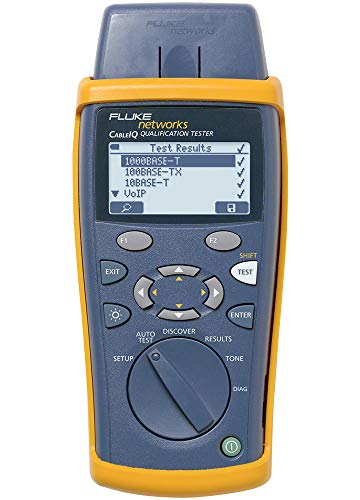
Fluke CIQ-100 CableIQ
What we liked
- Fluke Networks Cableiq Qualification Tester
What we didn't like
- Higher cost than basic verifiers
- Not a full certifier for warranty compliance
- Bandwidth qualification limited to about 1 Gbps
How to choose
Core Testing Needs
Identify whether you need basic wire mapping and continuity or advanced cable qualification. The MS2-100 excels at verifying proper pinouts and detecting opens, shorts, and split pairs, while the CIQ-100 can certify cabling to performance standards for data rates.
PoE and Voltage Detection
Check if the tester can detect Power over Ethernet (PoE) and phantom voltages. The MS2-100 identifies PoE availability and voltage levels, which is critical for installing IP cameras or wireless access points without damaging equipment.
Intuitive User Interface
Look for a clear, simple display that shows results at a glance. The MS2-100 uses a graphic wiremap and large icons, reducing time spent interpreting data on ladders or in tight spaces, while the CIQ-100 has more complex menus.
Durability and Portability
Consider the build quality and form factor for field use. The MS2-100 is compact, drop-tested, and has a rubber boot, making it ideal for daily carry in tool bags, whereas the CIQ-100 is larger and better suited for bench work.
The bottom line
The Fluke MS2-100 MicroScanner2 wins for most technicians because it focuses on essential wire mapping, length, and PoE detection with a rugged design, while the CIQ-100 adds advanced diagnostics like cable qualification but is overkill for basic troubleshooting.
Common questions
Yes, the MS2-100 can detect Power over Ethernet (PoE) and measure the voltage present on the cable. It shows the PoE type and voltage level, helping you verify that a switch port is delivering power before connecting a device.
The CIQ-100 can qualify cables to see if they support specific data rates like 10 Gigabit Ethernet, but it does not perform full certification. It measures parameters like length, delay skew, and attenuation to indicate if the cable is likely to pass certification.
The MS2-100 focuses on basic wire mapping, length measurement, and PoE detection for quick troubleshooting. The CIQ-100 adds advanced cable qualification features like bandwidth testing and fault location, making it better for verifying cable performance.
Yes, the Fluke MS2-100 works with both shielded (STP) and unshielded (UTP) twisted pair cable. It also supports coaxial cable testing with an optional adapter, making it versatile for different network installations.
For most field technicians, yes. The CIQ-100 offers advanced diagnostics like time domain reflectometry and cable qualification that are unnecessary for verifying simple connections. The MS2-100 is faster and more cost-effective for everyday jobs.
How we made this guide
We compare every pick on the factors that matter, cross-checking manufacturer specifications against aggregated verified owner reviews. We rank independently and never take payment for placement. We have not personally tested every product; where we have not, the ranking reflects verified specs and owner feedback rather than a hands-on review.
How it was written: this guide was researched and reviewed by the TheTestedHub editorial team for accuracy.
Affiliate disclosure: TheTestedHub is reader-supported. When you buy through links on our site, we may earn a commission at no extra cost to you.
