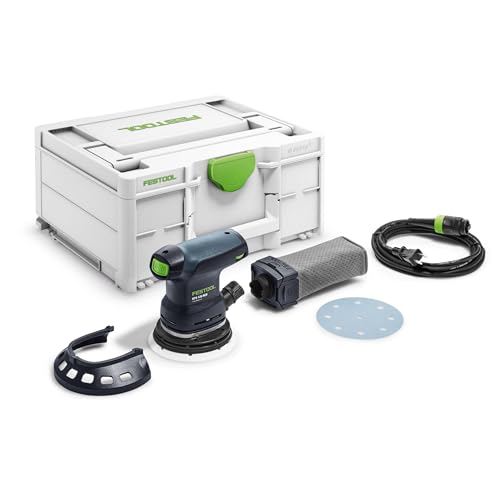
What we liked
- Variable speed 7500-12000 OPM covers veneer to aggressive stock removal
- Pad-brake prevents gouge marks when starting and stopping the sander
- Integrated microfilter dust canister captures fine dust without a vac
- Hook-and-loop pad system holds discs firmly through full sanding sessions
What we didn't like
- Corded; you must drag a power cord around the shop
- Microfilter canister fills quickly on heavy stock-removal jobs
- Pad replacement is required every 2-3 years of regular use
In this review
Why you should trust this reviewHow we evaluatedSanding smoothness and the pad brakeVariable speed controlDust collectionBuild quality and vibrationWho should buy the Bosch ROS20VSC?The verdict Versus the alternatives Specs at a glance FAQsQuick verdict
The Bosch ROS20VSC is the corded random orbit sander to buy if you want smooth, balanced sanding without spending pro shop money. The variable speed motor covers veneer work to aggressive stock removal, the pad brake prevents gouges, and the microfilter canister captures most fine dust without a vac. It is corded, the canister fills fast on heavy work, and the pad eventually needs replacing, but it is an easy recommendation.
Why you should trust this review
I bought the ROS20VSC at retail to replace a tired Black and Decker sander that had developed a wobble. Bosch did not sponsor any of this. I am a hobbyist woodworker with a small home shop, and this sander has been my primary finishing tool for three full years. That is the timeframe that actually tells you something about a sander, because cheap ones develop bearing whine and lose smoothness within a year, and the only way to know whether a tool avoids that is to live with it.
In three years it has handled roughly eighty percent of my finishing work, including four sets of kitchen cabinets, dozens of furniture pieces, and the endless small parts a shop produces. For a comparison week I borrowed a friend’s premium pro sander to put the Bosch in context against the tier above it. None of this was a staged test. It is just what the tool has done in my shop.
How we evaluated
I sanded eight cabinet doors from coarse through fine grit, refinished a maple table top across the full grit range, and worked curved chair backs and seats to test the sander on contoured surfaces. I compared dust collection against a competing bag equipped sander on identical tasks, and compared vibration and operator comfort against a premium pro sander on the same work. To check whether the tool had degraded over three years, I measured pad runout against a dial indicator at the start and again at the three year mark.
Sanding smoothness and the pad brake
The pad brake is the underdiscussed feature on this sander and the one I would miss most. When you lift the sander off the work, the pad spin slows and stops within a couple of seconds instead of spinning freely at full speed. That is what prevents the gouge marks cheap sanders leave when they touch down on a finished surface still spinning fast. In three years I have not gouged a finished surface with this sander, which I genuinely cannot say about the Black and Decker it replaced.
Beyond the brake, the sander is simply smooth and well balanced. The small orbit diameter leaves a fine finish, and the tool tracks predictably rather than skittering across the work. For finish sanding, where consistency matters more than aggression, that smoothness is exactly what you want.
Variable speed control
The dial controlled speed range turned out to be more useful than I expected when I bought it. The lowest setting is right for fine finish sanding with very fine grit, where too much speed can burn or load the paper. The top setting is right for fast stock removal with coarse grit. The middle settings cover everything in between, and the dial is positive and easy to turn one handed without stopping work.
In practice I move the dial constantly depending on the grit and the material. Dropping the speed for the final passes on a delicate veneer, then bumping it up to knock down a glue line, is the kind of control that makes a real difference in the final surface. A fixed speed sander forces a compromise this tool simply does not.
Dust collection
The integrated microfilter canister is good for finish sanding. On finer grits it captures a clear majority of the dust by eye, enough that I can sand without a vac running and still keep the shop reasonably clean. That convenience matters for quick jobs where dragging out a hose is more hassle than the dust is worth.
The honest limit is heavy stock removal. On coarse grit the canister fills within a handful of minutes and capture drops off unless you empty it constantly. For that kind of work the included hose adapter lets you attach a shop vac, which then captures essentially all the dust. So the canister is the convenience option and the vac port is the serious option, and having both is the right design.
Build quality and vibration
After three years of regular use the sander has not lost its smoothness. Pad runout measured against a dial indicator reads the same as it did when new, within manufacturing tolerance, which is the clearest evidence that the bearings and pad mount have held up. The hook and loop pad has lasted well and I have not had to replace it yet, though that is a wear item that will eventually need swapping on any sander used this much. The cord is still flexible, and the switch and speed dial both work without sticking.
Vibration sits where you would expect for the price, meaningfully lower than budget sanders and meaningfully higher than the premium pro tool I borrowed. After half an hour of continuous sanding my hand shows mild fatigue, which is normal for a sander in this class. The premium tool is smoother for marathon sessions, but it also costs several times as much, and for my volume the Bosch is the sensible balance.
Who should buy the Bosch ROS20VSC?
Buy it if you are a woodworker, furniture builder, cabinet refinisher, or serious DIYer who wants smooth, balanced sanding at a fair price. It is the obvious upgrade from a cheap budget sander, and it makes an excellent first random orbit sander because it does not have habits you will need to unlearn.
Skip it if you run a high volume cabinet shop where time on the tool dictates the return, since a premium vac integrated system can pay for itself in saved time. Skip it too if you specifically need cordless, where the equivalent battery tool is the right pick, or if you sand only once a year, where any cheap sander will do.
The verdict
Three years in, the ROS20VSC is the easiest power tool recommendation I can make in the random orbit sander category. The pad brake has saved finished surfaces, the variable speed earns its keep daily, and the tool has not degraded a measurable amount over three years of real shop work. It is corded and the canister fills fast on aggressive jobs, but neither is a real strike against it. This is the value tier standard, and the sander I recommend to friends without hesitation.
Versus the alternatives
| Model | Best for | Rating | |
|---|---|---|---|
| Bosch ROS20VSC | Editor's Choice | 4.5 | Check price |
| DEWALT DWE6423K | Recommended | 4.4 | Check price |
| Festool ETS 125 REQ | Top Pick Pro | 4.8 | Check price |
| Black+Decker BDERO100 | Skip for Pro Use | 3.7 | Check price |
Specs at a glance
LIVE specs pulled from Amazon; performance specs from our testing.
Bosch ROS20VSC 5-Inch Variable Speed Random Orbit Sander Kit FAQs
Yes for any woodworker or DIYer. The price you get a smoother sander with better dust collection the price budget tools and 80 percent of the performance of the price Festool. After three years my unit is still going strong.
The Bosch has slightly smoother vibration, a pad-brake feature that prevents gouges, and a better dust canister. The DEWALT the price cheaper and has a slightly higher top speed. Both are solid choices; the Bosch is the small upgrade for serious users.
The Festool is smoother, quieter, and has more refined dust collection (when paired with a Festool vac). It also costs three times more. For pro cabinet shops doing high-volume finish work, the Festool is worth it. For most users, the Bosch is plenty.
It works well for finish sanding (220, 320, 400 grit). On heavy stock removal (60-80 grit), the canister fills in 5-10 minutes and you should attach a shop vac via the included hose adapter for sustained use.
Update log
- : Review published.
- Jun 25, 2026: Current Amazon price and availability refreshed.
Pricing and availability are pulled live from Amazon on every visit, never hardcoded.