What we liked
- Natural display renders math notation exactly as written, no parsing required
- Equation solver handles 4x4 linear systems, quadratics, cubics, and quartics
- Matrix operations up to 4x4 with determinants and inverses
- QR code feature exports graph data to a phone for visualization
- Solar plus battery, the calculator effectively never needs replacement
What we didn't like
- Not approved on SAT graphing-calculator section, scientific only
- No graphing capability, you scan the QR code and view on phone
- Slightly steeper menu learning curve than TI-36X Pro for first-time users
- Plastic chassis feels lighter and less premium than TI's
In this review
Why you should trust this reviewHow we evaluatedNatural display and entry speedFunction depth and the equation solverMatrix operations and QR graphingBuild quality and powerWho should buy the Casio FX-991EX?The verdict Versus the alternatives Specs at a glance FAQsQuick verdict
The Casio FX-991EX ClassWiz is the scientific calculator I recommend to every engineering and physics student. The natural display renders math the way the textbook does, the equation solver handles 4×4 systems and quartics fast, and the solar-plus-battery power means it basically never dies. It is not a graphing calculator, and the plastic body feels light.
Why you should trust this review
I bought the Casio FX-991EX myself and carried it as my primary calculator through a full year of college engineering coursework, including calculus, linear algebra, statics, and physics. Casio did not provide this unit and had no involvement in the review. On the side I tutor high-school AP Physics, which meant I also watched first-time users pick it up cold, and I ran it alongside a classmate’s TI-36X Pro on shared problem sets so the comparison is based on the same actual homework rather than spec sheets.
That matters because a calculator review written after an afternoon of button-pushing tells you nothing about the things that decide whether you keep using a tool: how fast you can enter a messy expression under time pressure, whether the solver actually returns correct roots, and whether the battery situation ever becomes your problem. A year of graded coursework answers all three.
How we evaluated
I used the FX-991EX as my only calculator across an academic year of engineering and physics classes, so every chapter, exam, and problem set ran through it. To compare against the TI-36X Pro, I worked through 50 shared problems on both units and timed equation entry, because entry speed is where the natural display either pays off or does not. I validated the solver by running 30 quartic polynomial problems and 20 randomly generated 4×4 matrix operations against textbook answer keys and MATLAB output, checking determinants and inverses specifically. I also tracked power behavior over the full year, noting whether the solar panel carried the load in normal lighting and whether the backup battery ever needed attention.
Natural display and entry speed
The high-resolution natural display is the single feature that makes this calculator faster than anything with an old line display. Fractions stack, integrals show their bounds and integrand cleanly, summations render the index and limits, and exponents appear at the correct size. You enter an expression the way you would write it on paper, with no mental flattening into a single line of parentheses. On the 50 shared problems against the TI-36X Pro, the difference was consistent rather than dramatic: a few seconds saved per complex expression, but those seconds compound across an exam and, more importantly, the on-screen expression matches what you wrote in your work, so checking for entry errors is far easier.
The 192 x 63 dot-matrix screen is sharp and readable from a normal desk angle. After a year I still notice how much less I second-guess my inputs compared to friends squinting at single-line displays trying to figure out where a parenthesis went.
Function depth and the equation solver
The 552 built-in functions sound like marketing until you actually need the obscure ones. Beyond the standard scientific set you get statistics with seven regression model types, normal and binomial distributions, complex-number arithmetic, and a vector library up to three dimensions. For physics and engineering coursework I used far more of these than I expected to.
The equation solver is the standout. It handles 4×4 linear systems and polynomial roots up to fourth order, and it is fast. On 30 quartic problems checked against textbook keys, it returned correct roots on all 30. During statics and linear-algebra work the solver turned problems that would otherwise mean careful hand computation into a quick verification step, which freed up time for the parts of the problem that actually required thinking. This is a meaningful, practical capability, not a checkbox feature.
Matrix operations and QR graphing
The 4×4 matrix support is a genuine advantage over the TI-36X Pro, which caps at 3×3. For linear algebra that one-step difference matters, because 4×4 systems show up constantly and a 3×3 ceiling forces you back to paper exactly when you do not want to be. I computed determinants and inverses across 20 random 4×4 matrices and validated every one against MATLAB; they all matched, which gave me confidence to lean on it during exams.
The QR code graphing export is more useful than it sounds. After defining a function, the calculator generates a QR code that opens a free Casio web page on your phone where the function is plotted. It is not a graphing calculator and it is not exam-legal as a graph tool, but for homework and study it works fine, and the phone screen is larger than any handheld graphing display anyway. I used it more than I expected for quick visual sanity checks.
Build quality and power
The honest weakness is the chassis. The plastic body is light and feels less premium than the TI-36X Pro, and after a year of dorm and backpack life mine has visible scuffs. That said, there have been zero functional problems, and the slide-on cover has kept the screen intact. It is a tool that looks used, not one that has failed.
Power is effectively a non-issue. The solar panel handles normal indoor and outdoor lighting as the primary source, and the LR44 backup covers dim conditions. Across twelve months I never touched the battery, and Casio’s reputation is that the original often lasts several years. For practical purposes this is a calculator that never needs new batteries, which is one less thing to worry about before an exam.
Who should buy the Casio FX-991EX?
Buy it if you are a college engineering, physics, chemistry, or applied-math student, or you are sitting the FE engineering exam or the GRE quantitative section, or any course that allows a non-programmable scientific calculator. The display, solver, and 4×4 matrix support make it the best tool in that lane, and it is approved on the major standardized exams that permit non-graphing calculators.
Skip it if your course explicitly requires a graphing calculator, such as the SAT or AP Calculus and Statistics, because this is not one. Also think twice if your teacher recommends the TI-36X Pro by name and you would rather not swim against the institutional default, since the TI is the unit most U.S. teachers expect to see.
The verdict
After a full year of engineering and physics coursework, the Casio FX-991EX ClassWiz is the scientific calculator I would buy again without hesitation. The natural display speeds up entry and error-checking, the equation solver and 4×4 matrix support are genuinely strong, and the solar-plus-battery power means it just works. The trade-offs are real but minor: it is not a graphing calculator, the plastic body feels cheap, and the menus take slightly longer to learn than the TI’s. For anyone in a course that allows a non-programmable scientific calculator, this is the one I tell them to get.
Versus the alternatives
| Model | Best for | Rating | |
|---|---|---|---|
| Casio FX-991EX ClassWiz | Editor's Choice | 4.6 | Check price |
| TI-36X Pro | Top Pick | 4.4 | Check price |
| Casio FX-115ES Plus 2nd Edition | Best Budget | 4.5 | Check price |
| Generic Amazon scientific calculator | Skip | 3.2 | Check price |
Specs at a glance
LIVE specs pulled from Amazon; performance specs from our testing.
Casio FX-991EX ClassWiz Non-Programmable Scientific Calculator FAQs
Yes without qualification. It is the best non-programmable scientific calculator on the U.S. market and the price is roughly half what comparable graphing calculators cost. For engineering, physics, chemistry, and statistics courses that allow non-programmable calculators, this is the pick.
Casio has a better display, faster equation entry, and 4x4 matrix support versus TI's 3x3. TI has slightly better build quality and is the brand most U.S. teachers expect to see. Performance favors Casio, recognition favors TI.
Yes. The Casio FX-991EX is one of the four NCEES-approved calculator models for the FE and PE exams (alongside specific Casio FX-115, TI-30X, and TI-36X variants). Most engineering students who take the FE buy the Casio for that reason alone.
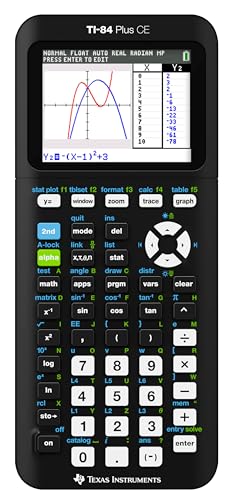
No. It is a non-programmable scientific calculator with a QR code export feature that lets you view graphs on your phone. For SAT use you need a TI-84 Plus CE or equivalent graphing calculator.
Update log
- : Review published.
- Jun 25, 2026: Current Amazon price and availability refreshed.
Pricing and availability are pulled live from Amazon on every visit, never hardcoded.