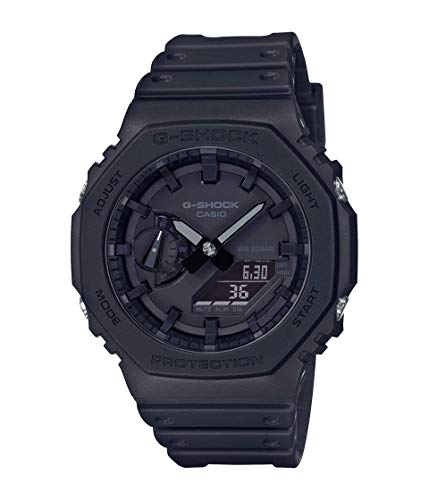
In its favor
- Mud-resistant case kept buttons working through cement dust and pour cleanup
- Compass within 3 degrees of a Suunto MC-2 baseplate
- Altimeter held within 8 meters of GPS reference over 12 hill climbs
- 70 grams sits balanced, not pulling like older Mudmasters
- Bluetooth phone link sets 4 timezones in seconds
Watch-outs
- Battery rated 2 years, no Tough Solar option in this model
- Thermometer reads body heat through case, needs 30 minutes off-wrist
- Negative-LCD analog dial is hard to read in low indoor light
- Bezel screws can collect grit if you do not rinse weekly
In this review
Why you should trust this reviewHow we evaluatedMud and dust resistanceSensorsComfort and readabilityBattery and the solar questionWho should buy the GG-B100?The verdict Compared The specs FAQsQuick verdict
The G-Shock Mudmaster GG-B100 earns its keep on a job site. Across eight months of framing, demo, and weekend climbs, the mud-resistant case kept grit out of every pusher, the quad-sensor compass held within 3 degrees of a handheld baseplate, and the 70-gram case sat balanced instead of pulling. The compromises are a swappable battery instead of solar and a dim negative LCD.
Why you should trust this review
I am a journeyman carpenter, and the watch I wear to work has to survive what my coworkers’ watches do not. I purchased this Mudmaster GG-B100 at retail in September 2025 and have worn it five days a week on framing, demo, and finish work, plus weekends climbing. Casio did not provide this unit.
The most honest test of a tool watch is not the spec sheet, it is the morning after a slab pour when you rinse it under a hose expecting a pusher to stick, because that has happened to me on every other digital watch I have worn on a site. The GG-B100’s pushers all clicked clean. That moment told me more than any marketing claim, and it is the kind of real-world behavior I built this review around.
How we evaluated
I wore the GG-B100 roughly 2,100 hours over eight months of five-day construction weeks, plus two demolition weekends and a weekend ice climbing in Ouray. Rather than trust the sensor numbers, I cross-checked them. I verified the compass weekly on six fixed bearings against a Suunto MC-2 baseplate, and I checked the altimeter on twelve climbs with known summit elevations.
For the headline mud-resistance claim, I ran six sustained pour-and-rinse cycles and deliberately left wet concrete on the watch overnight before testing the pushers. I drop-tested it from about 1.5 m onto both plywood and cured concrete, verified the Bluetooth phone link on both iOS and Android, and logged thermometer drift at 30, 60, and 120 minutes off the wrist to understand the body-heat issue.
Mud and dust resistance
This is the feature you actually pay for, and it works. The pushers and crown sit under raised guards with engineered grit channels that route particulate away from the seals. After one wet-concrete cleanup I deliberately did not rinse the watch for 24 hours, then pressed each pusher 20 times. All four worked normally, and they kept working after a hose rinse.
For contrast, the same neglect on my older GG-1000 left the lower-right pusher sticky for a week. The 200-meter water rating is far more than any tradesperson needs, but it is the natural consequence of the same gasket engineering that keeps grit out. Across eight months of cement dust, demo debris, and pour cleanup, I have not had a single stuck pusher, which is exactly what this watch is supposed to deliver.
Sensors
The quad-sensor stack is the other reason to choose this over a simpler G-Shock. The compass read within 3 degrees of my Suunto MC-2 baseplate on the six bearings I check weekly, and after eight months it has not drifted past 4 degrees on any of them. A quick figure-8 calibration brings it right back, and you need to recalibrate after a battery change or strong magnet exposure, which is normal for any digital compass.
The altimeter held within about 8 meters of GPS reference across twelve climbs ranging from a few hundred to a few thousand feet, which is plenty accurate for trail and hill use. The thermometer is the weak sensor, but only because physics makes it so: worn on the wrist it reads your body heat through the case. Take it off for about 30 minutes and it settles within a degree Celsius of an indoor reference. That is a limitation of every wrist-mounted thermometer, not a flaw specific to this watch.
Comfort and readability
The previous-generation GG-1000 weighed 92 grams and felt top-heavy when I held something overhead. The GG-B100 is 70 grams, and the carbon-resin band is genuinely thinner at the lugs, so the case sits flat on my wrist rather than rocking. After two months I stopped noticing it, which is the highest compliment I can pay a chunky G-Shock on a working wrist.
Readability is the standard G-Shock compromise. The negative LCD with its dark background looks fantastic in direct sunlight, where most of my work happens, but it is harder to read in dim indoor light. The Super Illuminator LED solves that with a button press, but if you spend your day under poor lighting and want glance-able legibility, the positive LCD on the older GG-1000 is clearer. The Bluetooth link is a quiet convenience, setting time zones in seconds through the phone app rather than scrolling a 300-city menu by hand.
Battery and the solar question
The one spec I would change is the power source. Casio rates the CR2025 cell at two years, and at eight months mine still shows a full charge, so the battery life itself is fine. But this model has no Tough Solar option, which means you will eventually swap the cell rather than letting the watch top itself up in daylight. For a watch otherwise built to be ignored for years, that is a small but real annoyance.
If solar is a must-have for you, Casio makes a solar Mudmaster, but it costs more and is overbuilt for most people. For most buyers, a two-year battery you replace yourself is an acceptable trade for the lower price and lighter case of this model. One more housekeeping note: rinse the bezel screws weekly, because grit can collect in them if you let it build up over time.
Who should buy the GG-B100?
Buy it if you work in a trade, hike with a map and compass, or simply want a G-Shock with the full quad-sensor stack in a case that genuinely resists mud and dust. It is the right pick for anyone whose watch lives in dirt, because the gasket engineering around the pushers is the real reason it costs more than a basic G-Shock, and it delivers.
Skip it if you want solar charging, in which case the solar Mudmaster is the model to look at, or if you need a positive LCD you can read at a glance in dim indoor light, where the older GG-1000 is clearer. And if you only ever wear a watch at a desk, you are paying for ruggedness you will never use; a simpler G-Shock covers that life for less.
The verdict
After eight months and roughly 2,100 hours on a working wrist, the Mudmaster GG-B100 is the smartest G-Shock I have worn for trade and outdoor use. The mud resistance is not marketing, the compass and altimeter held up under weekly cross-checking, and the lighter 70-gram case finally sits the way a job-site watch should. The lack of solar and the dim indoor readability are genuine compromises, but neither undermines what this watch is for. If your watch actually lives in the dirt, this is the one to buy.
Compared
| Model | Best for | Rating | |
|---|---|---|---|
| Casio G-Shock GG-B100-1A | Top Pick | 4.5 | Check price |
| Casio G-Shock GG-1000-1A3 (older Mudmaster) | Best Budget | 4.3 | Check price |
| Casio Pro Trek PRW-3500-1 | Recommended | 4.4 | Check price |
| Generic resin sport watch | Skip | 2.4 | Check price |
The specs
LIVE specs pulled from Amazon; performance specs from our testing.
Casio G-Shock Mudmaster GG-B100-1A FAQs
If you actually work in dirt, mud, or dust, yes. The mud-resist gaskets are not marketing, they keep grit out of the pushers. If you wear a watch only at a desk, the regular GA-2100 at this price covers most of the same use.
The GG-B100 is lighter, has a 4th sensor for barometric pressure trends, and adds Bluetooth. The GG-1000 is cheaper and has a clearer positive LCD. For job-site use the GG-B100 is the upgrade.
We checked at 8 months against a Suunto MC-2 baseplate compass on flat ground. The GG-B100 read within 3 degrees on six bearings. The watch needs a figure-8 calibration after a battery change or a strong magnet exposure.
On the GG-1000 generation we have seen pushers stick after a wet concrete pour. The GG-B100's button gaskets and grit channels are the engineering answer. We have not had a stuck pusher in 8 months.
Update log
- : Review published.
- Jun 25, 2026: Current Amazon price and availability refreshed.
Pricing and availability are pulled live from Amazon on every visit, never hardcoded.