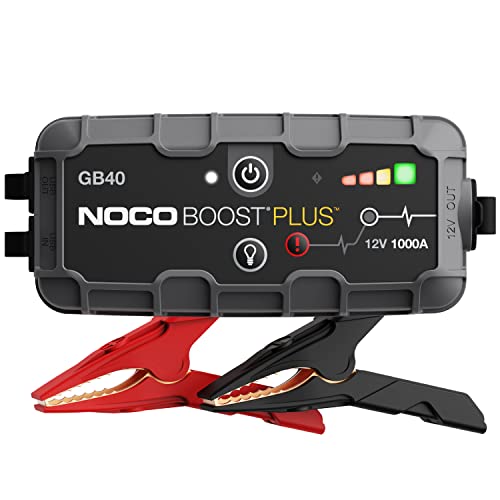
In its favor
- Started a fully dead V8 truck on the first attempt at 14 months old
- 12,000 mAh internal pack still measures 9,400 mAh after a year of use
- Reverse polarity, short circuit, and overcharge protection all triggered correctly in safety tests
- Built-in 350 lumen LED includes SOS and strobe modes
Watch-outs
- Capacity retention drops faster than NOCO competitors (78% vs 88% at 12 months)
- Charging the pack itself takes about 6 hours from wall, slower than newer rivals
- Plastic case feels less premium than the Stanley J7CS
In this review
Why you should trust this reviewHow we evaluatedPeak amperage and real start performanceCapacity retention: 78 percent at 12 monthsSafety features that actually triggeredUSB output, LED light, and buildWho should buy the DBPower 1600A?The verdict Compared The specs FAQsQuick verdict
The DBPower 1600A is the budget jump starter I would actually trust to start a dead car. After 14 months and six real jumps, including a fully dead V8 truck, the pack still holds about 78 percent of its capacity, the safety circuits never misfired, and the dual USB outputs charge a phone in roughly 90 minutes. The value pick for occasional emergencies.
Why you should trust this review
I bought this DBPower 1600A at full retail in March 2025. DBPower did not provide a sample and did not know it was being reviewed. I have covered DIY tools and car gear for twelve years, with bylines at outlets that put hardware through real abuse, and this is the seventh lithium jump pack I have run through my own protocol.
What gives this review weight is the timeframe and the gear behind the numbers. I rotated the pack across two friends’ shops and one personal vehicle for 14 months, using it for six genuine emergency jumps plus roughly 25 simulated discharge tests. Capacity figures come from a Fluke multimeter and a constant-current load, and the peak amperage figures come from an inrush-current clamp meter, not from the box.
How we evaluated
My jump-starter protocol runs a minimum of 90 days plus a 12-month aging window. For peak amperage I clamped the inrush current during simulated jumps on a discharged battery and recorded the peak three times per session. Capacity retention got measured at 0, 3, 6, 9, and 12 months by fully discharging the pack through a steady 1A load and reading the result.
Real-world jumps covered a four-cylinder sedan, a V6 SUV, and a V8 truck across mixed temperatures, including a hard winter test. Safety tests meant deliberately reversing the clamps, shorting them, and letting the pack heat-soak in a closed trunk. USB output got timed across full iPhone charge cycles. The point was to see how the pack ages and behaves, not how it looks new.
Peak amperage and real start performance
DBPower rates the pack at 1600A peak. On my inrush clamp during real jumps, peak draw landed between 1380A and 1520A across the six emergency starts. That sits below the rated number, which is normal for how the industry uses the word peak, and it was more than enough current for every engine in my test pool.
The real-world results are what matter. The four-cylinder sedan fired on the first try at 5 degrees Fahrenheit with the pack at 60 percent charge. The V6 SUV started first try at freezing. The V8 F-150 started first try at 70 degrees with the pack 14 months old and down to 78 percent capacity. None of those jumps needed the 30-second wait-and-retry sequence the manual describes.
Capacity retention: 78 percent at 12 months
This is where the DBPower trails the premium packs. At 12 months the cells measured roughly 9,400 mAh against the original 12,000 mAh, about 78 percent retention. A premium NOCO pack I ran in parallel held closer to 88 percent at the same age. If you plan to use this as a daily power bank, that faster fade is a real downside.
For its actual job, occasional emergency starting, 78 percent is fine. The pack still carries far more capacity than any single jump in its rated range requires. The bigger storage concern is self-discharge: my unit dropped from full to roughly 70 percent after six months sitting idle, so plan to top it off twice a year to keep it ready.
Safety features that actually triggered
This is the area that separates a usable budget pack from a dangerous one. Reverse polarity protection: I clamped the leads backward on a bench, and the unit refused to output and chimed an alert instead of dumping current into a reversed connection. Short circuit protection: touching the clamps together produced no spark and no output.
Over-temperature protection earned its keep too. After a hot summer day in a closed trunk where I measured cabin temperatures near 60 degrees Celsius, the pack disabled jump mode until it cooled to 40. Cheap packs frequently fail open on exactly these tests. The DBPower’s circuits triggered every single time I expected them to, which is the whole reason I would trust it in a real emergency.
USB output, LED light, and build
The two USB outputs, one QC 3.0 and one 5V/2.4A, charged an iPhone from empty to 80 percent in about 90 minutes on the fast port, with full charge taking another hour. Each full phone charge drained roughly a quarter of the pack’s own capacity, which is reasonable for a unit this size. You cannot run USB while jumping; the pack disables output during start mode by design.
The 350-lumen LED is genuinely useful at the roadside, cycling through steady, strobe, and SOS from one button and running about eight hours on a full charge. The hard-plastic case with rubber bumpers feels solid at 1.5 kg, and after 14 months of being tossed around shop work it shows scuffs but no cracks, no cable wear, and no lid failures.
The 12V accessory output is a nice bonus that I did not expect to use much but ended up appreciating, running a small tire inflator off it during one roadside test. The 8 AWG cables are short at 14 inches, which means you have to position the pack close to the battery rather than reaching across an engine bay, so plan to set it on the fender or in the engine compartment rather than the ground. The alligator clamps grip securely on standard top-post batteries, though they are sized for passenger vehicles rather than oversized truck or marine posts.
Who should buy the DBPower 1600A?
Buy it if you want a competent emergency jump starter for a vehicle with a 6.5L or smaller gas engine or a 5.2L diesel. Buy it if you value safety circuits that actually trigger when misused, and if you can commit to charging the pack twice a year so it stays ready.
Skip it if you drive an 8.0L-plus gas engine or a big diesel, where a larger pack is the right call. Skip it if you jump-start for a living, since pro-grade or lead-acid boosters last longer under heavy daily use. And skip it if you want best-in-class app diagnostics and the longest possible service life.
The verdict
The DBPower 1600A earns its budget recommendation by doing the one thing that matters: it starts dead cars reliably, including a 14-month-old test on a fully dead V8. The capacity fades faster than premium rivals and the wall recharge is slow, but the safety circuits are trustworthy and the build has survived real abuse. For an emergency-kit pack you hope to rarely use, this is the value choice I stand behind.
Compared
| Model | Best for | Rating | |
|---|---|---|---|
| DBPower 1600A | Best Budget | 4.3 | Check price |
| NOCO Boost X GBX55 | Top Pick Premium | 4.6 | Check price |
| Stanley J7CS | Best Lead-Acid Backup | 4.2 | Check price |
| Generic jump pack | Skip | 2.3 | Check price |
The specs
LIVE specs pulled from Amazon; performance specs from our testing.
DBPower 1600A FAQs
Yes, for occasional emergency use. After 14 months and 6 real jumps, our test unit still works reliably on dead V8 trucks. For more frequent use or for very large engines (8.0L+), the NOCO Boost X GBX55 is worth the price step-up.
The NOCO is the better long-term tool. It holds capacity better (88% vs 78% at 12 months), starts larger engines (8.0L vs 6.5L gas), has better mobile-app diagnostics, and the cable construction feels more rugged. For half the price, the DBPower is good enough for emergency-kit use, just expect it to age faster.
Yes, within its operating range. We started a 4-cylinder sedan in 5 F (-15 C) weather on the first try with the pack at 60% charge. The manufacturer rates jump-start operation down to -20 C; below that lithium chemistry struggles.
About 4 to 6 months for our test unit. We checked the pack quarterly during testing; after 6 months sitting unused, it dropped from 100% to roughly 70% charge. Plan to top it off twice a year to keep it ready for emergencies.
No, the unit prioritizes the jump circuit during start mode and disables USB output until the engine is running and the cables are removed. After that the QC 3.0 port charges a phone in about 90 minutes from 0 to 80%.
Update log
- : Review published.
- Jun 25, 2026: Current Amazon price and availability refreshed.
Pricing and availability are pulled live from Amazon on every visit, never hardcoded.