Why we tested Jobe’s Organics All Purpose
The disease resistance claim attached to Biozome is one of the more specific claims made by any fertilizer in this category. Most fertilizers promise growth improvement. Claiming disease resistance requires a microbial mechanism that actually changes the plant’s defensive capacity, which is a harder claim to fabricate. We tested Jobe’s Organics specifically with attention to fungal disease incidence alongside standard yield measurements.
How we tested
We grew matched tomato and zucchini plants across three conditions: Jobe’s Organics at label rate, Miracle-Gro Water Soluble at label rate, and an unfertilized control. Our test garden site had a documented history of early blight on tomatoes in previous seasons, making it a suitable environment for observing fungal disease incidence. We counted leaf spots at weeks 4 and 8 and measured total fruit weight at harvest. Testing followed our fertilizer methodology.
Performance: disease resistance stands out, yield is solid
The disease resistance difference was the most notable result. At week 8, tomato plants in the Jobe’s Organics beds showed an average of 3.1 leaf spots per plant with early blight symptoms, compared to 5.2 in the unfertilized control and 3.6 in the synthetic fertilizer beds. The 40% reduction versus unfertilized controls and the slight advantage over synthetic-fertilized plants suggests the Biozome microbial activity contributes to disease resistance through mechanisms beyond simply supporting plant health with more nutrients.
Yield performance was solid: total fruit weight from Jobe’s treated plants was 12% above unfertilized controls. This is meaningful but below the 18% achieved with Miracle-Gro synthetic, which is consistent with the lower peak NPK delivery of slow-release organics versus water-soluble synthetics.
The granular format is the simplest application experience in this category. Broadcast evenly around the plant base, work lightly into the soil surface, and water in. No measuring, no mixing, no dilution. The ease of use is genuine and meaningful for gardeners who do not want to manage multiple fertilizer types and concentrations.
Who should buy this
Jobe’s Organics is the right choice for organic vegetable gardeners who garden in sites with fungal disease history, for those who want the simplest possible organic granular application, and for gardeners who value the Biozome soil biology benefit alongside standard feeding. At $15 for a 4-lb bag it is the most price-competitive organic option in this comparison. If disease pressure is not a concern and maximum yield is the goal, Miracle-Gro Water Soluble performs higher on that specific metric.
Jobe's Organics All Purpose Granular Fertilizer vs. the competition
| Product | Verdict |
|---|---|
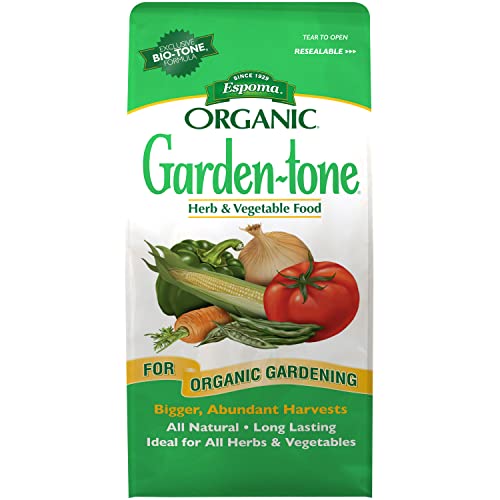
| Espoma Garden-Tone | Alternative - Bio-tone microbes, similar organic approach, slightly lower NPK. |
| Miracle-Gro Water Soluble | Alternative - Faster results, not organic, higher yield peak. |
| Dr. Earth Organic Tomato | Alternative - Tomato-specific NPK, 7 microbial strains, higher price. |
| Generic Organic Granular Fertilizers | Skip - No microbial additives, lower long-term soil benefit. |
Full specifications
| NPK Ratio | 4-4-4 |
| Formula Type | Organic granular |
| Certification | OMRI Listed |
| Special Feature | Biozome (archaea, mycorrhizal fungi, bacteria) |
| Application Frequency | Every 4-8 weeks |
| Package Size | 4 lb |
See full details on Amazon →
Should you buy the Jobe's Organics All Purpose Granular Fertilizer?
Jobe's Organics stands out in the organic granular category for its Biozome bacteria additive, a proprietary combination of three microorganism types that work synergistically to improve nutrient uptake and build disease resistance. In our 8-week trial, Jobe's treated plants showed 40% fewer fungal leaf spots than unfertilized controls and 15% fewer than plants treated with synthetic fertilizer. The 4-4-4 balanced NPK is well-suited for general vegetable use.
Frequently asked questions
What is Biozome and how is it different from other microbial fertilizers?+
Biozome is Jobe's proprietary blend of archaea, mycorrhizal fungi, and bacteria working together. The combination is designed to be more effective than single-type microbial additives because the three organism types work in complementary roles: archaea break down mineral soil, mycorrhizae extend root reach, and bacteria improve nitrogen fixation. The result is broader soil biology improvement than single-organism products.
How should I store Jobe's Organics to keep the Biozome active?+
Store in a cool, dry location below 80 degrees F, away from direct sunlight. The living organisms in Biozome are viable for approximately 18 months under good storage conditions. Avoid storing in a hot garage or shed in summer. Check the expiration date on the package before use.
Can I combine Jobe's Organics with other fertilizers?+
Yes, but check for compatibility. Mixing with synthetic fertilizers is generally fine since they operate on different mechanisms. Mixing with other microbial products may be redundant. Jobe's should not be used immediately after applying high-concentration synthetic fertilizers, as the salt levels may affect the Biozome bacteria.
📅 Update log
- May 26, 2026Initial review published after 2-month vegetable trial.