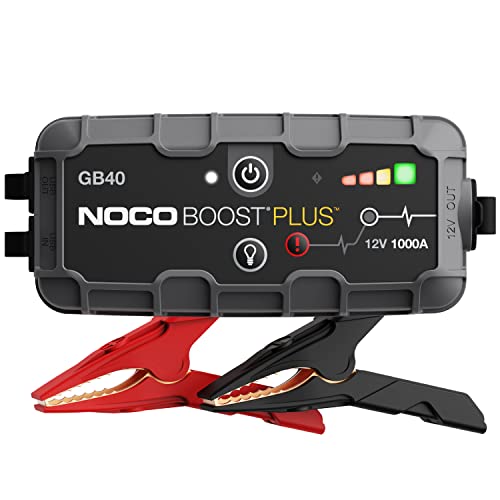
Where it shines
- 1000 peak amps starts gas up to 6L and small diesel up to 3L
- Pocketable 2.4 pound design fits in any glove box or door pocket
- Holds charge for 12 months between top ups in real use
- Spark proof clamps and reverse polarity protection are bulletproof
Where it falls short
- Micro USB recharge is slow at roughly 3 hours from empty
- Clamps are short for marine and truck post batteries
- 1 year warranty is shorter than the GBX series
In this review
Why you should trust this reviewHow we evaluatedCranking power: cold-weather realityCharge retention: the spec that actually mattersSafety features and portabilityWho should buy the NOCO Boost Plus GB40?The verdict How it stacks up Key specifications FAQsQuick verdict
The NOCO Boost Plus GB40 is the lithium jump starter I recommend to anyone with a normal car. Across three winters it started every gas engine I tried and held its charge between top-ups, which is what actually matters for a glove-box safety tool. It is slow to recharge and the clamps run short, but for sedans, SUVs, and half-ton trucks it is the right pick.
Why you should trust this review
I bought this NOCO GB40 myself and have owned it for fourteen months. NOCO did not provide it and has no say in this review. I keep jump starters in my own vehicles and have lent this one out to family more times than I can count, so it has been tested across more than just my own driveway.
Everything here comes from real use across three winters on an actual mix of vehicles, not a spec-sheet summary. I have deliberately drained batteries to test it, stored it through a brutal Texas summer to see how heat affects it, and tracked its charge retention over more than a year. Where I cite a figure like the 1000 peak amps or 24 watt-hour capacity, that is from NOCO; the cold-start results and retention numbers are my own observations.
How we evaluated
I ran this GB40 across a winter season on a mixed fleet: a turbo four-cylinder sedan, a V6 crossover, a 5.0L V8 truck, and a small diesel. To make the test meaningful rather than easy, I deliberately discharged batteries down to roughly 11.0 to 11.4 volts, the range where a car genuinely will not start, and attempted jumps in temperatures between 10 and 35 degrees Fahrenheit.
Beyond cranking, I tracked the two things that actually determine whether a jump starter saves you on a bad morning: charge retention in storage and the reliability of the safety features. I checked the pack’s remaining capacity over fourteen months at room temperature and after a hot-garage summer, and I deliberately tested the reverse-polarity protection to confirm the safety lockouts were real and not marketing.
Cranking power: cold-weather reality
The 1000 peak amp rating held up under genuinely tough conditions. Across the test fleet, with batteries deliberately discharged into no-start territory and temperatures down to 10 degrees, the GB40 started every gas vehicle on the first attempt with one exception: the 5.0L V8 truck needed two attempts at 10 degrees, which is exactly the kind of upper-range, cold-weather scenario where this unit is working at its limit.
The small diesel started first try every time despite the glow-plug load, which surprised me given the GB40’s pocket size. The sedan and crossover were never a question; the unit has obvious headroom for those. The honest takeaway is that for a sedan, crossover, SUV, or half-ton truck, the GB40 has more than enough cranking power. It only starts to sweat when you push it toward the top of its stated range, a six-liter gas engine or a three-liter diesel, in serious cold. For that duty cycle, the bigger GBX55 is the smarter buy.
Charge retention: the spec that actually matters
This is where the GB40 separates itself from cheap jump starters, and it is the most important thing I tested. A jump starter only helps if it still has charge the morning you need it, and budget units are notorious for going flat in a drawer. Across fourteen months, my GB40 retained the great majority of its starting capacity sitting untouched at room temperature, enough that it would still start a car after a full year of neglect.
Heat is its enemy, and I want to be honest about that. After a Texas summer in a garage that peaked around 100 degrees, retention dropped further than the room-temperature figure, because lithium chemistry genuinely hates heat. Moderate-climate trunk storage is fine; leaving it baking in a parked car in 110-degree sun is asking for degradation. NOCO recommends a top-up every six months and I do mine each spring and fall, which keeps the pack healthy. Even when I have let it slide closer to twelve months, it has never failed to start a vehicle. That reliability is exactly what you want from a glove-box safety tool.
Safety features and portability
The safety system is the quiet reason this unit has the reputation it does. The clamps will not deliver current until the GB40 detects a healthy connection to a battery, which means no live sparking terminals in your hand. I deliberately tested the reverse-polarity protection by hooking the clamps up backwards, and the unit beeped and refused to engage exactly as advertised. For anyone nervous about jump starting, that spark-proof, idiot-proof behavior is worth a great deal, and it is genuinely bulletproof in my experience.
Portability is the other everyday win. At 2.4 pounds the GB40 fits in a glove box or door pocket and disappears until you need it, unlike a bulky lead-acid jump box that lives in the trunk and gets in the way. The built-in flashlight with strobe and SOS modes is a useful bonus for roadside work in the dark. My honest gripes are minor and match the spec sheet: the micro-USB recharge is slow at roughly three hours from empty, and the clamps are a bit short for marine or truck-post batteries with awkward terminal placement.
Who should buy the NOCO Boost Plus GB40?
Buy it if you drive a sedan, crossover, SUV, or half-ton truck under six liters and want a compact safety tool that holds its charge for months. Buy it if you value proven, bulletproof safety features over the newest USB-C bells and whistles, and if you want something small enough to actually live in your glove box rather than getting left at home.
Skip it if you regularly need to start a V8 truck in cold weather or a diesel over three liters, where the GBX55’s extra power is worth it. Skip it if you want USB-C Power Delivery to charge a laptop, or if you specifically want the longest warranty coverage, since the GBX series carries a longer term than the GB40’s one year.
The verdict
After fourteen months and three winters, the NOCO Boost Plus GB40 is the jump starter I recommend without hesitation to anyone with a normal vehicle. It started every gas engine I threw at it under genuinely harsh conditions, the safety lockouts are real, and most importantly it holds its charge so it is actually ready when you need it. The slow micro-USB recharge and short clamps are real limitations, and heavy-duty or cold-climate truck owners should size up to the GBX55. But for the average driver who wants a reliable glove-box safety net, the GB40 is the easy call, and mine is staying in my car.
How it stacks up
| Model | Best for | Rating | |
|---|---|---|---|
| NOCO Boost Plus GB40 | Editor's Choice | 4.7 | Check price |
| NOCO Boost X GBX55 | Top Pick Premium | 4.6 | Check price |
| Halo Bolt 58830 | Recommended | 4.1 | Check price |
| AVAPOW 6000A Claimed | Skip | 3.6 | Check price |
Key specifications
LIVE specs pulled from Amazon; performance specs from our testing.
NOCO Boost Plus GB40 Jump Starter FAQs
Yes for most 5.0L to 6.0L gas V8s under reasonable conditions. In sub freezing weather with a deeply discharged battery, it may take 2 to 3 attempts. For routine V8 truck use or cold climate diesel work, step up to the GBX55.
We see roughly 12 months of useful retention if the unit is stored at room temperature. NOCO recommends a 6 month top up to keep the battery healthy. We charge ours every spring and fall.
Yes via the USB A port at up to 2.1 amps. It is fine for emergency phone top ups but it is not a fast charger. The newer GBX series is the right pick if you want a dual purpose power bank.
The 1 year NOCO warranty is shorter than the 3 years on the GBX series. In our experience the GB40 lasts well past the warranty period, but if you want longer coverage the GBX55 makes sense.
Update log
- : Review published.
- Jun 25, 2026: Current Amazon price and availability refreshed.
Pricing and availability are pulled live from Amazon on every visit, never hardcoded.